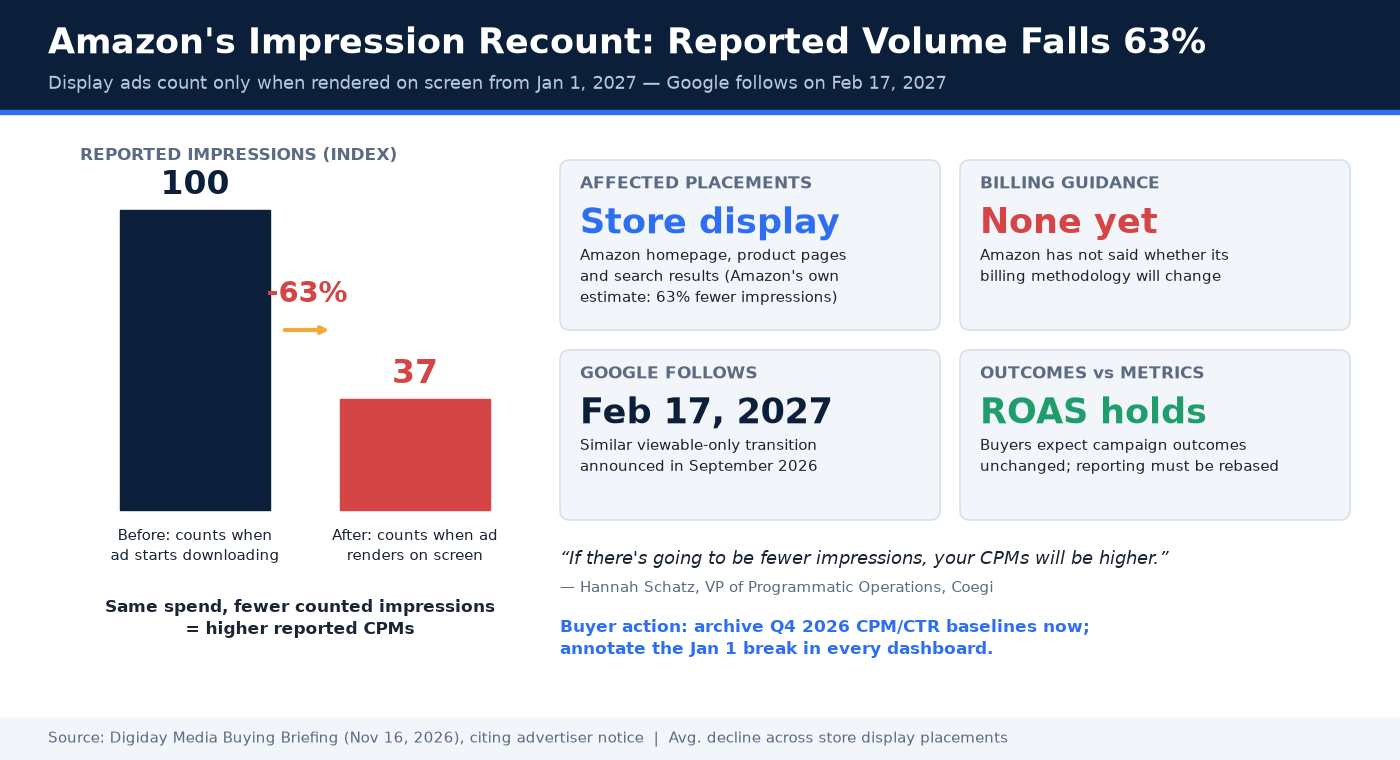
Somewhere in your 2027 dashboards, a cliff is coming. On January 1, Amazon will stop counting a display ad impression the moment the ad begins downloading to a user’s device, and start counting only when the ad actually renders on the user’s screen. According to an advertiser notice obtained by Digiday and reported on November 16, Amazon itself estimates brands will see roughly 63% fewer reported impressions across its store display placements — homepage, product pages and search results. Same ads, same audiences, same spend. Just a much smaller number in the report.
If that sentence made your stomach drop, you are not alone. Media buyers spent the week after the notice circulating between clients trying to explain a change that is simultaneously trivial and enormous. Trivial, because nothing about actual ad delivery changes — the ads that were seen will still be seen. Enormous, because impressions and CPMs are the currency in which the entire programmatic industry quotes prices, sets benchmarks, builds automated optimizations and signs contracts.
The mechanics deserve one careful paragraph, because the confusion starts here. Under the old methodology, an impression was logged when the ad started loading — even if the user never scrolled it into view, even if it rendered below the fold of a page the user abandoned. Under the new methodology, the count fires only on actual on-screen rendering. Amazon’s 63% estimate implies that nearly two-thirds of what its retail media platform has been reporting as impressions were, in the plainest sense, never looked at. The company is not destroying value; it is confessing to how much of the old number was air.
The pricing consequence is arithmetic, not economics. If spend stays constant and counted impressions fall by 63%, reported CPM rises mechanically — spend divided by a denominator that just shrunk to 37% of its former size. “If there’s going to be fewer impressions, your CPMs will be higher,” Hannah Schatz, VP of programmatic operations at agency Coegi, told Digiday. Agency Tonic Worldwide has estimated the optical CPM inflation could approach 170% in some scenarios — a third-party estimate, not Amazon guidance, but directionally consistent with the math. What Amazon has not done, and this is the part buyers should keep pressing on, is issue any guidance on whether its billing methodology will change alongside the reporting methodology. If billing follows reporting, effective costs change. If it doesn’t, only the optics do. Nobody outside Amazon currently knows which.
Google is making a parallel move. The company announced in early September that it will transition to a similar viewability-based counting approach effective February 17, 2027. Two of the largest ad platforms on earth resetting their impression definitions within seven weeks of each other is not a coincidence; it reflects years of pressure from advertisers and standards bodies who have argued that downloadable-but-unseen ads inflate reach claims across the open web and retail media alike.
The reassuring news comes from the buy side’s own veterans. “The bottom line is, we don’t expect this to change campaign results,” Jared Smith, senior director of strategy and innovation at January Digital, told Digiday. “The shift will make reporting metrics look different, but it shouldn’t move ROAS or CPA, which are the outcomes our clients care about.” That is the correct frame: outcome metrics survive the recount because both sides of their ratios — spend and conversions — are untouched. What breaks is everything indexed to impressions.
And plenty is indexed to impressions. Paul DeJarnatt, VP and head of investment at agency Novus, flagged the operational tail: “If you have a lot of automated processes, optimizations, reconciliations, built around these data sets already, you’re going to have to do a little bit of work.” Bid models trained on historical CPM distributions, pacing algorithms, cross-platform reach comparisons, quarterly benchmarks in client contracts, media mix models with impression-based adstock — each embeds the old denominator. None of them will politely self-correct on New Year’s Day.
There is also a subtler competitive dynamic. With fewer counted impressions available, buyers chasing the same on-screen inventory may bid more aggressively for genuinely viewable placements. “There’s going to be probably more competition on the platform,” Nola Ladd, awareness media supervisor at Collective Measures, told Digiday. Premium placements — above-the-fold homepage units, top-of-search positions — could see real price pressure, not just optical inflation. That would be the one place where the recount changes actual economics.
So what should a team actually do before December 31? Start by archiving. Export Q4 2026 CPM, CTR, reach and frequency data at the placement level, and store it somewhere your 2027 self can find, because year-over-year comparisons will otherwise be meaningless. Second, annotate every dashboard and report template with a methodology-break marker at January 1 for Amazon and February 17 for Google; future analysts will thank you. Third, ask your Amazon rep, in writing, whether billing will follow reporting — and file the answer. Fourth, audit any automation that consumes impression or CPM inputs, and plan re-baselining windows rather than letting models silently mis-price inventory in January. Fifth, reframe client conversations now, ahead of the ugly first-quarter charts: shift the north-star metrics to outcomes.
On that last point, Ernie DeColte, SVP of media at agency Level, offered the line that may end up quoted in a dozen Q1 board decks: “Impressions, CPMs, they shouldn’t be north star metrics… They’re tool metrics we use to optimize towards business impact. This might be a wake-up call to a few advertisers. Maybe it’s time to think about buying differently.”
He is right, and the timing is almost poetic. The impression recount lands just as AI answer engines pull discovery away from classic ad slots entirely, and just as retail media faces its own credibility questions. An industry that spent fifteen years optimizing a number that was two-thirds air is being handed a rare chance to reset what it measures — voluntarily, before someone else forces the issue.
The 63% is not a loss. It is a mirror. The buyers who treat it as a data-hygiene project will sail through January. The ones who treat it as a pricing crisis will spend Q1 explaining charts instead of fixing them.






