The strangest thing about China’s recommendation feeds isn’t that they love new content. It’s that they refuse to remember your old wins. A video that reached a million people on Tuesday buys you exactly nothing on Wednesday. Every post starts at zero.
Most explanations stop at the algorithm: interest matching, recency weighting, exploration budgets. All true — and all incomplete. The deeper answer is economic. The feed forgets because forgetting is how the platform keeps ownership of the audience.
The Asset Is the Session, Not the Creator
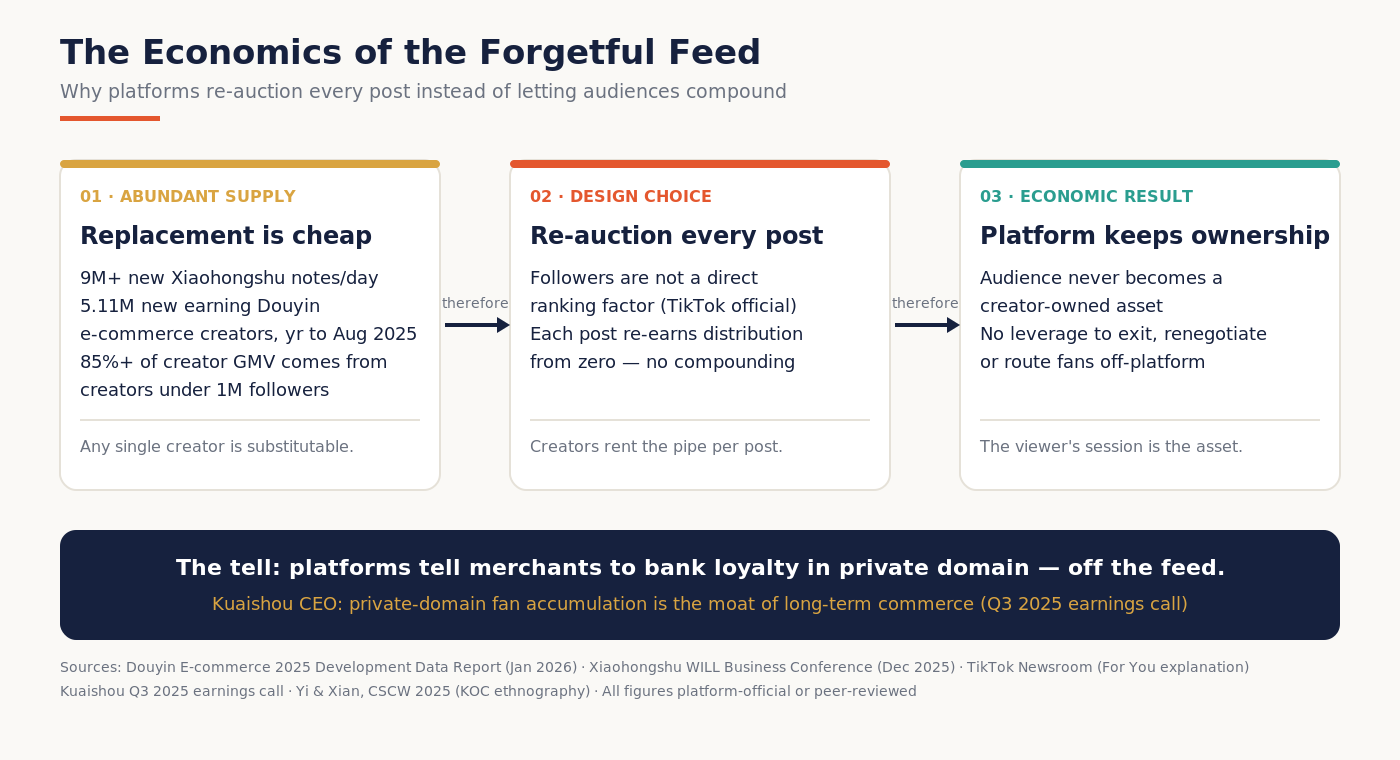
A platform’s real asset is the viewer’s session — the next fifteen seconds of attention. Creators are useful only insofar as they fill those seconds. And when supply is abundant, any single creator is substitutable. Douyin’s own 2025 e-commerce report says over 85% of creator-commerce GMV comes from creators with fewer than a million followers, and 5.11 million new e-commerce creators earned stable income in the year through August 2025. Xiaohongshu receives more than 9 million new notes a day. With replacement that cheap, banking a relationship with any one creator is a bad trade.
Re-Auctioning Keeps Supply Cheap
Imagine the alternative. If distribution compounded — if followers guaranteed reach — creators would accumulate an asset the platform can’t repossess. They could threaten to leave, demand better terms, route fans off-platform. Re-auctioning every post prevents exactly that accumulation. TikTok’s own explanation is blunt: follower count and past viral hits are not direct recommendation factors. The creator never owns the pipe. They rent it, post by post.
Even the learning budget belongs to the platform: a WWW 2024 audit of real TikTok feeds found that half or more of early recommendations are exploration — impressions spent on testing new content, not on rewarding past winners.
The human cost is documented. In their CSCW 2025 ethnography, Huiran Yi and Lu Xian found Xiaohongshu’s small creators living in precarious visibility, their promotional labor obscured and often unpaid. The treadmill isn’t a side effect of the machine. It’s the incentive structure working as designed.
The Tell: Where Platforms Say to Bank Loyalty
Notice where the platforms themselves tell you to build loyalty: nowhere near the discovery feed. Kuaishou’s CEO calls private-domain fan accumulation — not feed reach — the moat of long-term commerce. The feed is for encounters. Ownership happens off-feed. Even the platforms admit the feed was never meant to remember you.
For brands, the implication fits in one sentence: rent the firehose, but build the bucket somewhere the algorithm can’t repossess.






