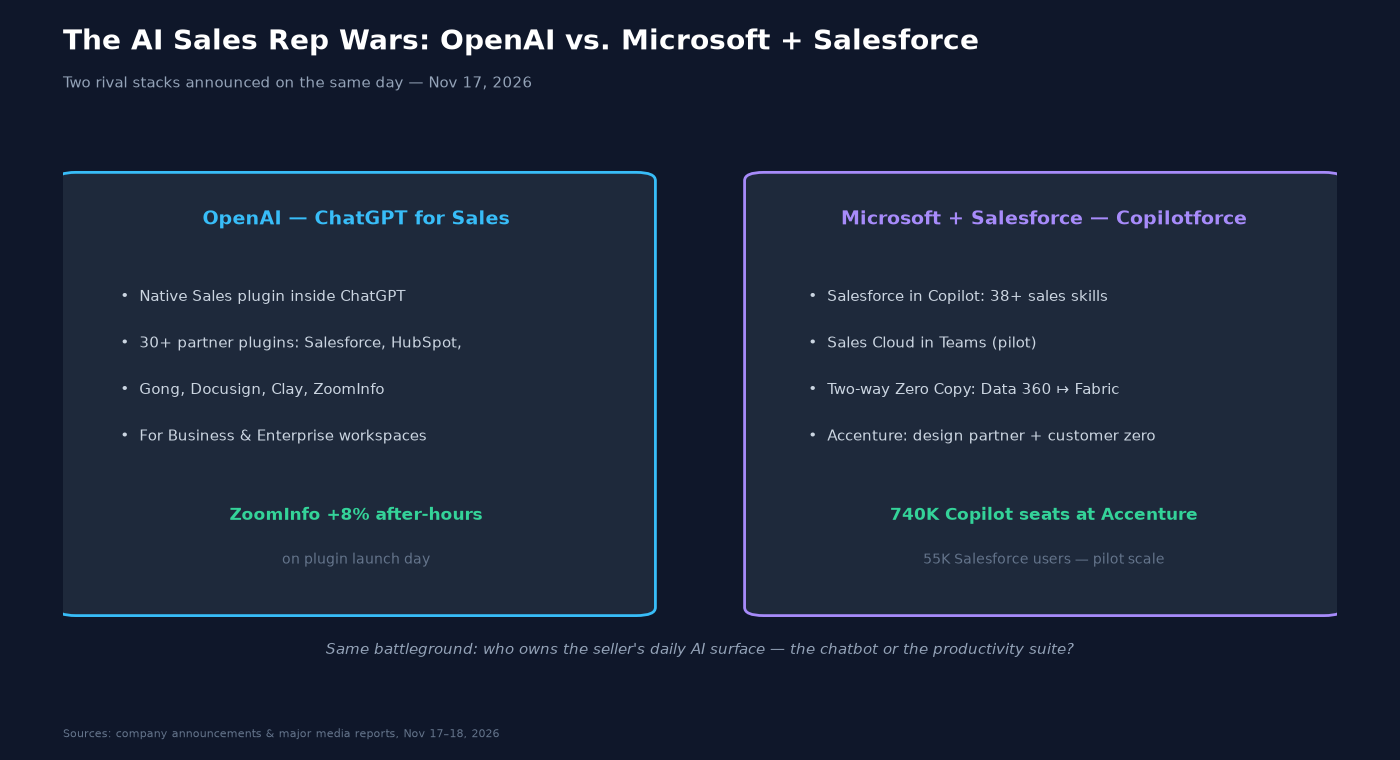
November 17, 2026 will be remembered as the day the “AI sales development rep” stopped being a startup category and became a platform war. Within hours, OpenAI announced ChatGPT for Sales — a native sales plugin bundled with more than 30 partner integrations — while Microsoft and Salesforce unveiled Copilotforce at Ignite, embedding Salesforce’s customer context and sales workflows directly into Copilot, Teams, and Fabric. Two stacks, one prize: the daily working surface of every B2B seller, and by extension the pipeline data that feeds modern revenue marketing.
The market voted immediately. ZoomInfo, whose GTM.AI sales extensions launched inside ChatGPT the same day, jumped 8% in after-hours trading. Salesforce, despite co-announcing the deepest Microsoft integration in years, fell 9.5% to close at $194.52 — a reminder that investors read “distribution partnership” and “disintermediation risk” in the same document.
What OpenAI shipped
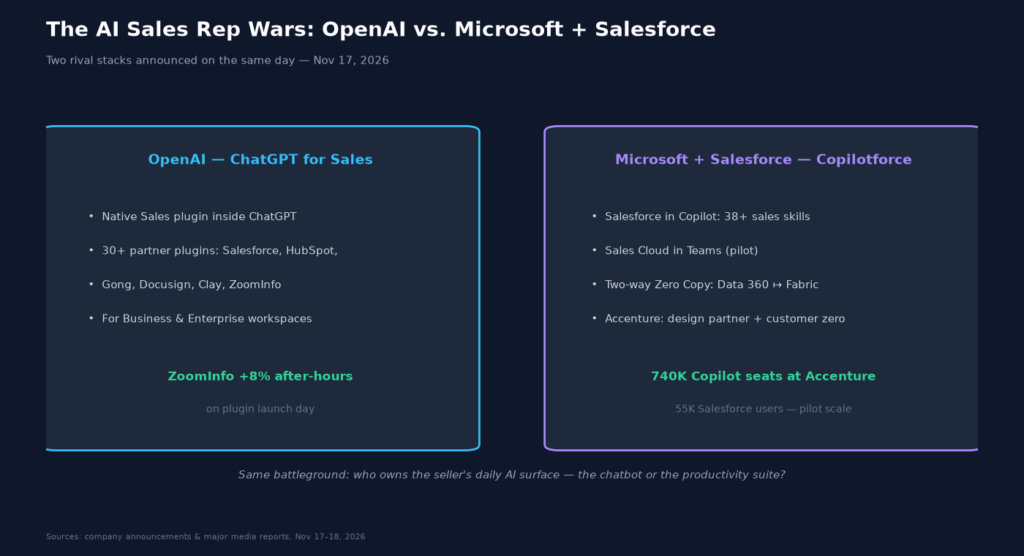
ChatGPT for Sales is not a new model; it’s a packaging of the chat surface into a sales workspace. A first-party Sales plugin handles core workflows — account research, meeting prep, follow-up drafting — while 30-plus new or enhanced partner plugins connect the systems sellers actually live in: Salesforce, HubSpot, Gong, Docusign, Clay, ZoomInfo, and others. It targets Business and Enterprise workspaces, where admins control connections. The partner responses were same-day and specific: Docusign added renewal briefs and legal-request routing to its plugin; Clay’s relaunched MCP plugin can build and preview enrichment workflows inside the chat; ZoomInfo exposed its B2B data graph “headlessly” through GTM.AI.
The strategy is vertical land-grab by conversation. OpenAI already owns enormous daily attention; ChatGPT for Sales converts that attention into a system-of-work position without building a CRM. Every partner plugin is a distribution deal in which the incumbent SaaS vendor keeps its data moat but cedes the interface.
What Microsoft and Salesforce shipped
Copilotforce runs the opposite play: the productivity suite absorbs the CRM. Salesforce in Copilot launched in public preview with 38-plus prebuilt sales skills — Pipeline Review, Close Planning, Deal Review, Customer Health, Renewal Radar, Call Follow-Up — grounded in both CRM records and Microsoft Work IQ’s context from Teams meetings, Outlook threads, and SharePoint documents. The pitch is that deal risk hides in conversations, not fields: the escalation discussed in Teams, the unresolved commitment in an email thread. Sellers act through authenticated Salesforce MCP access, with writebacks requiring explicit confirmation and respecting existing validation rules and permissions.
Underneath, a two-way Zero Copy federation between Salesforce Data 360 and Microsoft Fabric lets each platform query the other’s data without duplication — Fabric OneLake data queryable inside Data 360 (generally available), curated Data 360 intelligence shareable into OneLake (public preview). Sales Cloud in Teams is in pilot. And Accenture serves as both implementation partner and “customer zero,” deploying across a sales organization backed by 740,000 Copilot seats and 55,000 Salesforce users — a pilot at a scale most vendors never reach in production.
The marketer’s read: this is a data-gravity fight, not a feature fight
Strip the announcements to structure and the contest is clear. OpenAI bets that the chat window becomes the seller’s home screen, and CRMs become utilities queried through plugins. Microsoft and Salesforce bet that the governed enterprise suite remains home, and chat-grade intelligence gets embedded where compliance already lives. Both can be right for different segments: OpenAI’s packaging is fastest for lean, tool-flexible revenue teams; Copilotforce is built for enterprises where permissions, audit trails, and data residency are non-negotiable.
For marketing leaders — especially those owning marketing-sales alignment — three consequences deserve planning attention.
First, activity data quality is about to improve dramatically, and your attribution models should be ready to exploit it. AI-drafted follow-ups, proposed CRM activities, and call summaries mean the CRM finally captures the conversational middle of the funnel that humans never logged. Revenue attribution built on clean activity data becomes feasible; teams that redesign lead-scoring and pipeline-coverage reporting around it will see sharper forecasts.
Second, content’s buyer changes. When a seller asks an AI to prep a meeting, the AI assembles context from CRM notes, emails, and whatever public content it can reach. Vendor content that is structured, quotable, and machine-readable — pricing clarity, comparison pages, verified claims — increasingly shapes what the AI tells the seller, which shapes what the seller tells the buyer. GEO is no longer just about consumer discovery; it is about arm’s-length influence on B2B deals.
Third, governance is the differentiator to demand. Both stacks make much of permissions and confirmation-before-writeback, and reasonably so — an agent that can update opportunities and draft customer commitments is an operational risk surface. Ask either vendor for the audit trail, the permission model, and the human-confirmation boundaries before rolling out beyond pilot. The winners of this war will be decided as much by trust failures avoided as by features shipped.
The startups that defined the AI-SDR category should be nervous. The platforms just moved the category inside their walls — and the sellers, marketers, and data teams inside those walls should start rearranging accordingly.