OpenAI shipped two new models on November 17 — GPT-6.2 Astra for demanding professional work and GPT-6.2 Sol for everyday tasks — and aimed the announcement squarely at one number: cost. On Agents’ Last Exam, a benchmark of multi-step professional workflows, OpenAI says Astra beats its own predecessor by 5.2 points at less than a third of the cost, and leads Anthropic’s Claude Fable 5.2 by 5.5 points at just 5% of the cost. If that ratio holds in production, the economics of every AI-assisted marketing workflow — research, reporting, creative operations, agent pipelines — just changed.
The timing was not subtle. Anthropic’s record IPO was days from pricing. OpenAI released a cheaper, nearly-as-capable flagship into the exact news cycle in which its rival was asking public markets for a trillion-dollar valuation. Model releases are product news, but release dates are strategy.
What’s actually new
Astra’s pitch is professional polish: reliable handling of conventions in law, finance, and accounting; presentations that inherit exact fonts, layouts, and colors from templates; stronger computer use, demonstrated by building 3D models and animating physics simulations in Blender. On OpenAI’s internal GDPval-v2 benchmark it gains 6.2 percentage points over its predecessor while emitting 22% fewer output tokens — a compounding saving, since output tokens are the expensive ones.
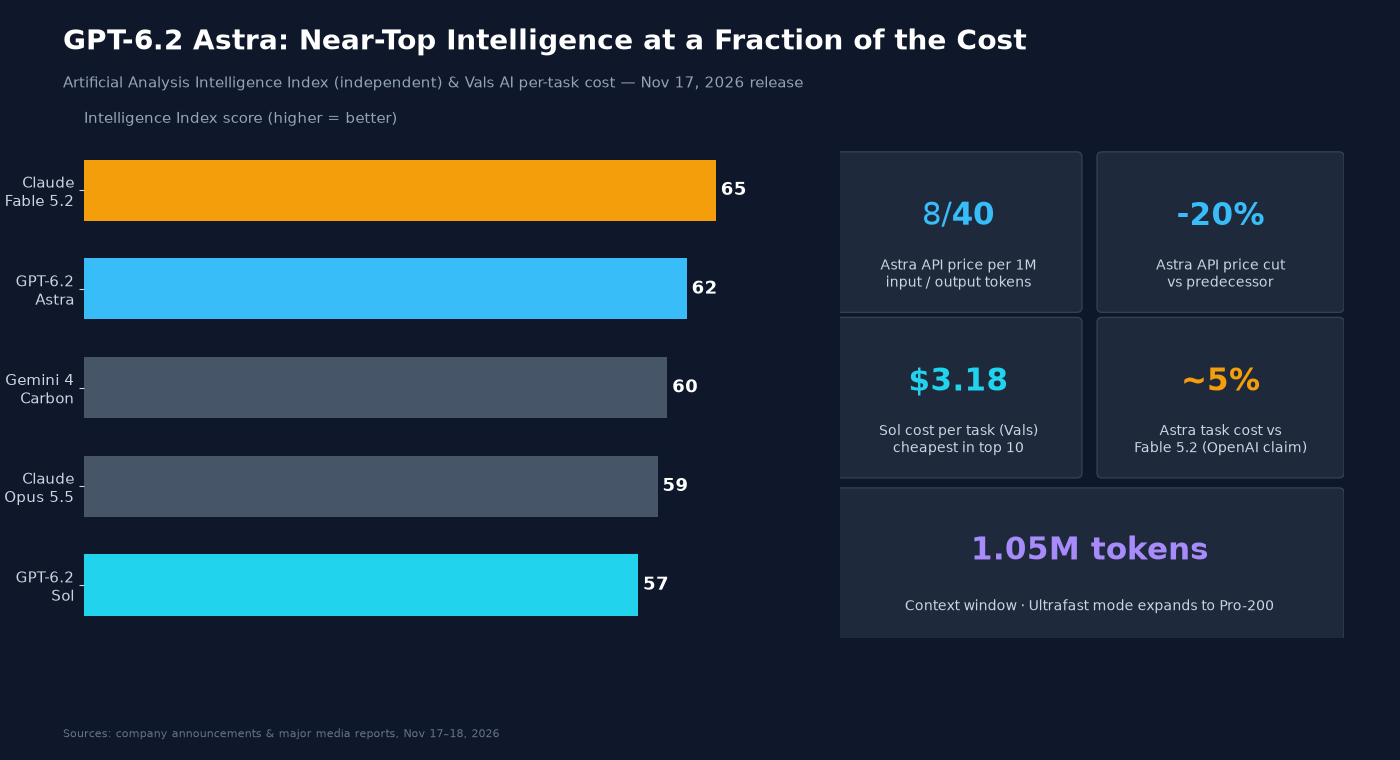
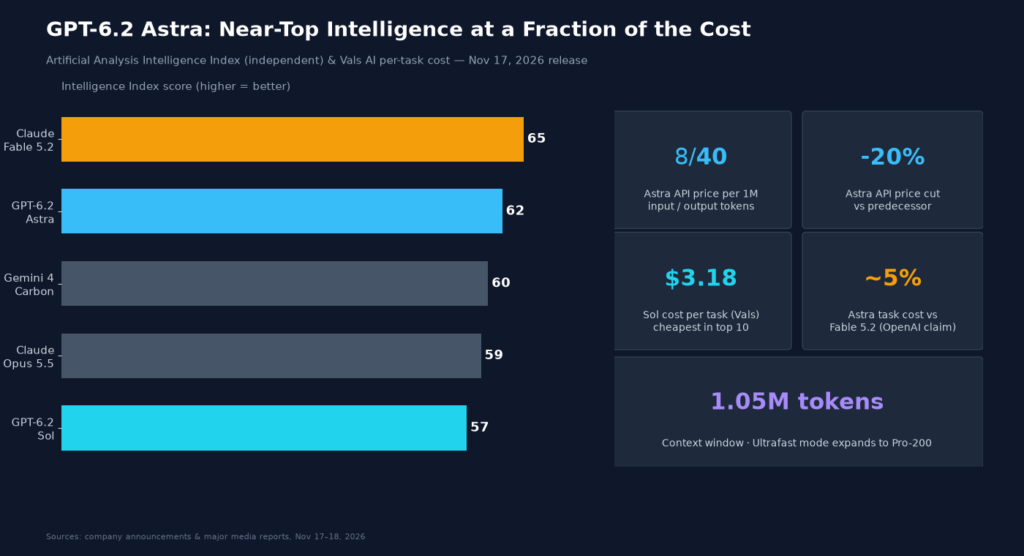
Pricing backs the pitch. Astra’s API costs $8 per million input tokens ($0.40 cached) and $40 per million output — 20% below its predecessor. Sol holds the previous price of $2/$10 and, on the coding benchmark FrontierCode 2.0, trails Astra by just half a point at one-fifth the cost. Both models carry a 1.05-million-token context window, are live in ChatGPT Work and Codex for paid tiers, and Ultrafast mode expands to more subscribers. For teams running long-document work — contracts, research corpora, brand archives — the context-plus-price combination is the headline feature.
The independent verdict: cheaper frontier, with asterisks
Three external evaluators published results within a day, and together they tell a more useful story than the launch post.
Artificial Analysis places Astra second on its Intelligence Index at 62, just behind Fable 5.2’s 65, ahead of Gemini 4 Carbon (60) and Claude Opus 5.5 (59). Crucially, it confirms OpenAI’s cost-performance claim in structure: OpenAI models dominate the Pareto frontier — the set of models where nothing else is both cheaper and better. But it also found coding flat: Astra’s coding-agent score is unchanged from its predecessor, and Sol actually drops three points. And on a deliberately brutal factual benchmark, Astra guesses instead of admitting ignorance 59% of the time at maximum effort (Sol: 55%) — not an everyday hallucination rate, but a warning about confident wrongness on hard questions.
Epoch AI ties Astra with Fable 5.2 at 174 on its Capabilities Index — while finding it weaker on messy real-world research tasks, where it “played it too safe and skipped key estimates.” Vals AI ranks Astra 7th and Sol 9th overall, with Sol the cheapest top-10 model at $3.18 per task versus Astra’s $10.68, and flags legal research as a weak spot for the base models. The composite picture: OpenAI has genuinely moved the price-performance frontier, without clearly moving the capability ceiling.
One more disclosure deserves attention: Astra is the first released model to hit “High” on OpenAI’s own scale for AI self-improvement — meaning it can meaningfully accelerate AI research — which OpenAI itself explicitly frames as a risk, mitigated with tighter research-environment controls and monitoring. Marketing teams rarely read safety sections; this one explains why the next model cycle may arrive faster than the last.
The marketer’s decision framework
For marketing operations, the right response is neither migration nor dismissal — it’s re-tiering. The cost story is most compelling for high-volume, well-specified work: SEO briefs at scale, product-description variants, campaign QA, transcript processing, first-pass competitive research. Sol at $2/$10, or $3.18 per agentic task in Vals’ measurement, makes previously uneconomical batch jobs viable. Route that work down the stack.
Keep frontier-critical judgment — final legal-adjacent claims, high-stakes analysis, anything where a confident error is expensive — on whichever model wins your own evals, and note that on independent tests Fable 5.2 still leads on raw capability and several knowledge benchmarks. The 5%-cost claim comes from OpenAI’s benchmark on OpenAI’s harness; your task mix is not their benchmark.
And build the eval before the migration: fifty representative tasks from your actual workflow, scored blind on correctness, completeness, and cost per finished deliverable. The teams that win the model-cycle treadmill are not the ones who switch fastest; they are the ones whose switching cost is lowest because measurement is already in place. With releases now landing at this cadence — and vendors openly pricing against each other’s funding events — that measurement infrastructure is the only durable advantage on offer.