You have probably seen this scene: a team publishes forty genuinely good articles — each one polished, researched, useful — and ChatGPT keeps quoting a competitor with twelve mediocre pages. It feels like theft. It usually isn’t. It’s a wiring problem.
Isolated good content is like pearls spilled on a table. Each pearl is beautiful on its own, but nobody can wear a pile of loose pearls. The semantic network is the string: a deliberate structure of concepts, questions, and evidence that lets a retrieval system travel through your knowledge instead of stumbling over one page at a time.
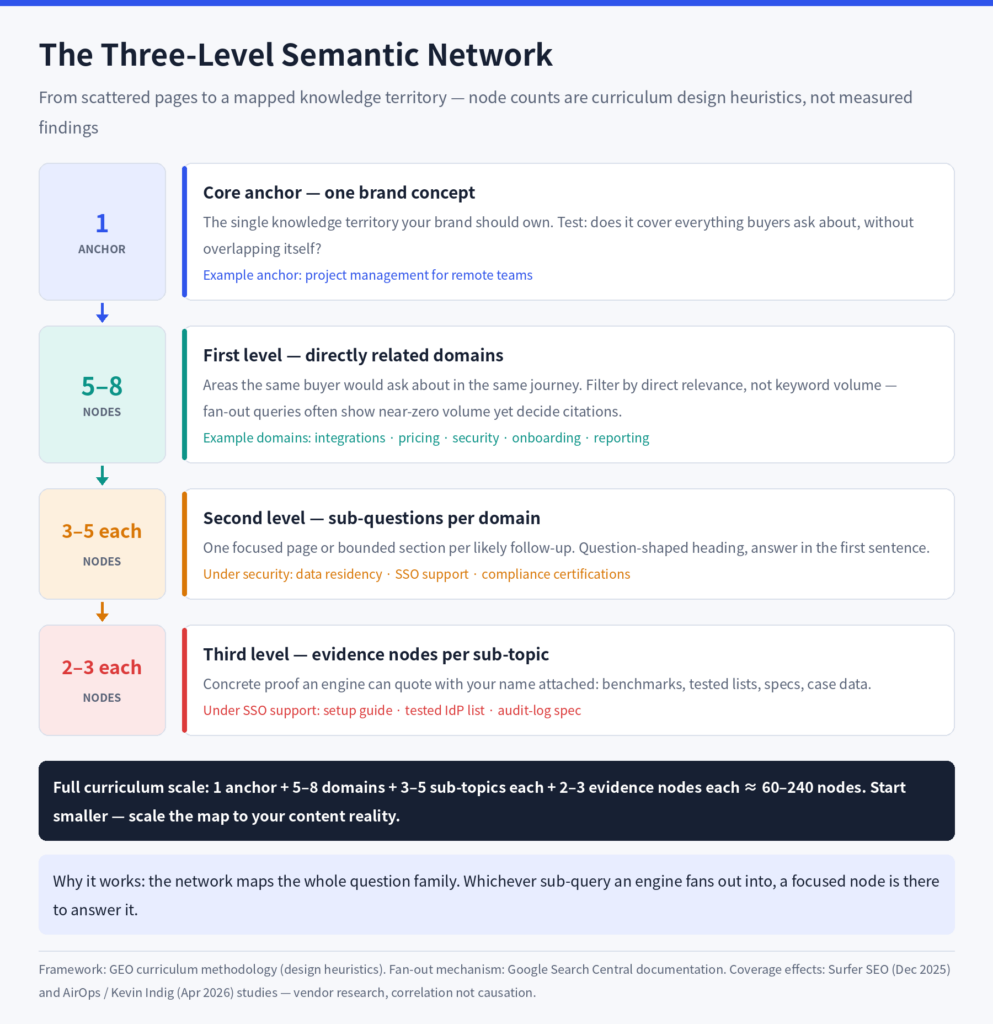
This module builds that string. One core concept. Five to eight first-level domains. Three to five sub-topics under each. Two to three evidence nodes under each of those. Internal links weaving everything into a traversable graph. And — this matters — an honest read of what the research actually proves versus what is simply good design.
Why AI Systems Reward Systematic Knowledge
The hierarchy signal is measurable
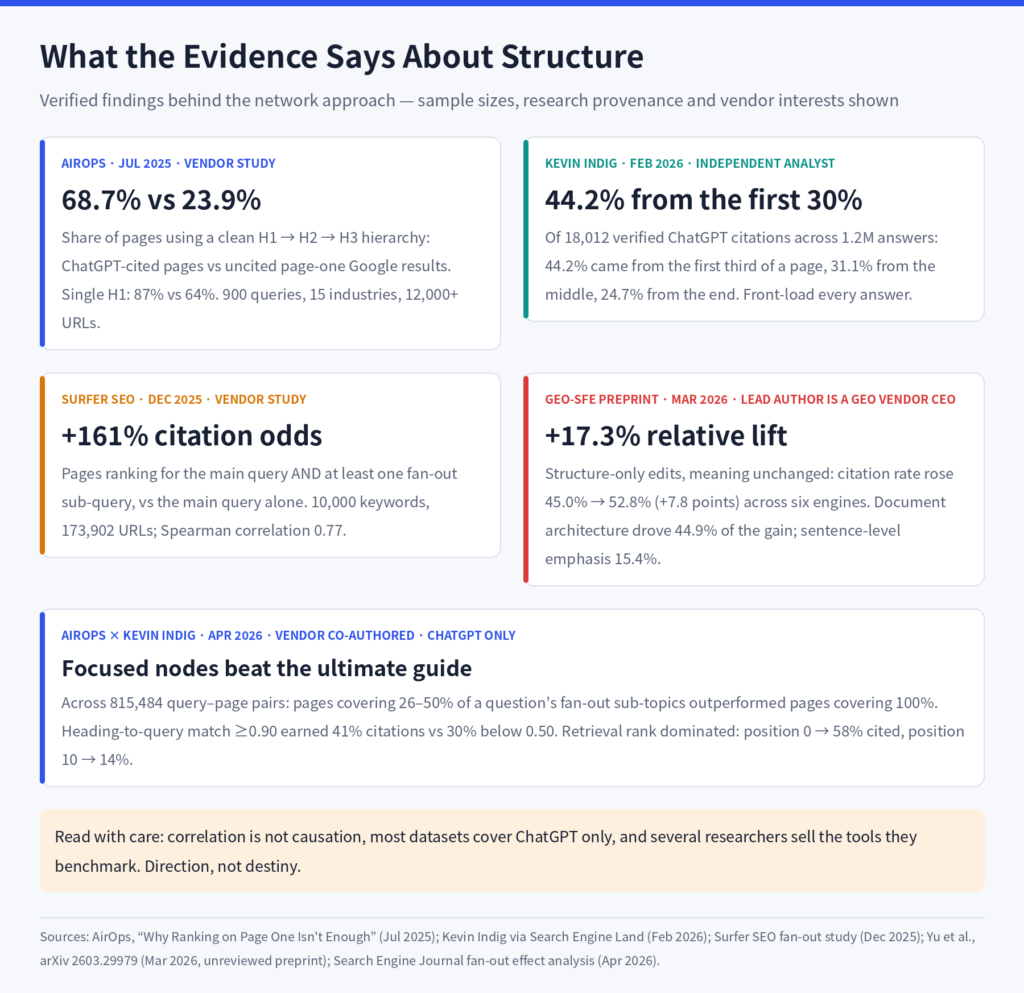
The most-quoted number in this space comes from AirOps, a content-workflow vendor that sells the tools it benchmarks — a conflict worth naming before quoting the finding. In July 2025 the company ran 900 high-intent queries across 15 industries through ChatGPT, then compared the cited pages against page-one Google results that went uncited: more than 12,000 URLs in total. Among cited pages, 68.7% used a clean, sequential heading hierarchy — H1, then H2, then H3, no skipped levels. Among the uncited Google leaders? Just 23.9%. A single H1 appeared on 87% of cited pages versus 64% of the Google group.
Correlation, not causation — but the gap is wide, and the mechanism is intuitive. An engine parsing your page treats headings as a map of how concepts relate. A clean hierarchy is a legible map; a heading salad is noise.
Structure moves citations even when the words don’t change
In March 2026, a team led by Junwei Yu — a University of Tokyo researcher who is also CEO of the GEO vendor VeReach, a dual role worth disclosing — posted a preprint called GEO-SFE on arXiv. The experimental design is the interesting part: the researchers changed only the structure of 200 benchmark articles — headings, chunking, emphasis — while holding the meaning constant, then measured citations across six generative engines and roughly 2,400 test cases.
Citation rates rose from 45.0% to 52.8%. That is a 7.8-percentage-point gain — a 17.3% relative lift, the abstract’s headline number, and one worth reading carefully, because plenty of secondary blogs mistranslate it into percentage points. In the ablation analysis, document-level architecture — hierarchy, navigation, cross-references — accounted for 44.9% of the improvement, section-level chunking for 39.7%, and sentence-level emphasis for just 15.4%. Bold text is the garnish. Architecture is the meal.
It is still an unreviewed preprint with a vendor among its authors. Treat it as strong directional evidence, not gospel.
The engine wants a path for the next question
Here is the part most content teams miss: your page is rarely answering the question the buyer typed. Google’s own Search Central documentation describes query fan-out — the system issues multiple related searches across subtopics and data sources to build one response. The buyer asks once; the engine asks many times.
Surfer SEO — again, a vendor studying its own market — measured what that means. Across 10,000 keywords and 173,902 URLs in late 2025, pages ranking for the main query plus at least one fan-out sub-query were 161% more likely to be cited in AI Overviews than pages ranking for the main query alone. The correlation between fan-out coverage and citation likelihood was a striking 0.77.
A semantic network is a pre-built answer grid for exactly those invisible sub-questions. You don’t need to predict every fan-out — Surfer found only about 27% repeat across runs — because the clusters they fall into are stable. Cover the family, and whichever variant fires, a node is waiting.
The Three-Level Model, Level by Level
One core anchor
Pick the single concept your brand should own. Not your company name — a knowledge territory. A project-management SaaS might anchor on “project management for remote teams.” Test the anchor with one question: does it cover everything your buyers ask about, without overlapping itself? If two candidate anchors keep generating the same sub-questions, you have one anchor, not two.
Five to eight first-level domains
Ask what a buyer who cares about the core also cares about: integrations, pricing, security, onboarding, reporting. The test is direct relevance — would the same person ask this in the same buying journey? Keyword volume is a poor filter here. Fan-out queries often show near-zero reported search volume and still decide which brands get named.
Three to five sub-topics per domain
This is where follow-up retention lives. Under security: data residency, SSO support, compliance certifications. Each sub-topic becomes one focused page or one clearly-bounded section, with a question-shaped heading and the answer in the first sentence. Kevin Indig’s analysis of 1.2 million ChatGPT answers and 18,012 verified citations found 44.2% of citations came from the first 30% of a page. Engines read like impatient journalists: get to the point, or get skipped.
Two to three evidence nodes per sub-topic
Under SSO support: a setup walkthrough, a tested list of identity providers, an audit-log specification. Evidence nodes are your verifiability layer — the concrete claims an engine can quote with your name attached. The original GEO study from Princeton (Aggarwal and colleagues, presented at KDD 2024) found that adding statistics, quotations, and citations boosted source visibility by up to 40%, while keyword stuffing did nothing. Evidence beats adjectives. It always has.
The scale — and its honest label
Run the arithmetic: one anchor, plus five to eight domains, plus three to five sub-topics each, plus two to three evidence nodes each, lands somewhere between roughly 60 and 240 nodes at full curriculum scale. More importantly, these counts are design heuristics from the curriculum — not research findings. Nobody has run a controlled trial proving eight domains beat six. The hierarchy preference is evidenced; the specific numbers are method. Start with the smallest network that covers your buyers’ real questions.
The Counterintuitive Part: The Network Is Not One Giant Page
If you read only the hierarchy study, you might conclude: build the ultimate guide, cover everything, win. The data says the opposite — at page level.
In April 2026, Kevin Indig and AirOps analyzed 815,484 query–page pairs from 16,851 prompts run three times each across 353,799 pages. Pages covering 26–50% of a question’s fan-out sub-topics outperformed pages covering 100%. The citation sweet spot was 500–2,000 words with 7–20 subheadings. What dominated everything else was retrieval rank — position zero in ChatGPT’s underlying search earned a 58% citation rate, position ten just 14% — and heading-to-query match: headings scoring 0.90 or higher cosine similarity to the query were cited 41% of the time versus 30% for weak matches.
Reconcile the two findings and the architecture becomes obvious. Each node is a focused, sharply-titled page that wins its one question. The site — not the page — carries the completeness. The network is how a small library beats an encyclopedia: every book short and specific, the catalog exhaustive. Even Wikipedia, the dataset’s outlier at a 59% citation rate, earns its exception through site-scale cross-linking no corporate blog can replicate on a single URL.
Internal Links: The Edges of the Graph
Three link types
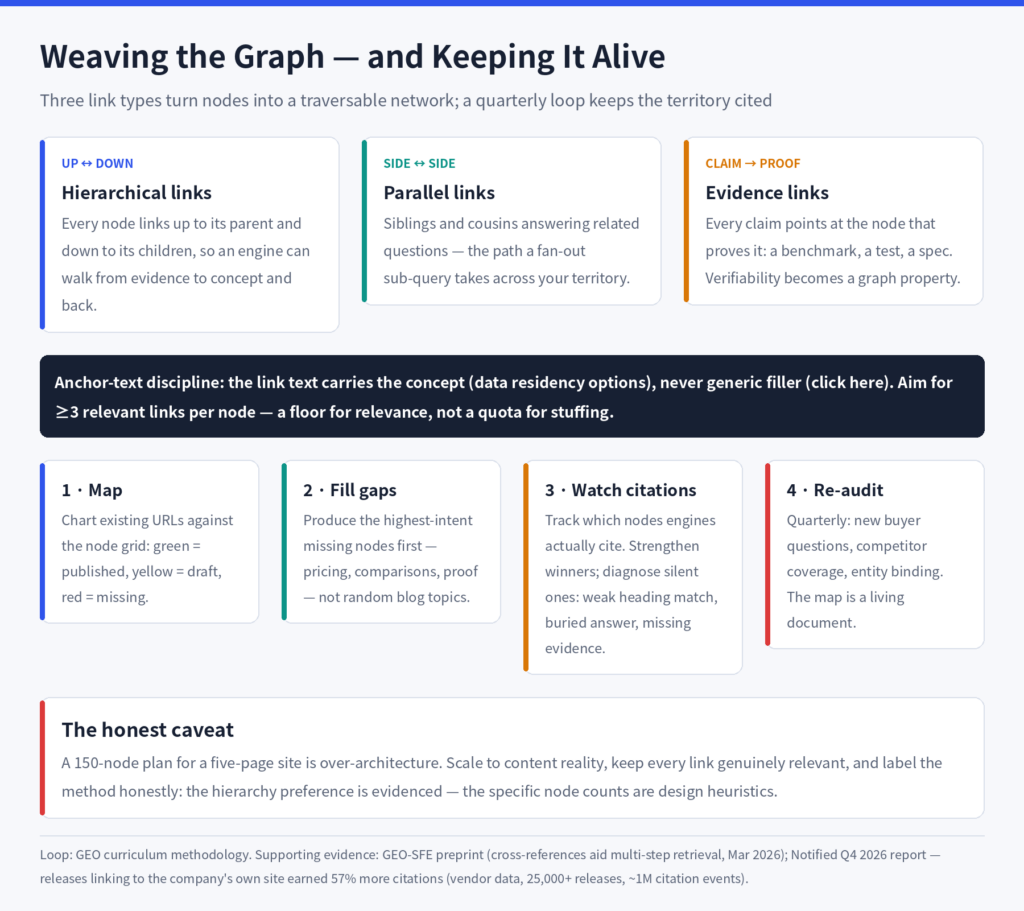
Hierarchical links run up and down the levels, so an engine can travel from evidence to concept. Parallel links connect siblings and cousins — the path a fan-out takes across your territory. Evidence links point every claim at the node that proves it. Three edge types, one graph.
Anchor text is a semantic signal
Write the concept into the link: “data residency options,” not “click here.” The GEO-SFE paper explicitly models internal-linking density as a feature supporting multi-step retrieval — engines that iteratively refine searches can follow your cross-references to assemble a fuller answer. There is corroborating evidence from an unexpected corner: Notified, which operates the GlobeNewswire newswire and studied its own product, reported in October 2026 that releases linking to the company’s own website earned 57% more AI citations across a dataset of more than 25,000 releases and nearly a million citation events. Vendor data, associations rather than causation — but directionally consistent.
Three per node is a floor, not a quota
The curriculum’s rule of at least three relevant links per node is a relevance floor. Stuffing ten irrelevant links into a paragraph doesn’t build a graph; it builds spam with extra steps. If a link doesn’t help a reader or an engine understand a relationship, delete it.
Build Gap-First, Not Blog-Random
Map every existing URL onto your node grid. Green for published, yellow for draft, red for missing. The map will sting — most teams discover their ten best articles cluster in two domains while buyers’ highest-intent questions (pricing, comparisons, proof) sit in red.
Produce against the gaps, highest purchase intent first. This is the difference between a content calendar and a coverage strategy: the calendar asks what we should publish this week; the map asks which question family we are losing. One honest note on case studies: earlier versions of this curriculum cited a SaaS tool going from zero to 43% AI citations in three months, an e-commerce brand tripling citation probability, and a consultancy drawing 18% of leads from AI. We attempted independent verification and could not confirm any of them, so they are removed from this article. What remains is the measured research above — a better foundation than an unverifiable before-and-after anyway.
Keep the Network Alive
A network is a living structure, not a launch project. Run a quarterly audit on three fronts. Coverage: what new questions are buyers asking, and which competitor nodes exist that you lack? Citations: which of your nodes actually get named by engines — strengthen the winners, diagnose the silent ones. Weak heading match? Buried answer? Missing evidence? Entities: probe the engines directly — ask them about your core concept and see whether your brand comes back bound to it. Adjust the map, refill the gaps, repeat. The moat is not the sixty pages you shipped in Q1. It’s the fact that in Q4 your territory still matches the questions.
Risks and Honest Caveats
Four failure modes deserve naming. Over-architecture: a 150-node plan for a five-page site is a fantasy org chart, not a strategy — scale to content reality. Link stuffing: covered above, but worth repeating because it is the most common way teams ruin a good graph. Framework-as-fact: the node counts and the three-links rule are design choices; cite them as method, never as measured science. And vendor-shaped evidence: nearly every large citation study in this field comes from a company selling AI-visibility tooling — AirOps, Surfer, Notified — or, in GEO-SFE’s case, a paper whose lead author runs a GEO vendor. The findings converge, which is reassuring, but convergence among interested parties is weaker than independent replication. Watch for academic follow-ups, and run your own before-and-after tracking. That’s the only dataset with your name on it.
Summary: String the Pearls
Isolated content is invisible content — not because it’s bad, but because engines retrieve and synthesize across question families, and a lone page can only answer one member of the family. The three-level semantic network gives you a mapped territory: one anchor, five to eight domains, three to five sub-topics each, two to three evidence nodes each, woven by hierarchical, parallel, and evidence links. Keep every node focused — the research is unambiguous that exhaustive mega-pages lose to sharp, well-matched ones, while site-level completeness wins the fan-out game. Build against gaps, front-load answers, write concept-bearing anchors, and re-audit quarterly. The pearls were never the problem. Now you have the string.