Question grading and anchor mapping is the discipline of turning a raw inventory of buyer questions into a prioritized content architecture: grade every question by decision proximity (P0 must-answer, P1 priority, P2 selective), then map each question type to the content carrier an AI engine can extract most cleanly — pricing tables, definition blocks, comparison rows, numbered steps. A 300-question list is raw material, not a plan. The grading tier counts (15–20 P0, 35–50 P1, 30–50 P2 per ~100 prioritized questions) are curriculum guidelines; the extraction logic behind the carriers is backed by published research on how AI engines select and absorb sources.
Why Question-Level Coverage Is Now the Unit of Competition
The market context makes prioritization unavoidable. In February 2024, Gartner predicted traditional search engine volume would drop 25% by 2026 as users shifted to AI chatbots. When Fractl and Search Engine Land tested that prediction in July 2026 against 1,010,848 high-volume keywords (379 brands, eight verticals, 35.4 billion monthly searches), they found 29% of tracked search volume in measurable decline as of April 2026 — yet total demand was essentially flat, because roughly 10.29 billion monthly searches lost on declining keywords were offset by 10.31 billion gained on growing ones. Search did not die. It rotated to different words — and increasingly to different interfaces.
Two findings from that study should sit at the top of every question map. First, the steepest erosion hit the middle of the funnel: 36% of comparison queries were declining, versus 19% at the top and 34% at the bottom. The X-versus-Y questions your evaluation-stage buyers ask are precisely the ones chatbots answer best. Second, 18% of surveyed US consumers had already bought something on an AI recommendation without verifying it through a separate search, and 59% said they were at least somewhat likely to visit a brand’s website after an AI mention. When the answer engine is the decision engine, a missing answer is not a lost click. It is a lost shortlist slot.
That is the case for grading. You cannot answer everything, and the cost of missing the wrong question is now asymmetric.
The Grading Discipline: P0, P1, P2
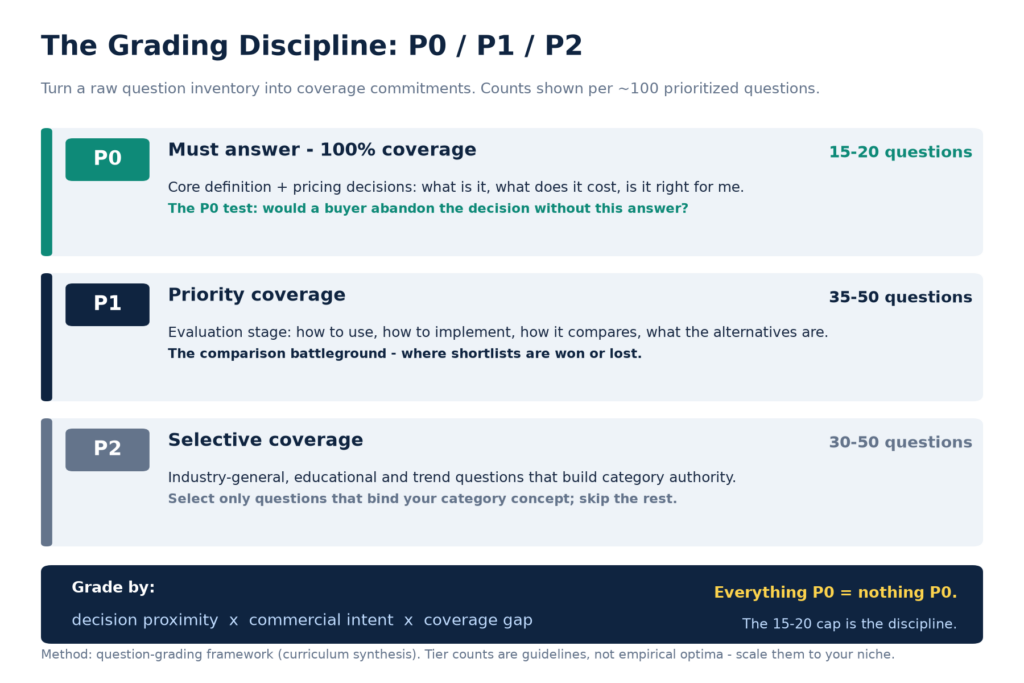
The framework sorts every collected question into three tiers.
P0 — must answer, 100% coverage (15–20 questions). Core definition and pricing-decision questions: what is it, what does it cost, is it right for me. These are the table stakes. If a buyer asks a P0 question and your brand has no extractable answer, you exit the decision at the moment it forms.
P1 — priority coverage (35–50 questions). Evaluation-stage questions: how to use it, how to implement it, how it compares, what the alternatives are. Given that comparison queries are the fastest-eroding search category, P1 is where the consideration battle now happens — inside the chat window.
P2 — selective coverage (30–50 questions). Industry-general, educational and trend questions. Answer the ones that bind your category concept to your brand; skip the ones that merely decorate a blog calendar.
The P0 Test and the Grading Formula
Grade by decision proximity multiplied by commercial intent multiplied by coverage gap. In practice, one question does most of the work: would a buyer abandon the decision without this answer? If yes, it is P0, regardless of search volume. A pricing question with 40 monthly searches outranks a trend question with 4,000, because the first sits at the decision and the second sits at the periphery.
The discipline lives in the cap. When every question is P0, nothing is P0. The 15–20 limit forces the argument about which questions actually gate revenue — and that argument, held with sales and support in the room, is more valuable than the spreadsheet it produces.
Anchor Mapping: The Answer Shape Decides the Carrier
Grading tells you what to answer. Anchor mapping tells you what form the answer must take. The principle: every question type implies an answer shape, and the content carrier must match that shape so a retrieval system can lift it cleanly.
- Pricing questions map to an FAQ block plus a tier or pricing table, because the answer is a set of extractable numbers.
- Definition questions map to a structured definition block with the answer in the first sentence — the X-is-Y form.
- Comparison questions map to a multi-dimension table plus scenario cases, because engines synthesize trade-offs from rows, not from prose scattered across paragraphs.
- How-to questions map to numbered steps with prerequisites.
- Outcome questions (when will I see results) map to a timeline with dated milestones, because dates make the claim verifiable.
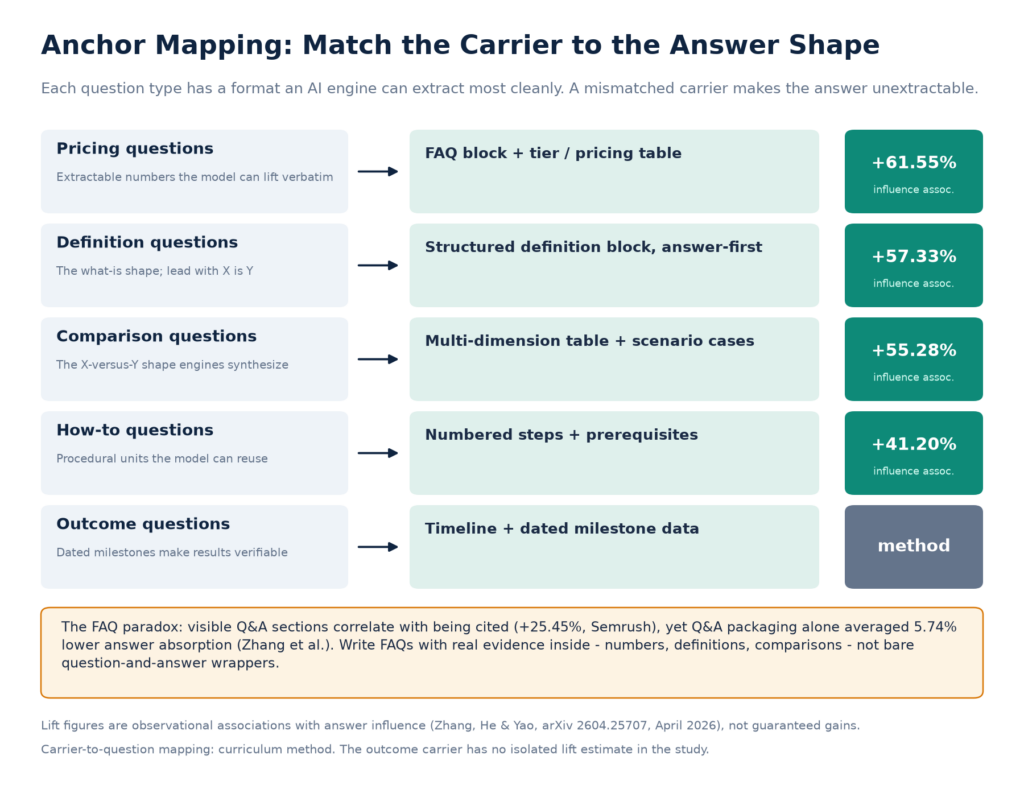
The evidence behind these pairings is stronger than intuition. An April 2026 measurement study by Zhang Kai, He Xinyue and Yao Jingang (arXiv 2604.25707, built on the public geo-citation-lab dataset of 602 prompts and 18,151 fetched cited pages across ChatGPT, Google AI Overviews and Perplexity) compared how deeply different kinds of content get absorbed into generated answers. Pages containing numbers or statistics averaged 61.55% higher answer influence; definition markers, 57.33%; comparison content, 55.28%; how-to content, 41.20%. Those four evidence genres are exactly the carriers the mapping prescribes. The specific question-to-carrier pairing is curriculum synthesis — but the underlying preference for extractable evidence is measured.
Position matters as much as format. Kevin Indig’s February 2026 Growth Memo analysis of 18,012 verified ChatGPT citations found 44.2% came from the first 30% of a page, 31.1% from the middle and 24.7% from the final third. Cited passages were also roughly 1.8 times more likely to use definitive language (36.2% versus 20.2% in uncited text). Answer first, in declarative sentences, or the carrier never gets read.
Being Cited Is Not Being Used
Here is the distinction most coverage plans miss. The same study found citation breadth and citation depth diverge sharply: Perplexity cited 16.35 sources per prompt on average, Google 12.06, ChatGPT only 6.88 — yet ChatGPT’s cited pages carried the highest average influence (0.2713 versus Google’s 0.0584 and Perplexity’s 0.0646). Fewer citations, deeper use.
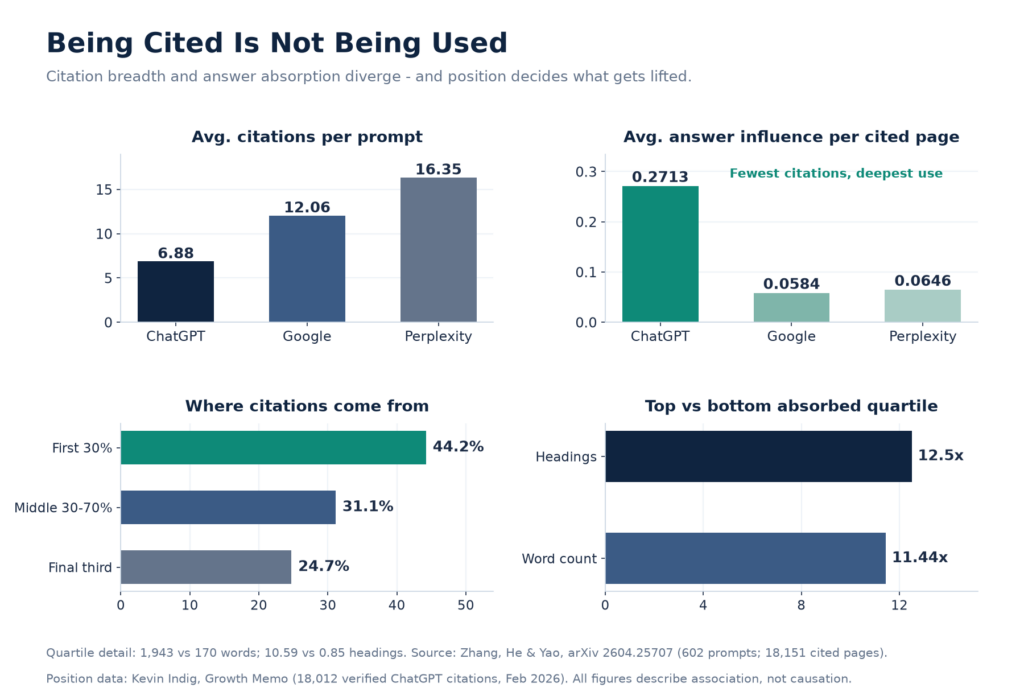
The structural profile of deeply absorbed pages reinforces the carrier logic. But the authors are explicit that semantic fit beats raw length — the strongest independent correlate of influence was relevance, not word count. A 2,000-word page about the wrong question is still about the wrong question. That is why the map starts from questions, not from word-count targets.
The FAQ Paradox: Question Marks Do Not Save Thin Answers
Two findings appear to contradict each other, and the resolution is the most useful lesson in this module. Semrush’s study of 304,805 AI-cited URLs against 921,614 URLs ranking on Google (11,882 prompts, July–August 2025) found visible Q&A formatting associated with citations at +25.45%, alongside clarity and summarization (+32.83%), E-E-A-T signals (+30.64%), section structure (+22.91%) and structured data elements in visible text (+21.60%). Yet the absorption study found Q&A-packaged pages averaged 5.74% lower answer influence than non-Q&A pages.
Both can be true. Q&A formatting helps a page get selected; it does nothing for how much of the page gets used. A FAQ of one-line answers is a citation candidate that feeds the engine almost nothing. The operational rule: use FAQ structure for pricing and decision questions, but put real evidence inside each answer — a number with a source, a definition, a comparison row. The wrapper earns selection; the evidence earns absorption.
One Canonical Page Per Question: The Worked-Example Discipline
The curriculum templates the method with 20 typical GEO questions fully mapped. The template columns are: question text, source channel (support, sales, community, competitor FAQ), grade, answer shape, carrier, canonical URL (existing or planned), semantic-network node, and monitoring status.
A five-row excerpt of the pattern, illustrative for a B2B SaaS product:
| Question | Grade | Carrier | Canonical page |
|---|---|---|---|
| What is [product category]? | P0 | Definition block, answer-first | Category explainer |
| How much does it cost? | P0 | FAQ + tier table | Pricing page |
| Is it right for a 20-person team? | P0 | Scenario answer + fit table | Pricing page section |
| How does it compare to [alternative]? | P1 | Multi-dimension table + cases | Comparison page |
| How long until we see results? | P1 | Timeline + dated milestones | Onboarding guide |
Two rules make the map operational. First, every mapped question has exactly one canonical answer page — multiple pages answering the same question split authority and invite cannibalization. Second, each canonical page links to at least three nodes of your semantic network, so the answer sits inside a connected knowledge structure rather than alone. Treat the finished map as a production backlog with acceptance criteria, not a spreadsheet artifact.
Supporting evidence for the structure discipline: AirOps’ July 2025 analysis of more than 12,000 URLs found 68.7% of ChatGPT-cited pages followed a sequential H1-to-H2-to-H3 heading structure, versus 23.9% of Google’s top results, and 87% of cited pages used a single H1 versus 64% of ranking pages. A controlled March 2026 study (GEO-SFE, arXiv 2603.29979) restructured articles without changing their substance and lifted citation rates from 45.0% to 52.8% — a 17.3% relative gain across six engines — with document architecture contributing about 45% of the improvement, chunking formats about 40%, and visual emphasis only about 15%. Structure is not garnish; it is most of the lever.
The Operational Cadence
The map is living infrastructure, not a one-time deliverable. Three rhythms keep it honest. Monthly refresh: pull new questions from support tickets, sales calls and community threads, and re-grade as the business evolves — a pricing change can promote a dozen questions overnight. Weekly AI-feedback loop: run your core questions through ChatGPT, Perplexity and Google’s AI surfaces; every unanswered or mis-answered question feeds back into grading with a named owner. Cross-team alignment: support, sales and content review one map together, so the organization holds a single question-truth instead of three private FAQ documents.
The foundational Princeton-led GEO research (Aggarwal and colleagues, KDD 2024) supports the loop’s design: content interventions lifted visibility by up to 40% in a 10,000-query benchmark, with the largest gains going to lower-ranked sources — adding citations raised the fifth-ranked source’s visibility by 115.1% — while keyword stuffing delivered little to no improvement. Gains varied by domain. You measure, adjust and re-measure; you do not deploy one universal trick.
Four Failure Modes
Grade inflation: everything becomes P0 and the cap quietly dies. Carrier mismatch: pricing answered in a prose paragraph the engine cannot lift, while the competitor’s table gets quoted. Cannibalization: three pages answer one question and none wins. Map-production disconnect: the map exists, the content calendar ignores it, and the linkage — the entire point — evaporates. Audit for all four quarterly.
Honest Caveats
The tier counts are heuristics, not empirical optima; scale them to your niche. The carrier mapping is a method built on measured associations — the absorption study’s authors explicitly decline causal claims, and platform behavior shifts between snapshots. Leave room for emergent questions your map never predicted; community listening catches what grading misses. Anonymize support-derived questions before they enter any shared document. And do not confuse visible structure with markup: Ahrefs’ May 2026 matched study of 1,885 pages that added JSON-LD schema found no meaningful citation lift on AI Mode (+2.4%) or ChatGPT (+2.2%), and a small unexplained decline in AI Overviews (−4.6%); a cited searchVIU test found five major AI systems extracted only visible HTML during live retrieval. Carriers are things readers and models can see — tables, steps, definitions — not invisible code.
Conclusion
Grading decides which questions you must own; anchor mapping decides the shape in which you own them. P0 gets 100% coverage in extractable carriers, P1 wins the comparison battle now migrating into chat windows, P2 builds authority selectively. One canonical page per question, answer-first, evidence inside every wrapper, refreshed monthly and tested weekly. Not all questions deserve an answer page — but every P0 does, in the shape the AI can lift.