Here is a strange thing about the most reliable channel in marketing. It is the one you own, the one with no algorithm you have to rent, the one every CFO still treats as free money. And in 2026 it quietly became less reliable — measurably, at the mailbox that holds roughly half of your list.
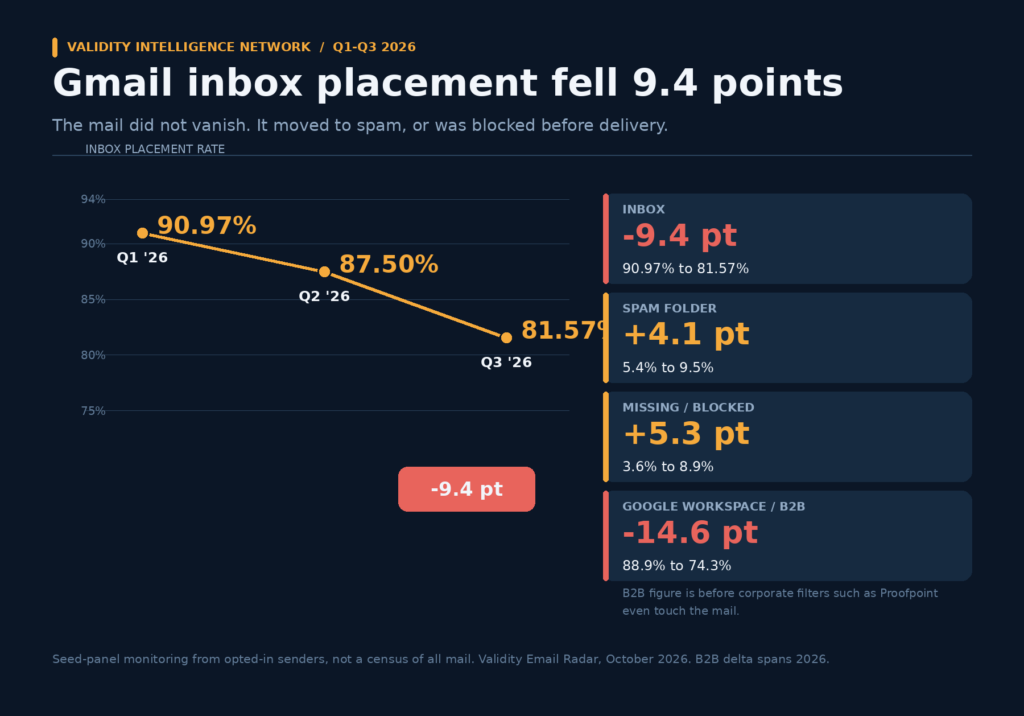
According to the Validity Intelligence Network, Gmail inbox placement fell from 90.97 percent in the first quarter of 2026 to 81.57 percent in the third. That is a 9.4-point drop in two quarters, at a mailbox Validity says represents 40.4 percent of inboxes globally and 53.9 percent in the United States. If you run a B2B program, hold on to something: placement at Google Workspace collapsed from 88.9 percent to 74.3 percent, a 14.6-point slide, and that is before corporate filters like Proofpoint get anywhere near the message.
The tempting reaction is to blame the holidays, or a bad subject line, or the intern. The less comfortable reaction is to admit the ground moved. This is not a seasonal wobble. It is three structural changes arriving at once: bulk-sender rules from 2024 that are now fully enforced, an inbox re-sorted by engagement rather than time, and AI summaries that read your mail before a human does. Sound familiar? It is the same zero-click dynamic that already rewrote SEO, now showing up in the one channel you thought was immune.
So what do you actually do? The honest answer is counterintuitive: send less, to fewer, more engaged people, and make your content legible to the machine that now reads first. Let us work through why.
The 9.4-point slide, in cold numbers
Start with the evidence, because the shape of the decline tells you more than the headline. Validity publishes quarterly inbox placement rates, or IPR, from its seed-panel network. Gmail opened 2026 at 90.97 percent in Q1, drifted to 87.50 percent in Q2, then fell to 81.57 percent in Q3. The mail did not evaporate. It moved.
Two other lines rose in lockstep. Spam placement went from 5.4 percent to 9.5 percent over the year, and missing mail — messages blocked or rejected before they reach any folder — went from 3.6 percent to 8.9 percent, more than doubling. That second number matters more than it looks. A rejection is not a soft demotion you can charm your way out of with better creative. It is the door closing.
The B2B cliff nobody put in the deck
If your list is mostly consumers, 81.57 percent is a bad quarter. If your list is mostly business addresses, it is worse. Workspace placement at 74.3 percent means roughly one in four messages never makes the inbox, and Validity is explicit that this figure is measured before third-party corporate filtering. In practice a B2B sender is running a gauntlet: Google’s own filters first, then whatever the recipient’s security team has layered on top. Treat 74.3 percent as the optimistic end of the range, not the number to budget against.
Read the fine print on the methodology
A quick dose of discipline before we extrapolate. These are seed-panel figures — test mailboxes that Validity’s customers use to preview campaigns, aggregated only from senders who opted in to share data. Validity itself calls the benchmark a snapshot in time and warns that a regular user may see different numbers in their own reporting. It is the most comprehensive view the industry has, and it is still a panel, not a census of every message on the internet. Keep that caveat in your pocket; it changes how confidently you can turn a nine-point drop into a dollar figure.
Delivered, inbox, seen: the three-layer funnel your ESP flattens
Most deliverability confusion comes from one dashboard cell doing three jobs. We need to pull them apart.
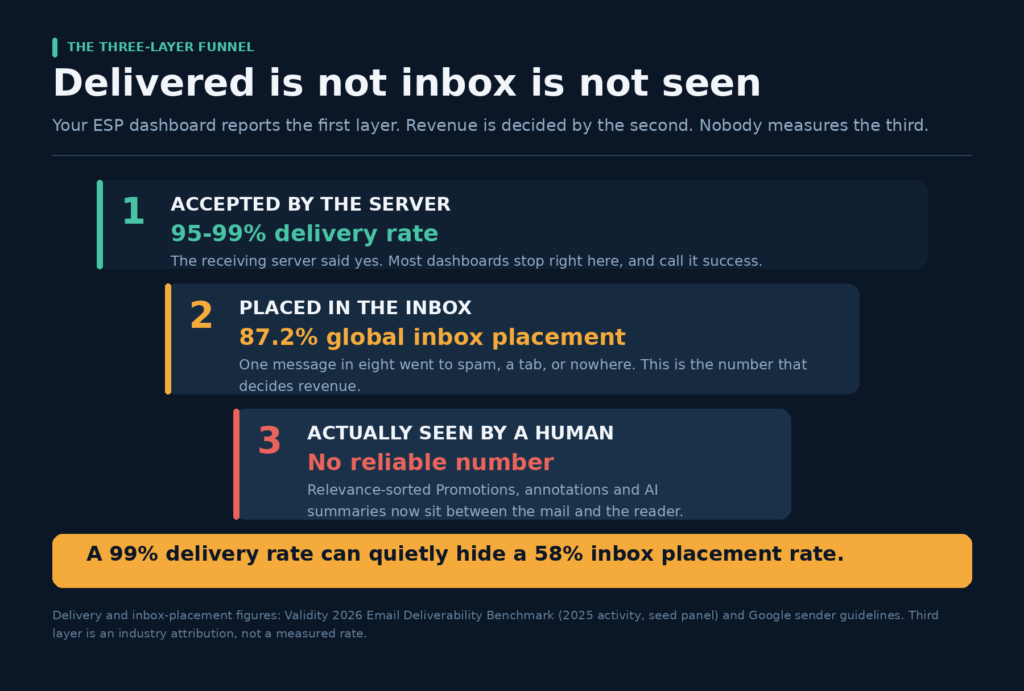
Layer one is delivery: the receiving server accepted the message. Typical delivery rates sit around 95 to 99 percent, and Zeta Global’s Q1 2026 benchmark put it at 99.26 percent. Layer two is inbox placement: of the messages accepted, how many actually landed in the inbox rather than spam, a tab, or nowhere. Validity’s 2026 benchmark, which measures 2025 activity, puts the global average at 87.2 percent, up 3.7 points year over year, with 6.6 percent in spam and 6.1 percent missing. Layer three is seen: whether a human being actually registered your message. Nobody measures that reliably, and in 2026 it is the layer under the most pressure.
See the trap? A 99 percent delivery rate can be reported as a triumph while a 58 percent inbox placement rate quietly eats your revenue. Every downstream metric — opens, clicks, conversions — is computed only on the messages that reached an inbox, but the denominator in your report still says you sent to everyone.
Why one in eight is the number to memorize
At 87.2 percent global placement, about one message in eight misses the inbox entirely. On a campaign to ten thousand people, roughly twelve hundred never get the chance to be opened. And the averages hide a wide spread: Validity’s 2025 provider table runs from Gmail at 89.8 percent and Yahoo at 87.3 percent down to Microsoft at 77.4 percent, with Europe strongest at 91.1 percent. If your audience skews Outlook-heavy, the global average flatters you. Benchmark against your own mix, not the headline.
Driver one: enforcement finally has teeth
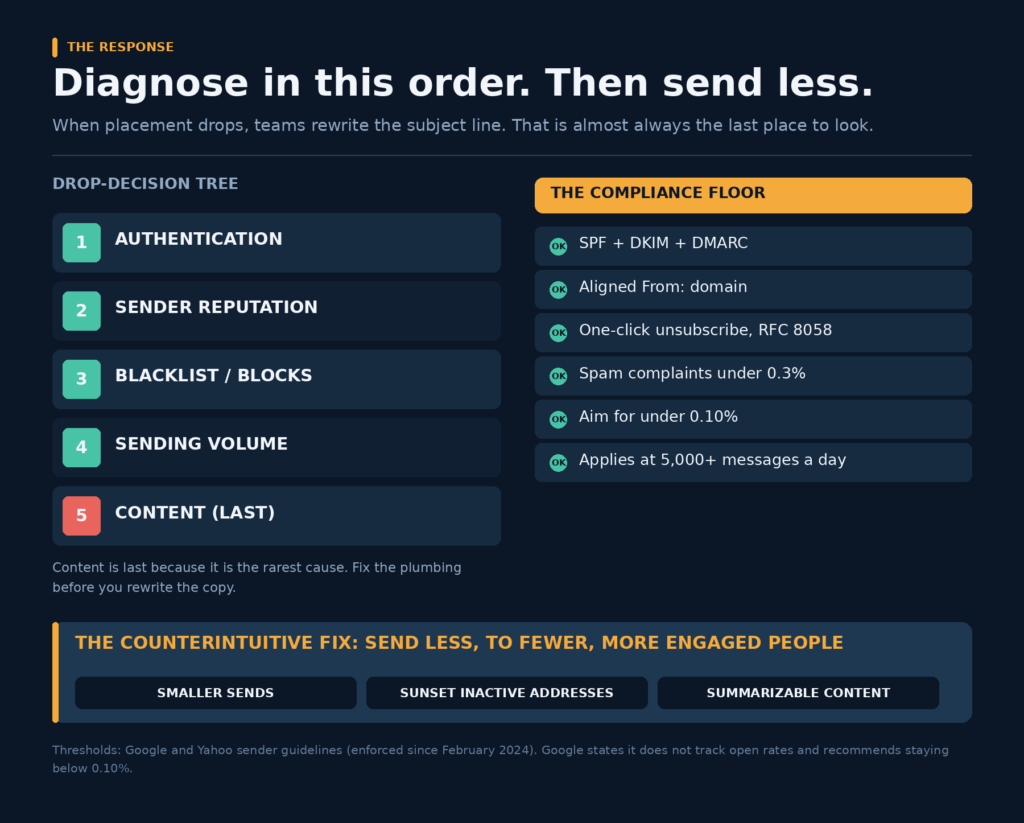
The first cause is the least glamorous, and the most within your control. Google and Yahoo introduced bulk-sender requirements in February 2024, and 2026 is the year Validity says they became fully enforced. Google’s own sender guidelines are unambiguous. For anyone sending 5,000 or more messages a day to personal Gmail accounts, you need SPF and DKIM authentication, a published DMARC record, an aligned From domain, one-click unsubscribe following RFC 8058 for commercial mail, valid forward and reverse DNS, and TLS. Microsoft joined the bulk-sender regime in 2025, so the same logic now reaches Outlook too.
Then there is the number that functions as a tripwire. Google says to keep the spam rate reported in Postmaster Tools below 0.10 percent and to never reach 0.30 percent or higher. The 0.3 percent ceiling is generous; the 0.10 percent target is the one that actually protects you. Cross the hard line and filtering escalates by default — placement can collapse almost overnight, and recovering takes time even after the rate comes back down. Non-compliance is no longer a warning letter. It is more spam placement and more rejections, which is precisely the pattern Validity measured in 2026.
There is a quiet irony here. Authentication was supposed to lift placement, and the global average did rise to 87.2 percent. But a rising tide of compliance and a falling Gmail line can both be true at once, because the bar keeps moving. Passing the 2024 floor buys you the right to be judged on everything else.
Driver two: the inbox got re-sorted
The second change is about where, not whether. In September 2025 Google began rolling out a Promotions tab sorted by Most Relevant instead of by recency, plus nudges that highlight timely offers and a dedicated Purchases view. The ranking leans on engagement: which senders a person opens, clicks, and replies to most. Around the same time, Gmail’s Manage Subscriptions gave users one screen listing every sender by frequency, with the heaviest at the top and a one-click exit.
Notice what that does to volume as a strategy. If relevance is measured as a share of your sends that earn a response, then blasting more mail to indifferent people does not add reach — it dilutes your own ranking signal. Google is careful to say users can switch back to Most Recent, but the default is now an algorithm, not a clock. Add automated Deal Annotations, which Zeta Global notes can introduce extraction errors into pre-open summaries, and the sender has lost a surprising amount of control over how the message is represented before it is even opened.
Zeta’s Q1 2026 benchmark catches the human side of this: unsubscribe rate rose about 70.6 percent year over year to 0.098 percent, which it attributes largely to Manage Subscriptions making it trivially easy to leave. Total open rate slipped to 51.0 percent and click rate to 1.89 percent. The funnel is not collapsing; it is being edited, one subscription at a time.
Driver three: the AI reader and email’s zero-click moment
The third driver is the one Validity labels a hypothesis, and we should be honest about that word. With Gemini woven into Gmail and Apple Intelligence replacing preheader text for a large share of opens, an AI layer increasingly triages, summarizes, and surfaces mail before a person reads it. Validity lists AI-generated summaries and inbox assistants as a contributor to reduced human engagement alongside the two harder causes. Bloomreach, quoting practitioners in the field, frames it neatly: deliverability is becoming desirability. Reaching the inbox is table stakes; the new question is whether an agent decides your message is worth surfacing at all.
This is not a controlled experiment, and I will not pretend there is a clean causal number for it. But the direction is consistent with everything around it. The same zero-click logic that let AI Overviews answer a query without a click can let an inbox summary deliver the offer, the deadline, and the value proposition without an open. If your email is one giant image, the machine has nothing to read. If the value is buried in paragraph four, the summary will not find it. Legacy engagement signals get noisier, and reputation becomes more volatile, exactly as several deliverability veterans quoted by Bloomreach warn.
Here is the useful reframe: treat the AI layer as a reader with a very short attention span and no patience for design. Whatever helps a web page get cited — front-loaded answers, explicit structure, clear entities — now helps a message get summarized accurately. The inbox is being GEO-ified.
What it costs you: translating placement into revenue without magic numbers
Let us talk money carefully, because this is where otherwise good articles get casual with arithmetic.
Validity offers a tempting illustration in its October 2026 post: at an average of 11 cents of revenue per message, every million Gmail sends this Black Friday will generate $5,500 less than last year. I am not going to lean on that figure, for a specific reason. Eleven cents times a 9.4 percent placement loss times one million messages is roughly ten thousand dollars, not fifty-five hundred. The published number and the stated inputs do not reconcile, and the post does not show its working. When a number cannot be reconstructed from its own ingredients, the disciplined move is to drop the number and keep the method.
So build the model yourself, with inputs you can defend. Take your own revenue per message — Klaviyo’s 2025 ecommerce benchmark puts a standard promotional email around $0.11 per recipient, which is a useful illustrative anchor, not a constant of nature. Multiply it by your Gmail share of the list, then by the placement loss you actually observe in your own seed testing:
Revenue at risk = revenue per message × Gmail sends × (your Q1 IPR − your current IPR)
That is it. No vendor number required. Run it with your own figures before the holiday peak, and you will also have something better than a scary headline: a baseline you can measure against after you fix the plumbing. And note the denominator trap — because roughly 392.5 billion emails are sent and received each day in 2026 according to a Radicati Group forecast, with around 45 percent of traffic classified as spam by Kaspersky’s 2025 measurement, the mailbox providers are rationing attention in a very crowded room. Small percentage moves are large absolute numbers.
Diagnose the drop in the right order
When placement falls, the instinct is to rewrite the subject line. That is almost always the last place to look. Work the tree in this order, because the cheap checks are also the most likely culprits:
- Authentication. SPF, DKIM, DMARC, and alignment. A single misconfigured record after a domain migration can move millions of messages.
- Sender reputation. Postmaster Tools, complaint trends, and domain health. Google, remember, says it does not track open rates and cannot verify the accuracy of third-party ones.
- Blacklists and blocks. Read your SMTP responses by provider. Group 4.7.28 rate limits and 5.7.26 authentication rejects separately.
- Sending volume. Sudden spikes without a history are punished; Google explicitly advises ramping slowly from engaged users.
- Content, last. Copy and creative matter, but far less often than teams assume.
List hygiene is strategy, not janitorial work
Once the tree is clear, the highest-leverage work is unglamorous: decide who no longer gets mailed. Sunset policies, engagement segmentation, hard-bounce tolerance near zero, and spam-trap avoidance are usually filed under maintenance. In a relevance-ranked inbox they are the growth lever.
Why? Every inactive address is a vote against you. It cannot open, cannot click, and drags down the engagement ratio that now decides both your Promotions ranking and, indirectly, your reputation. Google is deleting dormant accounts, and Validity’s own benchmark work recommends double opt-in as the cleanest permission signal. A smaller list that reliably responds outranks a bigger list that mostly ignores you, and the unsubscribe screen makes that indifference visible to the user in one glance.
The practical version: suppress anyone with no engagement in a defined window, re-permission them with a low-friction reply prompt, validate addresses at capture, and treat a rising hard-bounce rate as a stop-ship event. Your database is a garden. In 2026 the algorithm weeds it for you if you do not.
The counterintuitive fix: send less, to fewer, hotter people
Here is the recommendation that will feel wrong in a planning meeting. Do not push the team to ramp up frequency and volume to compensate for the nine-point drop. Validity says the quiet part out loud: in Gmail’s current world, less is more, and quality beats quantity.
The arithmetic behind it is simple once you accept the new ranking logic. Volume that lands in spam earns nothing. Volume sent to people who will not engage lowers the engagement share that decides your position. Volume in the week of Black Friday invites rate limiting and complaint spikes when you can least afford them. By contrast, a targeted send to a genuinely engaged cohort converts, generates clean positive signals, and stays on the right side of the 0.10 percent complaint target.
So govern frequency explicitly. Cap sends per recipient, segment by real behavior rather than demographics, and measure revenue per recipient over time instead of raw sends. And make the message summarizable: front-load the value in the first sentence, write CTAs as explicit actions rather than vague invitations, use schema-based annotations where relevant, and never ship an image-only email. If the AI layer can read it, it can represent it correctly. If it cannot, you have built a billboard for an empty room.
B2B is a different animal: the double filter
If you sell to businesses, take the consumer playbook and halve your confidence. You are dealing with two filters, not one, and the second is an administrator you cannot email.
Workspace placement at 74.3 percent is the optimistic layer. Beyond it sit Proofpoint, Mimecast, Microsoft 365 controls, and whatever the security team configured on Tuesday. Cold-email warmup is real but slower than the tooling vendors imply, and a plain-text-looking message is not a magic pass — what matters is consistent, low-complaint sending from a properly authenticated domain with a genuine reason to be in the inbox. Google even counts sending limits across different Workspace domains that share the same MX host, so a campaign that looks diversified on paper can still hit one quota.
The one asymmetry worth exploiting: a reply is a bidirectional signal, and messages from addresses in a recipient’s contacts are less likely to be marked as spam. Design the first touch to earn an actual human response, not a click. Everything else is downstream of that.
Writing for the layer that reads before humans do
Let us make the GEO analogy concrete, because it is the part most teams will skip. If an assistant summarizes your email in a sentence, what do you want that sentence to be?
Write for it the way you would write a page you want cited. Put the answer first. State the offer, the deadline, and the action in plain language near the top. Use short paragraphs, real headings, and tables rather than a wall of styled text. Give the machine explicit, scannable facts — a date, a price, a named product — instead of leaving it to infer from a clever headline. Test how your message appears in a summary and in a Deal Annotation before a major send, and keep customer service in the loop, because Zeta notes that automatically extracted annotations can misalign image and caption.
This is a genuinely new discipline, and it is still early. Bloomreach says it is exploring an AI overview score for email; others are experimenting with purpose-authored summary blocks near the top of the body. None of that is settled best practice. But the principle is already solid: the same clarity that earns a citation on the open web now earns a faithful summary in the inbox. Relevance, proof, and clarity beat frequency. Worth pinning above someone’s desk.
The monitoring stack, and a note on China’s mirror
You cannot manage what you measure only once a quarter. At minimum, run four things in parallel. Google Postmaster Tools for spam rate, authentication, and delivery errors on personal Gmail; Microsoft’s SNDS and Junk Mail Reporting Program for Outlook-side visibility; seed-list inbox placement testing before major campaigns, from a vendor such as GlockApps or Validity; and complaint-rate alerting that pages someone before 0.10 percent, not after 0.30 percent. Google’s guidelines are refreshingly direct about ramping volume slowly and watching server responses while you do it.
One honest limitation: Postmaster Tools reports on mail to personal Gmail accounts only, and seed tests are a preview, not a measurement of your real recipients. Triangulate. And if you are running the same program in China, the mirror is imperfect — QQ and 163 mailboxes have their own reputation and complaint mechanics with far less public instrumentation, while a large share of what a Western team would call lifecycle email has already migrated into WeChat and mini-program messaging rather than the inbox at all. Same discipline, different plumbing, thinner data.
Conclusion: a hygiene checklist grew up
The comfortable story about email was that it was the channel you controlled. The 2026 data does not destroy that story, but it does shrink it. You own the list. You do not own the inbox, the tab order, the annotation, or the AI summary that sits between your message and a person. A 9.4-point placement drop at a mailbox holding half your list is not a deliverability problem in the old sense. It is a strategic constraint on the whole program.
The winning response is deliberately unheroic. Fix authentication, keep complaints under 0.10 percent, watch the right dashboards, prune the list, send less, and write so a machine can summarize you accurately. Teams that treat this as a one-time compliance project will keep getting surprised. Teams that treat placement as a standing input to planning — the way they already treat budget and attribution — will quietly out-convert everyone still celebrating a 99 percent delivery rate.
The short version
- Gmail inbox placement fell 9.4 points in 2026, from 90.97 percent to 81.57 percent; Google Workspace fell 14.6 points to 74.3 percent.
- The mail went to spam, or was blocked; global inbox placement is 87.2 percent, so about one in eight messages misses the inbox.
- Three structural drivers: fully enforced bulk-sender rules, engagement-ranked Promotions and one-click unsubscribes, and an AI summary layer that acts as email’s zero-click moment.
- Delivered, inbox, and seen are three different numbers; a 99 percent delivery rate can hide a broken program.
- Diagnose auth → reputation → blocks → volume → content, in that order.
- The fix is smaller, hotter, more summarizable sends, monitored continuously — not more volume.






