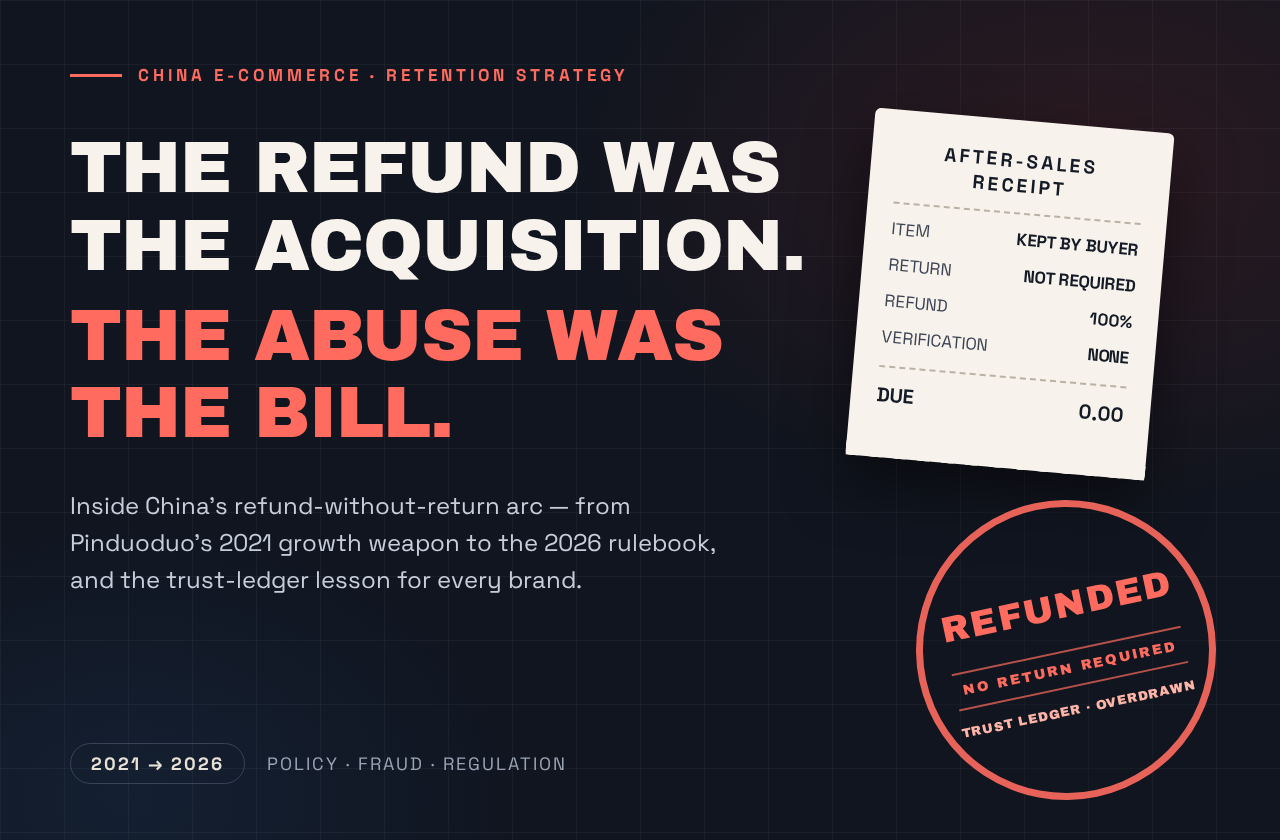
For four years, China’s e-commerce platforms ran the most aggressive customer-service experiment on earth: refund the buyer, let them keep the product, and bill the merchant. It worked — as acquisition. Then professional refund gangs and AI-faked defect photos turned the trust weapon into a trust liability, regulators summoned six platforms, and by April 2025 the industry had unwound the policy almost overnight. Order No. 116, effective February 1, 2026, now bans forcing merchants to accept refund-without-return at all. Yet a September 2026 Marketing Science experiment on 853,521 customers shows the underlying strategy still pays — when it’s partial, graded and verified. The reusable lesson: refund-as-retention is a trust deposit, and it overdraws the moment generosity outruns verification.
The Three-Year Habit That Ended in Handcuffs
In November 2026, police in Xi’an knocked on the door of a 29-year-old woman and found snacks everywhere — on the coffee table, on the nightstand, some half-eaten, some still sealed. Over three years she had placed more than 400 orders on Alibaba’s Freshippo grocery service and refunded nearly every one of them, citing “bad taste” or “not fresh.” The goods never went back. Total damage: over RMB 17,000. She told investigators the refunds felt thrilling, a way to relieve the stress of repeatedly failing her graduate-school entrance exam. She was criminally detained on suspicion of fraud.
The police notice carried a line every marketer should tape to their monitor: the refund-only rule is a convenience, not an immunity. One woman’s compulsive habit is a small story. The system that let it run for three years is the big one — and it’s the same system that briefly made “refund without return” the most talked-about retention strategy in global e-commerce.
What Refund-Only Actually Is — and Why It Made Sense
The policy’s Chinese name is jintuikuan, literally “refund only”: the buyer gets their money back without shipping anything back. Pinduoduo pioneered it in 2021, and the original logic was pure arithmetic. If someone receives bruised fruit or a RMB 10 phone case that arrived cracked, the return shipping can cost more than the item itself. Taking the product back destroys value; refunding without return preserves goodwill at a lower cost than reverse logistics.
But the second effect was the strategic one. A shopper who knows a bad purchase can be undone with two taps stops hesitating. Purchase risk collapses toward zero, first orders get easier, and the platform looks like the safest place to shop. The refund wasn’t a cost center. It was customer acquisition wearing a customer-service uniform — and Pinduoduo, then fighting for trust against entrenched rivals, wielded it deliberately.
The Copycat Months: How an Experiment Became a Standard
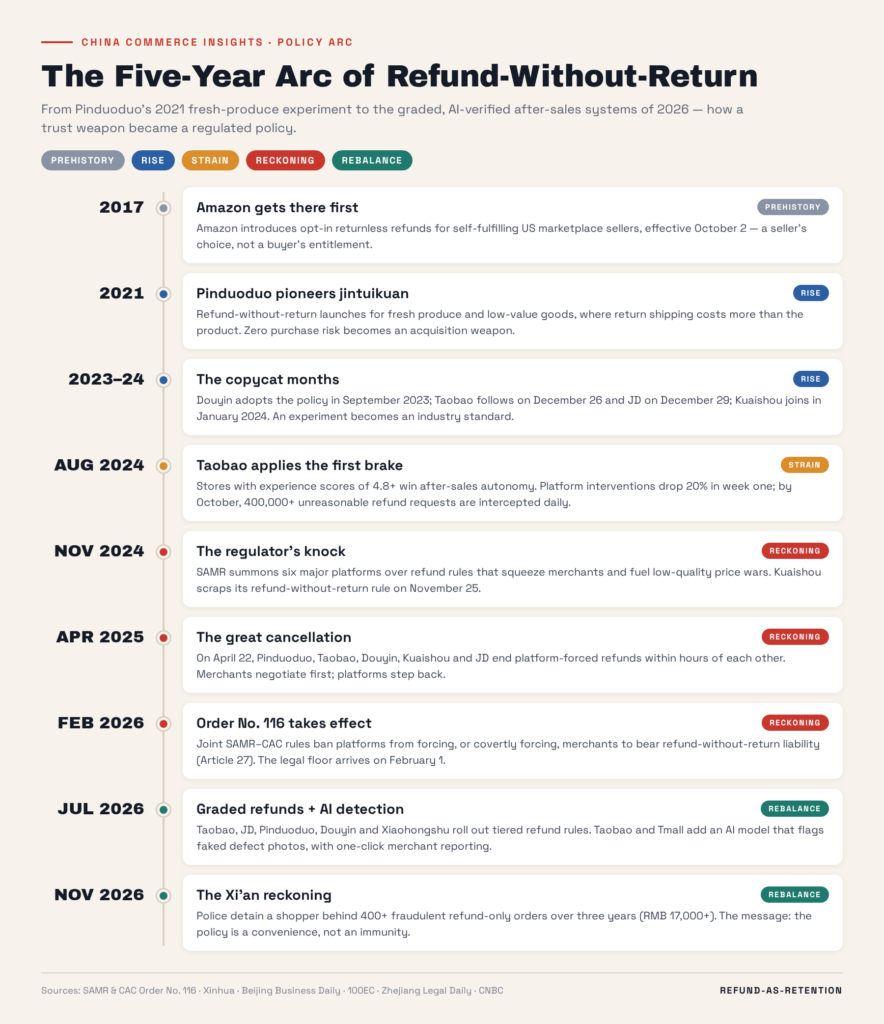
Once one platform weaponizes generosity, the others can’t afford to look stingy. Douyin’s e-commerce arm adopted refund-only in September 2023. Taobao followed on December 26, 2023; JD announced its version on December 27 and made it effective December 29; Kuaishou joined in January 2024. Within roughly one quarter, an experiment born in fresh produce became an industry-wide default across Chinese e-commerce.
Notice who paid. The platforms earned the loyalty; the merchants absorbed the refunds. When a platform adjudicates a dispute and grants a refund without requiring a return, the money leaves the seller’s account, not the platform’s. That asymmetry — generosity funded by someone else — is the original sin of the whole arc, and everything that follows is the interest on it.
Amazon Did It First — With One Crucial Difference
This was never a purely Chinese invention. In August 2017, Amazon told its self-fulfilling US marketplace sellers that starting October 2 it would offer “returnless refunds” for items too cheap to ship back or too damaged to resell. Sellers howled — one forum post read, “In other words, customers get things from us for free! Is this a joke?” — and CNBC’s reporting captured the outrage.
But read the fine print, because it changes everything. Amazon’s version was opt-in: the seller chose whether to participate, and buyers never knew in advance which items qualified. China’s version, at its peak, was platform-adjudicated and effectively compulsory: the merchant learned about the refund after it happened. Same mechanic, opposite power structure. One is a tool a business picks up; the other was a rule imposed on it. That distinction explains why the American version quietly persists while the Chinese version detonated.
The Abuse Bill Comes Due
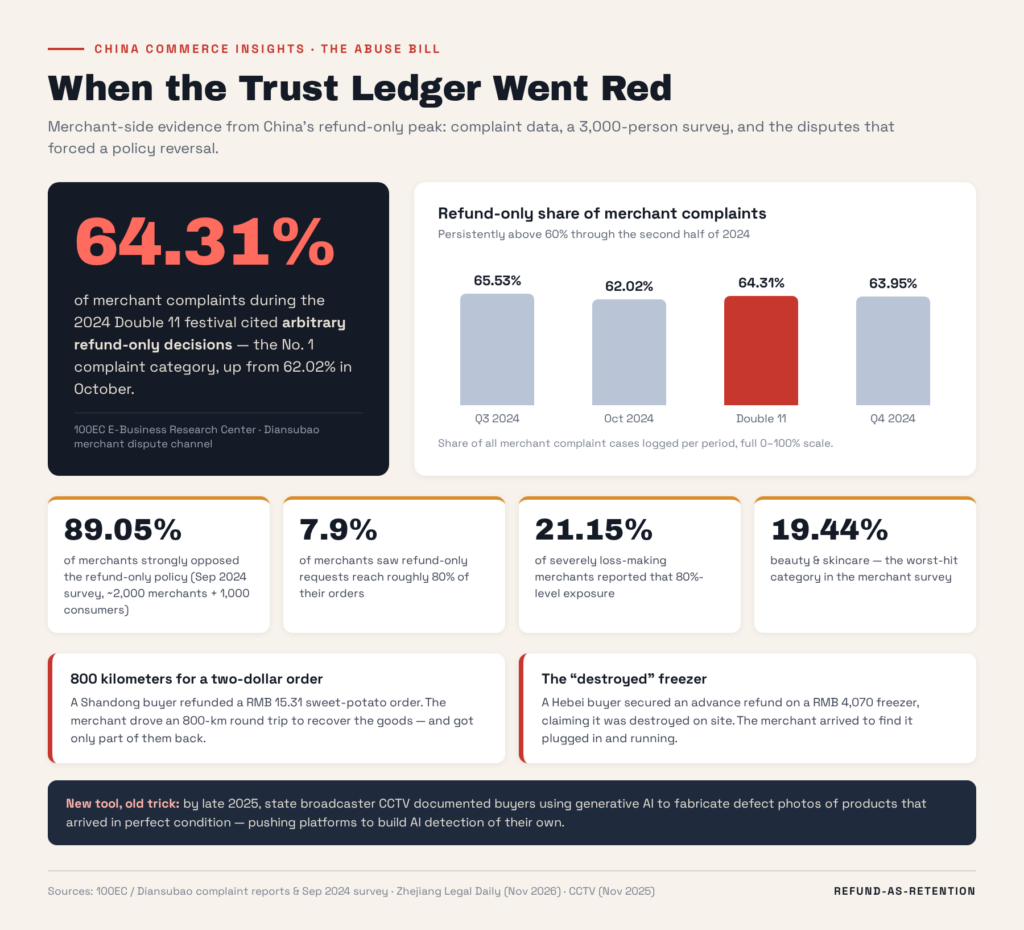
By late 2024, the merchants’ ledger was bleeding. According to complaint data from Diansubao, the consumer-dispute channel run by research firm 100EC, “arbitrary refund-only” was the top merchant complaint category all year — 65.53% of cases in Q3, 62.02% in October, and 64.31% during the Double 11 shopping festival. These are self-selected complaints, not a census of all merchants, but the consistency across periods is hard to dismiss.
The survey evidence was darker still. In September 2024, 100EC polled roughly 2,000 merchants and 1,000 consumers: 89.05% of merchants strongly opposed the policy. Some 7.9% said refund-only requests had reached around 80% of their orders, and among severely loss-making merchants, 21.15% reported that level of exposure. Beauty and skincare was the worst-hit category at 19.44%.
Then there were the cases that made the rounds. A Shandong buyer refunded a RMB 15.31 sweet-potato order; the merchant drove an 800-kilometer round trip to recover the goods and got only part of them back. A Hebei buyer secured an advance refund on a RMB 4,070 freezer, claiming it had been destroyed on site. The merchant arrived to find it plugged in and running. When recovering a two-dollar loss costs a day of driving, the rational merchant stops fighting — or starts cutting quality to survive. That’s the trap regulators later named explicitly: refund abuse fueling a low-quality, low-price race to the bottom, where the final victim is the honest consumer.
When the Evidence Itself Is Fake
Just as platforms began tightening, the fraud got an upgrade. In November 2025, state broadcaster CCTV documented buyers using generative AI to fabricate defect photos — pristine products digitally bruised, cracked, or moldy — and submitting them as evidence for refund-only claims. Earlier reporting had already shown shoppers running product photos through consumer AI tools to distort them into “damaged” versions. Human reviewers, trained to trust a photo, waved many of them through.
Think about what that does to the mechanism. The entire policy rests on evidence: a photo stands in for the physical return. Once evidence can be manufactured for free, verification collapses, and the trust ledger doesn’t just overdraw — it gets counterfeited.
The Regulator’s Knock
The state moved before the platforms did. In November 2024, the State Administration for Market Regulation summoned six major e-commerce platforms and told them, per Xinhua’s reporting, that their refund-only rules were squeezing merchants’ survival space and encouraging low-quality price competition. The demands: fix the rules, make them transparent, respect merchants’ autonomy. Kuaishou scrapped its refund-without-return service outright on November 25.
Taobao had actually applied the first brake earlier. In August 2024 it began exempting stores with experience scores of 4.8 or higher from proactive platform intervention in refund-only disputes. Platform-reported figures said interventions fell 20% in the first week, and by October the company claimed it was intercepting more than 400,000 unreasonable refund requests per day. Treat those as the platform’s own numbers — but the direction mattered. Generosity was being repriced, and score-based grading was the prototype of everything that came later.
April 2025: The Great Unwind
On April 22, 2025, the dam broke. Within hours, Pinduoduo, Taobao, Douyin, Kuaishou and JD all announced the same pivot: for goods already received, the platform would no longer proactively force refunds without returns. Merchants negotiate with buyers first; the platform intervenes only when necessary. JD’s revised rule took effect April 30; Taobao’s rollout followed around July.
The headlines said “refund-only cancelled,” and that was half true. What died was the platform-imposed version. Refunds without returns could still happen — by agreement, or when a return is genuinely impractical. Alongside the retreat, Taobao and Tmall launched a new store-rating system built on product quality, logistics speed and service, wired directly into search and recommendation traffic. The message to merchants was blunt: we’re taking away the referee who ruled against you by default, and replacing him with a scoreboard. Earn your autonomy.
February 2026: The Law Draws a Floor
Then the reversal became law. On December 18, 2025, SAMR and the Cyberspace Administration of China jointly published Order No. 116, the Administrative Measures for the Supervision of Online Trading Platform Rules, effective February 1, 2026. Article 27, item one, prohibits platforms from using their rules to force — or covertly force — merchants to bear refund-without-return after-sales liability against their lawful interests. A companion rule for live-streaming commerce took effect the same day.
The significance goes beyond refunds. The regulation says a platform may not fund its own competitiveness by conscripting merchants’ balance sheets. Whatever generosity a platform wants to offer, it must now be the merchant’s choice or the platform’s own expense. The trust weapon didn’t just lose its edge; the state confiscated the handle.
July 2026: The Policy Comes Back — With a Seatbelt
Here’s the twist most coverage misses: refund-without-return didn’t stay dead. In July 2026, per Zhejiang Legal Daily, Taobao, JD, Pinduoduo, Douyin and Xiaohongshu rolled out optimized refund-only rules with graded handling — decisions tiered by evidence quality, buyer history and merchant standing rather than granted by default. Taobao and Tmall, which had announced an industry-first AI fake-image detection program in January 2026, gave merchants one-click tools to flag fabricated defect photos.
So the arc isn’t rise-and-fall. It’s rise, overdraw, and rebuild: the same strategy, re-engineered with the two things the original lacked — verification before payout, and the merchant’s consent. Which raises the question every marketer actually cares about: does the underlying strategy even work?
What an 853,521-Customer Experiment Proves
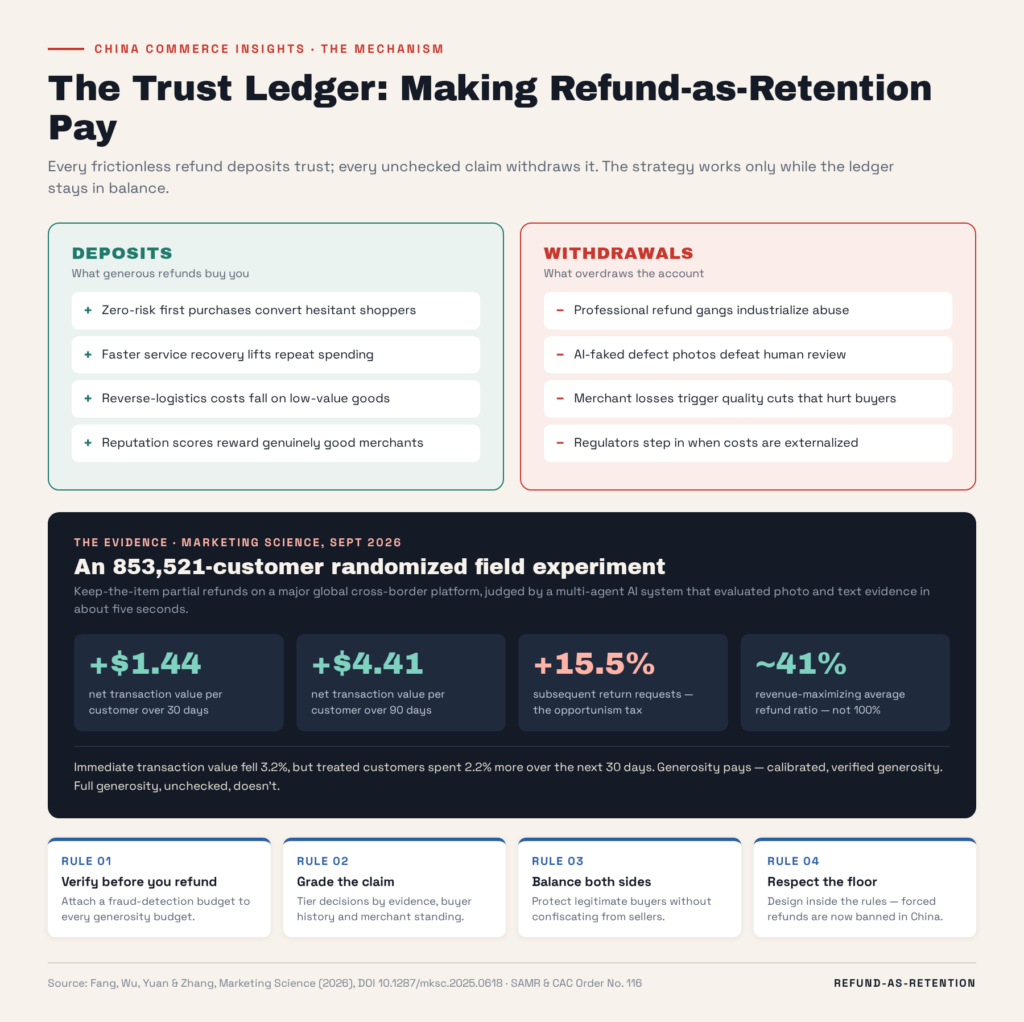
Now we have causal evidence, not folklore. In September 2026, Marketing Science published a randomized field experiment by Lu Fang, Chunhua Wu, Zhe Yuan and Kaifu Zhang, run with a major global cross-border e-commerce platform: 853,521 customers, randomly assigned to either the traditional return process or a returnless partial refund — keep the item, get a partial refund scaled to the claim. A multi-agent AI system judged photo and text evidence and generated offers in about five seconds.
The results read like the trust ledger in spreadsheet form. Immediately, generosity cost money: net transaction value on the initial order fell 3.2%. But treated customers spent 2.2% more over the next 30 days, and the net gain came to US$1.44 per customer at 30 days and US$4.41 at 90 days. The catch arrived on schedule: subsequent return requests rose 15.5%, concentrated in exactly the claims you’d expect from opportunists — subjective reasons, expensive items, rapid repeats. And the revenue-maximizing average refund ratio calibrated to roughly 41%, not 100%.
Read the caveats honestly: one platform, partial rather than full refunds, and a cross-border context. But the shape of the finding matches China’s arc almost eerily well. Generous refunds create real lifetime value — and abuse is not a hypothetical risk but a measured tax. Full, unverified generosity is the one design the data does not endorse.
The Trust Ledger: Four Moving Parts
Step back and the whole five-year arc compresses into one accounting metaphor. First, the deposit: a frictionless refund removes purchase risk and buys acquisition, retention and repeat spending. Second, the overdraw: when anyone can claim, professional gangs industrialize the withdrawal, merchants eat losses, and quality cuts push the damage back onto honest buyers. Third, the verification balance: graded decisions, AI evidence-checking and merchant autonomy restore the ledger — generosity stays, entitlement goes. Fourth, the regulatory floor: the state now forbids externalizing the cost of generosity onto merchants by force. Every refund policy you will ever design sits inside these four forces. China just ran the experiment at national scale so you don’t have to.
Three Things Everyone Gets Wrong
Misreading one: “generous refunds always help retention.” The arc says otherwise — unchecked generosity funds its own abuse, and the resulting merchant squeeze harms the very customers the policy was meant to serve. Retention gains are real but conditional on verification.
Misreading two: “cancelling refund-only was anti-consumer.” What was cancelled was the forced version. Legitimate claims still get refunded, low-value goods still qualify when returns make no sense, and merchant autonomy plus grading protects the quality that consumers actually depend on.
Misreading three: “platforms are neutral referees.” They never were. Refund-only was an acquisition weapon whose costs sat on merchants’ books; the unwind shifted burdens again. Platforms act in their own interest at every stage — which is exactly why the regulatory floor, not platform goodwill, is the durable protection.
The Playbook: Four Rules for Your Own Refund Policy
If you run a brand, a marketplace or a DTC store, the transferable rules are concrete. One: attach a verification budget to every generosity budget — fraud detection is not optional infrastructure, it’s the policy. Two: grade claims instead of granting them — evidence quality, customer history and item value should change the answer, and the research suggests partial refunds around the 40% mark beat both stinginess and full giveaways. Three: protect both sides of the transaction, because merchants who bleed quietly eventually ship worse products. Four: design inside the legal floor — in China, forced refund-without-return is now prohibited, and other regulators are watching the same externality. Then monitor the ledger itself: refund-abuse rate, merchant loss rate and quality complaints are leading indicators of a trust account heading for overdraft.
The Counterargument, Honestly Stated
The strongest objection deserves airtime: for a RMB 9.9 phone case with RMB 8 return shipping, forcing a physical return effectively deletes the consumer’s remedy. That’s real, and blanket cancellation genuinely hurt some low-value claims. The answer isn’t to reopen the unverified faucet — it’s grading plus subsidy, so impractical returns still resolve in the buyer’s favor without confiscating from the seller. The second objection, that platforms merely offloaded the burden onto merchants and shoppers, also lands: cancellation without investment in detection and cheap appeals is just a quieter form of the same evasion. The July 2026 rebuild is the test of sincerity. The strategy works; whether any given platform deserves credit for running it is a separate question, answered by its verification spend, not its press releases.
The Takeaway
The refund was the acquisition. The abuse was the bill. The regulation was the reckoning — and the graded, AI-verified systems of 2026 are the repayment plan. China’s refund-only arc is the cleanest trust-ledger case study modern commerce has produced: generosity compounds when it’s verified, and bankrupts when it isn’t. If you remember one sentence, make it this one — refund-as-retention works, but only while the ledger stays out of the red.