Every marketing team knows the joke: half the ad budget is wasted, you just don’t know which half. WeChat’s gifting feature quietly deletes the joke — because in a gift transaction, the brand isn’t paying for the ad at all. The sender is.
Flip the Ledger
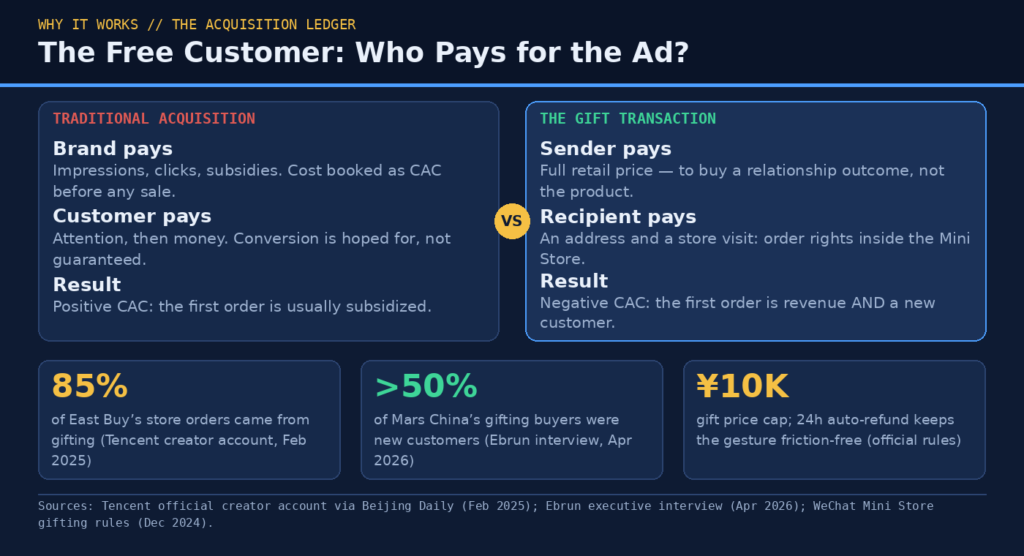
Run the accounting on a normal acquisition: the brand buys impressions, pays per click, hopes for conversion, and books the cost as CAC. Now run it on a blue-envelope gift. The sender pays full retail price. The recipient “pays” with an address, a store visit, and order-management rights inside the merchant’s WeChat Mini Store. The brand books revenue and a new customer in the same stroke. It is the rare acquisition channel with negative customer-acquisition cost: the first order isn’t subsidized — it’s profitable.
The verified numbers say this isn’t a thought experiment. Gifting reached 85% of East Buy’s WeChat store orders by early 2025, per figures published through Tencent’s own creator account. Mars’s China snacks business told e-commerce outlet Ebrun in April 2026 that more than half of its gifting buyers were new customers.
Why Senders Fund It: Risk, Not Generosity
Why would anyone pay full price to be your ad? Because they aren’t buying your product — they’re buying a relationship outcome. Gratitude, affection, face. And here’s the twist that explains the whole category: the sender, not the recipient, bears the social risk of a bad gift. Too cheap reads as careless; too expensive reads as obligation; too personal reads as misjudged taste.
That risk asymmetry is why “gift-worthy” beats luxurious. Snacks, candy, plush toys — the categories that dominated Spring Festival gifting — are standardized, legible, low-variance choices. They are insurance products for relationships. A brand designing for gifting isn’t decorating packaging; it’s underwriting the sender’s reputational risk. Price that risk right, and senders happily pay retail — repeatedly, on birthdays and thank-yous, not just festivals.
Why Tencent Throttles Its Own Engine
If the economics are this good, why did Pony Ma tell everyone to stop hyping the feature? Because the asset being monetized is the chat itself. WeChat’s moat is that conversations feel un-commercial. Every aggressive commerce push taxes that feeling, and taxed graphs migrate. The five-year “ecosystem connector” timeline isn’t modesty — it’s the incentive math of protecting the goose. The 2014 red packet smuggled payments into chat disguised as play; the blue envelope smuggles commerce in disguised as affection, and Tencent is metering the dose.
The Transferable Lesson
You probably can’t copy the button — it needs chat, payment and storefront inside one app. You can copy the ledger. Ask of any product: could a customer send this as an expression of a relationship, at a price that feels safe to give? If yes, your acquisition budget has a new line item: other people’s affection. That’s the why behind the trend. Gifting isn’t a commerce feature — it’s an ad the sender pays for, the recipient welcomes, and the brand profits from on day one.





