Ask a fashion executive how they beat competitors and you will hear about taste, trend forecasting, or brand heat. Ask how often their forecasts are wrong and the room goes quiet. Here is the industry’s open secret: almost everyone is wrong, most of the time. The majority of styles launched each season never become hits. The real competition was never about being right. It was about what being wrong costs you.
That is the lens that finally explains Shein.
The Two Bets
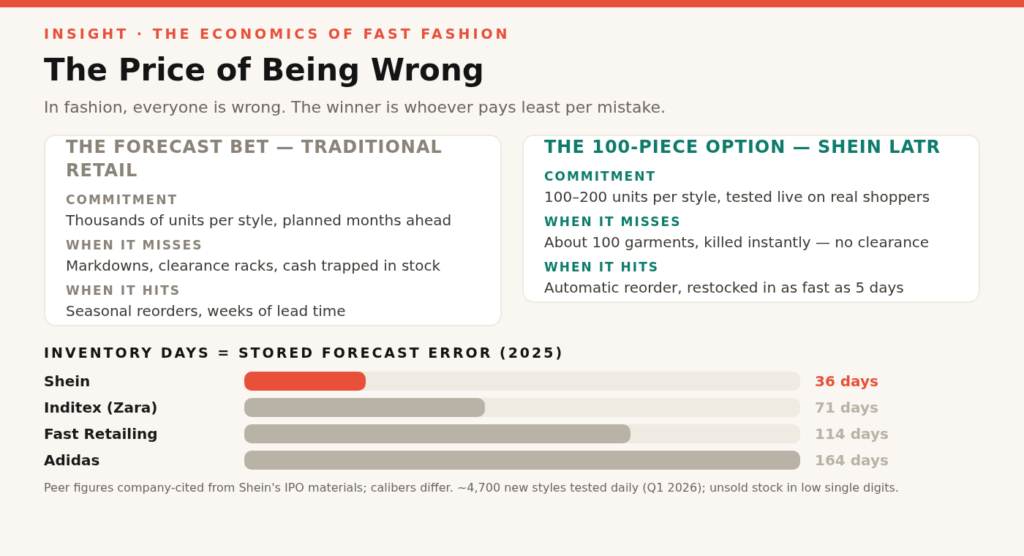
Traditional retail places a forecast bet. Thousands of units per style, committed months ahead, based on a prediction. When the prediction misses — and it usually does — the cost arrives as markdowns, clearance racks, and cash frozen in stock until someone buys it at half price.
Shein places an option instead. Its LATR system launches every style in a batch of just 100–200 units. If the market says no, the loss is roughly a hundred garments, killed instantly with no clearance spiral. If the market says yes, software reorders automatically — best-sellers restocked in as fast as five days. Same uncertainty, radically different downside. In finance, that asymmetry is the entire logic of options: cap the loss, keep the upside. Shein industrialized it for physical goods.
Why Cheap Mistakes Compound
Once a mistake costs almost nothing, you can afford to make thousands of them. Shein tested roughly 4,700 new styles every day in Q1 2026 — more experiments in a day than a traditional retailer runs in a season. Each experiment returns real purchase data, which sharpens the next round of tests. Errors stop being liabilities and become tuition.
The balance sheet keeps the score. Inventory days are, quite literally, stored forecast error — the physical residue of predictions that missed. Shein turned inventory in 36 days in 2025; Inditex took 71, Fast Retailing 114, Adidas 164 (figures as cited in Shein’s IPO materials). Unsold stock stayed in the low single digits. Shein does not forecast better than Zara. It simply keeps far less wrongness on its shelves.
The Catch: Someone Repriced the Experiment
The mechanism has a boundary condition, and 2025 found it. When the US ended de minimis and tariffs landed, the cost of moving every parcel — winner or loser — jumped. Fulfillment rose from 42.1% of revenue in 2023 to 47.7% in Q1 2026. The option structure survived; the premium on each option got more expensive. That is why the same company that mastered cheap mistakes is now pouring money into local warehouses and marketplace fees: it is trying to buy the premium back down.
The transferable lesson is uncomfortable for forecasters. Stop asking how accurate your predictions are. Start asking what each wrong prediction costs — and whether you can make being wrong cheap enough to do it every day.






