
Every marketer knows the standard growth equation: more visibility, more demand. China’s LGBTQ+ consumer market breaks that equation, and understanding why explains almost every strange number in this space — the 71% retention, the hostility to rainbow campaigns, the health services that triple their uptake simply by mailing a kit instead of asking you to walk into a clinic.
The mechanism is what I call the exposure tax. In a market where being identified as a customer carries social or professional risk, every purchase has two prices: the one on the tag, and the cost of being seen making it. Marketing that signals the customer’s identity loudly does not lower the second price. It raises it.
The tax is not hypothetical. The UNDP’s 2016 survey of nearly 30,000 people found only about 5% of sexual and gender minorities fully open at work or school. Inside Goldman Sachs — a firm with global inclusion policies — a mere 4% of employees disclosed minority status even anonymously, and under 1% were willing to be out at work, per the UNDP/ILO record. When anonymity itself is scarce, a billboard that says “we see you, valued customer” is not a welcome. It is an invoice.
This reframes the purchase decision entirely. Under quiet service, total cost equals price plus search effort. Under loud signaling, total cost equals price plus search effort plus the exposure tax. A rational consumer — and the Ipsos 2022 data shows this community is strikingly rational, weighting price at 50% and quality at 39% — simply declines the more expensive transaction. The campaign did not create demand. It taxed it.
The community has already audited this arithmetic. In the BlueCity × Ipsos survey, 56% opposed queerbaiting and 51% disliked stereotype-driven marketing. Read those numbers as pricing behavior, not sentiment: respondents are rejecting transactions whose hidden costs exceed their benefits.
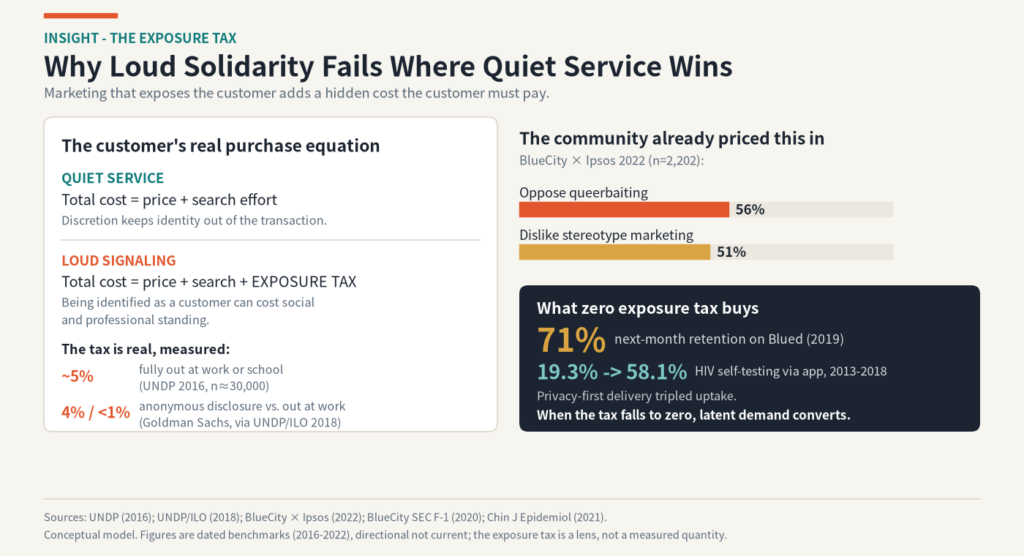
Now flip the mechanism, and the payoff appears. Strip the exposure tax to zero and latent demand converts at remarkable rates. Blued’s next-month retention hit 71% in 2019 — the signature of a service whose total cost is finally just the price. HIV self-testing among men recruited through the app rose from 19.3% to 58.1% between 2013 and 2018, not because awareness campaigns got louder, but because the transaction got quieter: book in the app, receive the kit by mail, never be seen. Same need, same people — different tax rate, triple the conversion.
That is the insight underneath the playbook. Serve-without-signaling is not timidity or a cultural quirk. It is tax policy. The brands that win this market are the ones that lower the total cost of being a customer to the price on the tag — and keep the receipt private.
One honest caveat: the exposure tax is a lens, not a measured statistic, and the supporting figures are dated benchmarks from 2016–2022. But lenses earn their keep by predicting, and this one predicts exactly what the data shows: in visibility-constrained markets, silence converts and noise repels. Anywhere disclosure is costly — not just China, not just this community — the same arithmetic will apply.






