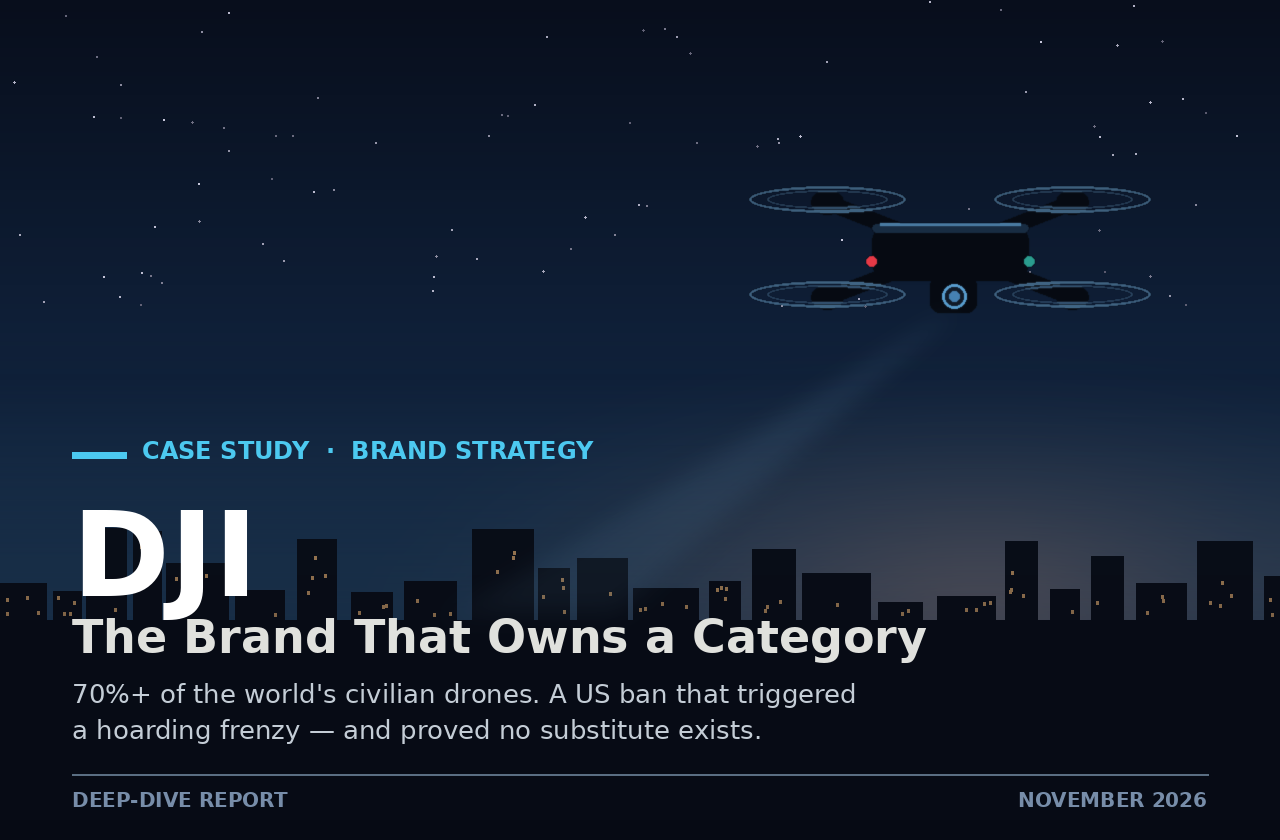
Ask a room full of people to name a drone brand. You will hear one word, over and over, until it stops sounding like a brand and starts sounding like the thing itself. Drone. DJI. The two have fused. That is not market leadership. That is category ownership — the rarest position in business, where your name becomes the noun everyone uses for the product.
And in December 2025, the United States government ran an experiment that proved it. Washington blocked new DJI models from the American market. Americans responded by hoarding them. Used prices spiked as much as 200 percent. One large dealer reported weekly sales up more than eightfold year over year. When you cannot ban a product without grounding the people who depend on it, you have not found a competitor. You have found the category.
This is the story of how DJI built that position — and what happens when geopolitics collides with a moat that no rival can cross.
Executive Summary
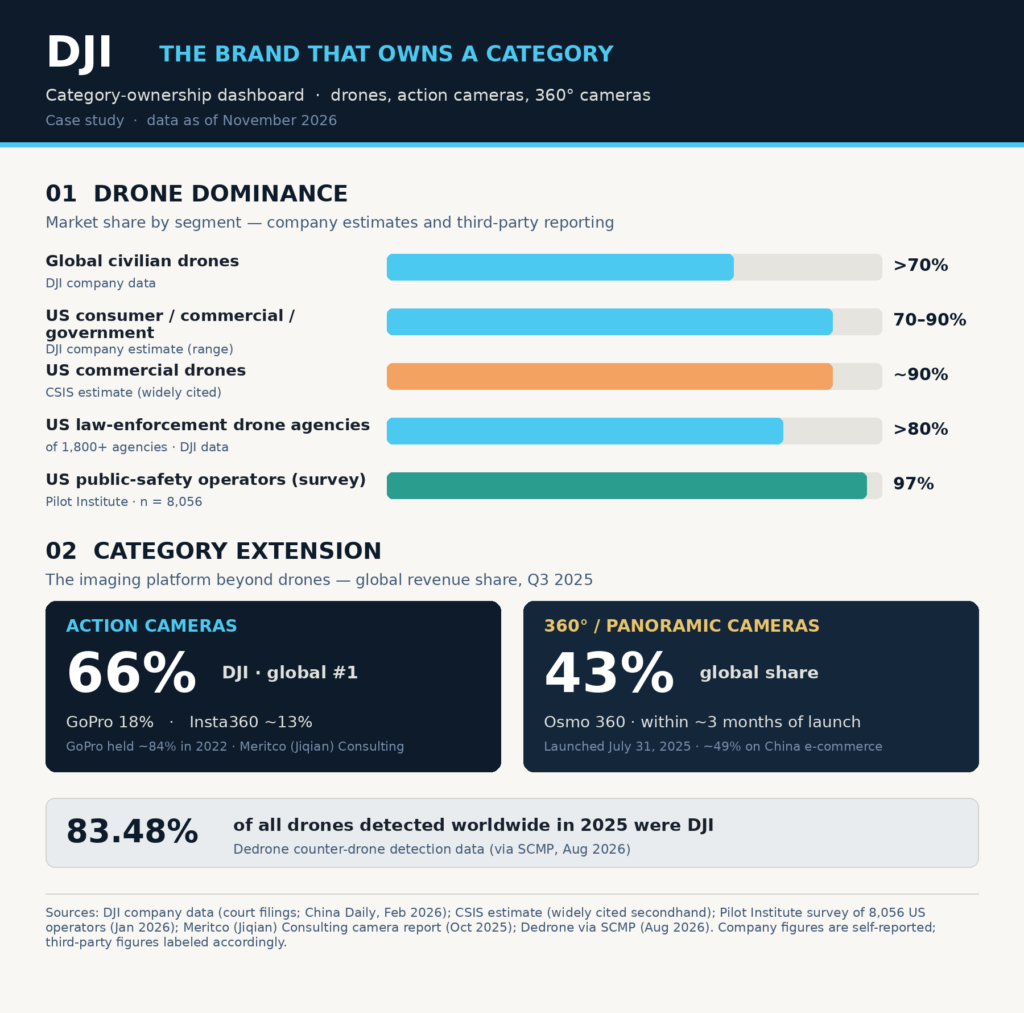
DJI holds more than 70 percent of the global civilian drone market and, by its own estimates, 70 to 90 percent across US consumer, commercial and government segments. More than 80 percent of the 1,800-plus US state and local law-enforcement agencies that fly drones rely on DJI. The Center for Strategic and International Studies has been widely cited putting DJI’s US commercial share near 90 percent. The ownership extends beyond drones: 66 percent of the global action-camera market by revenue in the third quarter of 2025, and 43 percent of panoramic cameras within months of the Osmo 360’s launch. The FCC’s December 22, 2025 Covered List decision banned new model authorizations — and the hoarding response, captured in a survey of 8,056 operators, became the clearest revealed-preference proof that no substitute exists. The lesson: category ownership is the ultimate moat, and the ultimate geopolitical target.
How a Dorm-Room Project Became the Category
Frank Wang founded DJI in Shenzhen in 2006 while studying at the Hong Kong University of Science and Technology. The first products were not drones at all. They were flight controllers — the brains that keep a model helicopter steady in the air. Wang had crashed enough remote-control helicopters as a kid to know that the hard part was not flying. It was not falling.
That obsession with stability became the company’s spine. By the time the original Phantom arrived in January 2013, DJI had spent years owning the components that mattered: flight control, gimbals, motors, software. The Phantom did not enter the consumer drone market. It created it. Before the Phantom, aerial photography meant soldering, tuning and a tolerance for crash repairs. After it, anyone could unbox a quadcopter and fly. Later that year, the Phantom 2 Vision integrated the camera, and the flying camera was born.
Here is the strategic point most retellings miss. DJI did not win a category. It designed one. It decided what a drone was — integrated, stable, ready out of the box — and then made sure every definition pointed back to itself.
The Four Layers of the Moat
Category ownership is not one advantage. It is four, stacked.
Layer one: category definition. When a brand becomes the generic name, marketing gets cheaper every year. People do not search for a consumer drone. They search for a DJI. Mind share compounds like interest.
Layer two: vertical integration. DJI owns the full stack — flight control, gimbal, camera, transmission, software. Competitors can copy any single piece. They cannot copy the integration, because the advantage lives in how the pieces talk to each other: the cost curve, the reliability, the iteration speed. This is why a well-funded rival can match a spec sheet and still lose the comparison.
Layer three: workflow lock-in. A police department does not buy a drone. It buys a program: trained pilots, mounted cameras, evidence workflows, software integrations, years of muscle memory. Switching means retraining, re-equipping and re-certifying — not shopping. That is why more than 80 percent of the 1,800-plus US law-enforcement agencies with drone programs fly DJI, and why a survey of public-safety operators put DJI usage at 97 percent.
Layer four: category extension. The capabilities that won drones — stabilization, imaging, autonomy — transfer. DJI marched into action cameras and took 66 percent of global revenue share by the third quarter of 2025, dethroning GoPro, which had held roughly 84 percent in 2022. Its Osmo 360, launched July 31, 2025, captured 43 percent of the global panoramic-camera market within about three months. The drone was the flagship category, not the whole company.
The Stress Test: December 22, 2025
The pressure had been building for a decade. The Army banned DJI in 2017. Commerce added it to the Entity List in 2020. The Pentagon placed it on the Chinese-military-companies list in October 2022. Then Congress wrote a trap into law.
Section 1709 of the FY2025 National Defense Authorization Act gave national-security agencies one year to audit DJI and Autel. If no agency completed the review by December 23, 2025, the FCC had to add their equipment to the Covered List automatically. DJI asked for the audit — in letters dated March 3, June 18 and December 1, 2025. No agency started it.
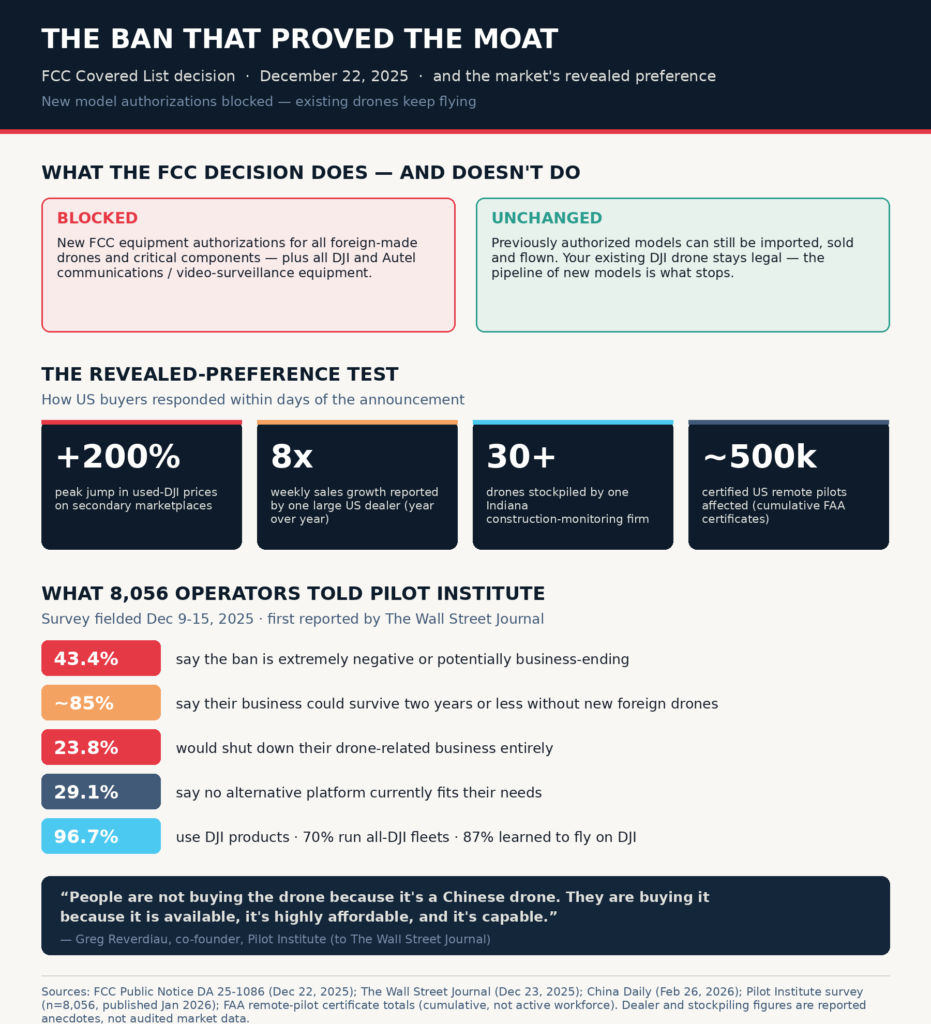
On December 21, an executive-branch interagency body issued a national-security determination. The next day, the FCC’s Public Safety and Homeland Security Bureau published Public Notice DA 25-1086. It added all foreign-made drones and critical components to the Covered List — the first time the list targeted an entire product category rather than named companies — plus all DJI and Autel communications and video-surveillance equipment.
The mechanics matter. Covered equipment cannot receive new FCC authorizations, which most wireless devices need to be imported or sold in the US. But previously authorized models keep their status. Your existing DJI drone flies on, legally. What stops is the pipeline: no new models, no next generation.
FCC Chairman Brendan Carr framed the decision as a way to secure American airspace and unleash American drone dominance — language that echoed the June 2025 executive orders on drone dominance and airspace sovereignty. The industrial-policy intent was not hidden. It was the headline.
On January 7, 2026, the FCC exempted some foreign drones and components — including European platforms and parts from Sony, Panasonic and Samsung — until January 1, 2027. No DJI or Autel product made the list.
The Hoarding: Revealed Preference in the Wild
Economists have a term for what people do when talk is cheap: revealed preference. You learn what someone truly values by watching what they buy. The ban handed researchers a natural experiment, and the results were brutal.
Within days, American operators were stockpiling aircraft, batteries and spare parts. Used DJI prices on secondary marketplaces jumped as much as 200 percent. One large dealer reported weekly sales up more than eightfold year over year. Eric Ebert, who runs a seven-pilot construction-monitoring company in Indiana, told The Wall Street Journal his firm had stockpiled more than 30 drones — because they could see what 2026 would bring.
The survey put numbers to the panic. Pilot Institute, co-founded by Greg Reverdiau in Prescott, Arizona, polled 8,056 US operators between December 9 and 15, 2025. The findings, first reported by the Journal: 43.4 percent said the ban would be extremely negative or potentially business-ending. About 85 percent said their businesses could survive two years or less without access to new foreign-made drones. Nearly a quarter — 23.8 percent — would shut down their drone business entirely. And 29.1 percent said no alternative platform currently fits their needs.
The same survey mapped how deep the roots go. 96.7 percent of operators use DJI. Seventy percent run fleets that are entirely DJI. Eighty-seven percent learned to fly on a DJI drone. The consumer Mini that a teenager unwraps today becomes the inspection business of 2035 — and that pipeline runs through DJI’s price point.
Reverdiau’s quote to the Journal is the whole case in one sentence: people are not buying the drone because it is Chinese. They are buying it because it is available, highly affordable and capable.
That is the moat test passing in real time. Not loyalty. Not nationalism. Arithmetic.
Two Courtrooms, One Category
DJI did not accept the listing. It fought on two fronts, and the docket reads like a procedural thriller.
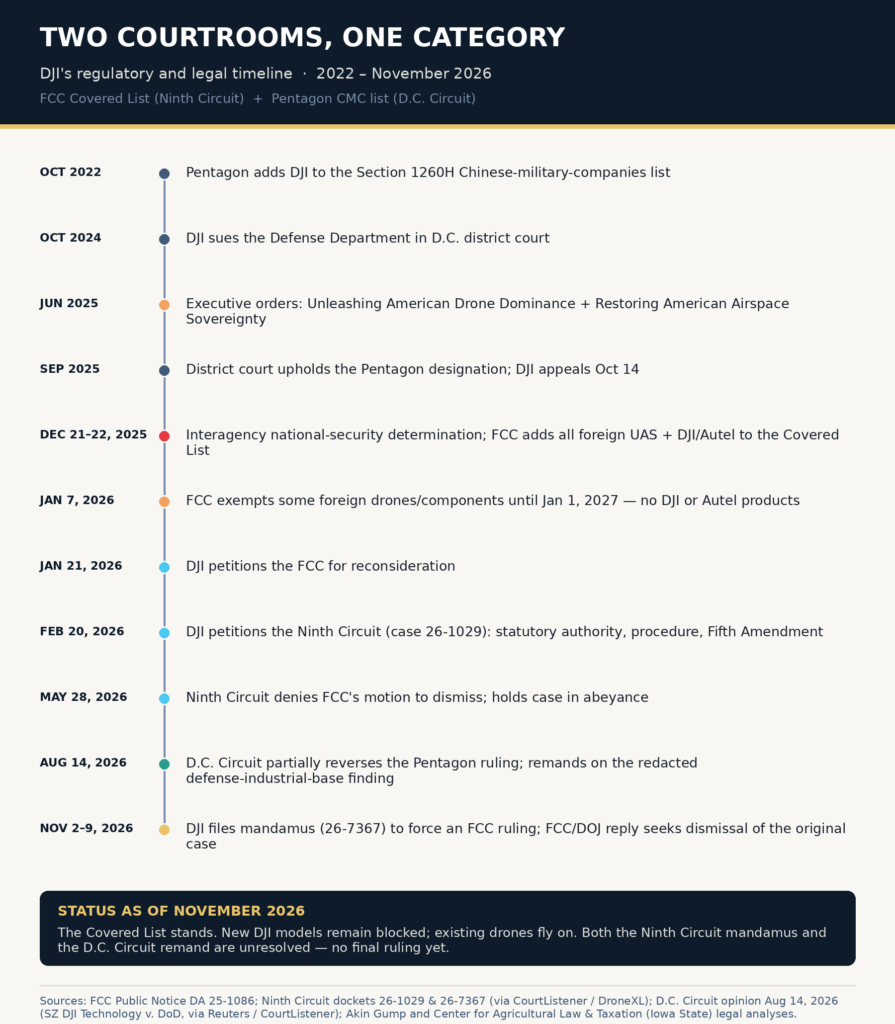
At the FCC, DJI petitioned for reconsideration on January 21, 2026. Its argument: the interagency assessment never named DJI or examined a single DJI product, and the statute demands a specific determination by a qualified agency — not a category-wide wave of the hand. On February 20, 2026, DJI petitioned the Ninth Circuit (case 26-1029), arguing the FCC exceeded its statutory authority, skipped required procedures and violated the Fifth Amendment.
The government’s response was procedural jiu-jitsu. The listing came from a staff-level bureau, it argued, so it is not a final order — DJI must wait for the full Commission to rule on reconsideration before any court can hear the case. The Ninth Circuit denied the FCC’s motion to dismiss on May 28, 2026, but held the case in abeyance. Months passed. The Commission did not rule. In April, DJI told the court the listing had trapped 25 unreleased products and roughly $1.56 billion in expected 2026 sales — about $700 million tied to set-asides of existing products and $860 million to the blocked launches. By November, DJI said the set-asides covered 19 existing products, including non-drone items.
So DJI opened a second front. On November 2, 2026, it filed a mandamus petition (case 26-7367) asking the Ninth Circuit to force the full Commission to decide — noting the agency had resolved comparable national-security petitions in under six months, and that a 2020 FCC order called Covered List placement a ministerial act. The legal team includes former US Solicitor General Elizabeth Prelogar. On November 9, the FCC and DOJ replied that the mandamus petition itself concedes a Commission order is needed first — and asked the court to dismiss the original case. As of this writing, no ruling has landed.
The parallel fight over the Pentagon’s Chinese-military-companies list produced the year’s clearest crack. DJI sued in October 2024; the district court upheld the designation in September 2025. But on August 14, 2026, the D.C. Circuit partially reversed and remanded. The Pentagon’s report contained a section titled DJI Contributes to the Chinese Defense Industrial Base — and every word of it except the heading was redacted. The appeals court held that the lower court could not sustain that finding on the unclassified record alone. There was, in the court’s words, no publicly stated rationale. The other three DJI arguments failed. But the one that survived goes to the heart of the matter: a designation without a stated reason.
What Everyone Gets Wrong
DJI is a drone company. It is an imaging and robotics platform. Drones are the flagship, but 66 percent of action cameras and 43 percent of panoramic cameras say the capability travels. Judge it as a drone maker and you miss half the business.
The ban kills DJI. The ban blocks new US authorizations. Existing devices fly, global markets keep buying, and the US is one market among many. Painful? Yes — DJI’s own filings count the damage in hundreds of millions. Existential? Not yet.
The security threat is settled. It is contested, in court, right now. DJI points to independent reviews — Kivu Consulting in 2018, a 15-month Department of the Interior evaluation, Booz Allen Hamilton and FTI Consulting in 2020, TÜV SÜD in 2022, and Idaho National Laboratory work for DHS. The Booz Allen audit found no evidence of data transmission to DJI, China or any unexpected party. DJI offers a Local Data Mode that cuts the app off from the internet, and US flight logs cannot sync to its servers. Skeptics rightly note the audits’ limits — testing conditions, the hardened Government Edition builds. Fair. But the point stands: the government had a year to run the audit Congress ordered, and chose not to. The D.C. Circuit has now said the Pentagon’s key finding lacked a public rationale. The evidentiary question is live, not closed.
It is just cheap. Price is the symptom, not the disease. Operators say affordable and capable in the same breath. The moat is integration plus workflow lock-in plus category definition. Cheap alone would have been copied years ago.
The Reusable Playbook
Strip away the geopolitics and four lessons survive for any brand.
- Create and define the category. Entering a market means fighting for share. Creating one means writing the definition — and putting your name inside it. The generic-name position is the deepest mind-share moat there is.
- Integrate vertically where the advantage compounds. Own the layers whose interaction creates the quality and cost gap. A rival can buy the same components. It cannot buy your integration.
- Lock in workflows, not devices. The device is replaceable. The trained pilots, the evidence pipeline, the software hooks — that is the switching cost. Sell the program, not the product.
- Extend into adjacencies where the capability transfers. Stabilization, imaging, autonomy — these travel across categories. DJI’s camera wins were not diversification. They were the same moat, poured into a new shape.
And one warning the playbook cannot ignore: the deeper your moat, the bigger your geopolitical target. Category ownership attracts industrial policy the way a lightning rod attracts lightning. Build the legal and supply-chain resilience before you need it.
Risks and Honest Caveats
Let us be precise about what we know and how we know it.
DJI is private. It publishes no audited financials. The share figures above are company-provided, filed in litigation and reported by China Daily; the CSIS 90 percent US commercial estimate is widely cited secondhand — its original report could not be directly located for this analysis. The camera shares come from Meritco (Jiqian) Consulting’s October 2025 report, measured by revenue. The FAA’s roughly 493,000 remote-pilot certificates are cumulative issuances, not a count of working pilots. Label the calibers, or the numbers will mislead you.
The substitution risk is real but slow. Skydio announced a $3.5 billion US manufacturing commitment in April 2026 and has shipped more than 60,000 drones cumulatively — against a single-year US registration dataset showing roughly 285,000 DJI aircraft. Industrial policy can build substitutes over years. It cannot conjure them over quarters. The current no-substitute condition is time-bound, and everyone in Washington knows it.
The legal outcomes are uncertain. The Covered List stands unless overturned. The mandamus and the remand are unresolved. And the broader Pentagon procurement ban reaches third-party purchases in 2027. The moat is global; the target is painted on the American wall.
Conclusion
DJI owns the drone category the way few brands own anything: more than 70 percent globally, 70 to 90 percent across US segments, four out of five law-enforcement drone programs, plus imaging adjacencies taken in a single product cycle. It built that position by defining the category, integrating the stack, locking in workflows and extending the capability.
The ban was supposed to be the stress test that broke it. Instead, the hoarding, the 200 percent price spikes, the 85 percent two-year survival clock — these became the proof. You cannot ban a category without banning the livelihoods built on it. That is the ultimate moat, and the ultimate target. The brand that is the category wins the market and inherits the geopolitics. Plan for both.