Everyone remembers where Zara won. Two weeks from sketch to store, a supply chain humming in Spain and Morocco, and a generation of shoppers trained to visit twice a month because the racks never looked the same. For twenty years, that was the fastest machine in fashion.
Then a company many Western executives couldn’t pronounce quietly built a faster one — not by designing better clothes, but by refusing to design anything at full scale until the market had voted. Shein’s advantage over Zara was never aesthetics. It was testing velocity. And in 2026, for the first time, we can read the entire machine’s instruction manual: the company’s Hong Kong IPO prospectus, filed in July, laid bare a decade of numbers that had been private since the day Chris Xu started selling wedding dresses online in Nanjing.
The numbers are spectacular. They are also, for the first time, under siege. This is the story of an algorithm that won the inventory war — and the tariff wall it just ran into.
The Origin: A Wedding-Dress Shop That Learned to Guess Less
Shein’s roots go back to 2008, to a cross-border wedding-dress store called ZZKKO. The fast-fashion pivot came in 2012, the SHEIN brand in 2013, and by 2014 the company was piloting the small-batch test-and-reorder system that would become its identity. The headquarters moved to Singapore in 2022. Here is the detail most people miss: Shein does not sell in mainland China at all. It is a Chinese-supply-chain company with a global customer base — roughly 273 million active shoppers across about 160 markets in 2025 — and zero domestic revenue. Origin and market are two different things, and conflating them explains almost every bad take about this company.
The flywheel that grew out of that Nanjing experiment is worth naming, because it explains the scale that followed: more customers generate more demand signals; more signals make the tests smarter; smarter tests attract more suppliers willing to run small batches; more suppliers mean more variety; more variety pulls in more customers. Each turn of the loop made the next turn cheaper. Zara’s loop runs through stores and seasonal calendars. Shein’s runs through data, and data compounds faster than real estate.
Fashion’s Impossible Triangle
Every apparel executive knows the trilemma. You can have variety, or speed, or inventory efficiency — pick two. More styles means more demand risk. Faster launches mean less time to read the market. Low inventory means fewer chances to catch a hit. The traditional answer, perfected by Zara’s parent Inditex, was to predict trends months ahead, produce in disciplined batches, and discount the losers quickly. It works. It also bakes a certain amount of failure into every season, like a tax you pay for the privilege of guessing.
Shein’s answer was to stop guessing.
LATR: Test First, Scale Second
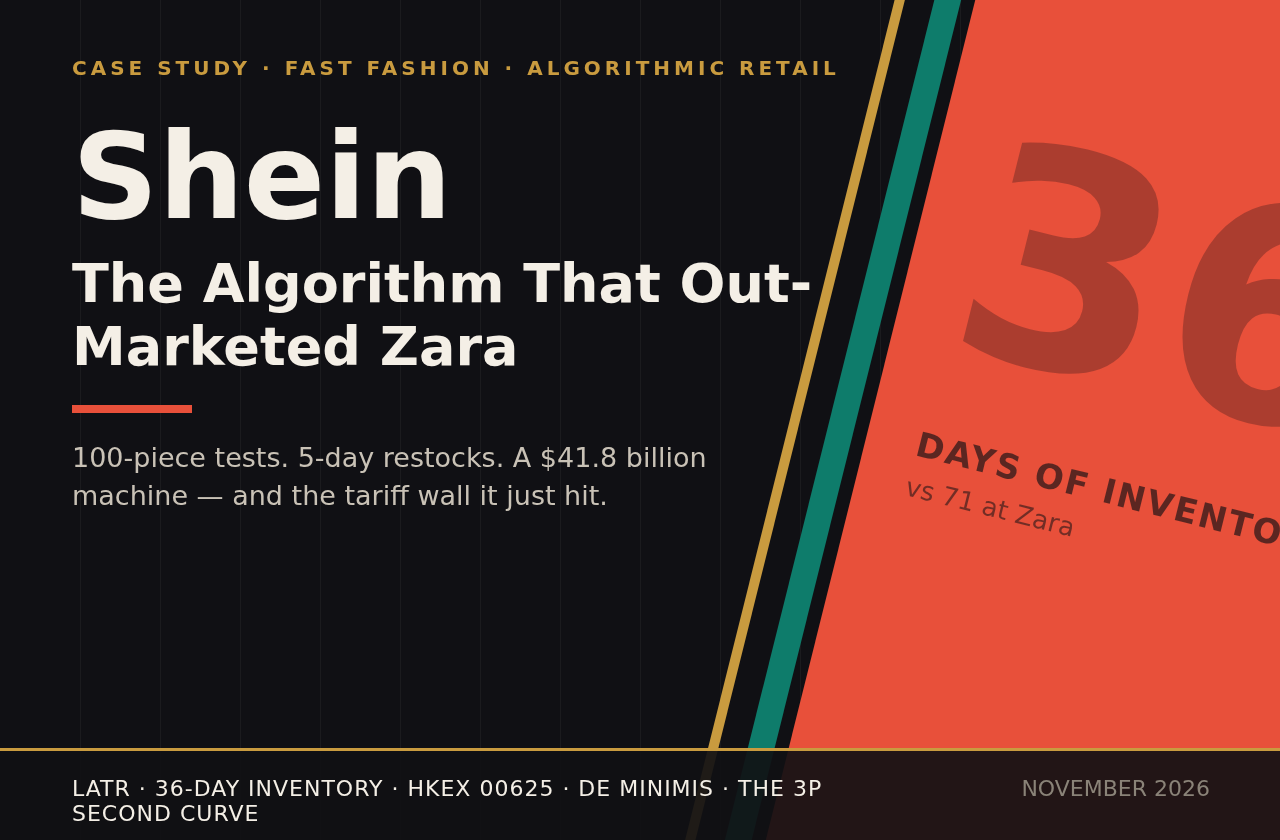
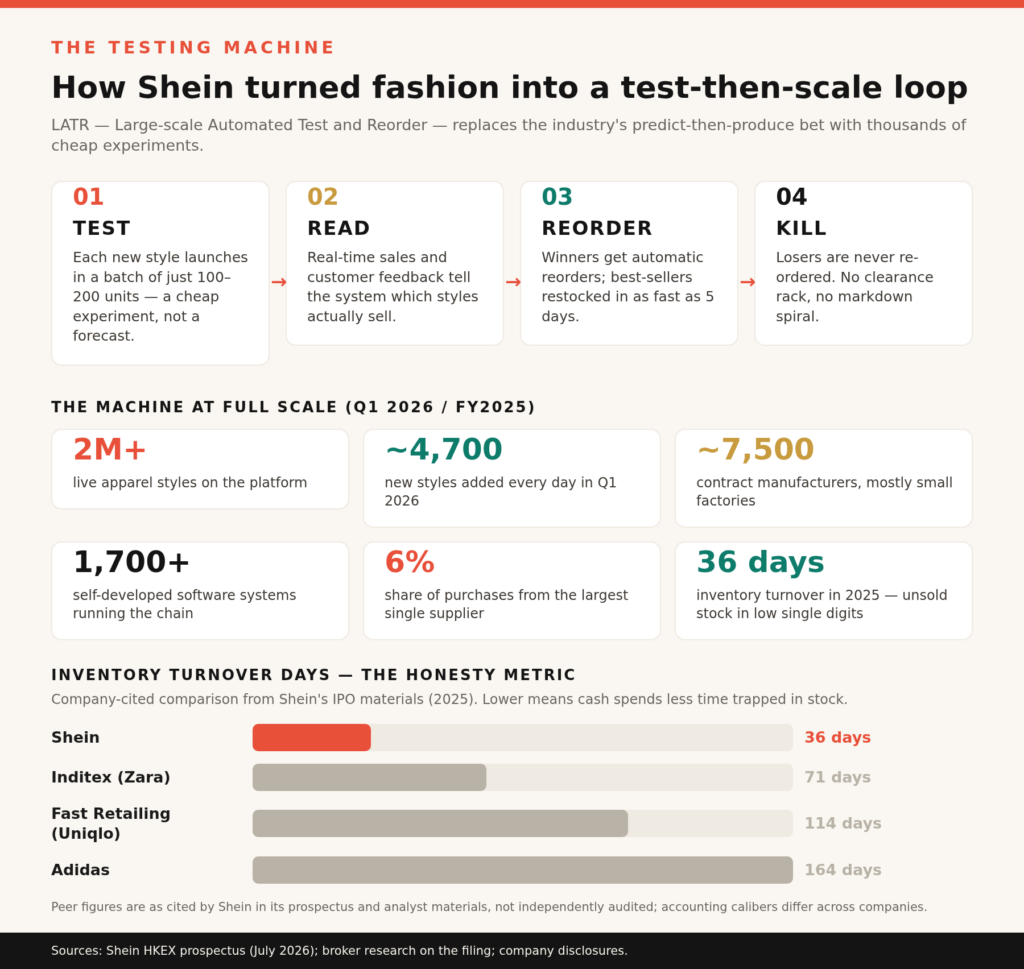
The prospectus gives the system a name: LATR, Large-scale Automated Test and Reorder. The mechanics are almost insultingly simple. Every new style launches in a batch of just 100 to 200 units. Real-time sales and customer feedback flow back into the system. If a style sells, the software automatically triggers reorders — best-sellers can be restocked in as fast as five days. If it doesn’t sell, nothing happens. No clearance rack. No markdown spiral. The loser simply dies at a cost of a hundred garments instead of ten thousand.
Think of it as A/B testing, the discipline Silicon Valley applied to buttons and headlines, pointed at physical inventory. Zara asks its designers to be right. Shein asks its customers, thousands of times a day, and pays almost nothing for the wrong answers.
The Proof: 36 Days Versus 71
The honest metric in retail is not revenue. It is how long cash sits trapped in stock. In 2025, Shein’s inventory turned over in 36 days. Inditex, the industry’s gold standard, took 71. Fast Retailing, Uniqlo’s parent, took 114. Adidas took 164. Shein keeps unsold inventory in the low single digits as a share of production — a number that would make a traditional merchandiser weep.
A caveat worth keeping: those peer figures come from Shein’s own IPO materials, not an independent audit, and accounting calibers differ across companies. But the direction is not seriously disputed by anyone who has read the filings. Shein turned inventory from a liability into something closer to a flowing river. That is working-capital advantage, and it compounds.
The Network Is the Moat
You cannot run 4,700 experiments a day with your own factories. Shein doesn’t try. Its supply chain spans roughly 7,500 contract manufacturers, mostly small and medium-sized factories clustered around Guangzhou’s Panyu district, up from about 5,800 in 2023. The largest single supplier accounts for just 6% of purchases; the top five together, 16.4%. No supplier has ever exceeded 10% in the track-record period.
The orchestration layer is the real asset: more than 1,700 self-developed software systems covering trend detection, design, order allocation, production scheduling, and warehousing. Suppliers get free cloud-based tools to manage orders, production, quality control, and shipping. Orders are allocated automatically by capability, price, and capacity. Shein even runs a manufacturing innovation center that patents physical tools — sewing templates and presser feet — and pushes them out to factories. The company doesn’t own the network. It conducts it, the way a conductor owns the orchestra’s tempo without owning a single instrument.
The Scale That Came Out of It
By the first quarter of 2026, the platform carried more than 2 million live apparel styles and was adding roughly 4,700 new ones every day — about a fifth of Zara’s entire annual output, daily. Full-year 2025 net revenue reached $41.85 billion, up 8%, with 1.078 billion orders from those 273 million active customers. Net profit was $2.06 billion. On the prospectus’s own market research, Shein now holds about 1.9% of a $1.74 trillion global fashion market — third place, behind only Nike and Inditex, in an industry where the top five combined barely clear 10%.
The Wall: When the Border Changed the Rules
Here is where the story turns. Shein’s low prices rested on two pillars: the testing machine, and a customs rule. The American de-minimis exemption let parcels worth $800 or less enter duty-free with minimal paperwork. CBP processed 1.36 billion such shipments in fiscal 2024. Shein and Temu were engineered around that pipeline.
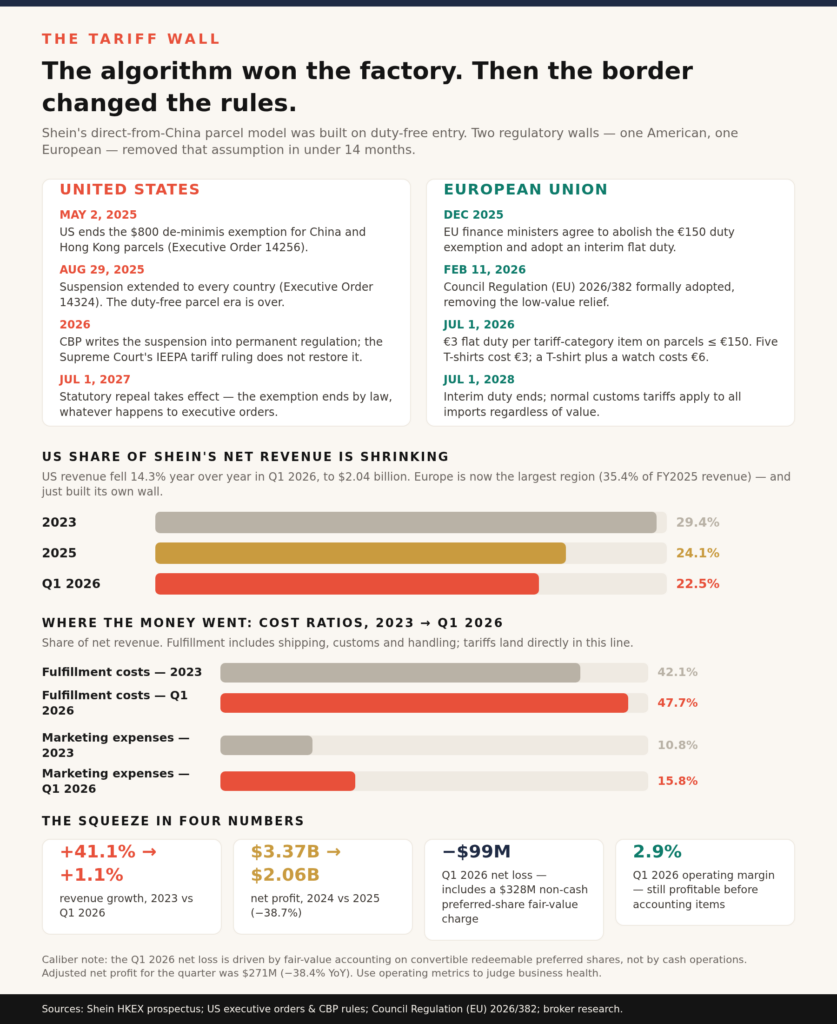
On May 2, 2025, an executive order ended the exemption for China and Hong Kong. On August 29, it ended for every country. In June 2026, CBP wrote the suspension into permanent regulation; a Supreme Court ruling that struck down other IEEPA tariffs left de minimis untouched, and the Court of International Trade upheld the suspension that August. Congress made it irreversible: statutory repeal takes effect July 1, 2027. Europe built its own wall in parallel — from July 1, 2026, the €150 duty exemption is gone, replaced by a flat €3 duty per tariff-category item on low-value parcels. Five T-shirts cost €3; a T-shirt plus a watch costs €6. The company’s largest region, Europe, at 35.4% of 2025 revenue, just got more expensive too.
The prospectus says it plainly: the removal of de minimis “has had an adverse impact on our sales in the U.S. and the overall growth of our net revenues.” That is a company confirming, in a legal document, exactly what the policy was designed to do.
Reading the Damage Honestly
The cost lines tell the story better than any headline. Fulfillment expenses climbed from 42.1% of net revenue in 2023 to 47.7% in Q1 2026 — tariffs land directly in that line. Marketing went from roughly 10.8% to 15.8% over the same span, because Temu and Amazon Haul are bidding for the same price-sensitive shoppers even as landed costs rise. US revenue fell 14.3% year over year in the first quarter, to $2.04 billion; America’s share of the business slid from 29.4% in 2023 to 22.5%.
Revenue growth collapsed from 41.1% in 2023 to 8% in 2025 to 1.1% in Q1 2026. Net profit fell 38.7% to $2.06 billion. And the quarter posted a $99 million net loss.
But read that loss carefully, because most coverage didn’t. It includes a $328 million non-cash fair-value charge on convertible redeemable preferred shares — an accounting artifact of the pre-IPO capital structure, not money leaving the business. Operating profit was $258 million, a 2.9% margin. Adjusted net profit was $271 million. And zoom out: on an adjusted basis, 2025 profit actually rose 62% to $1.82 billion, because the prior year carried its own fair-value noise. The business is squeezed, not broken. Anyone telling you Shein “lost money” without that distinction is selling a narrative, not reading a filing.
Notice, too, what did not happen: demand did not evaporate. American shoppers kept ordering at close to four purchases a year even as prices rose to absorb duties. The volume mostly stayed. The margin did not. That is the precise shape of a tariff tax on this business model — customers remain, but each one costs more to serve and more to acquire. If your pricing strategy assumed shoppers would abandon low-cost cross-border sellers the moment duty-free shipping ended, this filing suggests that assumption was too optimistic.
The Second Curve: Renting Out the Machine
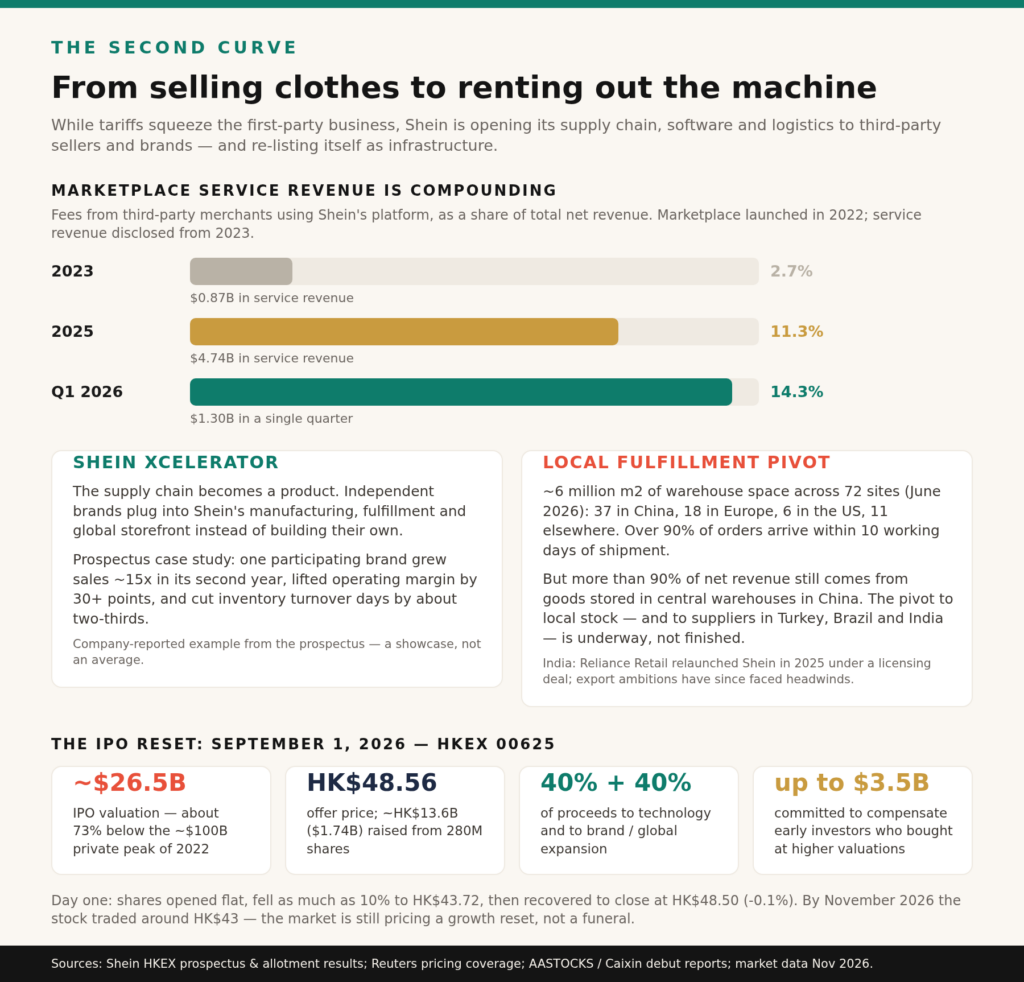
Shein’s answer to the wall is to become infrastructure. Its third-party marketplace, launched in 2022, lets other merchants sell through its platform and logistics. Service revenue grew from $868 million — 2.7% of the total — in 2023 to $4.74 billion, or 11.3%, in 2025, and hit 14.3% in the first quarter of 2026. The Xcelerator programme goes further, handing independent brands the whole supply chain as a service; the prospectus showcases one brand whose sales grew roughly fifteenfold in its second year while its inventory days fell by two-thirds. A showcase, not an average — but a statement of intent.
Meanwhile the physical footprint is shifting: about 6 million square meters of warehouse space across 72 sites, including 18 in Europe and 6 in the US, with over 90% of orders delivered within ten working days of shipment. The honest caveat: more than 90% of net revenue still flows from goods stored in central warehouses in China. The localization pivot — plus supplier diversification into Turkey, Brazil, and a Reliance-licensed India operation whose export ambitions have already hit headwinds — is real, and unfinished.
The IPO: A Repricing, Not a Funeral
On September 1, 2026, Shein finally listed — in Hong Kong, ticker 00625, after New York collapsed under lawmaker scrutiny of its supply chain and London collapsed over the wording of Xinjiang risk disclosures that Beijing’s regulator would not accept. The offer priced at HK$48.56, raising HK$13.6 billion gross, about $1.74 billion, at a valuation near $26.5 billion — roughly 73% below the ~$100 billion private peak of 2022. Shares fell as much as 10% on day one before closing essentially flat; by November they traded around HK$43, after touching HK$29.90 at the low.
Is that failure? Look at what the money does: 40% to technology, 40% to brand and global expansion — and up to $3.5 billion committed to compensating early investors who bought at higher valuations. The market repriced the growth story, not the machine. The 36-day inventory, the 7,500-factory network, and the compounding marketplace line all survived the listing intact. What died was the assumption that a duty-free parcel pipeline would last forever.
What Everyone Gets Wrong
Four errors dominate the commentary. First, that Shein out-designed Zara — it out-tested Zara; LATR is the moat, not the clothes. Second, that the story is only about forced-labor allegations — the scrutiny is real, Shein denies the allegations and audits its suppliers, but the proximate business pressure in 2026 is tariffs and logistics cost, plus a disclosed FTC consumer-protection investigation and French fines. Third, that the valuation collapse equals model failure — it equals a growth reset plus a regulatory wall. Fourth, that Shein is a Chinese domestic brand — it sells nowhere in China.
The Reusable Playbook
Strip away the fashion and four lessons travel to any category. One: test-then-scale beats predict-then-produce wherever demand is uncertain and experiments are cheap — the feedback loop, not the forecast, is the asset. Two: inventory turnover is the honesty metric; revenue can be bought with marketing, but working-capital efficiency cannot be faked. Three: orchestrate the supplier network rather than owning it — dispersed capacity plus software integration is more resilient than any single factory. Four: regulatory arbitrage is not a moat. Shein’s algorithm won round one; the second round is fought at the border, with local stock, diversified sourcing, and platform fees. Every cross-border business model built on a customs exemption should tattoo that on its wall.
Risks Worth Stating Plainly
The growth stall may be structural, not cyclical. The 3P pivot is unproven at group-level profit — marketplace revenue is recognized net, which flatters gross margin while fulfillment ratios climb. Returns are a quiet leak: refund liabilities rose from $223 million in 2023 to $464 million in 2025. And the ethics file stays open: labor-practice investigations, design-infringement lawsuits numbering more than forty, French fines over pricing and environmental claims, and regulators on two continents who now read Shein’s filings closely. Europe is not done, either — a separate EU-wide handling fee on small parcels is slated for November 2026, and the interim €3 duty gives way to full category tariffs in 2028. The wall is still being built higher.
Conclusion: The Algorithm Won. Now It Has to Learn the Border.
Shein out-marketed Zara by turning fashion’s biggest bet — what will people want? — into thousands of cheap questions asked daily, answered by real purchases, and scaled automatically when the answer was yes. The 36-day inventory cycle and the two-million-style catalog are the receipts. But the same filings that prove the machine works also prove its original delivery economics are gone, legislated away in Washington and Brussels with more walls coming. The company that mastered the factory now has to master the border, the local warehouse, and the platform fee. Round one belonged to the algorithm. Round two belongs to whoever adapts fastest — which, if history is any guide, is exactly the contest Shein was built for.