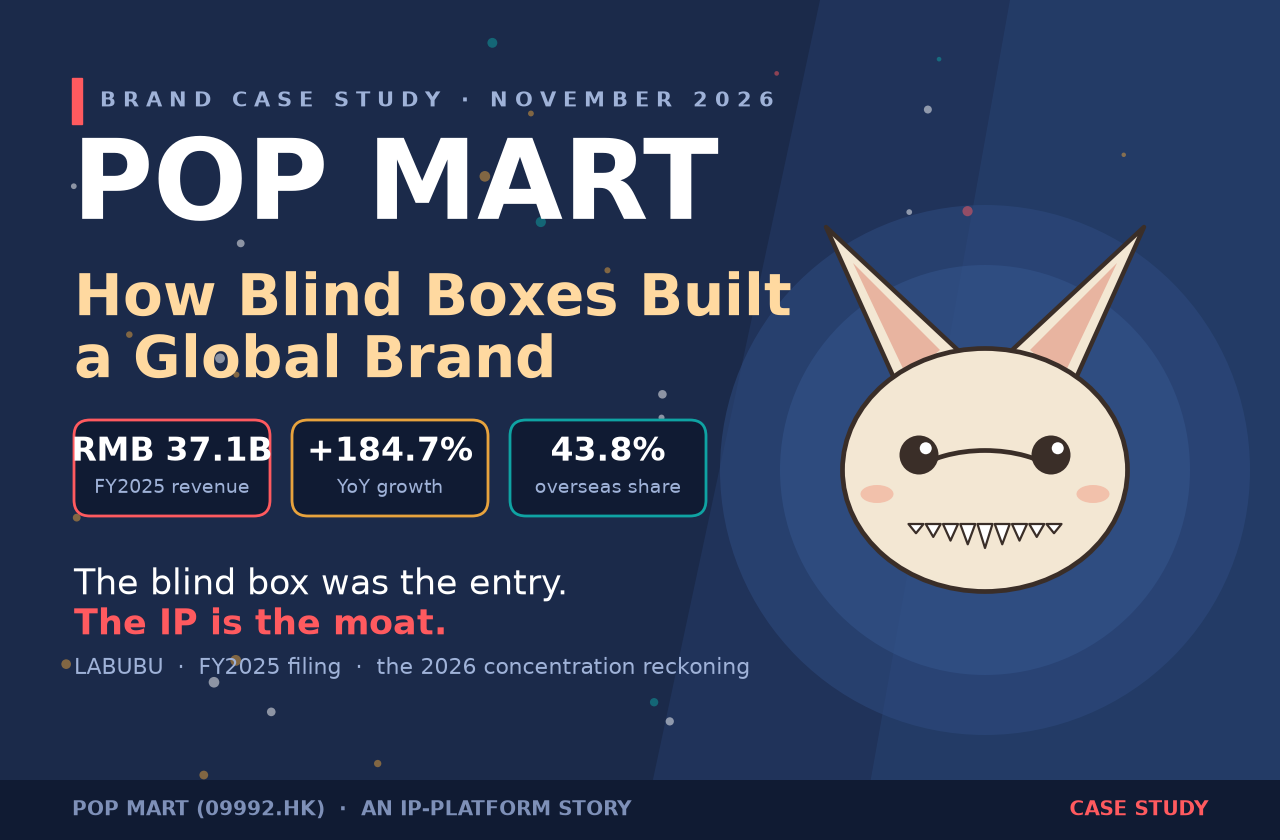
Pop Mart is usually told as a blind-box story — a gambling-adjacent unboxing trick that got lucky. That reading gets the mechanics right and the business wrong. The FY2025 filing describes something else: an artist-IP operating platform that happened to use blind boxes as its entry format. Revenue hit RMB 37.12 billion, up 184.7%; adjusted net profit reached RMB 13.08 billion at a 72.1% gross margin. One franchise — THE MONSTERS, home of LABUBU — delivered RMB 14.16 billion, or 38.1% of everything the company sold. Plush overtook figures as the top category. Overseas markets grew to 43.8% of revenue. And then, in the first half of 2026, the engine cooled: LABUBU revenue fell 7.5%, inventory days stretched from 123 to 201, and management admitted its growth target would probably slip. The lesson of this case is double-edged: blind boxes acquired the audience, the IP portfolio and member machine built the moat — and single-IP concentration is the test the company has not yet passed.
1. Background: A Variety Store That Learned to Sign Artists
The company began in November 2010 as a small lifestyle-goods shop in a Beijing shopping mall — stationery, gadgets, trinkets. Founder Wang Ning was copying a HK variety-store format, and for years the business went nowhere special. The turning point was a Japanese blind-box figure called Sonny Angel. By 2015 it accounted for roughly 30% of sales, and its repurchase rate looked like nothing else on the shelf. Then the licensor pulled the exclusive agreement.
That loss forced the pivot. Wang asked his customers what else they collected; the answer kept coming back Molly. In 2016 Pop Mart signed the exclusive rights to Kenny Wong’s character, and the first Molly Zodiac blind-box series sold out in four seconds on Tmall that August. The company stopped being a reseller of other people’s hits and became an incubator of its own. Revenue went from RMB 158 million in 2017 to RMB 1.68 billion in 2019; the December 2020 HK listing closed up nearly 80% on day one, at a market value around HK$95 billion.
The asset was never the box. It was the artist relationship underneath it. By FY2025, artist IPs generated RMB 33.41 billion — 90.0% of group revenue, up from 85.3% a year earlier, growing 200.4% year on year. Licensed characters (Disney, Sanrio and the like) fill out the rest. Blind boxes are one monetization format among plush, figures, accessories, theme parks and content.
2. The FY2025 Machine: What the Filing Actually Says
The annual results, published March 25, 2026, read like a different company’s numbers: revenue RMB 37.12 billion (+184.7%), adjusted net profit RMB 13.08 billion (+284.5%), gross margin 72.1% versus 66.8% in 2024, and an operating margin of 45.5%. Net profit attributable to shareholders was RMB 12.78 billion, up 308.8% — keep the two profit calibers apart, because most headlines blur them.
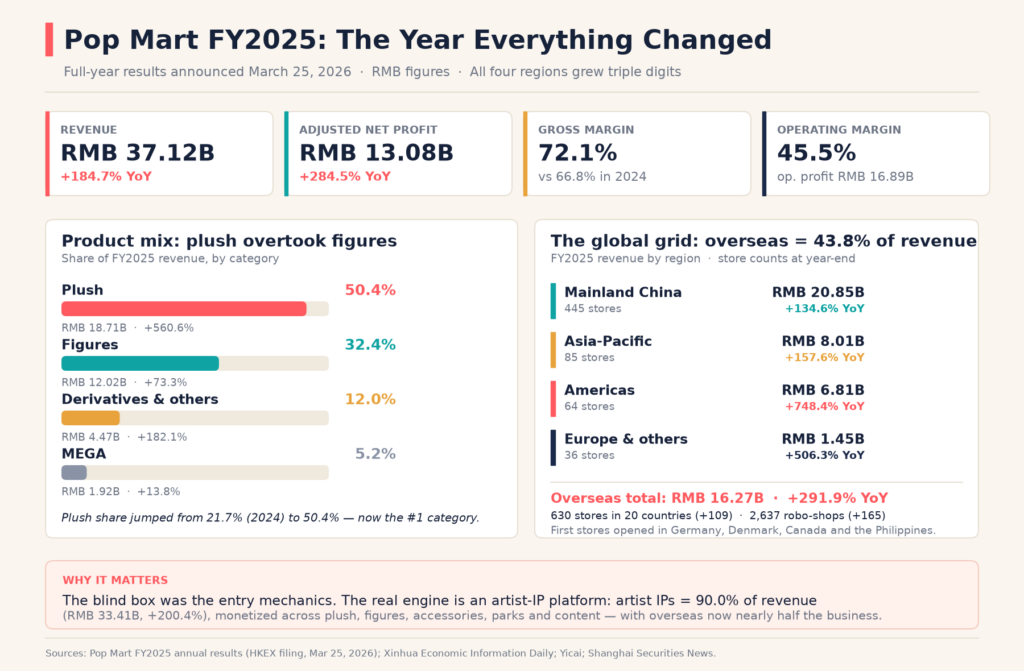
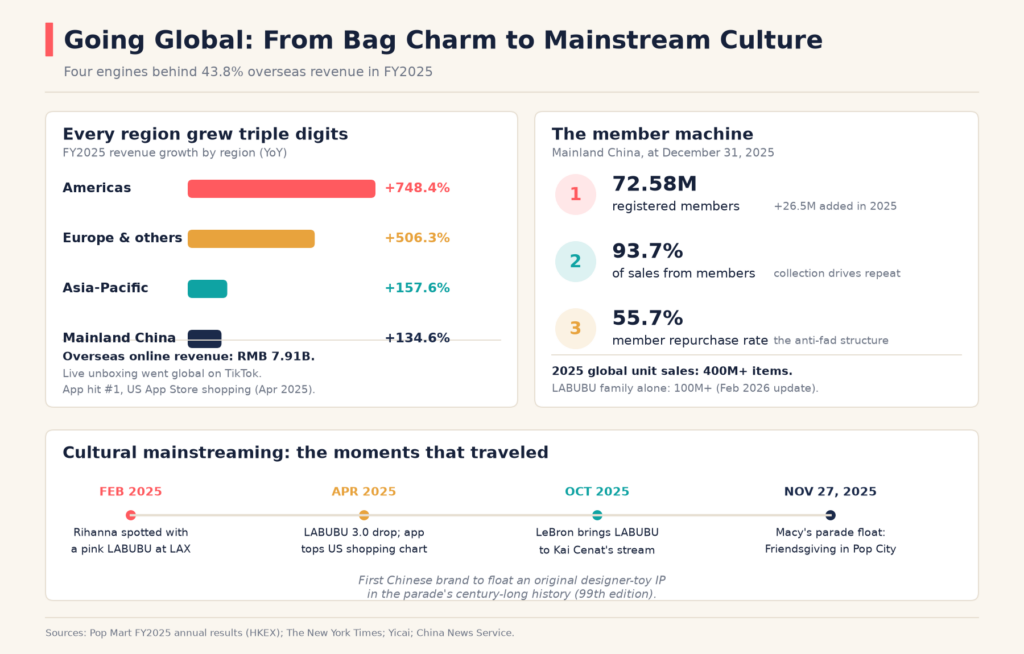
Two structural shifts hide inside the headline growth. First, plush became the biggest category: RMB 18.71 billion, up 560.6%, jumping from 21.7% to 50.4% of revenue and overtaking figures (RMB 12.02 billion, +73.3%). Second, overseas stopped being a side quest: RMB 16.27 billion, up 291.9%, now 43.8% of the group. Every region grew triple digits — Americas +748.4%, Europe & others +506.3%, Asia-Pacific +157.6%, mainland China +134.6%.
3. The Global Breakthrough: Four Engines
3.1 An IP That Travels Without Translation
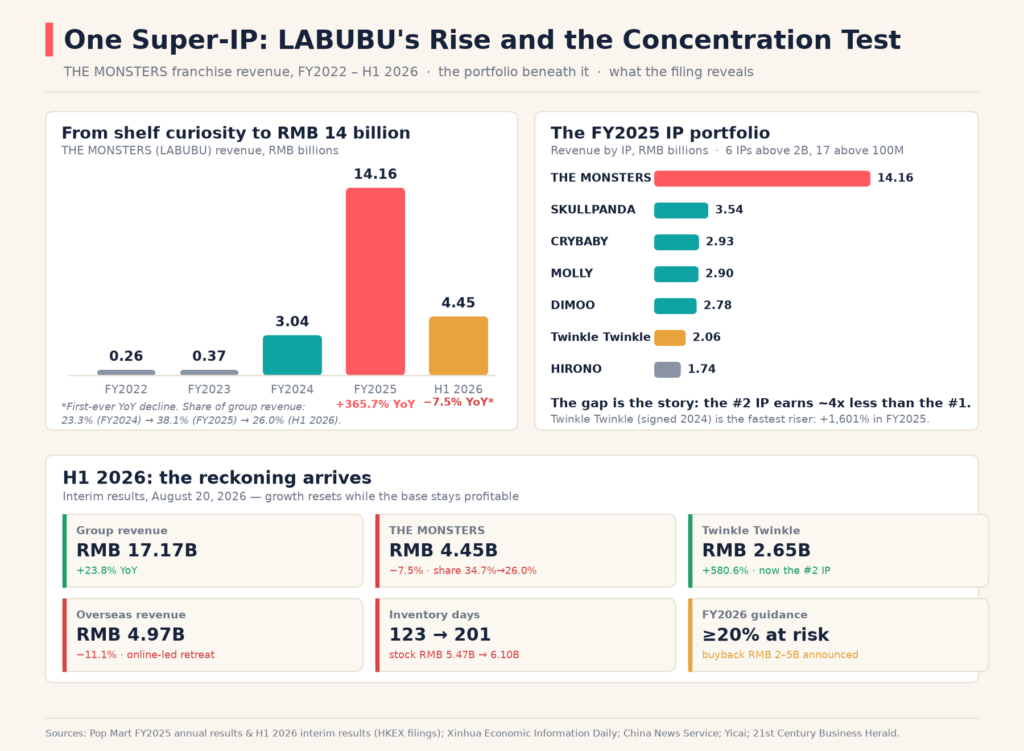
LABUBU — a nine-toothed, pointy-eared forest elf created by HK-born artist Kasing Lung in his 2015 picture book series The Monsters, licensed exclusively to Pop Mart in 2019 — has no dialogue, no backstory you must watch, no language barrier. The ugly-cute aesthetic reads the same in Bangkok, Paris and New York. Celebrity adoption did the rest: Lisa of BLACKPINK turned it into a Southeast Asian phenomenon in 2024; Rihanna was photographed with a pink LABUBU at LAX in February 2025; David Beckham, Dua Lipa and Brad Pitt followed. When the third-generation vinyl-plush pendant dropped in April 2025, the Pop Mart app climbed to #1 in the US App Store’s shopping category. THE MONSTERS finished FY2025 at RMB 14.16 billion, up 365.7% — the group’s first RMB 10-billion IP, and more than 100 million units sold worldwide according to the company’s February 2026 update.
3.2 The Format Shift: Plush as a Wearable Identity Token
Here is the quiet insight: the growth followed a social behavior, not a product plan. A figure sits on a shelf; a plush bag charm hangs off your backpack in public. It is wearable social display — an identity token you carry into the subway, the office, the concert. That is why plush grew 560.6% while figures grew 73.3%. The format evolved because the display venue moved from the bedroom shelf to the street.
3.3 The Retail and DTC Grid
Pop Mart ended 2025 with 630 stores across 20 countries (net adds of 109) and 2,637 robo-shops, opening first stores in Germany, Denmark, Canada and the Philippines, plus landmark flagships in Bangkok, Shanghai and Sydney. Overseas online revenue reached RMB 7.91 billion, with the live-unboxing format — proven in China — pushed onto TikTok for global audiences. The Americas alone grew from RMB 803 million to RMB 6.81 billion.
3.4 The Member Machine
By December 31, 2025, mainland registered members totaled 72.58 million, after 26.5 million additions in one year. Members contributed 93.7% of sales, and the repurchase rate stood at 55.7%. Collection is the loop: you buy one, you want the set, you come back. That is the retention engine underneath the viral moments.
3.5 The Parade Moment: Mainstreaming, Not Niche
On November 27, 2025, LABUBU rode into the 99th Macy’s Thanksgiving Day Parade on a float titled Friendsgiving in Pop City — a 16-foot furry inflatable LABUBU alongside Mokoko, with SKULLPANDA, MOLLY, DIMOO, Peach Riot and Duckoo sculpted into the set. It was the first time a Chinese brand floated an original designer-toy IP in the parade’s century-long history. The detail worth noting: Pop Mart had approached Macy’s roughly 18 months earlier. This was a planned cultural insertion, not a lucky cameo — and spectators who had never heard of Pop Mart knew LABUBU by name.
4. The 2026 Concentration Reckoning
4.1 The Cooling, in Numbers
The H1 2026 interim results (August 20, 2026) kept growth positive but broke the myth of invincibility: group revenue RMB 17.17 billion (+23.8%), adjusted net profit RMB 5.16 billion, gross margin down to 69.7%. THE MONSTERS fell 7.5% to RMB 4.45 billion — its first year-on-year decline — with its revenue share sliding from 34.7% to 26.0%. Overseas revenue fell 11.1% to RMB 4.97 billion, almost entirely an online story: APAC online −39.8%, Americas online −45.6%, Europe online −59.0%, while offline still grew (+16.2%, +19.5%, +49.8% respectively). Inventory climbed from RMB 5.47 billion to RMB 6.10 billion, and inventory days stretched from 123 to 201.
4.2 What Management Admitted
Wang Ning had set a FY2026 target of at least 20% growth back in March. By August he was saying the company would probably miss it, and labeling 2026 an operational adjustment year — sales growth, explicitly, not the priority. He described 2025’s boom as one bright spot hiding a hundred flaws: customers facing sold-out shelves or hours-long queues, supply chain and store operations strained, problems masked by spectacular numbers. COO Si De put his finger on the overseas gap: many overseas staff hired during the 2025 surge knew only Labubu 3.0 — their brand knowledge thinner than that of an average fan. The company announced its first results-call buyback, RMB 2–5 billion over six months.
4.3 The Market Repriced Growth, Not Quality
The stock had already voted. On results day in March 2026, shares fell 22.5% to HK$168.30 despite the record profit. From the August 2025 peak near HK$340, the shares were more than halved by late August 2026, when they closed at HK$149. This is a growth-expectation reset — 184.7% to a contested 20% — not a business collapse. A company earning RMB 5 billion in half a year at a 30% adjusted net margin is not failing; the market is simply refusing to pay for the old growth curve.
4.4 The Pipeline Answer — and Its Limits
The portfolio is the hedge: six IPs above RMB 2 billion in FY2025, seventeen above RMB 100 million. Twinkle Twinkle, an IP signed in 2024, grew 1,601.4% to RMB 2.06 billion in FY2025, then surged 580.6% to RMB 2.65 billion in H1 2026 to become the #2 IP. But THE MONSTERS still outsells it 1.7 to 1, and the incubation machine is not infallible: recent launches Supertutu and After-School Merodi landed flat, and some regular editions of June 2026’s LABUBU Retro Barber Shop series traded below retail on the secondary market within days. Making the next LABUBU remains unproven at super-scale.
5. What Everyone Misunderstands
The gambling frame. The box is an entry mechanic — uncertainty plus collection plus social display. But plush now outsells the boxed figures business, and 90% of revenue comes from artist IPs, not from the packaging format. Judge the company by its IP economics, not by its unboxing psychology.
The fad assumption. A 55.7% repurchase rate and 93.7% member sales share are structural retention, not a passing craze. Yet the fad risk is real at the top of the pyramid: one franchise carried 38.1% of FY2025 revenue. Both things are true at once — the base is sticky, the peak is cyclical.
The China-only story. Overseas is 43.8% of revenue and was the fastest engine in 2025; the Macy’s float was mainstream cultural placement, not an ethnic-niche curiosity. The H1 2026 overseas retreat changes the slope, not the direction.
The collapse read. Profit is real, margins are real, cash generation is real. What broke was the expectation of perpetual triple-digit growth. Repricing a growth curve is not the same as a broken business model.
6. The Reusable Methodology
- IP is the asset; format is the variable. Sign artists, incubate characters, then monetize across boxes, plush, accessories, parks and content. Let the format follow the social behavior — wearable display beat shelf display because the street beat the bedroom.
- Build the member machine before you need it. Collection loops plus membership turned a viral moment into 72.58 million registered members and a 55.7% repurchase rate. Retention infrastructure is the anti-fad structure.
- Global mainstreaming needs a no-language-barrier aesthetic plus local operations. The IP traveled because it required no translation; the retail worked because stores, livestreams and teams were localized. The parade float was the signal — planned 18 months ahead.
- Diversify the portfolio deliberately, and measure incubation repeatability. Seventeen RMB 100-million IPs is a pipeline, not a guarantee. The platform’s value is its ability to make the next hit, not to ride the current one.
7. Risks and Honest Caveats
Single-IP concentration is the live risk: 38.1% in FY2025, and the next super-IP has not been proven at that scale. Inventory and operational strain are real — 201 inventory days and an admitted overseas capability gap mean the adjustment year is necessary and costly. Scarcity economics cut both ways: as plush capacity scaled up, secondary-market premiums on hidden editions reportedly shrank by more than half, and some regular editions fell below retail. And a caliber discipline for anyone citing these numbers: adjusted net profit (RMB 13.08 billion) is not attributable net profit (RMB 12.78 billion); the 43.8% overseas share is FY2025, not H1 2026 (when it fell to about 29%).
Conclusion
Pop Mart built a global brand not on blind boxes but on an artist-IP operating platform: LABUBU’s RMB 14.16 billion and a Macy’s parade float, plush overtaking figures at 50.4% of revenue, overseas at 43.8%, and a member machine of 72.58 million people repurchasing at 55.7%. The blind box was the entry; the portfolio, the members and the global retail grid are the moat. The 2026 reckoning — LABUBU down 7.5%, inventory days at 201, a growth target at risk — exposes the unfinished test: can the platform manufacture its next super-IP, or was LABUBU a once-in-a-decade wave? The reusable lesson is clear either way: IP is the asset, format is the variable, retention is the moat, and concentration is the price of a single spectacular hit. Pop Mart’s next chapter is about proving incubation repeatability — making the next LABUBU, not just riding this one.