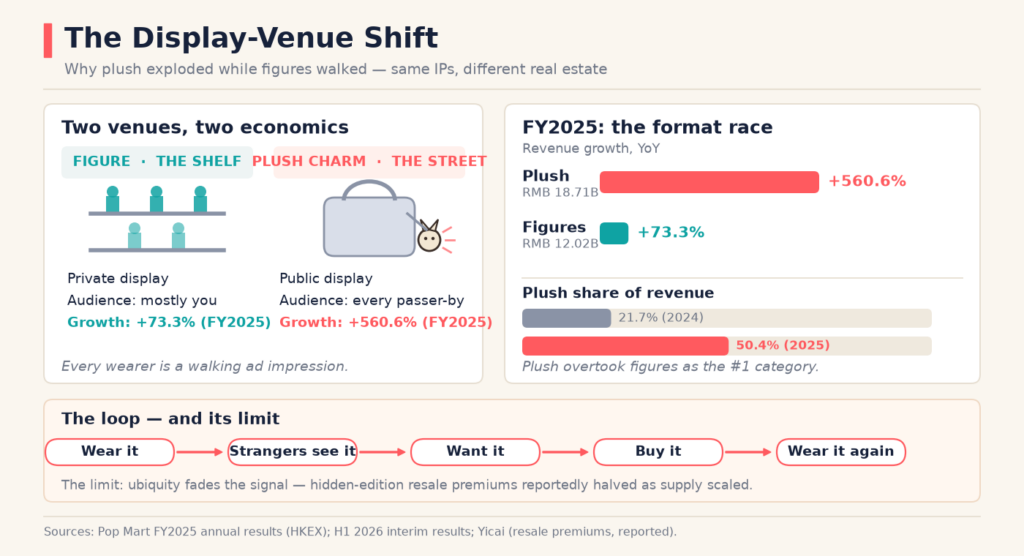
Here is a puzzle hiding inside Pop Mart’s record year. Same company, same characters, largely the same fans — yet in FY2025 plush revenue grew 560.6% while figures grew 73.3%. Plush jumped from 21.7% to 50.4% of group revenue and became the number-one category. If LABUBU mania explains everything, why didn’t the mania lift every format equally?
The answer is not the character. It is the real estate.
A figure lives on a shelf. A charm lives on the street.
A figure is private display. You unbox it, pose it, photograph it once — and then it faces you, alone, for the rest of its life. A plush bag charm is public display. It hangs off a backpack into the subway, the office, the queue at a concert. Every commute becomes an ad impression; every wearer becomes an unpaid media channel, repeated daily, aimed at strangers who fit the demographic better than any targeting parameter.
That is the mechanism behind the gap. The format didn’t win because plush is cuter. It won because plush moved the display venue from the bedroom to the street — and street impressions compound. One buyer generates hundreds of exposures a month. A shelf generates roughly one, to an audience of one.
The loop that paid for the empire
Follow the sequence: someone wears the charm, strangers see it, they want it, they buy one, they wear it too. The customer base doubles as the media plan. Pop Mart’s FY2025 filing shows the result: plush at RMB 18.71 billion, figures at RMB 12.02 billion, and overseas markets — where the bag-charm habit traveled fastest — at 43.8% of revenue. The company sold 400 million-plus units worldwide in 2025; more than 100 million of them were LABUBU family products. You cannot buy that distribution. You can only design an object worth wearing.
The limit built into the loop
Street display works because it signals identity — and identity signals need scarcity. When everyone wears the same elf, the signal fades from statement to uniform. The market noticed before the filing did: as plush capacity scaled up, secondary-market premiums on hidden editions reportedly shrank by more than half, and by mid-2026 some regular LABUBU editions traded below retail. In H1 2026, THE MONSTERS revenue fell 7.5%, its first decline. The loop that built the empire contains the seed of its own cooling: ubiquity is the tax that street display pays for scale.
The takeaway
For any brand selling collectibles, the question is not which character to launch next. It is which venue your object will live in. Design for the shelf and you sell to one person. Design for the street and your customers become your channel — until everyone is wearing it, and you need the next signal. Pop Mart’s plush empire was built on that trade. Its 2026 adjustment year is the bill arriving.



