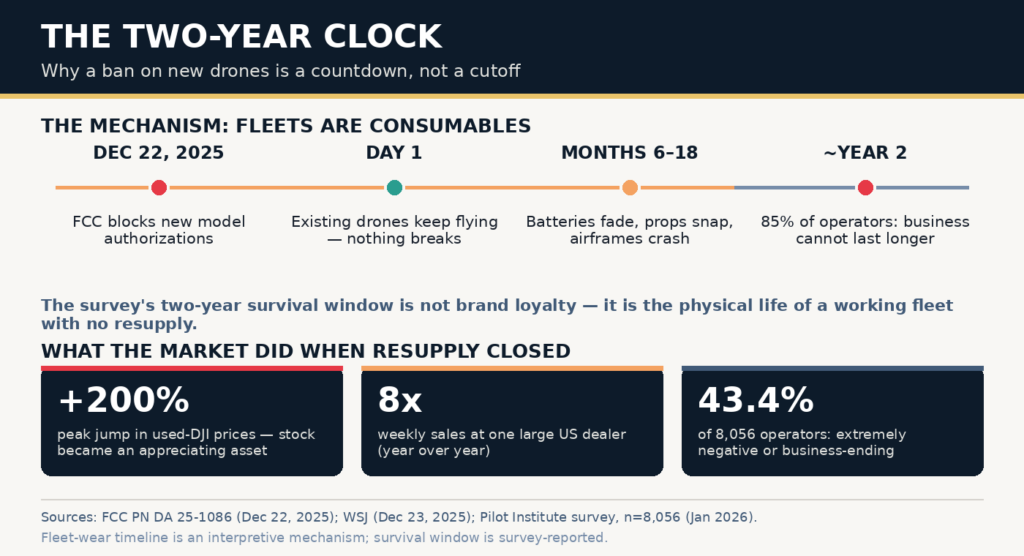
When the FCC blocked new DJI models in December 2025, most coverage reached for the obvious frame: a ban, a victim, a geopolitical fight. But the most revealing number in the whole affair was not a market share. It was a duration. In a survey of 8,056 US drone operators, about 85 percent said their businesses could survive two years or less without access to new foreign-made drones.
Two years. Not forever, not immediately. A countdown. And that oddly specific window tells you more about DJI’s moat than any share statistic ever could.
The Ban Nobody Felt — Yet
Here is the mechanism most headlines skipped. The Covered List decision blocks new equipment authorizations. It does not ground a single existing drone. On December 23, every DJI aircraft in America flew exactly as it had on December 21. Nothing broke. Nothing stopped.
So why did prices on used marketplaces jump as much as 200 percent within days? Why did one large dealer report weekly sales up eightfold year over year?
Because operators were not pricing today’s flight. They were pricing the end of resupply.
Fleets Are Consumables
A working drone fleet is not an asset in the way a building is an asset. It is a consumable wearing a capital-equipment costume. Batteries degrade on a charge-cycle clock. Propellers snap. Arms crack in crashes that are routine, not exceptional, in inspection and construction work. A commercial airframe under daily use lives a hard, finite life.
Which means a fleet without a parts pipeline does not stay a fleet. It slowly becomes a museum. The two-year survival estimate is not a statement about brand loyalty or patriotism. It is an engineering estimate: how long can my current aircraft and spares keep earning before attrition wins?
That reframe changes everything about the hoarding. Stockpiling 30 drones — as one seven-pilot Indiana firm did — looks irrational only if you think the ban stopped the drones. It didn’t. It stopped the replacement. Buying inventory before a supply cutoff is not panic. It is the most rational purchase a business can make: converting depreciating cash into the one asset that will keep producing revenue when the store shelves go empty. The 200 percent used-price spike was the market correctly repricing scarcity, not sentiment.
Why Switching Loses to Hoarding
The textbook response to a supply ban is substitution. The survey says 29.1 percent of operators see no alternative platform that fits their needs — and even those who see one face the real cost: retraining pilots, rebuilding evidence workflows, re-certifying programs. Switching is a project. Hoarding is a purchase order. When the clock is running, businesses buy time first and transformation later, if ever.
That asymmetry is the deepest layer of DJI’s moat, and Washington’s ban accidentally measured it. A competitor replaces a product. A category owner replaces a livelihood — which is why 43.4 percent of operators called the decision extremely negative or potentially business-ending, while their existing drones kept flying, untouched, overhead.
The lesson generalizes beyond drones. If you want to know how deep a switching cost really is, do not ask customers what they prefer. Watch what they do when resupply closes. The two-year clock is the moat, made visible.



