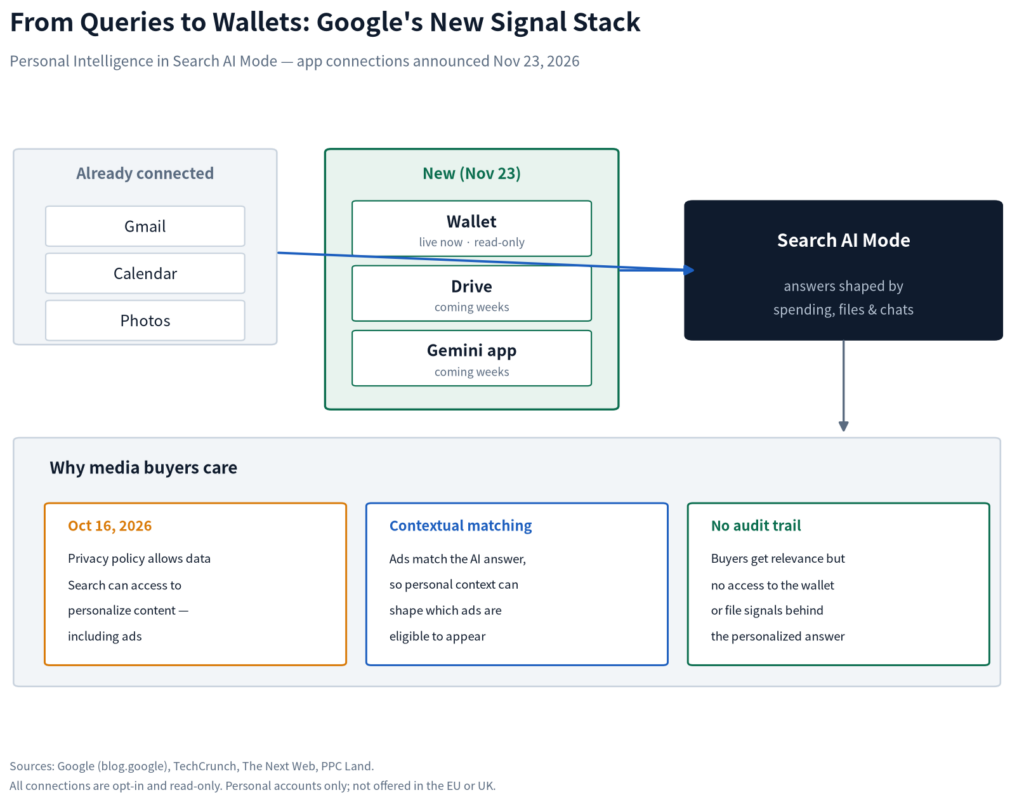
Google’s Personal Intelligence — the opt-in feature that lets AI Mode read your connected apps — added three new sources: Wallet (rolling out now), Drive and the Gemini app (coming over the following weeks). Gmail, Calendar and Photos were already connectable. The update is limited to personal accounts in the U.S. and select markets; it is not offered in the EU or UK, and Workspace accounts are excluded.
The Wallet connection is read-only. Per Google’s own announcement and TechCrunch’s reporting, AI Mode can see card names and transaction records — merchant, amount, date — to answer questions like “where did I spend the most last month?” or to tailor shopping suggestions. It cannot see full card numbers or make purchases. Users connect each app individually and can disconnect at any time; Google says the data is not used to train its models.
Why this is an ads story, not just a privacy story
Here is the mechanism most coverage glosses over. In October 2026, Google updated its privacy policy to state that data accessible to Search — including connected-app data — can be used to personalize content and ads. Google’s clarification: AI Mode ads remain contextual, matched to the conversation, rather than targeted directly from your inbox or wallet. But if your spending history changes the answer AI Mode generates, and ads are matched to that answer, then your private data has influenced which ad you see — one step removed, and completely invisible to the advertiser.
The advertiser buys the answer’s context. The user’s wallet helps write the answer. Nobody selling ads gets to see the wallet.
What media buyers should do this week
- Audit your product data, not your audiences. When answers are personalized upstream, the lever you control is the feed: complete attributes, accurate pricing, real availability. AI Mode pulls shopping suggestions from the Shopping Graph — a poorly structured feed loses eligibility before relevance is even judged.
- Expect attribution noise on brand and loyalty queries. If AI Mode answers “where should I rebuy X” using a user’s transaction history, your CRM-based remarketing logic and Google’s personalization logic may disagree. Watch for divergence between search-term reports and actual conversion paths through December.
- Don’t panic-shift budgets. This is opt-in, U.S.-first, and early. The right posture is measurement hygiene now, budget decisions after you see Q4 AI-referred traffic data.
The competitive context: why Google is plumbing your life into Search
This launch did not happen in a vacuum. ChatGPT has spent 2026 building memory, connectors and shopping features that make it a persistent personal assistant rather than a query box. Perplexity’s Comet browser pushes the same direction from the browsing side. Google’s structural advantage is not model quality — it is the fact that Gmail, Calendar, Photos, Maps and Wallet already hold a decade of most users’ lives. Personal Intelligence is the strategy of monetizing that advantage before an assistant competitor can replicate it through integrations.
For advertisers, the strategic read is this: Google is converting Search from a keyword-matching business into a context-resolution business. Keywords were an explicit, advertiser-visible signal. Context is implicit, personal, and opaque. Every step of that conversion moves leverage from the buyer of ads to the seller of ads — because only the seller can see the full picture that determines which ad is relevant.
What the ad auction actually sees
Walk through a concrete example. A user with Wallet connected asks AI Mode: “I need a new carry-on for a trip next month.” Without Wallet, the answer draws on the query, general shopping data and the Shopping Graph. With Wallet, AI Mode may notice the user recently bought premium luggage-brand accessories and flew with a specific airline — and skew its suggestions toward premium brands. Ads, per Google, are matched contextually to the resulting answer. The premium-brand advertiser wins an impression that their keyword targeting alone would never have earned. They will see it in reporting as an ordinary AI Mode impression. There is no “wallet-influenced” segment to bid on, exclude, or analyze.
The irony of the privacy debate: the user gets a consent toggle; the advertiser doesn’t even get a report column.
This is why the October privacy-policy change matters more than the Wallet launch itself. The policy created the legal basis for connected-app data to inform ad personalization; the Wallet launch is the first high-salience test of how far that basis stretches in practice. Watch for two things: whether Google ever exposes aggregate “personalized context” performance breakdowns to advertisers (currently: no), and whether competitors cite this opacity in their own pitches — expect Microsoft and Perplexity sales teams to weaponize it within weeks.
A measurement playbook for Q4
Concretely: first, split your Search and PMax reporting by surface wherever the API allows, so AI Mode impressions are at least isolable. Second, run brand-query lift checks weekly through December — if AI Mode’s personalized answers are substituting for brand searches, your branded search volume may dip while total brand demand is unchanged, and a naive read would cut brand budget at exactly the wrong moment. Third, keep a clean holdout region for any December budget reallocation you consider; with personalization changing upstream of the auction, pre/post comparisons alone will mislead you. None of this requires new tools — it requires deciding now, before holiday noise makes every signal ambiguous.
Looking ahead (3–7 days, medium confidence): expect privacy-focused coverage and at least one regulator-adjacent commentary cycle as the Wallet rollout expands; Google is likely to publish clarifying FAQs about ad eligibility. The EU/UK exclusion will keep drawing attention as a product-strategy question, not just a compliance one.