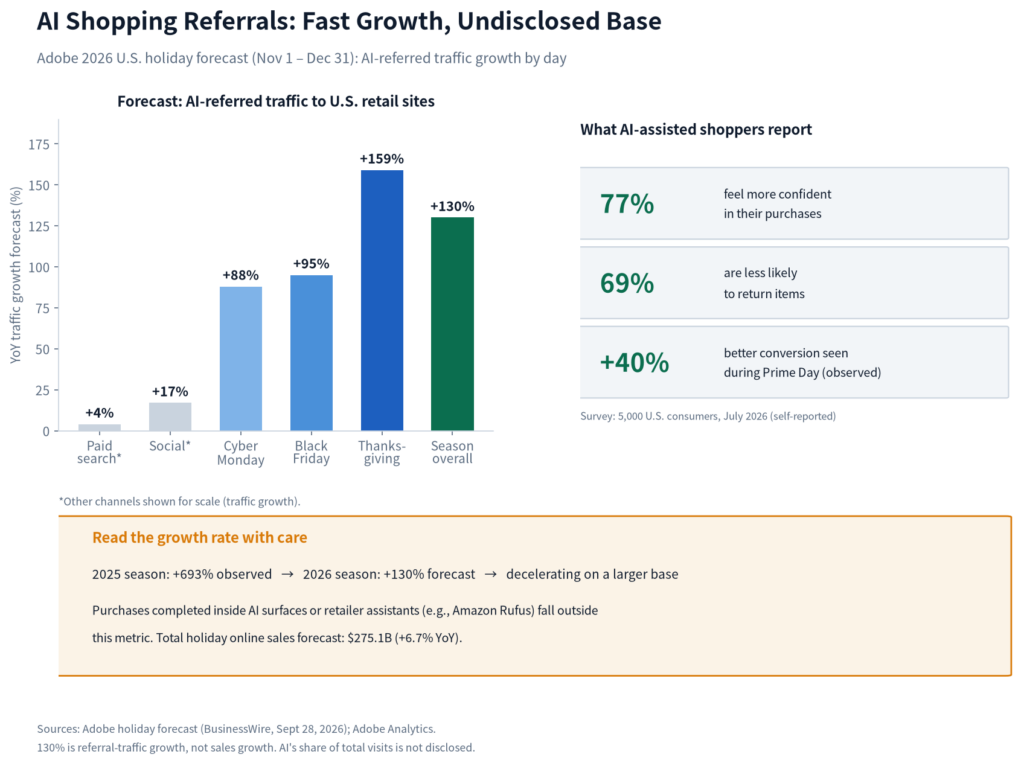
Adobe’s holiday forecast — built on Adobe Analytics’ trillion-plus visits to U.S. retail sites — projects +130% year-over-year growth in AI-referred traffic for the Nov 1–Dec 31 window. Day-by-day: Thanksgiving +159%, Black Friday +95%, Cyber Monday +88%. Total holiday online sales are forecast at $275.1 billion, up 6.7%. Affiliate and partner-driven revenue is expected to grow 12%.
Consumer survey data (5,000 U.S. shoppers, July 2026) adds the behavioral layer: 77% of AI-assisted shoppers say they feel more confident in purchases, and 69% say they’re less likely to return items. During Prime Day, Adobe observed AI-referred traffic converting roughly 40% better than other channels.
First: it’s referrals, not revenue. The 130% counts visits arriving from AI services — chat assistants, AI search — not purchases. Conversion quality looks promising in Adobe’s samples, but a traffic forecast is not a sales forecast.
Second: the base is undisclosed. Adobe has not published AI’s share of total retail visits. Growth of 130% on a 1% base and on a 10% base are entirely different business cases. And the deceleration is stark: 2025’s season showed +693% growth. A slowing growth rate on a growing base is normal maturation — but “AI is about to take over holiday shopping” is not what this data says.
Third: walled gardens are outside the metric. Purchases completed inside AI surfaces, or assisted by retailer-native tools like Amazon Rufus, don’t show up as AI-referred traffic to the retailer’s site. The measured channel is the leaky part of a bigger phenomenon.
130% growth you can’t size is a trend indicator. It tells you the direction of shopper behavior — not how many dollars to move.
Practical moves for the next two weeks
- Instrument AI referrals separately. Tag chatgpt.com, perplexity.ai, gemini and copilot referrers in analytics now, before Thanksgiving traffic hits. If you can’t see the channel, you can’t evaluate it in January.
- Make product pages machine-legible. AI assistants favor pages with clear specs, structured data, honest availability and comparison-friendly content. This overlaps almost completely with good SEO hygiene — do the work once.
- Watch return rates, not just conversion. If the 69% lower-return signal holds in your own data, AI-referred customers may deserve a higher LTV assumption — which changes what you can pay to acquire them.
Why the growth rate fell from 693% to 130% — and why that’s healthy
A decelerating growth rate is what maturation looks like arithmetically. In 2024, AI-referred retail traffic was a rounding error; almost any absolute increase produced triple-digit percentages. By 2026 the base is larger, so the same absolute growth prints a smaller percentage. The dangerous misreading runs in both directions: bulls cite 130% as proof of an imminent channel takeover, while bears cite the collapse from 693% as proof the AI shopping hype is deflating. Neither is supported. What the data supports is narrower and more useful: AI assistants are becoming a habitual research step in holiday shopping, and the referral pipe from that research to retailer sites is widening — at an unknown but still likely modest share of total traffic.
There is also a composition effect worth naming. Early AI-referred traffic skewed toward tech-enthusiast users with high purchase intent — a flattering cohort. As AI usage broadens to mainstream shoppers doing gift research, price comparison and inspiration browsing, expect the average intent of an AI-referred visit to dilute even as volume grows. Adobe’s 40% conversion advantage was measured during Prime Day, on that earlier cohort. If your January analysis assumes that advantage persists at 130%-scaled volume, your channel economics will disappoint.
The walled-garden blind spot, quantified conceptually
Consider where an AI-influenced purchase can complete: (1) the shopper clicks through to the retailer site — counted by Adobe; (2) the shopper buys inside an AI surface with native checkout — not counted; (3) the shopper asks Amazon’s Rufus or Walmart’s Sparky and buys on-platform — not counted as an external AI referral; (4) the shopper researches in ChatGPT, then walks into a store — not counted anywhere digital. Adobe’s metric captures leg 1 of a four-leg journey. As OpenAI, Perplexity and the retailers themselves invest in native checkout, leg 1’s share of AI-influenced commerce may actually shrink while total AI influence grows. That is the scenario in which next year’s Adobe number looks weak and everyone misreads it again.
The metric measures the pipe, not the water. AI’s influence on holiday shopping is bigger than AI-referred traffic — and increasingly routed around it.
What to build before next November
Three durable assets come out of this season. First, a tagged, historically-comparable AI-referral dataset in your own analytics — start the taxonomy now (assistant name, landing page type, session depth, conversion, return status) so 2027 planning rests on your data rather than vendor forecasts. Second, machine-legible product content treated as a maintained asset: specs, structured data, comparison pages and honest stock status, versioned and audited quarterly, because assistants re-crawl and stale availability is a silent conversion killer. Third, a returns-adjusted LTV model by acquisition channel; if AI-referred customers genuinely return less, that is a structural margin advantage worth paying up for — but only once your own cohort data confirms the survey signal. The brands that build these three assets in the next six weeks will read next year’s forecast headlines as confirmation, not revelation.
Looking ahead (3–7 days, high confidence on direction, low on magnitude): Cyber Monday will produce the first hard read on whether the 130% forecast was conservative. Expect a wave of agency “AI traffic” case studies next week — check each for base rates and whether on-platform purchases were included before citing it in a deck.