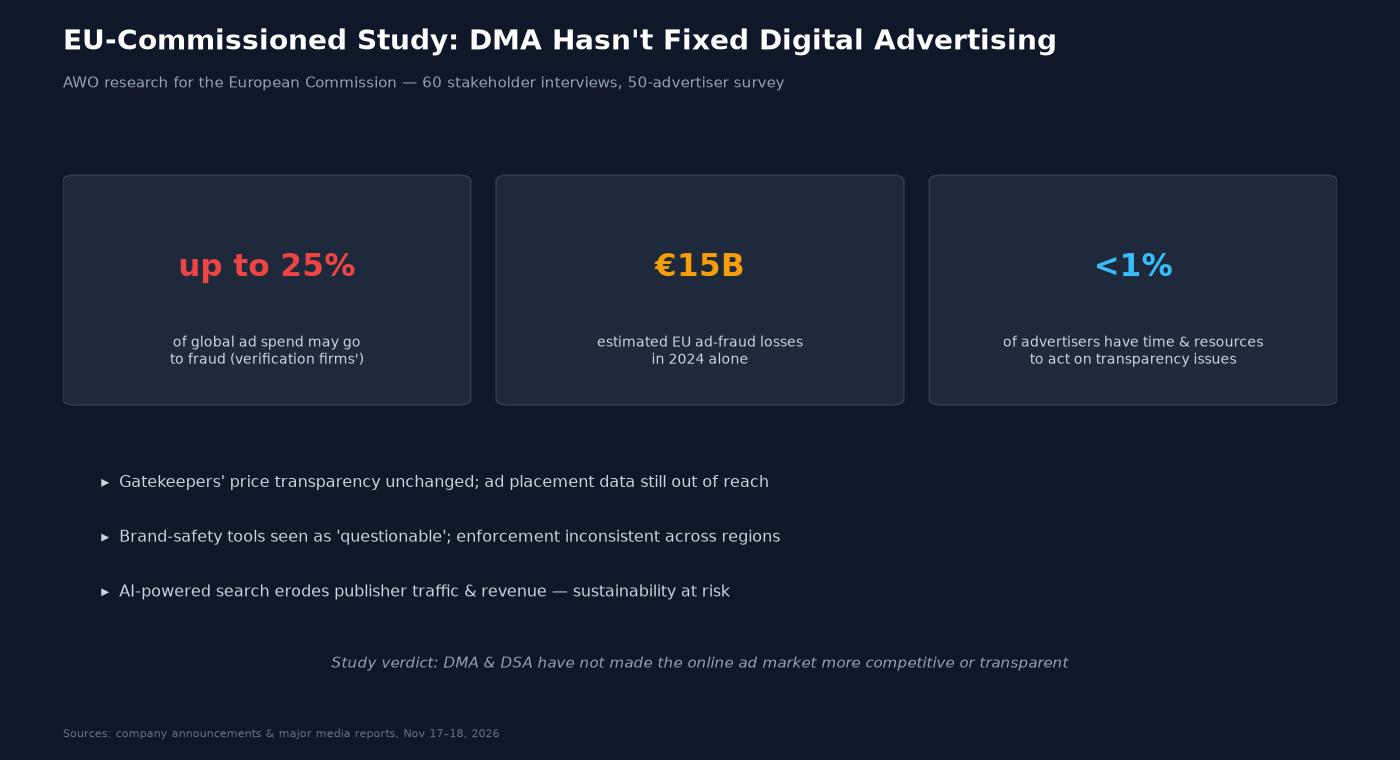
Three years after the European Union’s Digital Markets Act began reshaping the rules for Big Tech, a study commissioned by the European Commission itself has delivered a verdict the bloc did not want to hear: the DMA and its sibling, the Digital Services Act, have so far failed to make online advertising more competitive or more transparent. The research, conducted by the law firm and consultancy AWO through 60 stakeholder interviews, a 50-advertiser survey, and a review of regulatory reports and academic literature, lands at an awkward moment — as AI-powered search erodes the publisher economy the regulations were partly meant to protect.
The findings read like a catalogue of the industry’s open secrets. Most advertisers interviewed said gatekeepers’ price transparency had not improved under the DMA. Advertisers still lack sufficient access to ad performance and placement data — the raw material needed to manage brand safety, avoid funding illegal content, and verify what they are actually buying. Platform-provided brand-safety tools were described by surveyed advertisers as “questionable” or “semi-successful,” with inconsistent enforcement across regions and limited real-time control. And the study concludes the DMA has not dented the competitive position of Google and Meta at all.
The fraud number deserves its own paragraph
Buried in the interviews is a figure that should stop every CMO mid-scroll: verification providers told the researchers that as much as 25% of global ad spend could be going to fraudsters. Applied to the EU alone, that is roughly €15 billion in 2024 — more than three times the revenue of the bloc’s largest publisher, Axel Springer. The estimate comes from vendors with a commercial interest in alarm, and it is an upper-bound perception rather than an audited measurement; the honest reading is “somewhere between troubling and catastrophic, and nobody can prove which.” That uncertainty is itself the finding. An industry that cannot bound its own leakage within a factor of several has a measurement crisis, not a rounding error.
The study also complicates the privacy narrative. Google’s Privacy Sandbox and Apple’s App Tracking Tracking Transparency framework, it finds, have reduced advertising effectiveness and publisher revenues without adequately balancing privacy against competition — shortcomings on both axes. The “consent or pay” model spreading across European publishers fares no better: the researchers conclude it worsens user control and expands third-party data sharing. The uncomfortable synthesis is that a decade of interventions — antitrust, privacy, consent — has produced a market that is simultaneously less transparent, less measurable, and no more competitive.
The demand side is part of the problem
The study’s most damning observation is not about platforms. It is about advertisers. Interviewees described publishers as “uniformly unhappy” and structurally weak, while advertisers were split on whether they cared about competition and transparency at all. Fewer than 1% of advertisers, the report estimates, have the time, resources, and inclination to act on these issues. Marketing’s talent crisis, the delegation of expertise to agencies, and agencies’ own drift into the adtech stack — buying into “the way things are now” — create what the researchers call an inherent status-quo bias. Formal joint-business programs between big advertisers and the gatekeepers soften scrutiny further. As one researcher put it: nobody is having the honest conversation, because the only parties who’d benefit are advertisers and publishers themselves.
Meanwhile the ground keeps moving. Publishers report Google traffic declines getting worse throughout the year as AI-powered answers replace clicks — the same dynamic Google itself confirmed on its recent earnings call. The study warns publishers’ financial sustainability is at risk, which loops back to advertisers: a thinner open-web supply of quality content means fewer trustworthy placements, more made-for-advertising inventory, and a fraud problem with more places to hide.
What a practical advertiser should do with this
Regulation may or may not respond — the study is advisory, pointing toward stronger enforcement or new legislation, and the Commission’s next moves are worth watching. But advertisers do not need to wait for Brussels.
Rebuild your verification stack as if the 25% number might be true for your account until proven otherwise: independent ad verification, log-level data access where contracts allow, placement reporting you actually read, and inclusion lists rather than open-exchange sprawl. Renegotiate agency contracts toward transparency deliverables — data access, audit rights, placement reporting — instead of treating them as platform-shaped black boxes. And put a price on the open web in your planning: if quality publisher inventory keeps shrinking, the surviving premium environments deserve budget weight before their prices reflect the scarcity.
The EU commissioned this study to evaluate its law. It accidentally produced the best available argument for why advertisers should stop outsourcing their curiosity. The gatekeepers were never going to audit themselves. Neither, apparently, were the agencies. That leaves you.






