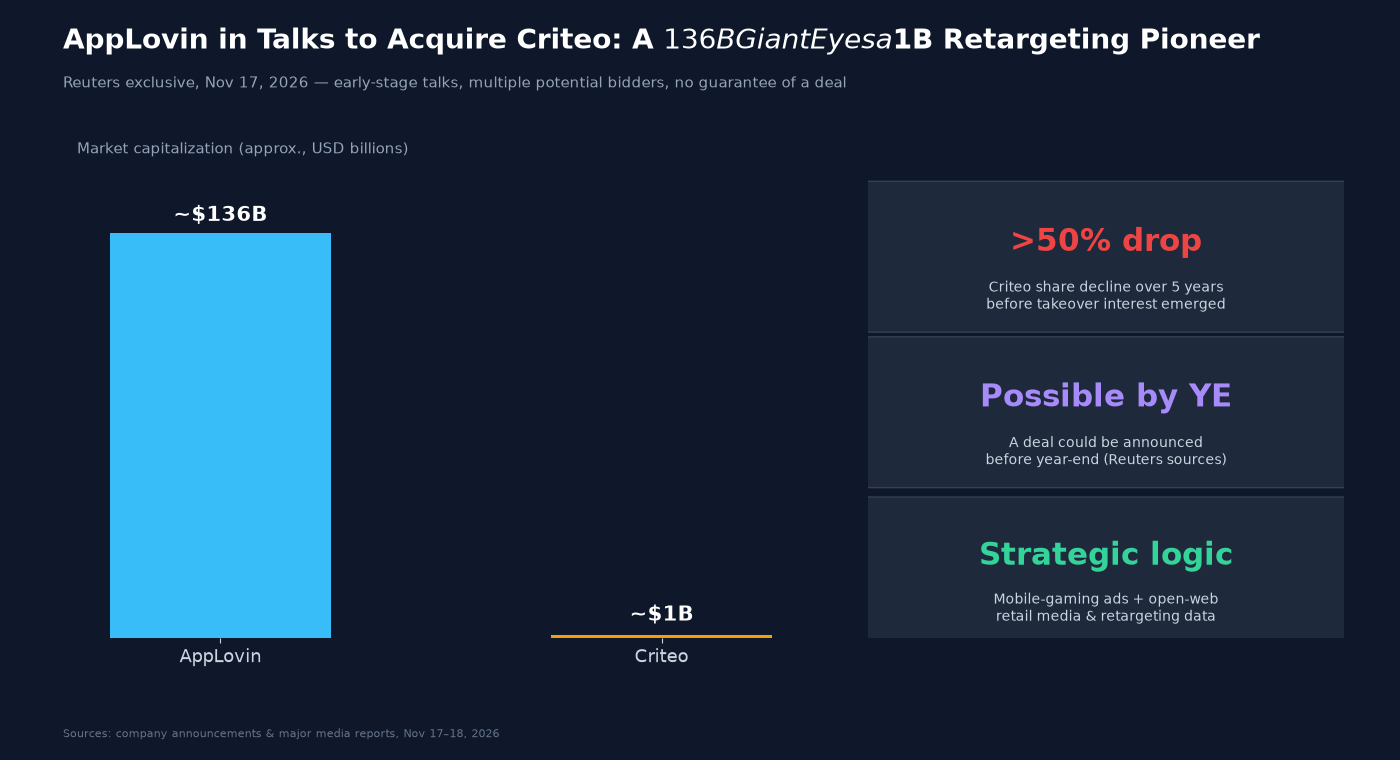
Reuters reported on November 17 that AppLovin, the mobile-gaming advertising giant now valued at roughly $136 billion, is among the companies in talks to acquire Criteo, the Paris-founded ad tech firm whose market capitalization has shrunk to about $1 billion after a five-year share decline of more than 50%. The talks are early, involve multiple potential bidders, and may produce nothing — all parties declined to comment. But a deal could be announced before year-end, according to people familiar with the matter, and the strategic logic is legible enough to analyze now.
Start with the size mismatch, because it is the story. AppLovin is worth more than a hundred Criteos. Two companies that both grew up in performance advertising’s golden age now occupy opposite ends of the market’s judgment. The difference is not execution alone; it is where each company’s data lives and what AI can do with it.
Why Criteo became cheap
Criteo built its franchise on a precise, valuable trick: following shoppers across the open web and re-showing them the products they almost bought. For a decade, commerce retargeting was among the most measurable money in advertising. Then the foundations shifted. Third-party cookies degraded under browser restrictions and privacy regulation; Apple’s ATT framework gutted mobile identifiers; and the European Commission’s own commissioned research — published this same week — found that privacy frameworks reduced ad effectiveness without fixing transparency. Retargeting’s raw material, the cross-site identity graph, has been dissolving for years. Criteo pivoted toward retail media, building ad businesses on retailers’ own first-party data, but the transition has not convinced public markets, and the stock’s long slide reflects a business whose core engine is aging faster than its replacement is scaling.
Why AppLovin wants it anyway
AppLovin’s ascent ran the opposite path. Its AXON recommendation engine turned mobile-gaming ad inventory into an AI-driven performance machine, and the company has been expanding beyond gaming into e-commerce advertising with striking momentum. What AppLovin has is modeling muscle and demand-side scale. What it lacks is what Criteo still owns: deep commerce relationships across European and global retailers, retail-media infrastructure, and years of purchase-intent data infrastructure on the open web — precisely the surfaces where AppLovin wants its next growth curve.
Read that way, the talks are not a rescue of a fallen peer; they are an acquisition of distribution. Buying Criteo would hand AppLovin an established retail-media network and open-web commerce footprint that would take years to build organically, at a price that is rounding error against its own market cap. The risk is the classic ad tech roll-up trap: integrating a declining core business whose people, contracts, and technology were built for a cookie-era world, while the identity substrate keeps eroding underneath.
The consolidation wave this signals
Whether or not this specific deal closes, the direction of travel is clear. Ad tech’s middle class is being hollowed out. Companies whose value rested on identity graphs and arbitrage are repricing toward distress, while companies whose value rests on AI modeling, first-party data networks, and owned demand are accumulating the capital to buy them. Expect more of these pairings: an AI-native acquirer with a currency-like stock, and a data-asset-rich target with a broken narrative. Regulators permitting, the independent retargeting vendor — a staple of every 2015 martech landscape — is becoming an endangered category.
For working marketers, three implications follow. If you run Criteo-powered retargeting or retail-media programs, nothing changes tomorrow — talks are not a transaction — but roadmap risk belongs in your vendor reviews now. If you negotiate commerce-media deals, consolidation strengthens the largest networks’ pricing power over time; lock favorable terms while alternatives still exist. And if your measurement still leans on cross-site identity, treat this news as another reminder that the graph-based era is being sold for parts. First-party data programs and clean-room partnerships are not future projects; they are the replacement parts for infrastructure currently on the auction block.
A $136 billion company circling a $1 billion pioneer is not just a deal story. It is the market’s summary judgment on which half of ad tech’s past decade survives the next one.






