Here is a number that should stop any marketer mid-pitch: in the half-year to September 2026, the average active M-Pesa customer in Kenya made 50.89 chargeable transactions a month. That is more than one and a half paid interactions every single day, with one platform, on one SIM card. No consumer in a banked market — not in New York, not in London, not in Shanghai — transacts with a single financial brand at that intensity.
Africa skipped banks the way it skipped landlines. But the story everyone tells — leapfrogging, inclusion, feel-good fintech — misses the marketing point entirely. Mobile money did not just move cash. It assembled an audience: verified, high-frequency, wallet-first, and measurable in ways a census bureau could only dream of. The rail is mature. The playbook for reaching the people on it is still a blank page.
This piece reads the newest data — GSMA’s 2026 State of the Industry report, Safaricom’s FY2026 results and its November 2026 half-year update, the World Bank’s Findex 2025 — and turns it into a working marketing thesis for wallet-first Africa.
The $2 Trillion Milestone, and What It Actually Measures
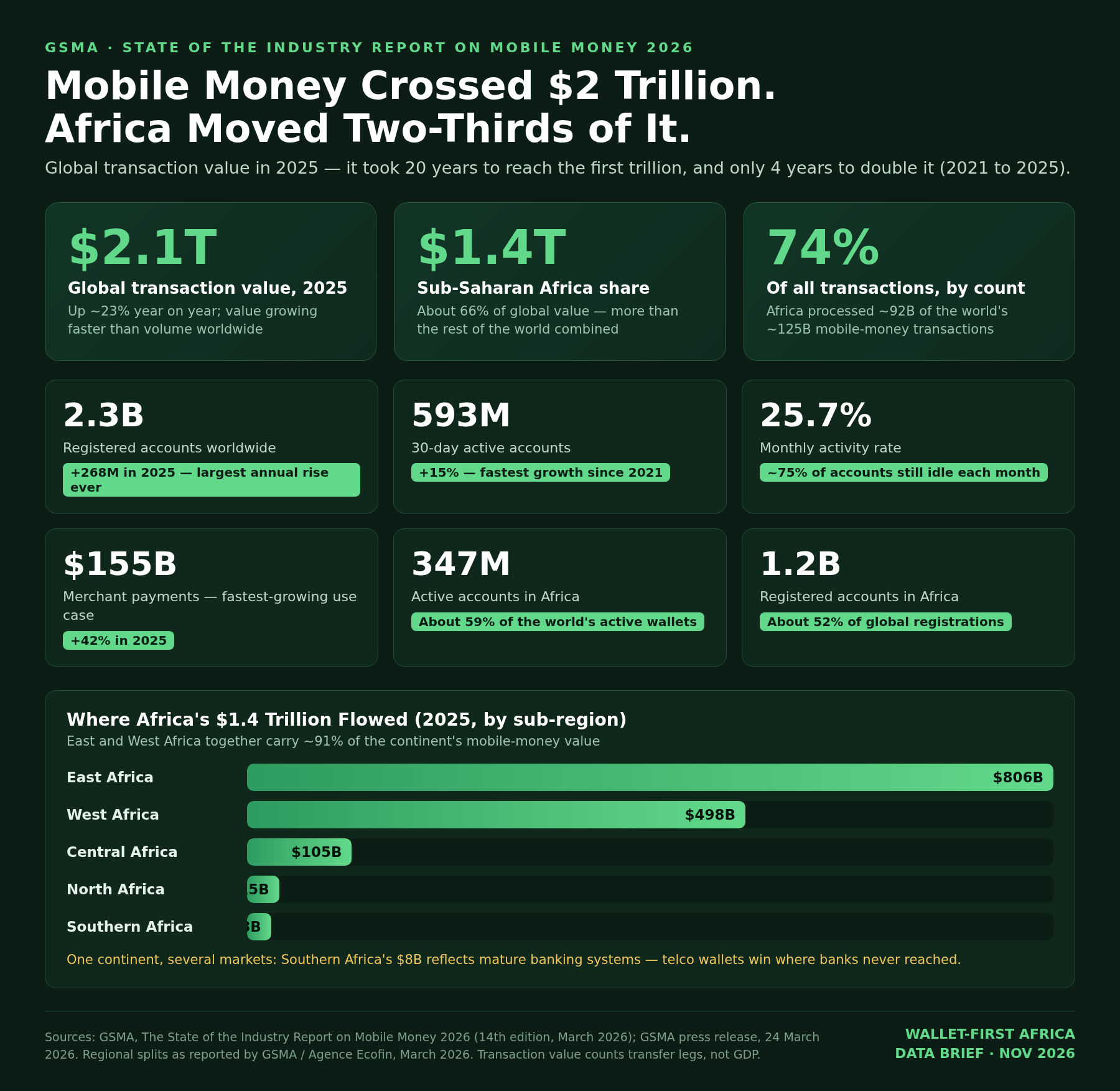
The GSMA’s 2026 report confirms the headline: global mobile money processed $2.1 trillion in transaction value in 2025, up roughly a fifth year on year. It took the industry twenty years to cross the first trillion; it took just four to double it. Registered accounts reached 2.3 billion (up 268 million, the largest annual jump on record), and 30-day active accounts hit 593 million, up 15%.
Sub-Saharan Africa is the engine: roughly $1.4 trillion — about two-thirds of global value — and the source of most new registered and active accounts. By transaction count, Africa is even more dominant: about 92 billion of the world’s ~125 billion transactions, or 74%. Small tickets, enormous velocity.
Two caveats keep you honest. First, transaction value counts transfer legs, not economic output — it is a flow metric, not GDP. Second, the monthly activity rate is only 25.7%: nearly three-quarters of registered wallets sit idle in any given month. The audience is real, but it is the active slice that matters, and Africa’s active slice (347 million accounts, ~59% of the world’s) is where the frequency lives.
M-Pesa by the Numbers: One Wallet, Larger Than Its Economy
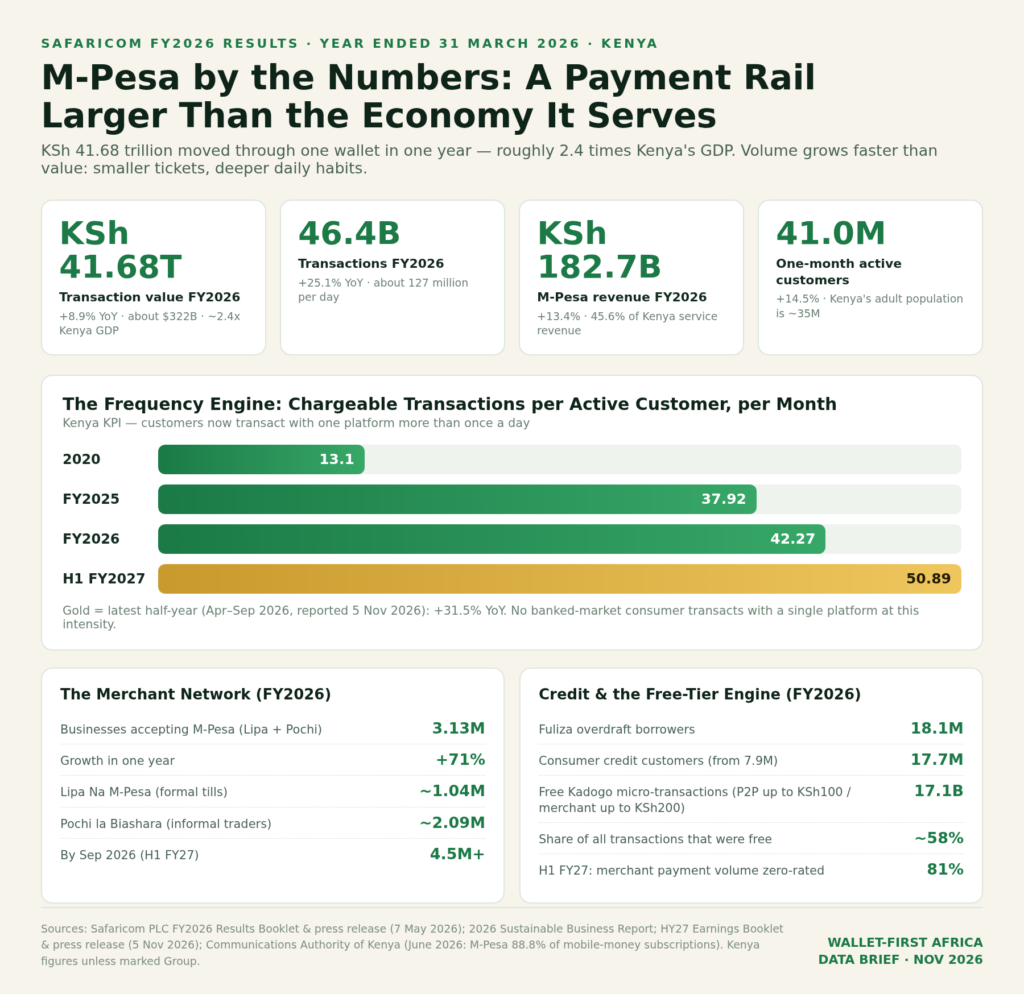
Safaricom’s fiscal year ends in March, so FY2026 covers April 2025 to March 2026. In Kenya, M-Pesa moved KSh 41.68 trillion across 46.4 billion transactions — value up 8.9%, volume up 25.1%. At roughly KSh 129 to the dollar, that is about $322 billion flowing through one wallet in one year, on the order of 2.4 times Kenya’s GDP. (A note on a common error: the widely quoted “46.4 trillion” figure is the transaction count in billions, not the value in shillings. The value is KSh 41.68 trillion.)
The wallet is now the telco’s business: M-Pesa revenue reached KSh 182.7 billion (+13.4%), or 45.6% of Safaricom Kenya’s service revenue. One-month-active customers grew to 41.0 million (+14.5%) — against an adult population of roughly 35 million, a reminder that “active” counts include multiple wallets and business users, not a headcount of citizens.
And the frequency keeps climbing. Chargeable transactions per active customer per month went from 13.1 in 2020, to 37.92 in FY2025, to 42.27 in FY2026, to 50.89 in H1 FY2027 (+31.5% year on year). Meanwhile the average ticket fell about 13% to roughly KSh 898. Read those two lines together and the strategy writes itself: this is not a big-basket market. It is a high-velocity, micro-ticket, daily-habit market.
The Free-Tier Engine: Why “Value Growth” Is the Wrong Scoreboard
If you only watch transaction value, M-Pesa looks like it is slowing (+8.9%). Watch volume and behavior, and it is accelerating. The reason is deliberate: Safaricom has been zero-rating the small transactions that build habit.
Under the Kadogo tariff, person-to-person transfers up to KSh 100 and merchant payments up to KSh 200 are free. In FY2026 those free micro-transactions totaled 17.1 billion — 36.8% of all volume. Count all non-chargeable transactions and roughly 58% of the 46.4 billion transactions cost the customer nothing. By H1 FY2027, after free limits were raised, 81% of merchant payment volume was zero-rated.
This is a customer-acquisition and retention machine disguised as a pricing policy. Every free kiosk payment, every free bus fare, every free airtime top-up is a repetition that wires the wallet into daily life. For a marketer, the implication is blunt: the rail is subsidizing the very frequency your campaign should ride. You are not competing for a monthly shopping trip. You are competing for a slot in a routine that already runs fifty times a month.
Four Marketing Assets the Rail Built for Free
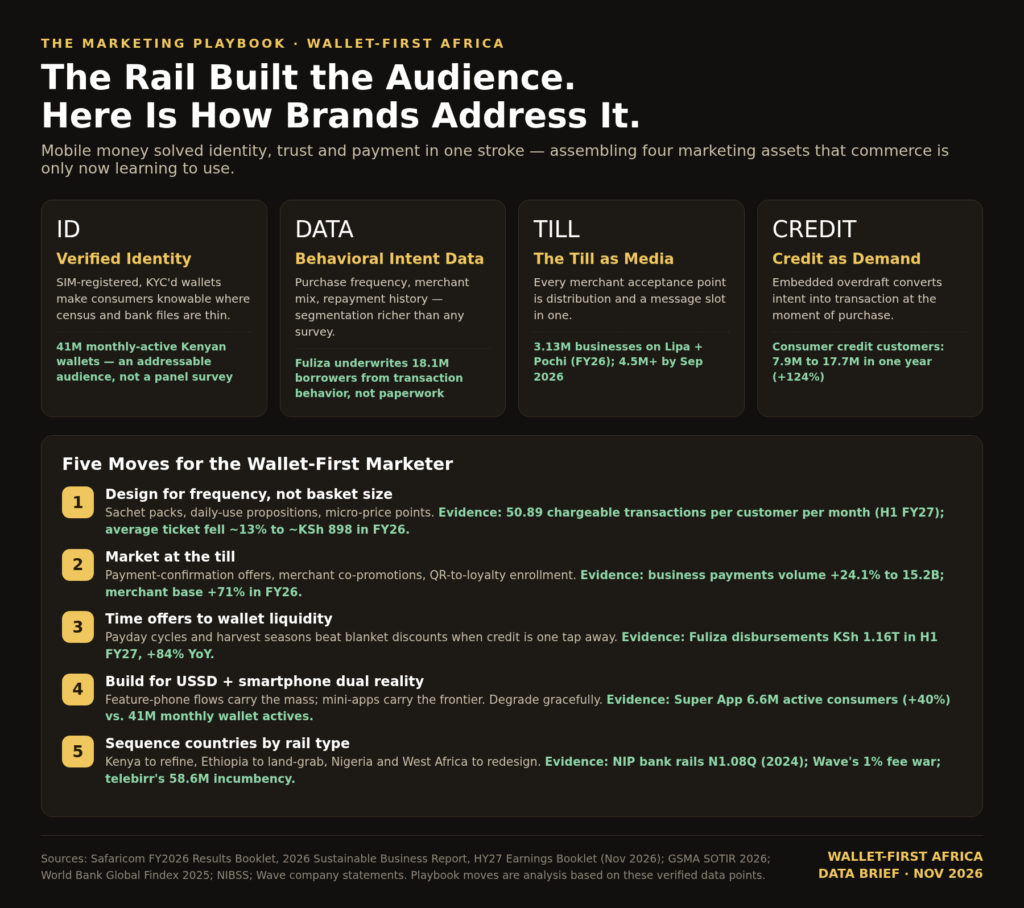
Mobile money solved identity, trust and payment in one stroke for people the formal economy never served. In doing so it handed marketers four assets that usually cost a fortune to build.
1. Verified identity at mass scale. SIM-registered, KYC’d wallets make consumers knowable where bank files and census data are thin. Forty-one million monthly-active Kenyan wallets are an addressable audience, not a panel survey extrapolation.
2. Behavioral intent data — the credit-bureau effect. Purchase frequency, merchant mix, repayment history: segmentation richer than any questionnaire. Fuliza, the overdraft product, underwrites 18.1 million borrowers from transaction behavior, not paperwork. The World Bank’s Findex 2025 found that 32% of Kenyan adults borrow from mobile-money providers — 86% of all formal borrowers. The wallet is the credit bureau.
3. The merchant acceptance network — distribution and media in one. Businesses accepting M-Pesa (Lipa Na M-Pesa plus Pochi la Biashara) reached 3.13 million in FY2026, up 71%, and 4.5 million+ by September 2026. Every till is a touchpoint; every payment confirmation is a message slot. This is the UPI success-page lesson, adapted to an agent-network reality.
4. Credit as demand creation. Consumer credit customers jumped from 7.9 million to 17.7 million in a single year (+124%). Embedded financing converts intent into transaction at the exact moment of purchase, for liquidity-constrained consumers. Fuliza disbursements hit KSh 1.16 trillion in H1 FY2027, up 84%. Credit is not a side product here; it is a demand engine.
What Everyone Misunderstands About the Unbanked Consumer
The poverty-market assumption. Low ticket does not mean low value. Fifty transactions a month at small tickets is high-velocity loyalty. Lifetime value math works on frequency, not basket size. The FMCG sachet economy figured this out decades ago; the digital rail just made it measurable.
The “Africa is one market” error. It is not, and the GSMA aggregate hides it. More on the four distinct plays below — but treating Kenya’s agent-wallet model as a continental template is the most expensive mistake in the plan.
The “mobile money is just payments” frame. The wallet is becoming a platform: mini-apps, merchant tools, credit, savings, insurance. Safaricom’s Super App reached 6.6 million active consumers (+40%), and over two million customers entered structured savings and investments (Ziidi assets under management hit KSh 18.7 billion). The super-app trajectory here is payments-first, not chat-first — closer to PayPay than to WeChat.
The “value growth is stagnation” misread. Covered above: value +8.9% against volume +25.1% is not a stall. It is deepening — more users, smaller everyday tickets, cash substitution progressing. The marketing opportunity grows with frequency, not ticket.
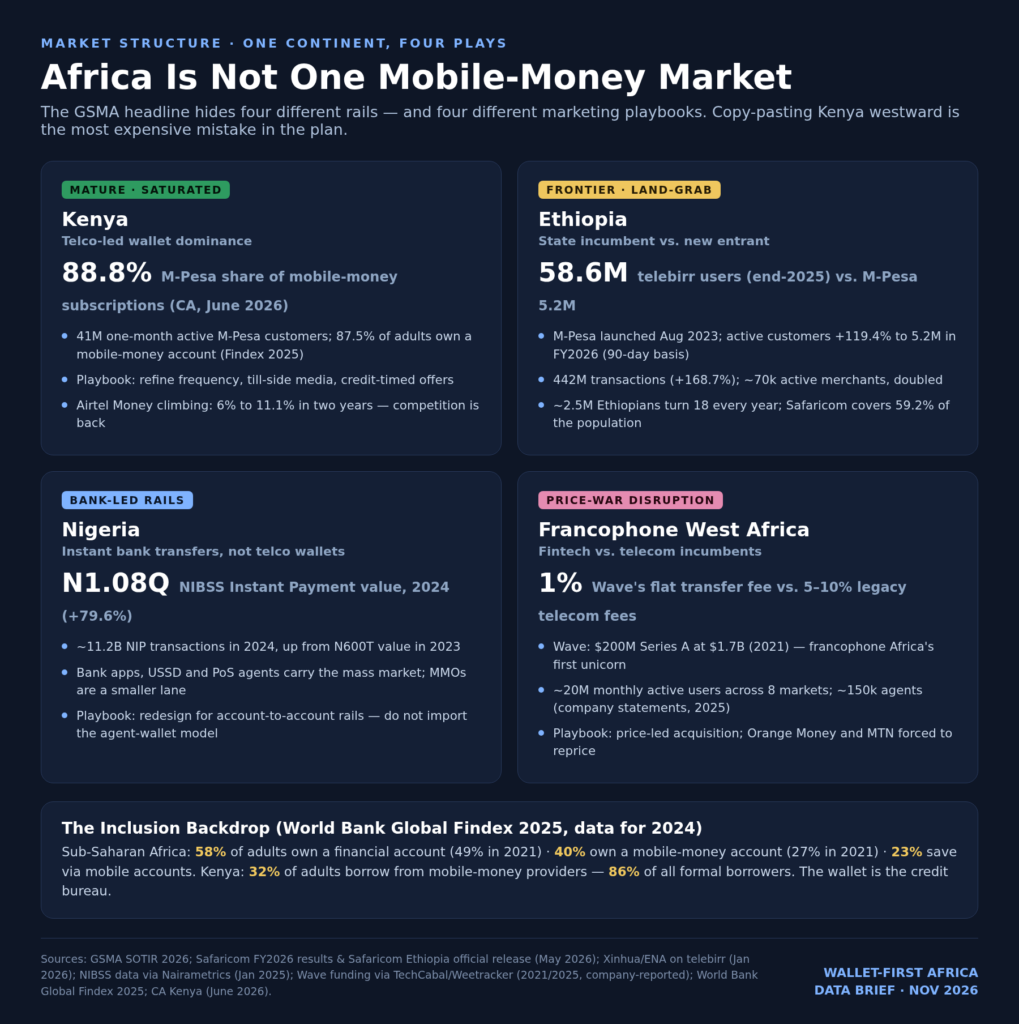
One Continent, Four Plays: Kenya, Ethiopia, Nigeria, the Francophone West
Kenya — mature, saturated, competitive. M-Pesa holds 88.8% of mobile-money subscriptions (Communications Authority, June 2026), but Airtel Money has climbed from 6% to 11.1% in two years. With 87.5% of adults already owning a mobile-money account (Findex 2025), growth comes from depth, not reach. This is where you refine the playbook.
Ethiopia — the frontier land-grab. M-Pesa launched in August 2023 and reached 5.2 million active customers in FY2026 (+119.4%, 90-day basis), with 442 million transactions (+168.7%) and ~70,000 active merchants. But the incumbent is formidable: state-owned telebirr serves ~58.6 million users (Xinhua/ENA, January 2026). Roughly 2.5 million Ethiopians turn 18 every year. The honest caveat: M-Pesa Ethiopia’s revenue is still negligible — users and transactions have arrived; monetization has not. This is a land-grab, not a harvest.
Nigeria — bank-led rails, a different animal. The mass market runs on NIBSS Instant Payment, which moved ₦1.08 quadrillion in 2024 (+79.6%) across ~11.2 billion transactions. Bank apps, USSD and PoS agents carry the volume; telco wallets are a smaller lane. Do not import the agent-wallet model — redesign for account-to-account rails.
Francophone West Africa — a price war. Wave charged a flat 1% transfer fee against the 5–10% legacy telecom fees, raised a $200 million Series A at a $1.7 billion valuation in 2021 (francophone Africa’s first unicorn), and reports ~20 million monthly active users across eight markets. Orange Money and MTN were forced to reprice. Here the playbook is price-led acquisition, not agent density.
The Wallet-First Playbook: Five Moves for Brands
Move 1 — Design for frequency, not basket. Small packs, sachet pricing, daily-use propositions. The wallet’s rhythm rewards repeat micro-transactions. If your SKU cannot be bought in a KSh 50–200 moment, you are invisible to the rail’s dominant behavior.
Move 2 — Market at the till. The Lipa/Pochi network is distribution and media. Payment-confirmation offers, merchant co-promotions, QR-to-loyalty enrollment. Business payments volume grew 24.1% to 15.2 billion in FY2026 — that is 15.2 billion message slots a year.
Move 3 — Time offers to wallet liquidity. When credit is one tap away, timing beats discounting. Align offers to payday cycles and harvest seasons, not to a quarterly promo calendar. Fuliza’s 84% disbursement growth tells you liquidity is the binding constraint, not price.
Move 4 — Build for the USSD + smartphone dual reality. Feature-phone USSD flows still carry mass usage; smartphone mini-apps carry the frontier (6.6 million Super App actives versus 41 million wallet actives). Campaigns must degrade gracefully across both, or you will design for the 16% and miss the 84%.
Move 5 — Sequence countries by rail type. Kenya to refine, Ethiopia to land-grab, Nigeria and the francophone west to redesign. One continent, four strategies. The brands that win will be the ones that stop translating a Nairobi deck into Lagos and start rebuilding it.
Risks and Honest Caveats
Regulatory repricing. Kenya equalized excise duty on money-transfer fees at 15% as of July 2023 (ICTD), and interoperability mandates and fee caps keep compressing wallet economics. The rail’s pricing is politically set; a campaign built on today’s fee structure can be repriced by a finance act.
Fraud and trust maintenance. SIM-swap and social-engineering fraud target the same trust the rail built. Safaricom recovered KSh 953 million in inflated agent commissions in FY2026 — a reminder that the agent network is both the moat and the attack surface. One consumer-protection incident can reprice the whole category.
Data-use ethics. Transaction data as a marketing asset collides with Kenya’s Data Protection Act (2019). Consent architecture is not optional. Safaricom itself introduced data minimization on person-to-person transfers (recipients see two names and a masked number) — the platform is tightening privacy even as marketers want richer targeting.
The bank-led counter-rails. Mobile money’s dominance is East African, not continental. Nigeria’s NIBSS/bank apps and agency banking grow fast. Generalizing the M-Pesa model westward without redesign is not ambition; it is a category error.
Conclusion: The Audience Was Already Assembled
M-Pesa turned the SIM card into a bank, a credit bureau and an identity system for consumers the formal economy never served — and in doing so built the world’s most transaction-dense audience: fifty touches a month, $2.1 trillion of global mobile-money flow, 4.5 million merchant touchpoints and counting.
Commerce and marketing are only now arriving at this pre-built audience. The playbook writes itself from the data: frequency-first pricing, till-side media, liquidity-timed offers, dual USSD/smartphone delivery, and country-specific rail strategies.
Africa’s lesson for every emerging market is this: when you solve trust and payment together, you do not just enable transactions. You assemble the audience itself. The brands that learn to speak wallet-first inherit it. The ones that keep pitching banked-market playbooks to a fifty-transactions-a-month consumer will keep wondering why Africa “underperforms” — when the truth is they never showed up where the consumer actually lives.