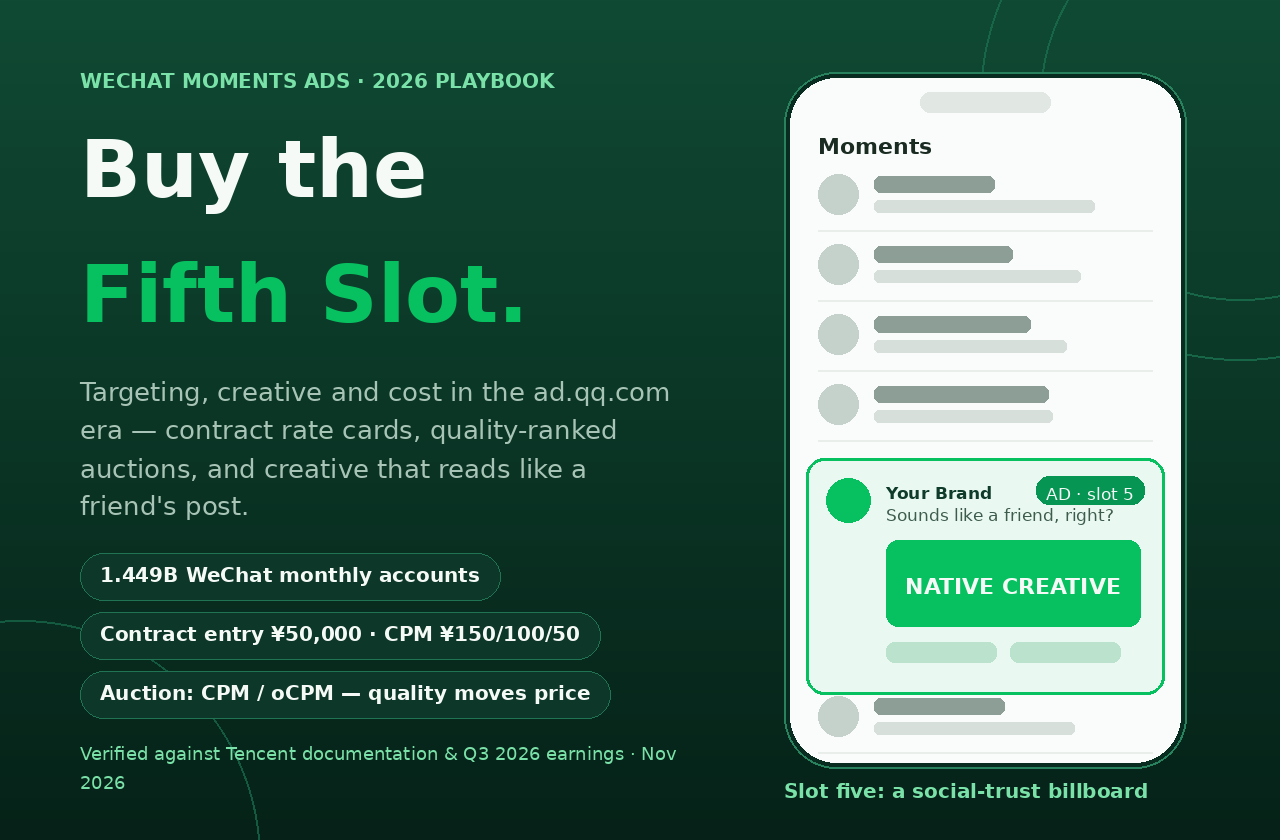
WeChat Moments ads remain the most native paid placement in Chinese digital: a brand post sitting around the fifth slot of a friend feed, wearing an avatar, a nickname and a casual line of copy. But the buying machinery has moved — self-serve delivery left the WeChat Official Accounts backend for Tencent’s unified platform at ad.qq.com, and the old direct-client auction accounts were shut off on January 8, 2025. Today you choose between contract buying (a city-tier CPM rate card, campaigns from RMB 50,000) and auction buying (CPM or oCPM, ranked by bid and creative quality), aim with a targeting stack that is quietly shrinking under privacy rules, and land every click inside WeChat. This playbook covers the migration, the money, the targeting, the creative and the compliance gates — with figures checked against Tencent’s current documentation and its November 2026 earnings.
Why the Fifth Slot Still Matters
Start with scale. Tencent’s third-quarter 2026 results, released on November 18, 2026, put combined Weixin and WeChat monthly active accounts at 1.449 billion. Marketing services revenue for the quarter hit RMB 43.0 billion, up 19 percent year on year — the fastest-growing major segment in a company that grew 8 percent overall. Full-year 2025 told the same story: RMB 145 billion in marketing services revenue, also up 19 percent. Tencent credits AI-driven ad targeting and closed-loop commerce inside WeChat, and keeps repeating one line buyers should care about: ad load stays far below industry peers.
That scarcity is the product. Moments ads launched in January 2015 with three advertisers — BMW, Coca-Cola and vivo — and the launch mechanics revealed the design philosophy: the ad appeared no higher than the fifth post, slid down the feed as friends posted, and quietly vanished after hours if nobody interacted. Users could like it, comment on it, and see their friends’ likes — the same social verbs they use on each other. An early CCTV poll found more than 80 percent of users called the ads commercial harassment; the format survived, and scarcity became its defense. You are not renting a banner. You are borrowing a seat at a dinner table with only a few seats per person per day.
The Platform Moved: ad.qq.com Is the Front Door
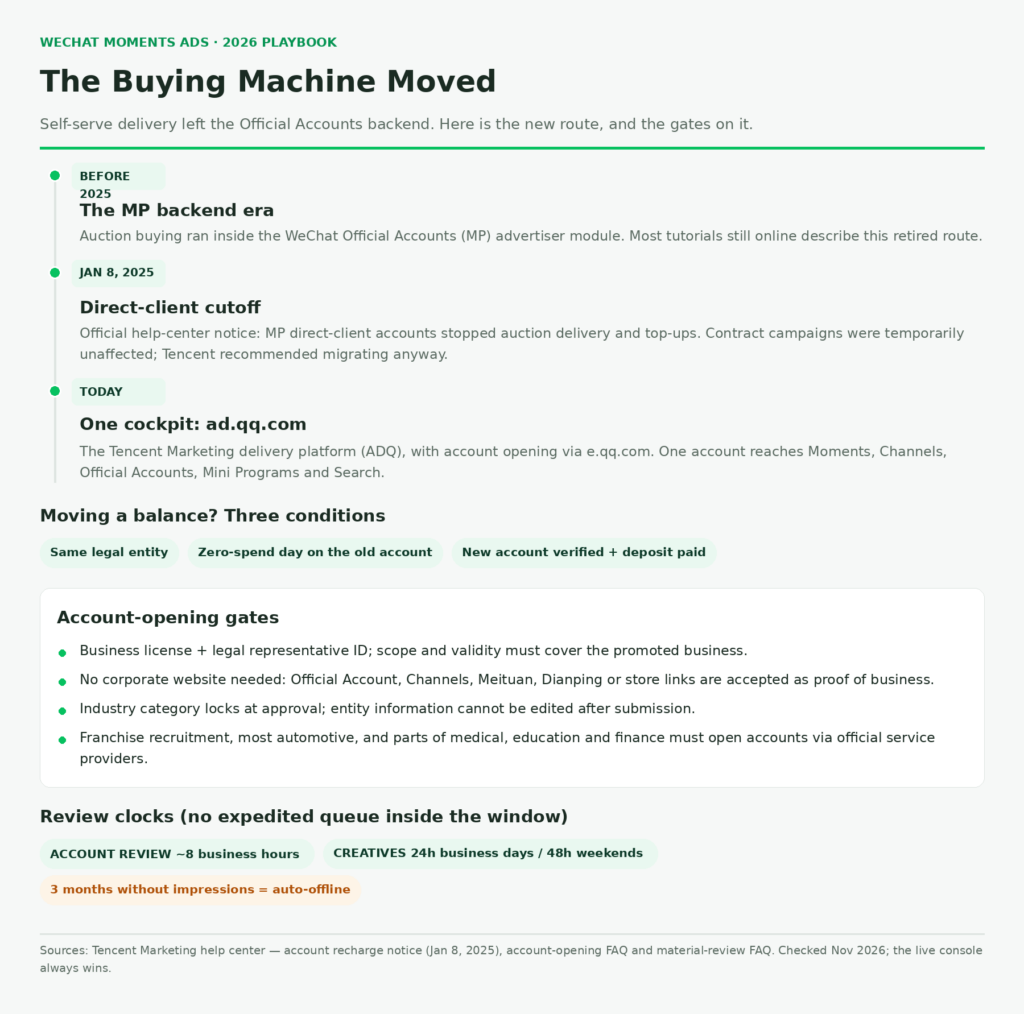
If your team learned Moments buying from a tutorial that starts inside the WeChat Official Accounts (MP) backend, that tutorial is obsolete. Tencent’s help-center notice dated January 8, 2025 is explicit: direct-client accounts on the MP platform stopped auction delivery and top-up services. Contract campaigns were temporarily unaffected, but Tencent recommended migrating anyway. Balances can move to the new platform — cash only to a direct-client account under the same legal entity, on a day with no spend, after the new account passes review, identity verification and any required deposit.
The destination is the Tencent Marketing delivery platform, usually called ADQ, at ad.qq.com, with account opening through e.qq.com. One account now reaches Moments, Channels, Official Accounts, Mini Programs, Search and the wider Tencent inventory. Same social feed, new cockpit.
Opening an Account Without Tripping the Gates
Enterprises need a business license plus the legal representative’s ID, and the license’s validity period and business scope must cover what you plan to promote. Some industries accept natural-person accounts with an ID and a handheld photo. One practical detail: you don’t need a corporate website. Tencent accepts your Official Account, Channels page, Dianping, Meituan, RedNote or e-commerce store link as proof of business.
Three traps deserve respect. First, your industry category locks at approval — promote a different category and you open a new account. Second, entity information cannot be edited after submission; a typo means starting over. Third, several industries must open accounts through official service providers rather than direct: franchise recruitment, most automotive categories, and parts of medical, education and finance, among others. Current help-center guidance puts account review at about eight business hours, with weekends deferred. After approval comes identity verification — for enterprises, typically corporate bank-account verification — before you can top up.
Two Ways to Buy: Contract or Auction
Moments inventory sells in two fundamentally different ways, and conflating them is the most expensive mistake foreign teams make. Contract buying reserves impressions ahead of time at a published rate. Auction buying drops your ad into a real-time competition where creative quality moves the price. Tencent’s sales-strategy documentation, updated September 2025, also confirms a third billing option on the contract side: time-based buying, CPT, billed by the hour for Moments.
Contract Buying: The City-Tier Rate Card
Contract — the trade calls it scheduled buying — locks volume and price. You book one to 28 days ahead, freeze the budget, and Tencent guarantees delivery. Rate-card documentation circulated through Tencent’s sales channels sets single-campaign minimums at RMB 50,000 and prices impressions by city tier:
- Core cities (Beijing and Shanghai): RMB 150 CPM for image outer layers, RMB 180 for video.
- Key cities (20 high-activity cities): RMB 100 for image, RMB 120 for video.
- All other cities: RMB 50 for image, RMB 60 for video.
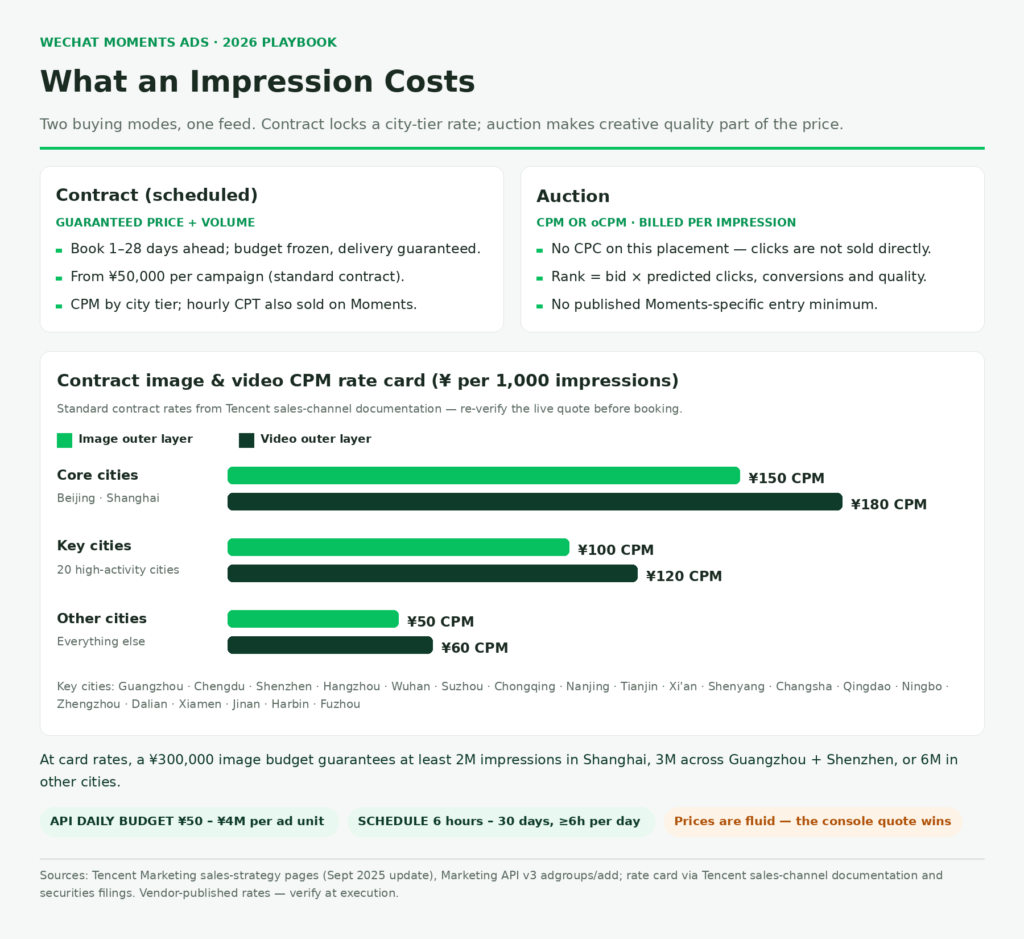
Tencent’s own contract-sales documentation confirms the tier structure and the key-city roster: Guangzhou, Chengdu, Shenzhen, Hangzhou, Wuhan, Suzhou, Chongqing, Nanjing, Tianjin, Xi’an, Shenyang, Changsha, Qingdao, Ningbo, Zhengzhou, Dalian, Xiamen, Jinan, Harbin and Fuzhou. Geography is the price lever. At those rates, a RMB 300,000 image campaign buys at least 2 million impressions in Shanghai, 3 million across Guangzhou and Shenzhen, or 6 million in smaller cities.
Channel documentation also describes premium contract variants — short-burst promotions priced above the standard card, and long-duration social campaigns running one to four weeks — with substantially higher commitment minimums that are not published on the public help center. Confirm those numbers with your channel manager before building a plan around them. And treat the whole card as a rate, not a law: the mechanics are stable, the prices are fluid, and the buying console’s live quote always wins.
Auction Buying: CPM and oCPM, Ranked by Quality
Auction is where performance teams live. Per the current sales-strategy documentation, the Moments placement supports exactly two auction billing modes: CPM (bid per thousand impressions, billed per impression) and oCPM (you set a target conversion cost and the system bids automatically toward it, still billed per impression). There is no CPC on Moments — you cannot buy clicks directly on this placement.
One correction if you learned this from older guides: the city-tier auction bid floors copied across the internet trace back to IPO-era documentation from around 2019 and no longer appear in Tencent’s current public sales pages. Do not budget against them. Plan around the mechanism instead, because the mechanism is stable: impressions flow to the ads with the highest effective competitiveness — your bid combined with predicted click-through, conversion likelihood and creative quality. A convincing friend-style post beats a lazy banner at the same bid. That is the auction telling you what the format wants.
On entry budgets, the help center publishes no Moments-specific minimum. The platform’s Marketing API enforces a system-level daily budget between RMB 50 and RMB 4 million per ad unit — a guardrail, not a recommended test budget. The same API sets scheduling rules worth knowing: a Moments campaign runs at least six hours and at most 30 calendar days, at least six hours per day, on a consistent daily time window.
Targeting: A Powerful Stack, Quietly Shrinking
The Stable Layers
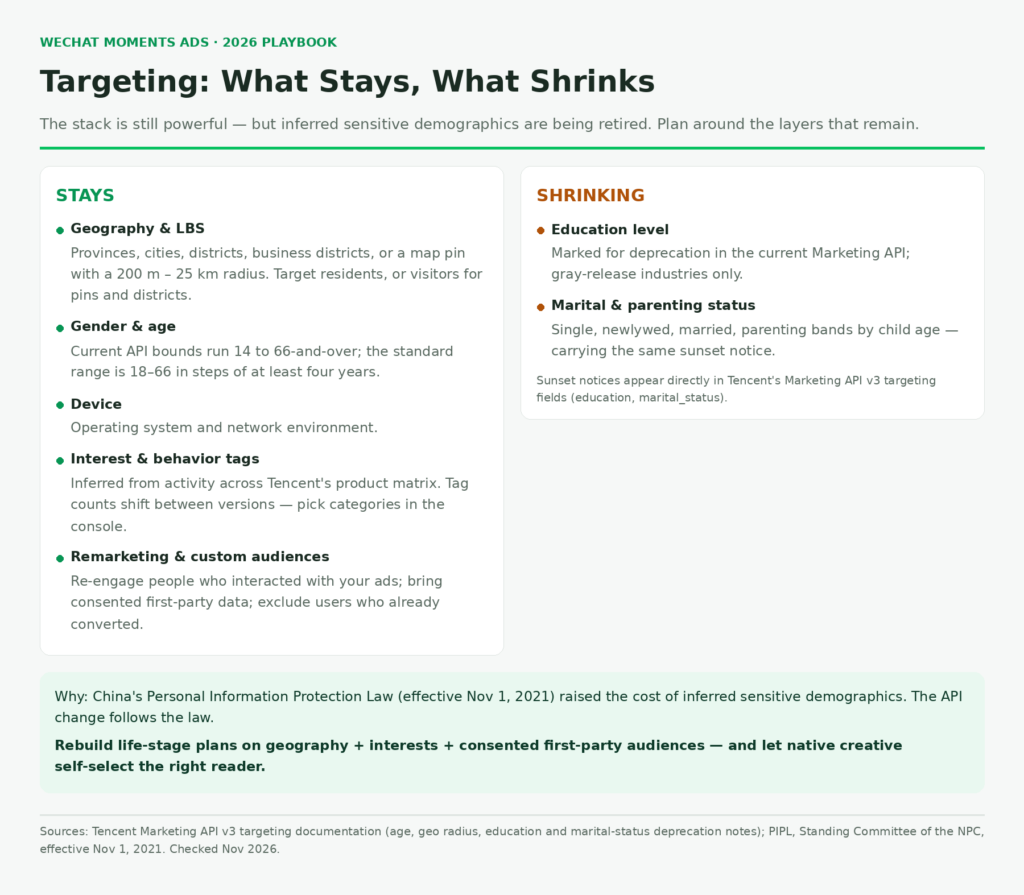
Tencent’s documented Moments targeting covers geography, gender and age, device type, interest and behavior tags, and remarketing. Geography is the sleeper hit for local businesses: beyond provinces, cities and districts, you can target business districts or drop a map pin with a radius from 200 meters to 25 kilometers. Province and city targeting on WeChat traffic uses residents; for map pins and business districts you can also choose people who visited. A clinic can buy the three kilometers around its door and almost nobody else.
Age bands in the current API accept bounds from 14 up to 66-and-over, with a standard range of 18–66 in steps of at least four years — forget the 5-to-60 range in old tutorials. Interest and behavior tags are inferred from activity across Tencent’s product matrix; the exact tag counts have shifted across documentation versions, so pick categories in the console rather than trusting any blog’s census. Remarketing re-engages people who interacted with your previous ads, custom audiences bring your own consented data, and the API can exclude users who already converted so you stop paying to persuade the persuaded.
The Shrinking Layers
Now the part most guides miss. WeChat became famous for life-stage targeting — single, newlywed, married, parenting a child of a specific age — plus education level. Tencent’s current API documentation marks both education and marital-status targeting as being phased out, available only to a gray-release subset of industries. Read that next to China’s Personal Information Protection Law, effective November 1, 2021, and the direction is obvious: inferred sensitive demographics are retreating. If your China plan depends on targeting new mothers by child age, rebuild it around geography, interests, first-party audiences and creative that self-selects the right reader.
Creative That Reads Like a Friend’s Post
The format is a costume, and your ad has to wear it convincingly. The avatar and nickname are your brand persona. The outer text should read like a casual first-person line, not a headline shouting a discount. Imagery should look like something a person would actually post. The regular series supports a single image, multi-image sets of three, four, six or nine, or video — including vertical video. Nine formats exist across the regular, card and full-frame series, but the regular native style is where both buying modes meet and where most teams should start.
Use the Social Mechanics, Not Just the Social Look
Tencent’s format documentation lists outer-layer features most foreign teams never touch:
- First-comment reply: your ad ships with a brand comment of up to 40 characters, and users can reply to it as they would reply to a friend. Replies are visible to the commenter’s friends — a small word-of-mouth engine.
- @-friend comments: a user can tag one friend per comment; the tagged friend gets a notification, and under normal delivery conditions the ad can appear in that friend’s feed too. Those tagged exposures are not charged. Free earned reach, built into the ad unit.
- Store badge: a location link under the copy opens a store page with map navigation and one-tap calling — the offline bridge for local businesses.
- Conversion social proof: if your account logged at least 50 conversions on the same objective in the past 30 days, the outer layer can display that count.
- Contract-only extras: celebrity avatar-and-name styling, and vertical video that plays your Channels live room directly in the feed.
Design the first comment before you design the image. It is the cheapest creative real estate on the placement.
Keep the Click Inside WeChat
Every serious Moments landing stays in the app: a Mini Program, a WeChat Store product page, a WeCom contact-add, an Official Account page, or a native canvas page. The API’s optimization goals include e-commerce orders, adding WeChat contacts and WeCom consultations — the plumbing of closed-loop conversion. Tencent’s Q3 2026 filing leans on exactly this: deeper closed-loop marketing across mini-dramas, WeChat Store and other WeChat services. No browser detour, no app-switch tax, payment one tap from the post.
So measure the loop, not the click. Track impressions, outer-layer click-through, landing engagement, then orders or qualified contacts inside WeChat. Last-click attribution undersells a feed placement whose likes are visible to friends; watch branded search and store traffic lift alongside direct conversions, and let oCPM optimize toward the deep event — the order or the qualified lead — rather than the shallow tap.
AIM+: The Automation You Are Now Bidding Against
In 2025 Tencent launched AIM+, a smart-delivery matrix built around an LLM-driven delivery agent, and named it in its third-quarter 2025 earnings. It began with scenario agents for store commerce, content consumption and lead generation; the fourth quarter added app-promotion and product direct-purchase agents. A one-click creative-selection feature mines your entire asset library and, Tencent says, delivers five times the creative supply of manual picking.
The company-reported numbers are striking: roughly 80 percent fewer platform operations per RMB 10,000 of spend, 47 percent fewer creative operations, one WeChat Store case with ROI up 94 percent, and a game advertiser cutting test cycles by 50–70 percent. Treat these as vendor data — Tencent sells this automation, and the figures are not independently audited — but the direction matches what buyers report. Your job shifts from pulling levers to feeding the machine: clean conversion signals, a deep creative library, honest budgets. The humans who win are the ones who make things worth selecting.
Compliance Gates You Cannot Skip
Four regulatory layers sit on top of Tencent’s own review, and all four are current law or current platform policy.
- Ad identifiability. The Internet Advertising Administrative Measures (SAMR Order No. 72), effective May 1, 2023, require ads to be recognizable as ads — and require review-style or experience-sharing content with purchase links to carry an ad label. Moments ads carry the platform’s ad tag automatically; your native styling must not try to hide it.
- Absolute claims. The Advertising Law bans national-level, highest-level and best-style superlatives. SAMR’s 2023 enforcement guideline adds context-based exemptions, but as a foreign brand, write claims you can document and skip the superlatives entirely.
- AI labeling. National rules from the Cyberspace Administration of China and three co-signing ministries, effective September 1, 2025 alongside a matching mandatory national standard, require explicit labels on AI-generated content. Tencent’s help-center notice of April 16, 2026 applies this to ads: AI-generated areas must carry a persistent label for the full duration — wording such as “this ad material was generated using AI technology” — and digital humans must be labeled as AI digital humans. A one-frame disclosure will fail review.
- Data consent. PIPL’s consent framework, effective November 1, 2021, is the backdrop to shrinking demographic targeting. Use platform targeting and your own consented first-party audiences; never scraped lists.
Platform review itself is predictable: creatives and landing pages clear within 24 hours on business days or 48 hours on weekends and holidays, with no expedited queue inside that window — build the lag into launch dates. Approved creatives that earn no impressions for three months are automatically taken offline and must be resubmitted. Tencent’s material rules also demand evidence for any sales or rating claims shown in creative, and authorization for any person’s likeness.
Risks and Honest Caveats
Four honest caveats before you spend. Prices are rates, not promises — re-verify the card and any minimums in the console at execution time. The RMB 50,000 figure is a contract minimum, not a universal entry ticket; auction entry is a different, lower conversation. Life-stage and education targeting is being withdrawn, so strategies built on it have a shelf life. And the native trust is fragile: over-commercial creative breaks the friend-post illusion, and the auction punishes it through quality scores before users ever do. The format rewards brands that act like guests, not billboards.
Conclusion: Buy Like a Friend, Measure Like a CFO
Moments ads in 2026 come down to five moves. Know the migration: buy on ad.qq.com, not the MP backend. Choose the mode by goal: contract for guaranteed bursts at city-tier rates, auction for optimized conversion. Target with the layers that are staying — geography, interests, remarketing — not the ones being retired. Write creative that earns its place in a friend feed, and use the built-in social mechanics: the 40-character first comment, the free @-friend reach, the store badge. Then keep the click inside WeChat and measure the closed loop. The fifth slot is a social-trust billboard. Advertise like a friend, and the format works for you; advertise like a banner, and you are paying premium CPM to be ignored.