There is a leaderboard for the AI race that everyone watches — benchmarks, valuations, chip counts — and one that almost nobody outside China talks about: downloads. On November 21, People’s Daily put that second leaderboard on the front page of the national conversation. Citing Ministry of Industry and Information Technology data, the paper reported that Chinese open-source large models have passed 10 billion cumulative downloads worldwide. In the same piece, it named Moonshot AI’s newly released Kimi K3.1 Pro — full weights now public — as the largest open-weight model on earth by parameter count.
The usage data behind the headline is just as striking. On OpenRouter, the marketplace where developers route real production traffic, Chinese models processed 119.1 trillion tokens in the week of November 9–15 — first place globally for the 29th consecutive week. Domestically, China’s daily token consumption has crossed 500 trillion, and the paper notes a detail that says more about commercialization than any benchmark: token top-up centers have appeared on domestic e-commerce platforms, and tokens were a hot-selling item in Double 11 livestreams. Compute has become a consumer product with a checkout button.
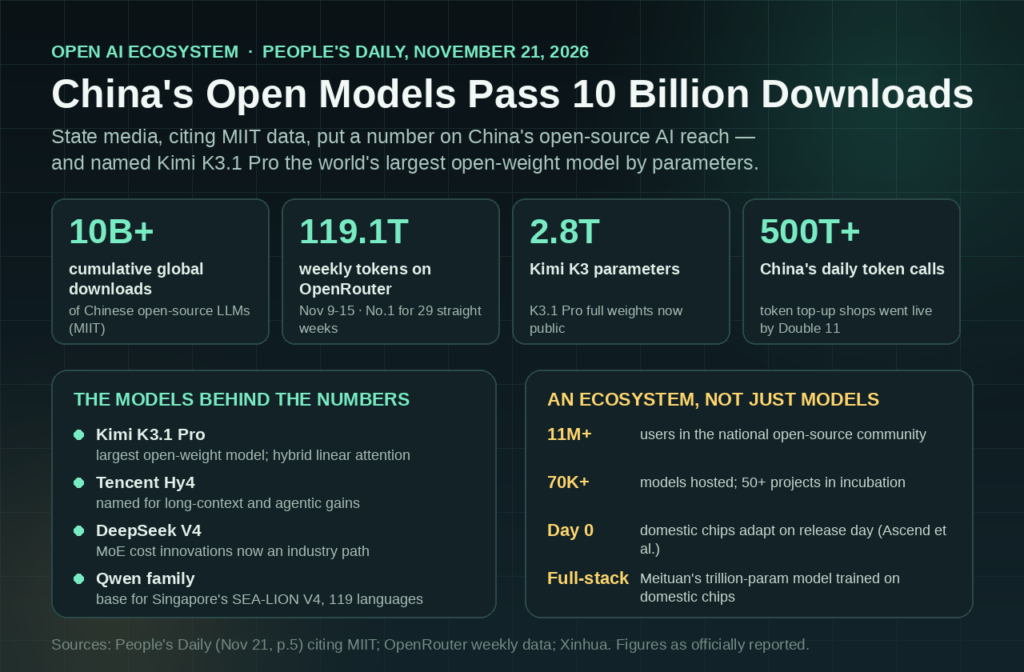
The models earning those numbers are worth naming, because the strategy differs by lab. Moonshot’s Kimi K3 rebuilt attention itself — a hybrid linear mechanism that makes million-token contexts cheap to decode and trillion-scale training stable; founder Yang Zhilin told the paper that Chinese open models are becoming “the benchmark in global vendors’ evaluations and an important sample for overseas research institutions.” Tencent’s Hy4 was cited for gains in instruction-following, long-context understanding and long-horizon tasks. DeepSeek’s mixture-of-experts cost innovations, the paper notes, became a direction the entire global industry now explores. And Alibaba’s Qwen family is quietly becoming infrastructure abroad: Singapore’s SEA-LION V4, built for Southeast Asia’s messy multilingual reality, was pretrained on 36 trillion tokens using Qwen’s open weights and its 119-language coverage.
Underneath the models sits an ecosystem that state media is now counting like industrial output: a national open-source community with more than 11 million users, over 70,000 hosted models, and 50-plus projects in incubation. Domestic chipmakers adapt to new open models on release day — “Day 0” compatibility that was unimaginable a year ago. Meituan trained and runs a trillion-parameter model entirely on domestic compute, and its November update shifted the official framing from “it runs” to “it runs fast and cheap.” The open-weight strategy and the domestic-silicon strategy are converging into one stack.
For global marketers and product teams, the practical implication is uncomfortable and simple: the default option for building AI features is increasingly a model you can download for free, fine-tune on your own data, and run wherever you like — and it increasingly speaks Chinese in its documentation first. The 10-billion-download milestone is not propaganda about the future; it is a measurement of decisions developers have already made, one download at a time. When state media starts keeping score of an open ecosystem, it usually means the score is already winning. The question for every AI vendor selling closed capabilities is no longer whether open models are good enough. It is what, exactly, they are still charging for.