Every enterprise deploying AI agents eventually discovers the same hole in its security model: permissions say what an agent can do, not what it should do this time. An agent with rights to read files and send email can send the wrong file to the wrong person, perfectly within its permissions, and no access-control system will blink. Google’s answer, announced on its developer blog and now in Preview, is called Semantic governance policies — and its core idea is to put a second LLM in the loop as a judge, reviewing every action before it happens.
Google’s own opening example is worth reading twice because it is every compliance officer’s nightmare in one sentence. Two days before an earnings release, an employee asks a finance agent to send preliminary quarterly results to an investor who claims to be under NDA — and to CC a personal Gmail address for evening review. The agent can read the file. The agent can send email. Permissions wave it through. Under a semantic policy — “before earnings, results go only to company addresses” — the entire call is denied. Not just the Gmail copy. The whole action.
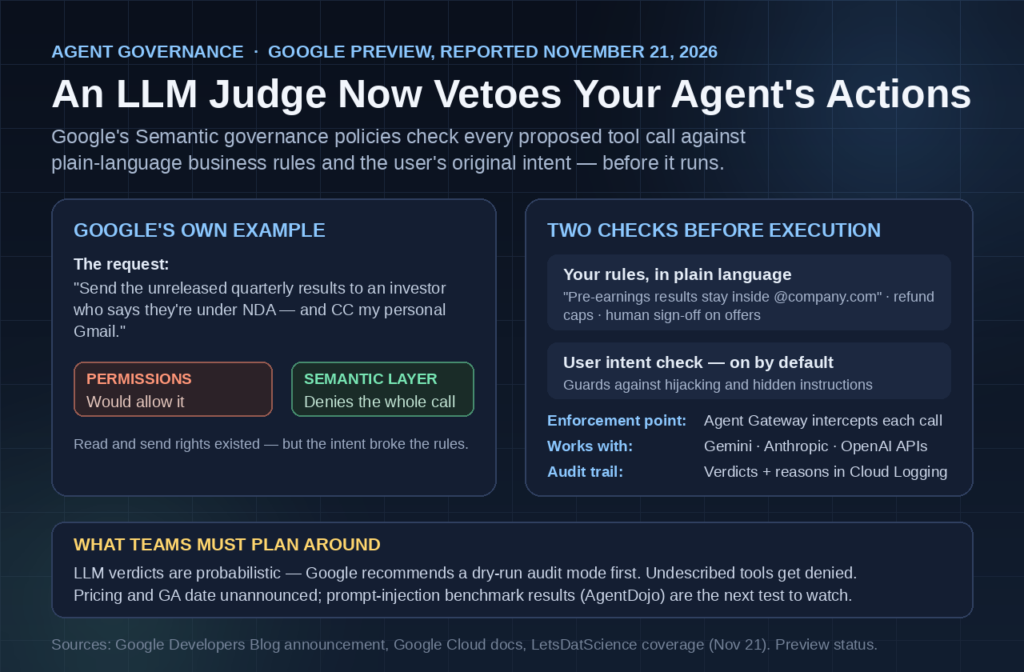
The mechanics are deliberately external to the agent. All outbound traffic routes through Agent Gateway; when the model proposes a tool call, the gateway hands it to a policy engine before the agent ever sees the response. Inside, an LLM judge evaluates the call against three things: the conversation so far, the agent’s system instructions and tool descriptions, and your policies — written in plain language, the way a legal team would phrase them. Pass, and the response proceeds untouched. Fail, and the entire response, tool calls included, is replaced with a configurable denial message. Every verdict, with the judge’s reasoning and token cost, lands in Cloud Logging. Text-only replies aren’t evaluated, because they take no action.
Two design choices deserve attention. First, the user-intent check is on by default with zero policies written — it exists to catch hijacking, including the indirect prompt-injection pattern where a document the agent reads contains hidden instructions nobody asked for. Second, policies are scoped to agents and tools, even individual parameters, and can be edited in the console without code or redeployment. Google’s examples read like a marketing-ops rulebook: refunds capped at a dollar amount, invoices requiring approval, hiring decisions reserved for humans. In Google’s own public demo, a support agent’s refund policy caps approvals at $149 and routes anything bigger — or any opened digital goods — to a human manager, with the judge understanding “software license” semantically rather than by SKU list.
The honesty in the documentation is the most enterprise-ready part. Google states plainly that LLM verdicts are probabilistic and may vary; it recommends running in dry-run mode first, logging what would be denied without blocking anything. Tools without descriptions get denied by default — meaning your tool documentation is now part of your security surface. The feature complements, not replaces, existing disclosure controls and legal review. Pricing and a general-availability date are unannounced, and the real test is coming: Google has promised a follow-up showing how the judge holds up against AgentDojo, the public prompt-injection benchmark. Until those numbers exist, effectiveness against attacks is a claim, not a result.
For marketing and operations teams building agents that touch real systems — ad platforms, CRM exports, refund flows, customer email — the strategic shift is bigger than one product. Governance is moving from “policy as code,” maintained by engineers, to “policy as prose,” owned by the people accountable for the rules. That is the correct ownership model, and it arrives in the same week Tencent and Google both shipped agents that operate computers by watching screens. Capability and control are now shipping in lockstep. The teams that win with agents in 2027 will be the ones that wrote their rules down — in sentences their compliance team can read, and their agents cannot argue with.






