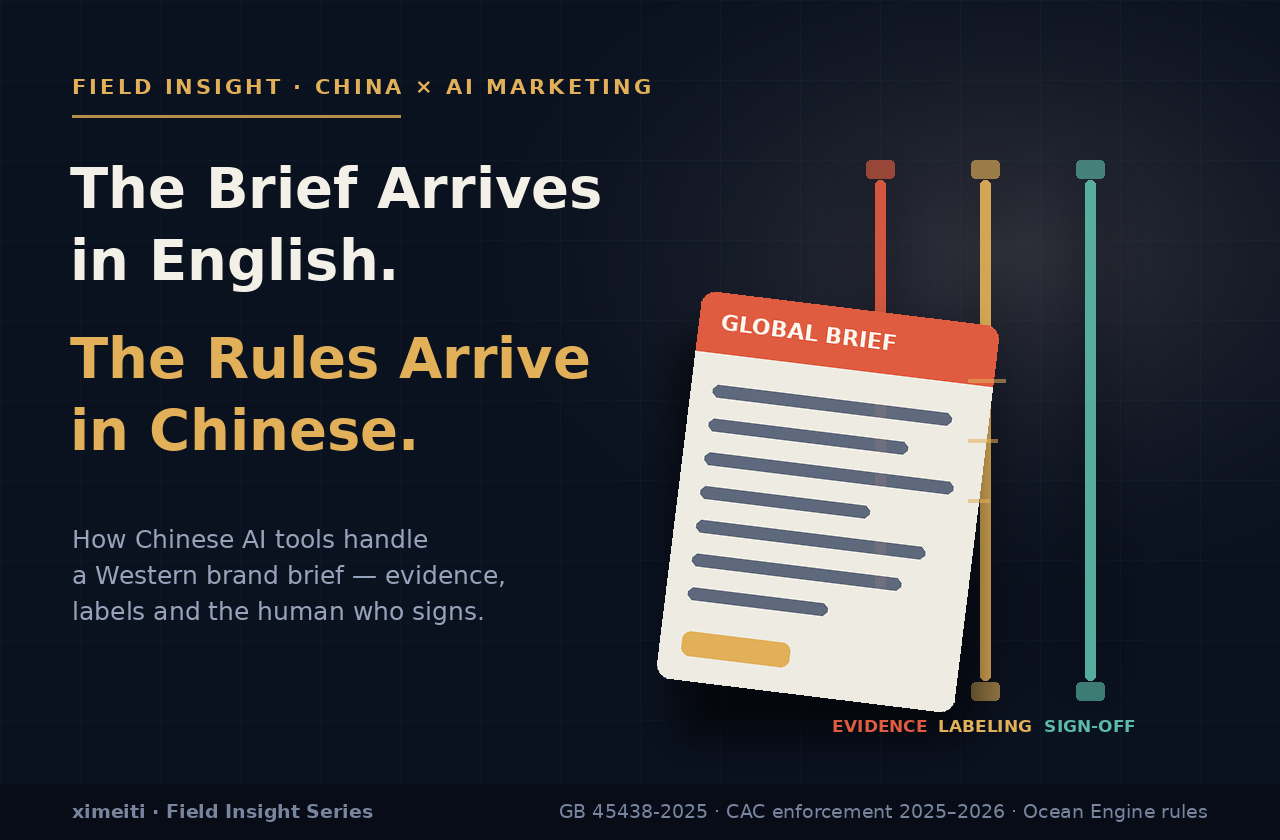
Hand a Western brand brief to a Chinese AI content tool and something strange happens: you get exactly what you asked for. Fluent copy. On-tone headlines. Platform-shaped scripts that read like they were written by someone who grew up scrolling Douyin. The demo looks like a win.
Then the asset hits the real world, and it stops.
Not because the Chinese was awkward. Because nobody attached a test report to the UPF claim. Because the publish button now demands a label decision the brief never mentioned. Because a synthetic presenter said “I tried it for two weeks” — and the platform rules say a synthetic person is not allowed to have tried anything.
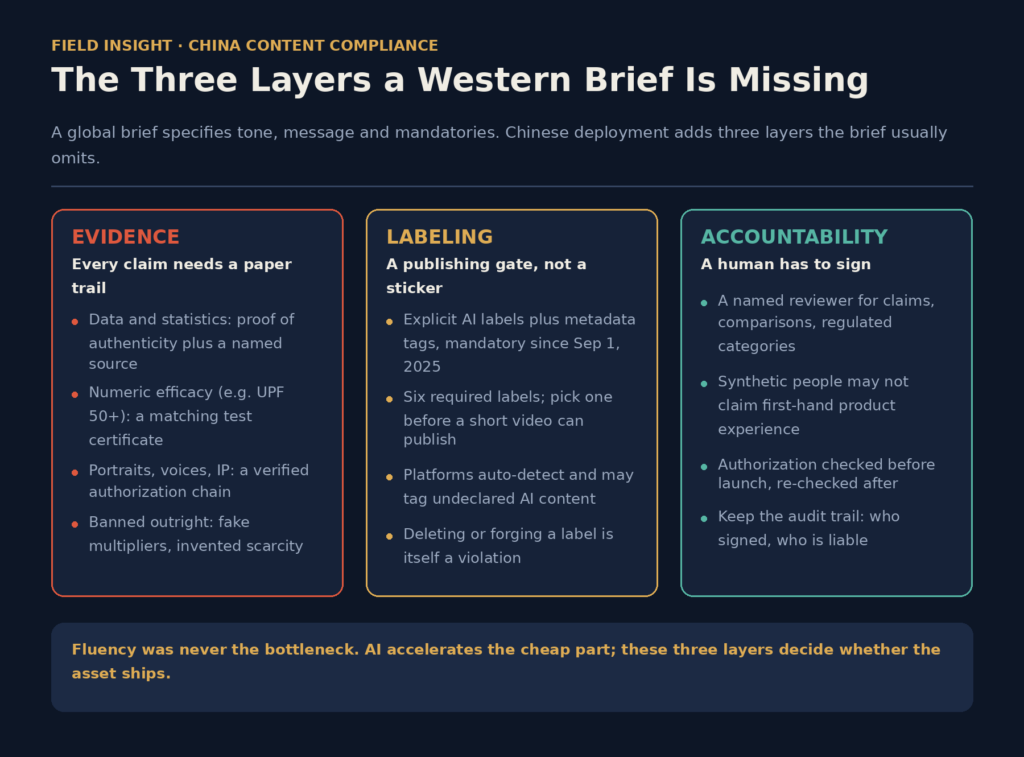
Here is the thesis of this piece, and it is worth stating plainly: the gap between a Western brief and Chinese deployment is not language. It is substantiation, labeling and accountability. The AI tool accelerates the part that was never the bottleneck, and stays silent about the three layers that actually decide whether your content ships.
One honest caveat before we go further, because the title promises “first-hand”: this is first-hand field observation of rules, enforcement and workflow — not a lab benchmark of specific tools. We describe what the output must satisfy, whoever generated it. That is the actionable layer anyway.
What a Western Brief Optimizes For
Open a typical global brief. You will find tone of voice, message hierarchy, mandatories, do-nots, maybe a mood board. It is a document about expression. It assumes that once the words are right, the asset is ready — legal will glance at it, someone will translate it, and the media plan does the rest.
That assumption travels badly. In China, the words being right is roughly step one of five. The remaining steps are documentary, procedural and human, and none of them appear in the template most global teams export.
Layer One: Every Claim Needs a Paper Trail
The rules of Ocean Engine — ByteDance’s advertising platform, which runs Douyin ads and the Qianchuan commerce-ad system — read less like creative guidance and more like an evidence checklist. They are public, and they are blunt.
Cite market data, a statistic or a survey result? You must submit proof the data is authentic and name the source. Claim “No. 1 in sales” or “a million downloads”? Proof again — self-generated numbers are not a loophole. Advertise a sun-protection garment at UPF 50+? A matching test certificate, please. Use someone’s face, name or voice? A verified authorization chain.
And some claims are banned outright, no paperwork will save them: invented scarcity (“sold out the moment it launched”), and unsupported multipliers — the rules literally list examples like “sound quality improved 80 times” and “this glue is a hundred times stronger than 502.”
Read that list again and notice what it is not. It is not a style guide. A line like “clinically proven 3x better” is not a creative choice your copywriter can A/B test. It is a document-submission requirement. The brief that carries only copy, and no claim-evidence table, has already failed — the AI just made the failure faster and prettier.
Layer Two: Labeling Is a Publishing Gate, Not a Sticker
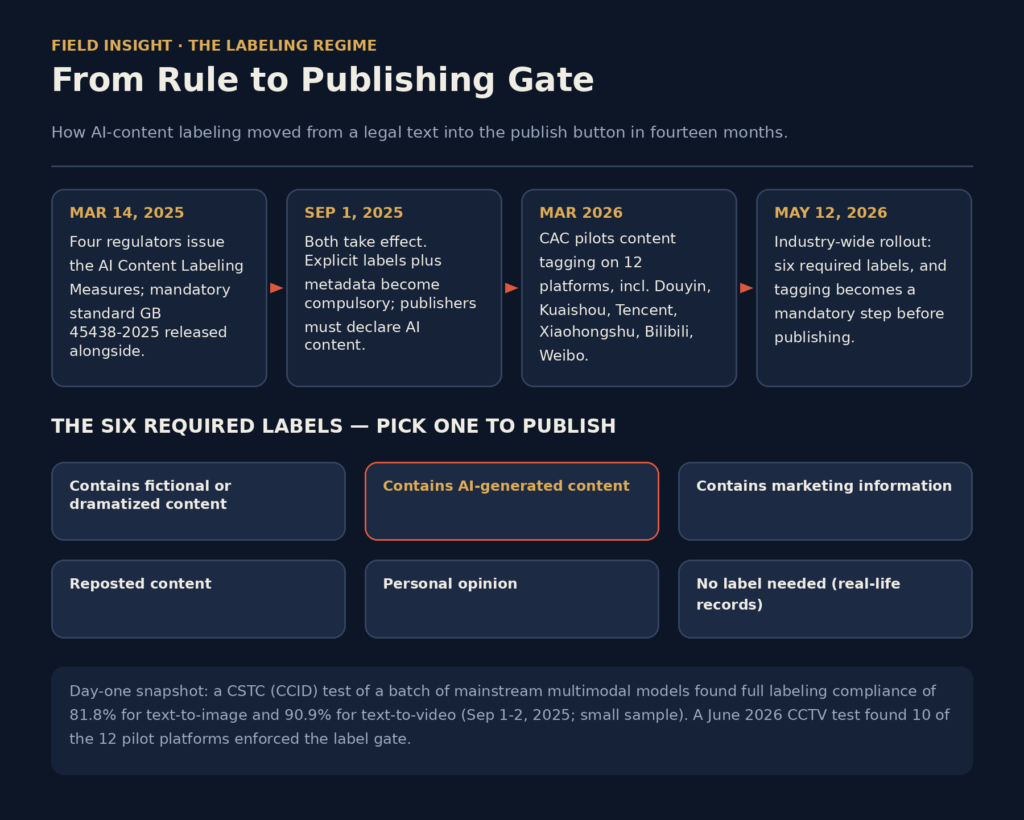
Since September 1, 2025, China has had a dedicated AI-content labeling regime: the Measures for Labeling AI-Generated Synthetic Content, issued jointly by four regulators — the Cyberspace Administration of China (CAC), the industry ministry, public security and the broadcast regulator — paired with a mandatory national standard, GB 45438-2025. Explicit labels the audience can see, plus implicit tags in file metadata. Not optional. Not “best practice.” Compulsory.
The interesting part is what happened next: the requirement migrated from the legal text into the publish button.
In March 2026, the CAC began piloting content tagging on twelve platforms — Douyin, Kuaishou, Tencent, Xiaohongshu, Bilibili, Weibo, Taobao, JD, Pinduoduo, Alipay, Meituan and Baidu. On May 12, 2026, it rolled the system out industry-wide with three moves: six required labels (contains fictional or dramatized content; contains AI-generated content; contains marketing information; reposted; personal opinion; no label needed for real-life records), tagging made a mandatory step before any short video can be published, and retroactive audits of existing content. You literally cannot press publish without choosing.
For a brand brief, this changes the unit of work. Labeling is no longer something the social team “handles at upload.” It is a per-asset decision that belongs in production planning: which elements are AI-generated, which label applies, who confirms it. Retrofit after rejection is the expensive path.
Layer Three: A Human Has to Sign
The third layer is the one global teams underweight most, because it sounds like bureaucracy. It is actually liability allocation.
Chinese practitioner workflows for AI content organize around fact-checking, hallucination flagging and human approval nodes that cannot be skipped for high-risk material — claims, comparisons, regulated categories. Treat these as practitioner analysis rather than regulation, but notice that the platforms are converging on the same logic from the other direction.
In October 2026, Ocean Engine moved authorization verification upstream: any asset using a person’s likeness, name or voice must carry lawful authorization checked before launch, re-checked periodically, and renewed when it expires. The company reports that interceptions of unauthorized assets in Q3 2026 more than doubled versus Q1, and that roughly 2,000 deliberately evasive advertiser entities were banned. Those are platform-reported numbers — the platform is describing its own enforcement — but the direction is unmistakable: the checkpoint moved from “respond to complaints” to “verify before you spend.”
Even more pointed for AI-generated creative: the rules prohibit AI virtual humans from claiming first-hand product experience, and prohibit synthetic fake experience content in reviews and seeding posts. Your digital presenter can read a script beautifully. She cannot say “I used it.” That sentence now belongs to a real human who actually did — which means the brief needs a named reviewer of record and an audit trail, not just an approval emoji in a group chat.
The Enforcement Backdrop: This Is Not Theoretical
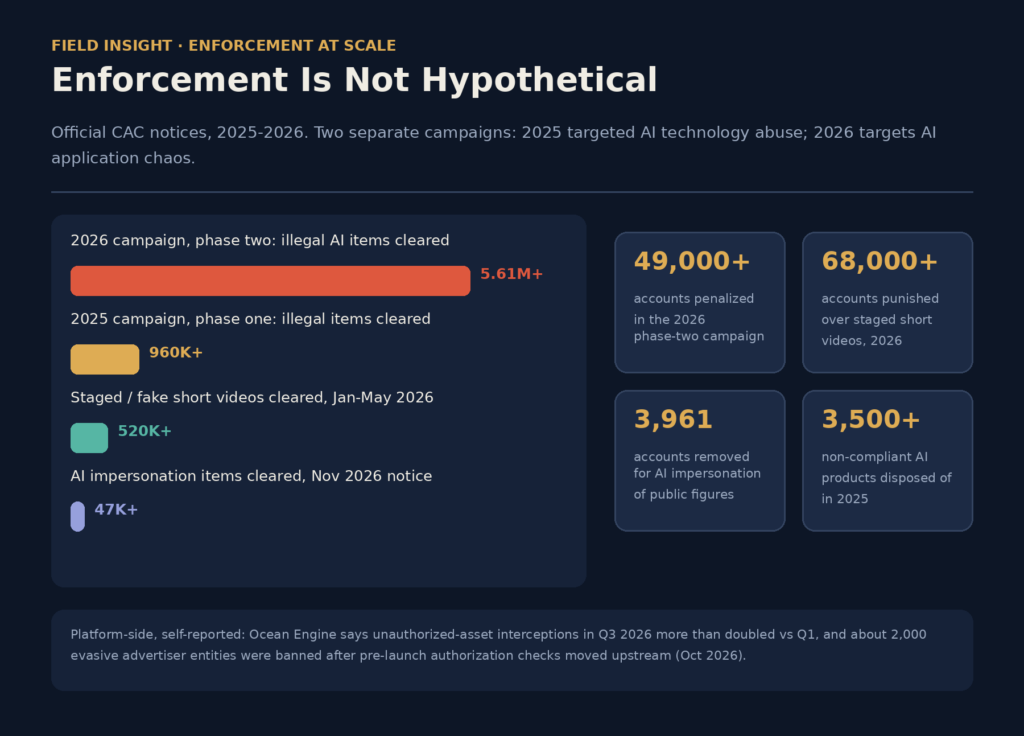
If you suspect these are paper rules, look at the cleanup numbers — and keep two campaigns straight, because they are different actions in different years.
The 2025 campaign against AI technology abuse reported, in its first phase, over 3,500 non-compliant AI products disposed of and more than 960,000 illegal items cleared. The 2026 campaign against AI application chaos went much bigger: by its second-phase notice in September 2026, more than 5.61 million illegal items cleared, over 49,000 accounts penalized, and some 2,400 websites and apps disposed of. Separately, staged and fake short videos drew their own cleanup — over 520,000 videos and 68,000 accounts between January and May 2026. And in November 2026, a dedicated notice on AI impersonation of well-known public figures reported 47,000-plus items cleared and exactly 3,961 accounts removed — fake celebrity endorsements, cloned voices selling products, that entire economy.
One more data point for the “the tools will handle it” crowd: on the day the labeling standard took effect, the China Software Testing Center — part of the CCID research group under the industry ministry — tested a batch of mainstream multimodal models and found full labeling compliance of 81.8% for text-to-image and 90.9% for text-to-video. Small sample, one-day snapshot, but the message generalizes: even the generation side was not fully compliant on day one. Your workflow cannot assume the label arrives attached.
Four Misunderstandings That Keep Recurring
“Translation is localization.”
No. Language is the smallest part. Platform grammar, substantiation and labeling are the localization work. A perfectly translated claim without a test report is a perfectly translated rejection.
“The AI output is ready.”
Fluency is not review clearance. The enforcement numbers above are, in large part, the sound of fluent content failing review at industrial scale.
“Compliance is a blocker.”
It is an entry condition, like a customs declaration. Teams that build evidence and labeling into the brief ship faster than teams that treat them as a surprise at the border. The constraint targets unsupported claims, not expression — substantiated creativity is untouched.
“One brief fits all platforms.”
Douyin, Xiaohongshu and WeChat differ in format grammar and in how tagging is implemented. A June 2026 CCTV field test found ten of the twelve pilot platforms enforcing the label gate — two still let videos publish with one tap. Same rule, different plumbing. One master brief, platform-specific annexes.
What This Means for Your Brief: Four Moves
First, ship a claim-evidence table with every brief: claim, required document, owner. No evidence, no claim — decide that before the AI writes a word, not after the platform asks.
Second, make labeling a production dependency. Per asset, decide which elements are AI-generated and which label applies, before shooting or rendering.
Third, name the human. A reviewer of record for high-risk content, a sign-off that cannot be skipped, an audit trail that survives staff turnover. Put authorization expiry dates in a shared calendar, not one person’s phone — lost ledgers are the most common compliance accident.
Fourth, fork the brief per platform. Keep the strategy central; attach platform annexes for format, tagging flow and category rules. And keep AI in the presentation layer — backgrounds, polish, script drafts — while the evidence layer stays human: real tests, real users, real signatures.
The Counterargument, and Its Limit
Fair objections exist. This piece does not benchmark tools directly — correct, and it says so. But the rules define what output must satisfy regardless of which model drafted it, so the requirements layer is where the leverage is. “Compliance kills creativity” confuses the target: the ban is on unsupported claims, not on ideas. And “AI will handle compliance automatically” keeps colliding with the accountability question — who signed, who is liable — which is precisely why practitioner frameworks and platform verification both keep a human node that cannot be skipped.
Conclusion: Fluency Was Never the Bottleneck
A Western brief meets three Chinese layers it usually omits: documentary substantiation for every claim, procedural labeling at the publishing gate, and named human accountability. None of this is secret; all of it is published, enforced at million-item scale, and baked into the publish flow. The fix is unglamorous and cheap relative to a rejected campaign: a claim-evidence table, a labeling decision per asset, a reviewer of record, platform annexes. The tools made drafting nearly free. That was never the expensive part. The expensive part is proving what you said, declaring what you made, and standing behind both — and that part still has your name on it.