While chip stocks were having their worst week since 2008, the debt market quietly conducted its own referendum on the AI boom — and published the results. Apollo Global Management and Goldman Sachs announced the pricing of a roughly $44 billion financing package to buy Nvidia’s next-generation Vera Rubin chips and lease them to SpaceX. It is, the firms said, the largest GPU financing ever arranged. Investors oversubscribed it. They also demanded to be paid like it might go wrong.
The number that matters is 8.259%. That is the yield on the largest tranche — $25.17 billion of senior secured A3 notes maturing in April 2033 — against an average of 5.95% for US investment-grade debt the same day. A spread of 231 basis points. The smaller tranches tell the same story: about $4.4 billion of A2 notes priced at 7.66%, and $2.56 billion of subordinated B notes at 8.36%. These are investment-grade-rated securities borrowing at costs the market normally associates with riskier credits. The rating says blue chip. The yield says: we have questions about the collateral.
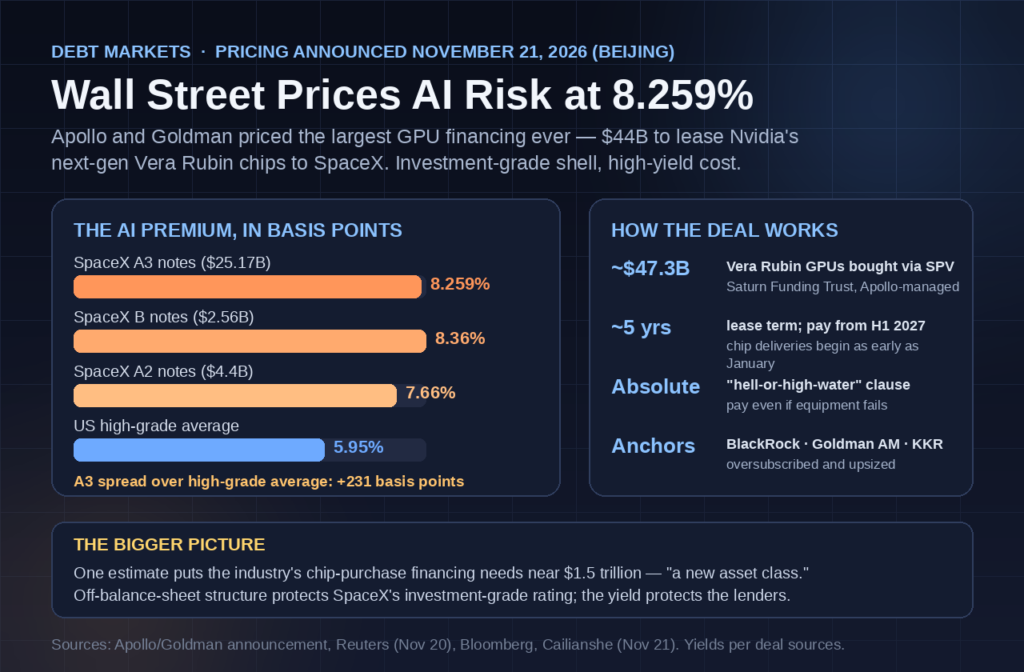
The collateral is the question. The chips are purchased through a special-purpose vehicle called Saturn Funding Trust, managed by an Apollo-backed entity, which buys roughly $47.3 billion of GPU equipment and leases it to SpaceX for about five years, with payments beginning when deliveries start in the first half of 2027 — chip shipments could begin as early as January. The structure keeps the borrowing off SpaceX’s balance sheet, protecting the investment-grade rating that lets the company keep raising money fast. But the lenders wrote themselves unusual protections: a “hell-or-high-water” clause obligating SpaceX to keep paying even if the equipment fails or a natural disaster strikes. You do not write that clause for assets you trust to hold their value. GPUs depreciate on the rhythm of Nvidia’s product cycle, and everyone in this deal knows it.
There is recent history sharpening the caution. SpaceX’s unsecured bonds from its June offering fell badly in secondary trading, leaving some investors burned; CreditSights noted real client skepticism about this new deal, and the wide pricing was partly the cost of coaxing traditional bond buyers back to the table. BlackRock, Goldman Sachs Asset Management and KKR accounts anchored the transaction — sophisticated money, entering at a price that compensates for what it cannot fully model.
Zoom out and this stops being a SpaceX story. Diameter Capital’s Scott Goodwin estimates companies will need roughly $1.5 trillion to finance the chips driving the AI buildout, and called structured deals like this “a new asset class.” That is the real news: AI infrastructure is being financialized into securities that pension-adjacent money can hold — with a risk premium attached, in public, in basis points. Equity investors spent the week arguing about whether AI valuations make sense. The bond market answered with a number. For anyone building a business on AI infrastructure — from cloud procurement to marketing-tech vendor selection — 8.259% is the cost of capital your suppliers are now paying. It will show up in their pricing, their contract terms, and their survival odds. The AI premium is no longer a metaphor. It has a coupon.