Masayoshi Son has made a career of bets that looked absurd until they didn’t. His latest, according to The Information, was a doozy even by his standards: the SoftBank chairman recently approached Wall Street institutions about financing a possible buyout of SK hynix — the Korean memory-chip giant — at a price that could have reached $1 trillion. A SoftBank spokesperson confirmed the idea had been explored and said it is no longer under active consideration. The deal is dead. The signal it sent is very much alive.
Start with the arithmetic, because it explains both the ambition and the shelf. SK hynix, which listed in the US this July, carries a market value of roughly $580 billion today, down sharply from its peak a month ago. The $1 trillion figure Son floated works out to approximately that peak valuation plus a 40% control premium — the standard math of a takeover, applied at a scale the industry has never seen. It is also about nine times SoftBank’s own market capitalization of roughly $109 billion. Son was asking banks how to buy a company nine times the size of his own.
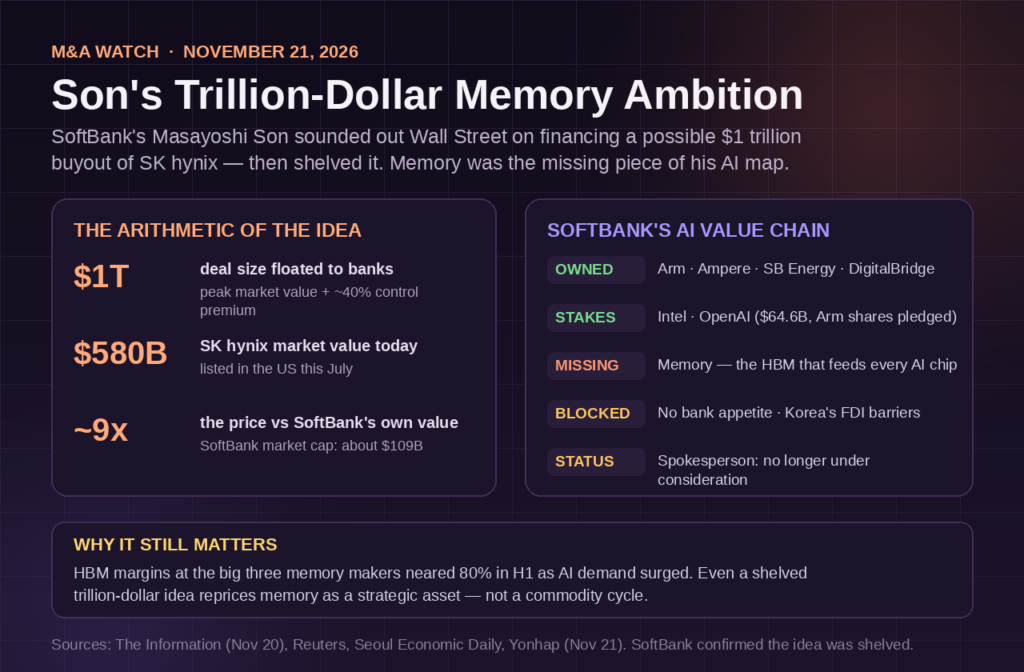
Why SK hynix? Look at what SoftBank already owns. It is the largest shareholder of Arm, whose chip designs sit inside nearly everything; it owns server-chip designer Ampere, data-center-and-power operator SB Energy, and data-center investor DigitalBridge; it holds significant stakes in Intel and OpenAI — the latter a $64.6 billion commitment financed by pledging Arm shares as collateral. Design, compute, energy, financing, and the leading AI lab: all covered. The one link Son has never secured is memory — specifically the high-bandwidth memory that must be stacked beside every advanced AI accelerator. SK hynix, Samsung and Micron are the only three suppliers on earth, and the AI boom pushed their profit margins toward 80% in the first half of this year. In Son’s map of the AI value chain, HBM is the last unowned territory.
The obstacles were structural, not cosmetic. There was no indication any Wall Street institution was willing to finance a purchase of that size for a balance sheet already strained by the OpenAI bet. South Korea guards its core technology assets against foreign control, and a Japanese conglomerate taking over the nation’s memory champion was never going to breeze through review. And SK Group, which controls SK hynix, has shown no sign of wanting to sell. The idea appears to have died in its early conceptual stage — which is exactly where deals like this usually die.
So why does a dead deal matter? Because it tells you what the smartest, most aggressive capital allocator in AI thinks the endgame looks like: vertical control of the entire chain, with memory as the crown jewel. Son’s trillion-dollar daydream landed in the same week that Micron warned 2027 supply will be tighter than 2026, Samsung promoted its HBM research chief to run the memory business, and memory stocks led a global chip selloff. The market is nervous about memory’s cyclicality; Son was willing to bet a trillion dollars on its permanence. Both views cannot be right — and every procurement team signing multi-year HBM contracts, every brand planning hardware costs into 2027, is implicitly choosing a side. The deal Son shelved is the clearest statement yet of what the bull case actually believes.






