Open two phones side by side. On one, a shopper in Chicago types “best carry-on under 7kg” into Google and clicks a result. On the other, a shopper in Chengdu scrolls Douyin, sees a suitcase crushed by a scooter, laughs, taps the yellow cart, and pays — without ever typing a word. Same product. Same intent, eventually. But two completely different economies produced those sales.
Western digital marketing grew up inside a search economy: people declare what they want, and advertisers compete to capture it. China’s mobile economy grew up inside a feed economy: algorithms manufacture the want before any query exists. We’ve spent twenty years arguing about formats — SEO versus short video, PPC versus livestreams. That argument misses the point. The real split is about gravity: does your market’s center of mass sit on capturing demand, or creating it?
And here’s the twist that makes this piece timely: AI answers are dissolving the split from above. A query answered by a synthesized recommendation is both economies at once. Let’s unpack how we got two physics — and why they’re merging into a third.
1. The Phenomenon: Two Defaults, Two Budgets
The Western default: capture what people already want
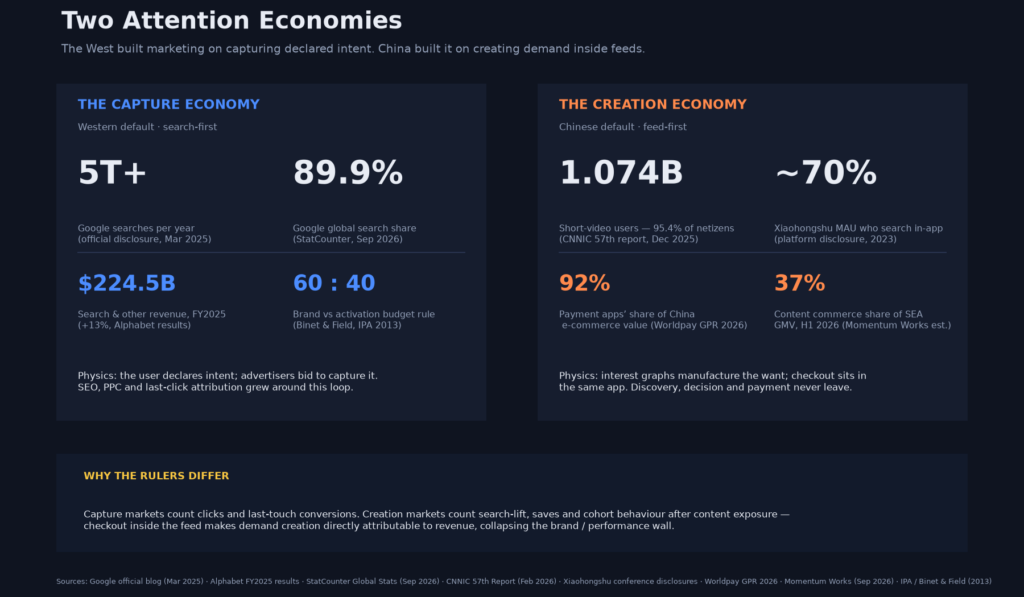
Google disclosed in March 2025 that it processes more than 5 trillion searches a year — its first volume disclosure since 2016, when the figure was 2 trillion. That’s roughly 14 billion questions a day, and StatCounter’s panel still credits Google with about 90% of worldwide search referrals (89.94% in September 2026). The money follows the intent: Alphabet’s Search & other business booked $224.5 billion in 2025, up 13%. An entire discipline — keywords, bids, quality scores, last-click attribution — was built to harvest declared demand at the moment of declaration.
The Chinese default: manufacture the want, close it in-app
China’s official internet census (CNNIC’s 57th report, covering December 2025) counts 1.125 billion netizens, of whom 1.074 billion — 95.4% — use short video. It was the only major app category that grew both users and usage rate in 2025. Douyin’s daily audience runs into the hundreds of millions by third-party estimates (ByteDance no longer publishes precise DAU figures, so treat any exact number with suspicion). Products get discovered mid-scroll, judged by community verdicts, and bought without leaving the app.
2. The Budget Signature: One P&L or Two?
Western budgets inherited a wall. Binet and Field’s 2013 IPA study — roughly a thousand effectiveness-award campaigns across 700 brands — famously recommended splitting spend about 60:40 between long-term brand building and short-term sales activation. Two budgets, two clocks, two measurement regimes.
Chinese budgets never hardened that wall. Content production, creator seeding and feed ads blur into one demand-creation line, because checkout lives where content lives. When payment apps carry 92% of China’s e-commerce transaction value (Worldpay’s Global Payments Report 2026, based on 63,000+ consumers across 42 markets), a livestream isn’t “brand activity that might convert someday.” It’s a register with a camera attached.
3. The Deep Mechanism: Why History Split the Map
Cause one: where the corpus lives, attention follows
The West’s open, crawlable web let Google index everyone’s content and become the universal intent layer. China’s content moved inside super-apps — WeChat articles, Taobao listings, Xiaohongshu notes — where crawlers couldn’t reach. Open search starved. Then trust cracked: after the 2016 Wei Zexi case, a joint investigation by China’s cyberspace, industry and health regulators found Baidu’s paid-ranking system weighted money too heavily and labeled ads too faintly. Baidu was ordered to reweight ranking toward credibility, cap promotions at 30% of a results page, and it removed 2,518 medical institutions and 126 million promotional listings. Discovery didn’t wait around; it migrated into communities and feeds.
Cause two: the mobile leapfrog
Most Chinese netizens came online after feeds already existed. No desktop-search habit to unlearn. Western users had fifteen years of “Google it” muscle memory before feeds arrived. Habits are infrastructure.
Cause three: checkout bolted to the feed
Chinese platforms attached wallets and carts directly to content, making demand creation measurable to revenue on the same day. Western feeds spent years shipping traffic elsewhere — creation sat in social’s P&L, capture in search’s. What gets measured together gets budgeted together.
Cause four: different objective functions
Interest-graph feeds optimize session time through novelty; search optimizes query satisfaction through relevance. One rewards fresh, emotionally hooky content; the other rewards evergreen answers. Different objective functions breed different ecosystems — and different marketer reflexes.
4. China Never Killed Search — It Fragmented It
Here’s the misconception to retire: “China has no search behavior.” It searches constantly — inside apps. Xiaohongshu disclosed that roughly 70% of its monthly users search, and a third open the app and go straight to the search box. Platform-reported figures put daily searches around 600 million by late 2024, on a base of 300M+ monthly users. Verdicts on Xiaohongshu, how-tos on Douyin, products on Taobao: search fragmented into vertical intent pools, each with its own optimization discipline.
Notice what the standard scoreboard misses. StatCounter measures website referrals — Baidu led China with about 47% of all-device referrals in September 2026 — but it cannot see a search that starts and ends inside an app. The measurement itself is a relic of the open-web era. The map is not the territory.
5. The Export Proof: Creation Gravity Is Spreading
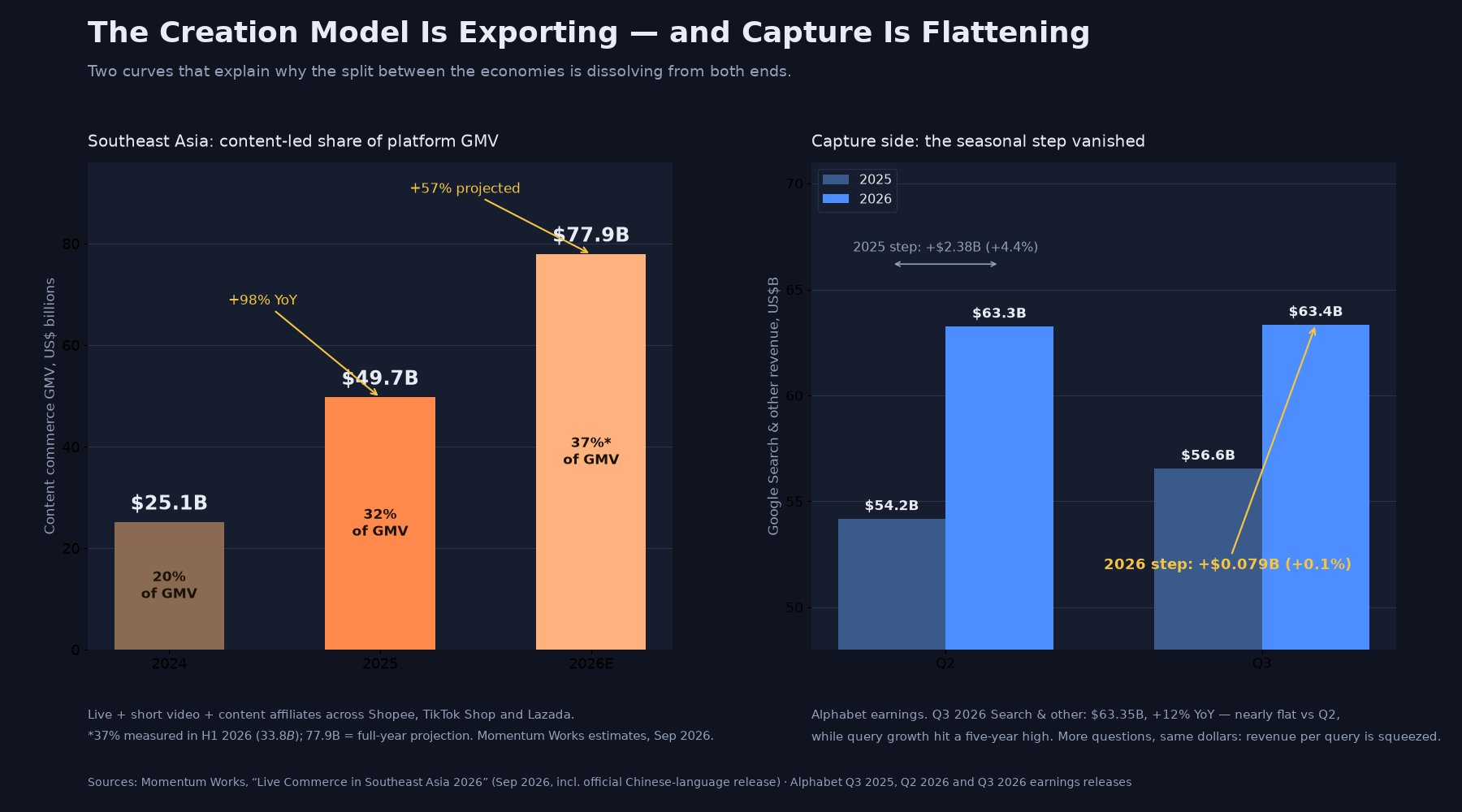
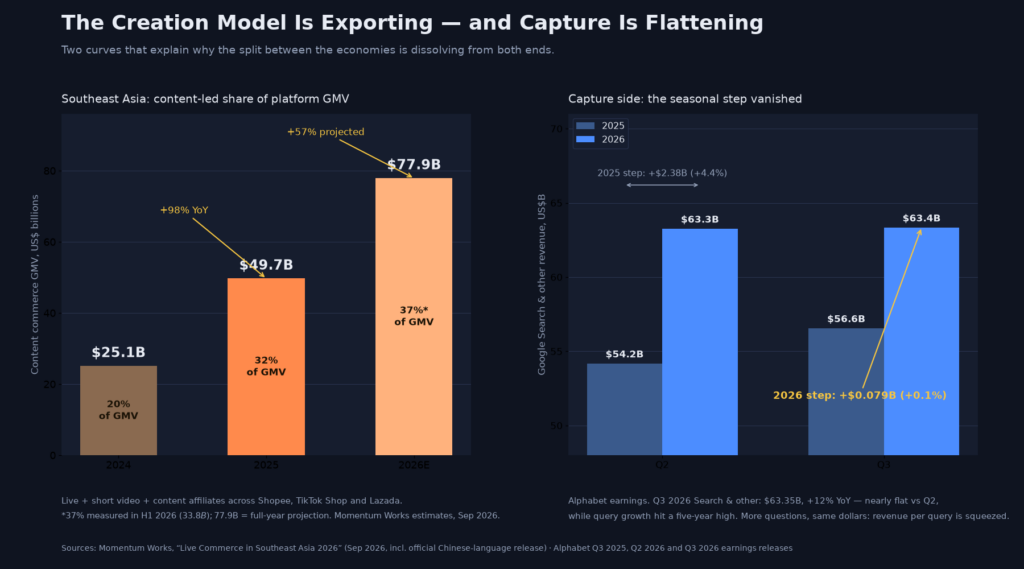
If feed physics were a Chinese quirk, they’d stay in China. They didn’t. Momentum Works estimates Southeast Asia’s content commerce — live, short video and content-led affiliates across Shopee, TikTok Shop and Lazada — grew from $25.1 billion in 2024 (about 20% of platform GMV) to $49.7 billion in 2025 (32%, up 98%), reaching $33.8 billion in the first half of 2026 alone — 37% of GMV, on track for roughly $77.9 billion for the year. These are research-firm estimates, not audited accounts, but the direction is unmistakable: the exported model is creation-first commerce.
Meanwhile the capture side shows strain. Alphabet’s Q3 2026 Search revenue grew 12% year-on-year to $63.35 billion — but only $79 million versus the prior quarter, essentially flat, against a $2.4 billion seasonal step a year earlier. Management said query growth hit a five-year high. More questions, same dollars: monetization per query is under pressure as answers replace clicks.
6. What Everyone Misunderstands
Three errors keep circulating. First, “feeds won everywhere” — no; Western search spend remains enormous and intent capture still closes most considered purchases. The split is about center of gravity, not extinction. Second, “demand creation is soft” — Western doctrine treats creation as brand (unmeasurable) and capture as performance (real). China’s closed loop made creation directly attributable, collapsing the wall Binet and Field spent a decade defending. Third, “the split is permanent” — which brings us to the merge.
7. The Twist: AI Answers Are Both Economies at Once
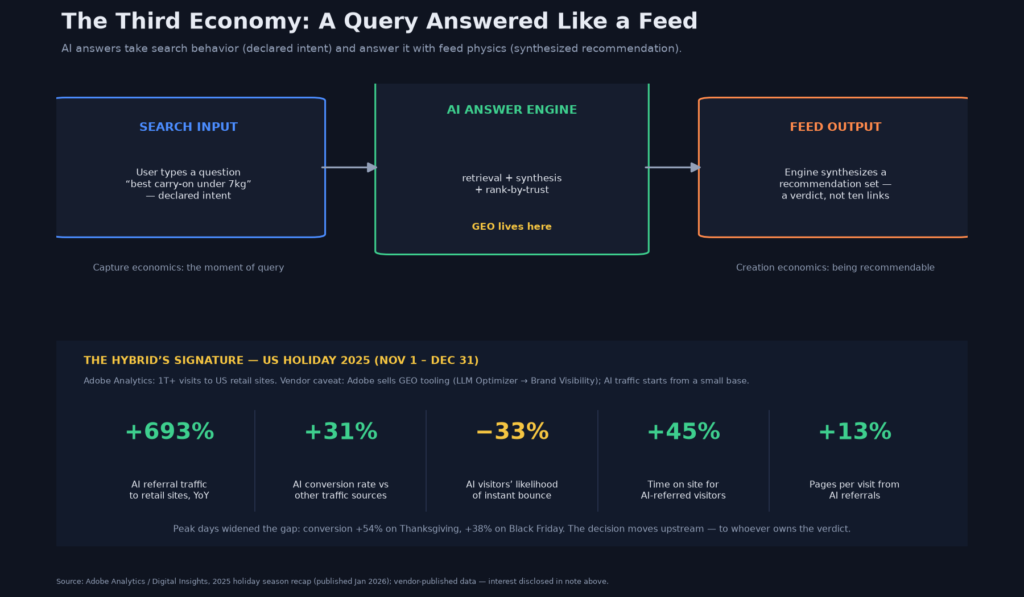
Watch the anatomy of an AI shopping answer. The user declares intent — pure search behavior. The engine retrieves, synthesizes and ranks a recommendation set — pure feed physics. One surface, both economies. The shopper gets a verdict, not ten blue links.
Adobe Analytics — and note the interest here: Adobe sells generative-engine optimization tooling, so discount the enthusiasm accordingly — measured the 2025 US holiday season across more than a trillion retail-site visits. AI-sourced referrals grew 693% year-on-year from a small base, and converted 31% better than other traffic (54% better on Thanksgiving). AI-referred visitors were 33% less likely to bounce instantly, spent 45% longer on site, and viewed 13% more pages. Small base or not, the signature is clear: the query arrives pre-decided. The choice is moving upstream, into the answer.
8. The Counterargument, and Its Limit
Fair pushback: Google still dominates outside China, Baidu keeps meaningful health and legal traffic, and TikTok Shop means Western feeds now carry checkout too. True — convergence is underway from both sides. But origins cast long shadows: skills, org charts and budget lines were built around one gravity, and they don’t rewire in a quarter. And if AI answers merely restored old search economics by citing and clicking through? Adobe’s decision-stage data says otherwise — confidence up, returns down, choice made before the visit. The hybrid rewards whoever owns the verdict, not whoever hosts the click.
9. What Brands Should Actually Do
Budget by gravity, not habit. In capture-gravity markets, defend intent coverage — search plus AI answers. In creation-gravity markets, fund the content engine and creator bench as performance lines, because that’s what they are there. Misallocated budgets are the most common cross-border error we see.
Build both corpora. Evergreen answer-content for retrieval (search and AI engines cite what they can verify), plus fresh feed-content for discovery. Two clocks, one strategy.
Measure with the right ruler. Creation gravity counts search-lift and cohort behavior after exposure; capture gravity counts clicks and last touch. Import the wrong ruler and you’ll defund the right strategy.
And prepare for the merge: being recommendable at the moment of query is the new job description. That’s what GEO — generative engine optimization — actually is: the discipline where the two economies meet. China’s AI adoption makes this urgent, not theoretical: CNNIC counted 602 million generative-AI users by December 2025, 42.8% of netizens. The audience for synthesized verdicts is already mass-market.
Conclusion: Fluent in Both Physics
Two accidents of history built two marketing physics. The crawlable web crowned search and made Western marketing a capture discipline. Walled super-apps crowned feeds and made Chinese marketing a creation discipline with a cash register attached. Neither is “the future,” because AI answers are fusing query and recommendation into a third economy that pays whoever becomes the verdict. The feed ate the search box twice — first in China, now everywhere, one answer at a time. Learn both physics. Keep both rulers. The merge doesn’t care which one you grew up in.