Two markets, two ways of deciding whom to believe. In the West, institutions clear the risk and reviews fine-tune the choice. In China, the crowd clears the risk itself — and the certificate is just the ticket through the door. Both systems are now being rewritten by the same technology: AI that manufactures fake evidence at zero marginal cost, and AI that consumers increasingly ask to verify it for them. This piece walks through the data behind each stack, why they took their shapes, and what brands should actually do about it.
The Number That Broke Western Review Trust
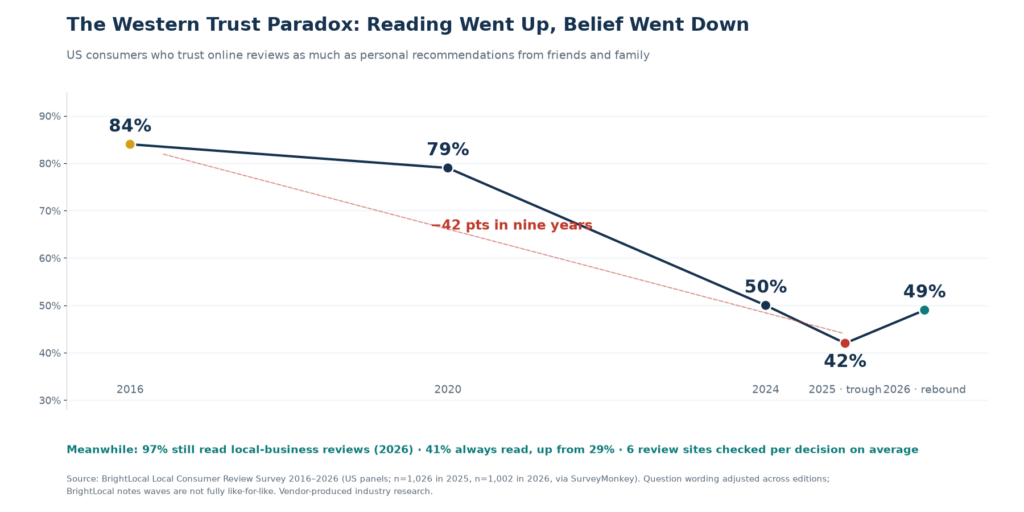
Here is a statistic worth sitting with. In 2020, 79% of US consumers told BrightLocal they trusted online reviews as much as personal recommendations from friends and family. In 2025, that figure was 42%. In 2026, it recovered slightly to 49% — still less than two-thirds of where it stood six years earlier, and far below the mid-80s peak (84–85%) the same survey recorded in 2016–2017.
One caveat before we build anything on this: BrightLocal is a local-marketing software vendor, and its Local Consumer Review Survey is industry research, not academic work. The panels are real and representative — 1,026 US adults in 2025, 1,002 in 2026, recruited via SurveyMonkey — but the firm itself notes that question wording has shifted across editions, so the waves are not perfectly like-for-like. Treat the series as a strong directional signal, not a laboratory measurement.
And the direction is unmistakable. Trust in the crowd layer of Western commerce roughly halved in under a decade.
The Trust Paradox: More Reading, Less Believing
Now here is the twist that most coverage misses. While belief collapsed, usage climbed. In the 2026 survey, 97% of consumers read reviews for local businesses, 41% said they always read them (up from 29% a year earlier), and the average consumer consults six different review sites before choosing a business. Google’s share of review-reading actually fell from 83% to 71% — not because people stopped researching, but because they spread their suspicion across more sources.
Read that again: people trust reviews less, so they read more of them, in more places. Cross-checking replaced believing. The review stopped being a verdict and became a piece of evidence — one exhibit in a case file the consumer assembles personally. The top trust factor in 2026 was not the star rating; it was whether a review was corroborated by other reviews with similar sentiment (56%). Consumers also got pickier: 47% refuse businesses with fewer than 20 reviews, 74% only weigh reviews written in the last three months, and 31% now demand 4.5 stars or more, nearly double the 17% who said so in 2025.
If that pattern sounds familiar, it should. It is exactly how Chinese shoppers have treated reviews for years.
China’s Verification Reflex
Ask anyone who shops on Taobao or browses Xiaohongshu before buying, and you will hear the same routine described almost like a checklist: read the photo reviews, scroll to the negative ones, check the follow-up reviews posted weeks after purchase (追评), look at the sales count, scan the Q&A section, then cross-check notes on another platform before committing. Nobody taught this in a class. It is a reflex trained by a decade of counterfeit exposure and uneven institutional recourse — a generation that learned, purchase by purchase, that the safest verifier available was other buyers’ documented experience.
The trust hierarchy at the discovery moment shows the same logic. In iiMedia Research’s 2025 survey of Xiaohongshu users, 52.12% said they most trust recommendations from KOLs — professional creators with vertical expertise — when deciding what to buy, while 22.66% trust ordinary-user (KOC) recommendations and 14.46% say they ignore who posted and judge the content alone. Celebrity endorsements sit at the bottom of the table. Two honest footnotes: iiMedia is a commercial research firm, and its published table has an internal gap — the listed shares sum to only 90%, and a state-media write-up reported the celebrity figure differently, so we deliberately avoid quoting that one decimal. The headline structure is consistent across both versions: expertise-bearing creators and documented peer experience carry the trust; fame does not.
That last point matters more than it looks. The Chinese crowd layer is not naive hero-worship. It is a preference for evidence format over status.
Certifications Exist in China — They Just Don’t Choose for You
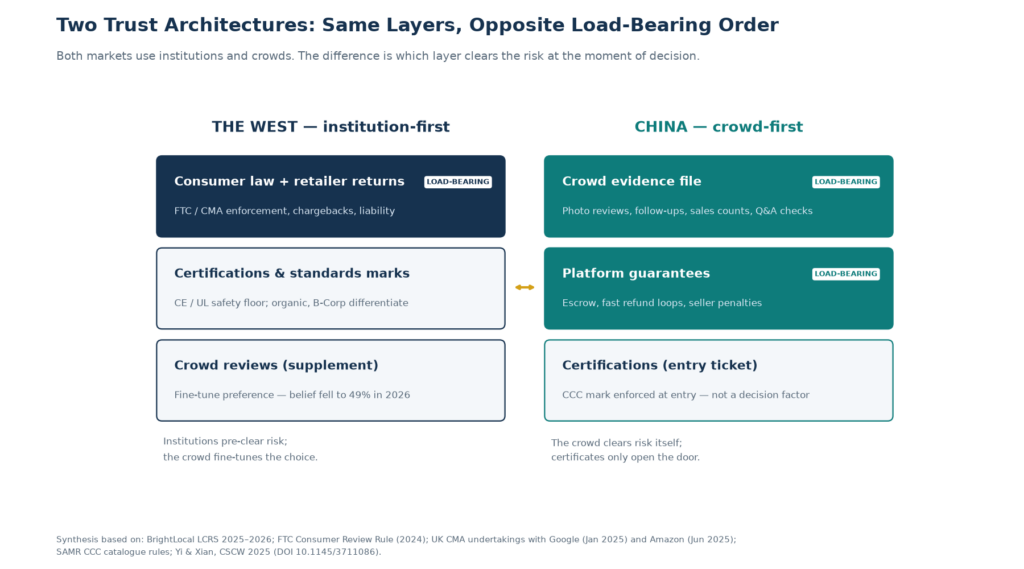
The lazy version of this story says China has no institutional trust layer. That is false, and the correction is the whole insight. China runs one of the world’s most extensive compulsory certification systems: the CCC mark, administered by the State Administration for Market Regulation. Products on the compulsory catalogue — appliances, toys, wiring, vehicle safety parts — cannot legally be manufactured, sold or imported without certification, and the system keeps tightening: a 2025 SAMR announcement moves 16 product categories from supplier self-declaration to third-party certification, with full enforcement from January 2027.
So certifications are real and enforced. But notice what they do: they gate market entry. They are the floor every legal product must clear, which means they cannot differentiate one listing from another at the decision moment. Every toaster on the shelf has the mark. What chooses the toaster is the evidence file — the photos, the follow-up reviews, the sales momentum, the answered questions.
The West inverts this. Safety regulation, product liability and retailer return policies pre-clear the risk so quietly that shoppers rarely think about them — you do not inspect a UL mark before buying a kettle. Against that invisible floor, certifications become differentiators when they are voluntary: organic, Energy Star, B-Corp. And reviews sit on top as the preference layer, the tie-breaker between pre-cleared options. When that top layer eroded under fakes, Western consumers had institutions to fall back on. Chinese shoppers, historically, did not — so the crowd itself became the load-bearing institution.
Why Each Stack Took Its Shape
Trust systems are scar tissue. Each encodes the injuries its market survived.
The West’s mature consumer-protection regime — enforceable product liability, chargebacks, no-questions returns — made individual verification optional. Why interrogate the crowd when the law and the retailer already stand behind the purchase? China’s e-commerce boom outran its institutional recourse, and shoppers filled the gap themselves: verify by default, trust documented experience over claims.
The second driver is where recourse lives and how fast it moves. Western recourse runs through regulators, courts and retailers — reliable but slow. Chinese platforms collapsed recourse into the app: escrow payments, instant refund flows, seller penalties, review-and-refund as one motion. When the platform makes complaining cheap and fast, the review becomes not just evidence but leverage.
The third driver is the cost of faking. Western certifications are expensive to fake because faking them is a legal event; reviews are cheap to fake, which is precisely why that layer collapsed. Inside Chinese platforms, reviews are tied to verified transactions and seller reputations that the platform can punish — faking is costlier inside the loop. Costlier, note, not impossible. A nine-month ethnographic study of Xiaohongshu by University of Michigan researchers Huiran Yi and Lu Xian, published at CSCW 2025, documents how marketers deliberately dress paid KOC content as spontaneous ordinary-user posts. The crowd layer works despite industrial astroturfing, not because astroturfing is absent.
What Everyone Gets Wrong
Three errors keep recurring in commentary about these systems.
First, the dichotomy caricature. Yes, both markets have both layers. The claim is about load-bearing order at the decision moment — which layer clears risk and which merely refines choice. Precision, not tribalism.
Second, the reviews-are-dying conclusion. Western review trust fell while usage rose. That is not abandonment; it is adaptation. The system evolved from believing to cross-checking, and businesses that read the 42% headline as permission to ignore reviews are misreading their own customers.
Third, the one-system-is-better error. Crowd trust scales fast and catches what institutions miss — real usage flaws no safety standard tests for — but it is gameable and volatile. Institutional trust is slow and blind to experience, but stable and hard to fake. Each system is the other’s insurance policy. The interesting question is not which wins. It is what happens when both get attacked at once.
The Fake-Review Arms Race, in Numbers
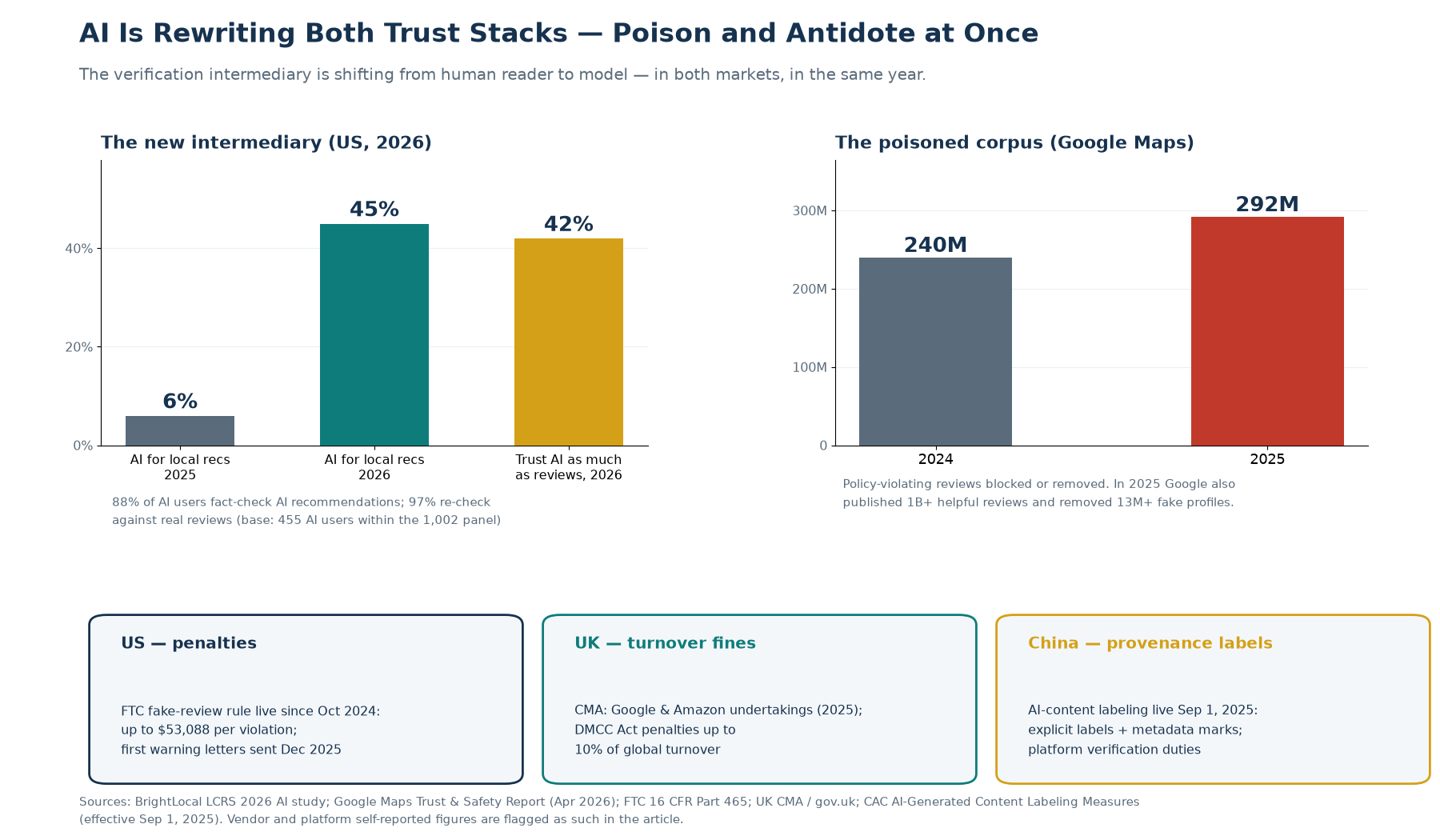
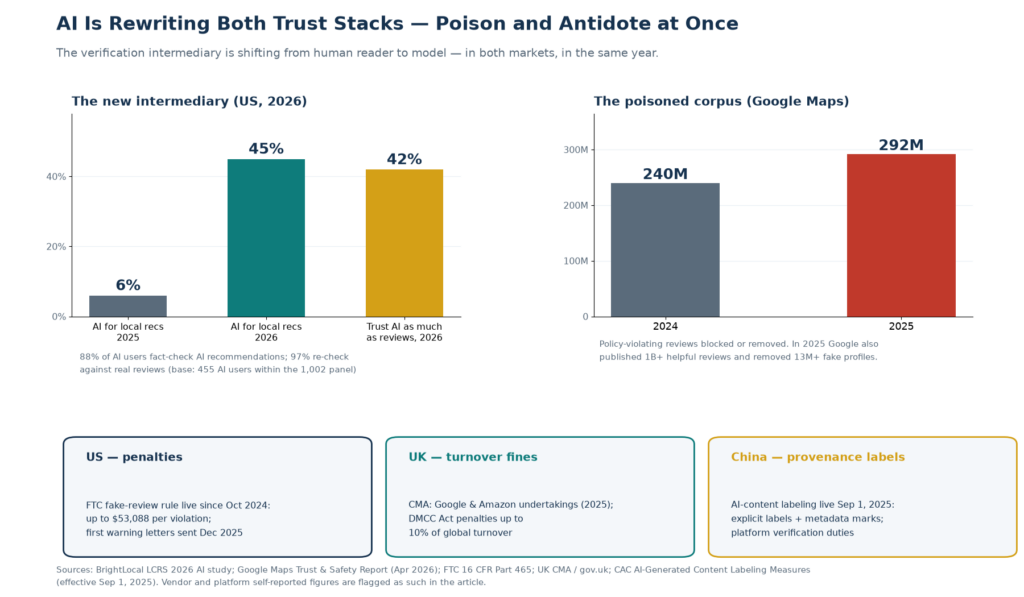
What attacks them is industrialized fabrication, and the platforms’ own disclosures show the scale. Google blocked or removed over 240 million policy-violating reviews on Maps in 2024 — 40% more than the year before — and over 292 million in 2025, while publishing more than a billion legitimate reviews and removing over 13 million fake business profiles. Those are Google’s self-reported figures from its Trust & Safety disclosures, and removal counts measure detection effort as much as fraud volume. Still, the trajectory tells you the crowd layer is under sustained siege.
The frontier is AI-written reviews, and here the most-cited study comes with a mandatory asterisk. Pangram Labs — a company that sells AI-detection software, so treat this as vendor research with a commercial interest — analyzed roughly 30,000 front-page reviews across 500 Amazon best-sellers and classified 3% (909 reviews) as AI-generated with high confidence. The unsettling detail is not the 3%; it is that 93% of those machine-written reviews carried the Verified Purchase badge, and 74% awarded five stars, versus 59% of human-written reviews. The badge that was supposed to anchor authenticity verifies a transaction, not a human narrator. Purchase verification and content authenticity have come apart.
Consumers sense this even when they cannot name it. In BrightLocal’s 2025 survey, 46% said a review would look fake to them if they suspected AI wrote it — the single strongest fake signal, ahead of paid-review suspicion at 42%. The crowd’s immune system is now attacking anything that reads too smooth. Which creates a nasty irony for brands: polish itself has become a trust liability.
Regulators Step Into the Crowd Layer
For years, Western institutions policed the certification floor and left the crowd layer to platforms. That is changing fast, and the enforcement record is now concrete.
The US FTC’s Consumer Review Rule took effect in October 2024, banning fake or AI-generated reviews, sentiment-conditioned incentives, undisclosed insider reviews, review suppression and fake social-media indicators, with civil penalties up to $53,088 per violation. In December 2025 the agency sent warning letters to ten companies — its first public enforcement step under the rule. The precedent cases matter too: Fashion Nova paid $4.2 million in 2022 for suppressing reviews below four stars, and the FTC’s 2025 NextMed action targeted paying customers to remove honest negative reviews.
The UK moved harder. The CMA secured formal undertakings from Google in January 2025 and Amazon in June 2025 to detect fake reviews and sanction offenders, estimates that reviews influence up to £23 billion of UK consumer spending annually, and now wields DMCC Act powers to fine up to 10% of global turnover. In March 2026 it opened five new fake-review investigations spanning funeral services, food delivery and car sales. The message across both jurisdictions: the crowd layer is now regulated infrastructure, not a marketing playground.
China took a different route to the same destination. Rather than policing review sentiment, its four-regulator AI-content labeling measure — effective September 1, 2025 — requires explicit labels plus hidden metadata marks on AI-generated text, images, audio and video, and obliges platforms to verify those marks and flag suspected synthetic content. It is provenance regulation: do not just punish the fake, make the machine-made declare itself. Two philosophies of trust repair — the Anglo-American one punishes deception after the fact; the Chinese one wires identification into the content pipeline.
AI as the New Trust Intermediary
While regulators build floors, consumers are quietly hiring a new verifier. BrightLocal’s 2026 AI study found that the share of US consumers using AI tools for local business recommendations jumped from 6% to 45% in one year, making AI the third most-used recommendation source, ahead of Yelp and TripAdvisor. Perhaps the most symbolic number in this entire piece: 42% of consumers now trust AI recommendations as much as traditional reviews — the same 42% that review trust itself bottomed out at. The collapsing layer and its replacement crossed paths.
But do not mistake this for blind delegation. Among the 455 AI users inside that survey panel, 88% fact-check AI recommendations and 97% at least sometimes verify them against real reviews on the original platforms. The verification reflex did not disappear in the West — it arrived, wearing new clothes. AI has become the first reader, not the final authority; the model summarizes the crowd, and the human audits the model against the crowd.
For brands, this rewires the trust question. It is no longer only what does the customer conclude about you. It is what does the model conclude about you, from whichever corpus your market feeds it — and models trained on astroturfed corpora will confidently summarize the astroturf.
What Brands Should Actually Do
Sell to the layer that carries the load where you sell.
In China, build the evidence file, not the star average: photo-rich reviews, cultivated follow-up reviews, sales-count momentum, complete Q&A sections, consistent notes across platforms — and fast, public responses to negatives, because in a crowd-first system a visible unresolved complaint is a verdict on the whole brand.
In the West, layer deliberately: certifications and guarantees as the trust floor, authentic experience reviews as the preference layer, and active defense of review authenticity — under the FTC rule and CMA regime, incentivized or suppressed reviews are now a penalty risk, not just a reputation risk. Respond to everything; the reply is the one column of the review profile you actually author, and generic templates now read as synthetic.
Everywhere, prepare for machine reading. Structured credentials and authentic review patterns must both be legible to AI assistants, because the model is increasingly the first customer your evidence meets. And never port the trust format wholesale: a review-lite Western product page underperforms in China because it is missing the evidence file, while Chinese-style review farming reads as astroturf to Western consumers whose AI-suspicion reflex is already triggered.
The Counterargument, and Its Limit
Is the dichotomy overdrawn? Both systems contain both layers — granted, and that is why the claim is about load-bearing order, not absence. Is China’s institutional layer rising? Absolutely: consumer law, platform liability and SAMR enforcement keep maturing, and the crowd’s relative load should lighten over time. But trained reflexes persist as habit long after the injury heals; verification is now culture, not just coping. And will AI unify the stacks? Plausibly, on a decade horizon — machine verification could converge both markets on model-audited evidence. The limit is that models inherit market-specific corpora, so near-term AI amplifies the divergence it may eventually erase. Convergence is a bet, not a 2026 planning assumption.
Conclusion
Two trust systems, two histories. The West built institutions that let consumers stop verifying, then watched its review layer buckle under industrialized fakes. China built a verification reflex that made the crowd itself the institution, priced in photo reviews and sales counts. Neither is trustier — each is scar tissue shaped by different injuries, and both are now being rewritten by AI that poisons and rebuilds verification at once. The operating rule for brands is simple: certifications plus defensibly authentic reviews in the West, the full evidence file in China, and machine-legible truth everywhere. Because the newest verifier in both markets is no longer human — and it reads everything.