Every trust system runs on a hidden budget line: the effort consumers must spend to confirm that a seller is telling the truth. Call it the verification tax. For decades, the West paid almost nothing — consumer law, chargebacks and retailer returns pre-cleared the risk, so belief was cheap and checking was optional. China paid the tax upfront, in a counterfeit era when institutional recourse was thin: shoppers learned to read photo reviews, follow-up reviews and sales counts because nobody else would clear the risk for them. The tax was prepaid in bad purchases, and the reflex became a cheap habit.
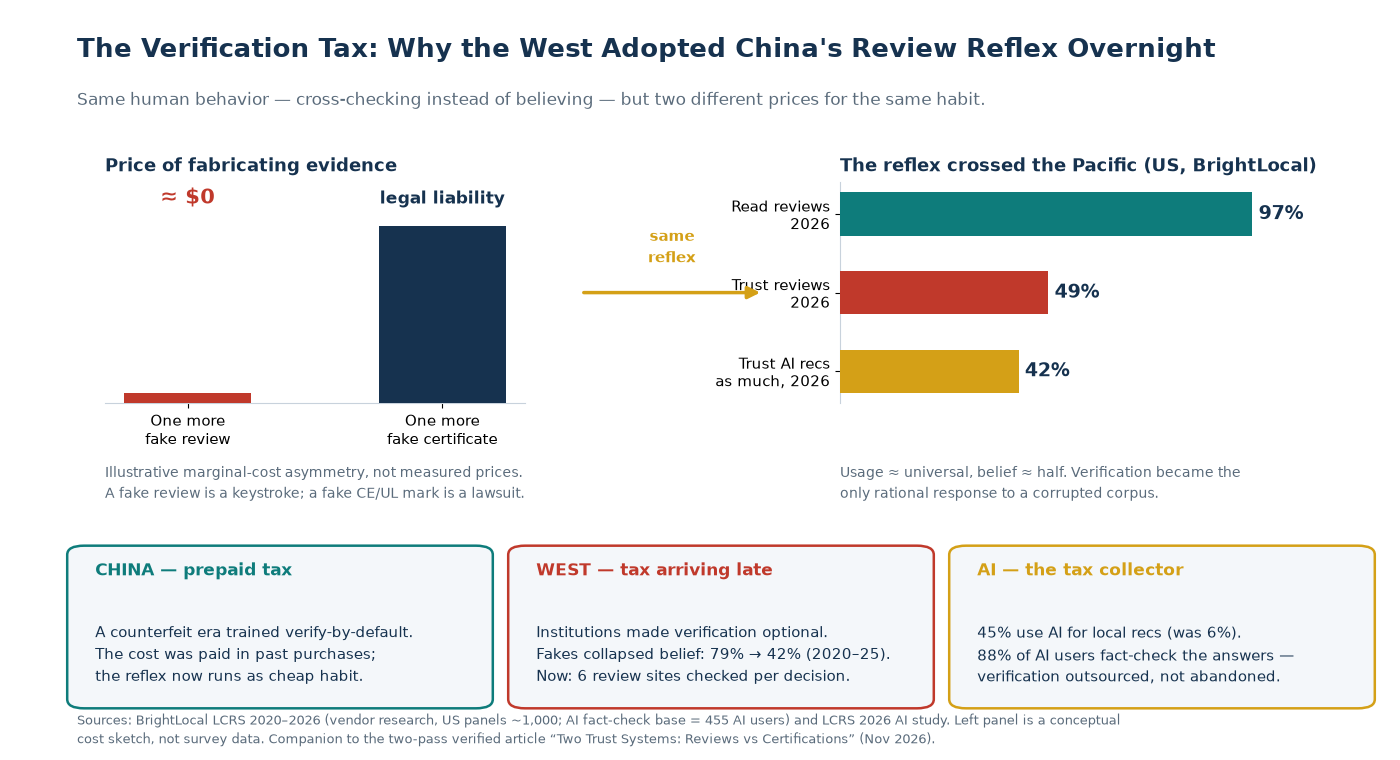
Then the West’s exemption expired. Industrialized fake reviews — Google removed 240 million policy-violating reviews in 2024 and 292 million in 2025 — corrupted the corpus that belief depended on. Trust-as-recommendation fell from 79% in 2020 to 42% in 2025, recovering only to 49% in 2026 (BrightLocal, vendor research, US panels of about a thousand). And here is the mechanism worth noticing: usage did not fall. It rose. 97% still read reviews, 41% always do, and the average decision now involves six review sites. When belief gets expensive, rational consumers do not stop buying — they start auditing. The West did not lose its trust system. It got billed for one.
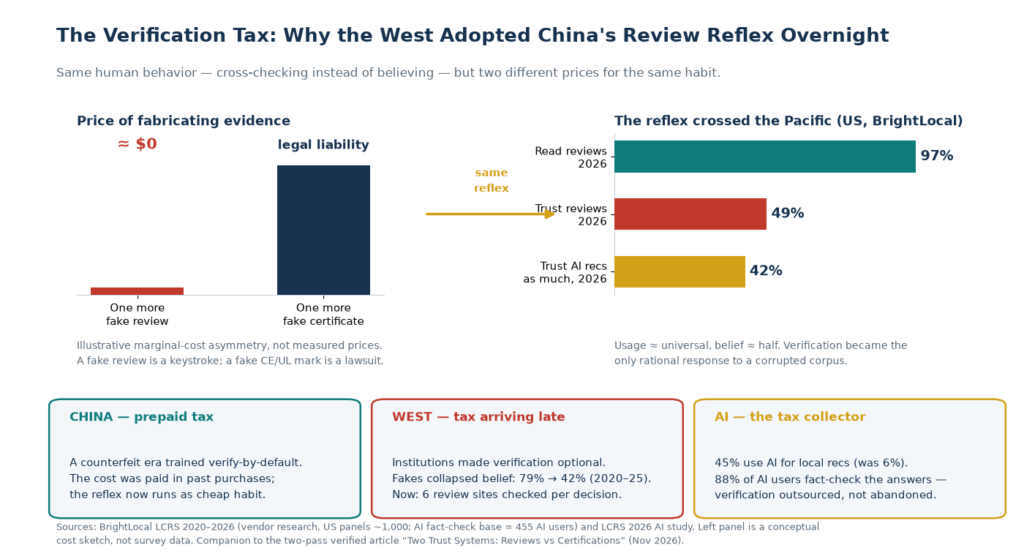
Why did the tax arrive so suddenly? Because faking scales differently on each layer. A fake certificate is a legal event — expensive, rare, policed. A fake review is a keystroke, and AI dropped its marginal cost to effectively zero. The West built its cheap-belief equilibrium on the assumption that the crowd layer was costly to corrupt. That assumption held for twenty years and then broke in about three. China’s equilibrium never made that assumption, which is why its shoppers look unbothered by a scandal that rewired Western behavior: they were already paying the tax.
The newest twist is who collects it. AI adoption for local recommendations jumped from 6% to 45% in one year, and 42% of consumers now trust AI as much as reviews. But among AI users, 88% fact-check the answers and 97% re-verify against real reviews. Read that correctly: the tax was not abolished — it was outsourced to a model, with the human retained as auditor. Outsourcing only works if the model’s corpus is clean, which returns the whole problem to platforms and regulators.
For brands, the economics are blunt. In a high-tax market, every friction you remove from verification — photo evidence, answered questions, machine-legible credentials — is a price cut on your product. In a low-tax market that just got billed, authenticity is the new scarcity. The verification tax explains why the same product page wins in Shenzhen and loses in Seattle: not taste, not culture — the price of proving you are real.