In April 2016, ASOS announced it was switching off its Chinese operation. The British fashion pure-play had launched a local site in 2013, built local warehousing, and hired local teams. Three years later the company told investors it would absorb up to £10 million in closure costs — mostly non-cash — plus roughly £4 million in operating losses for the year, and serve Chinese shoppers from its UK site instead. Bloomberg put the prior fiscal year’s China loss at £5.2 million and named the culprit in its headline: Alibaba’s competitive weight.
Nobody at ASOS had forgotten how to write subject lines. The email programme, the merchandising calendar, the brand playbook — all of it was competent. What failed was the habitat. The tactic assumed an open-web shopper who browses a standalone site, pays by card, and returns via a newsletter. That shopper exists in London. In Hangzhou, she lives inside a super-app, pays with a wallet, and returns because a feed reminded her. Same tactic. Opposite result.
Here is the part most post-mortems miss: the traffic runs both ways. Chinese livestream hard-sell stalls in America. WeChat’s overseas expansion — backed by a marketing budget Reuters reported at up to $200 million in 2013, complete with Lionel Messi ads — never cracked the West’s messaging market, and India banned the app outright in June 2020. The failures are symmetric. And symmetry is evidence. It tells you the problem is not that one market is “better” or one culture is “harder.” The problem is structural: every tactic is an organ of a stack, and organs die without their host.
This piece is the master key to our China–West comparison series. One test, four layers, applied to failures in both directions.
The Symmetric Failure Pairs
Line up the casualties and a pattern jumps out.
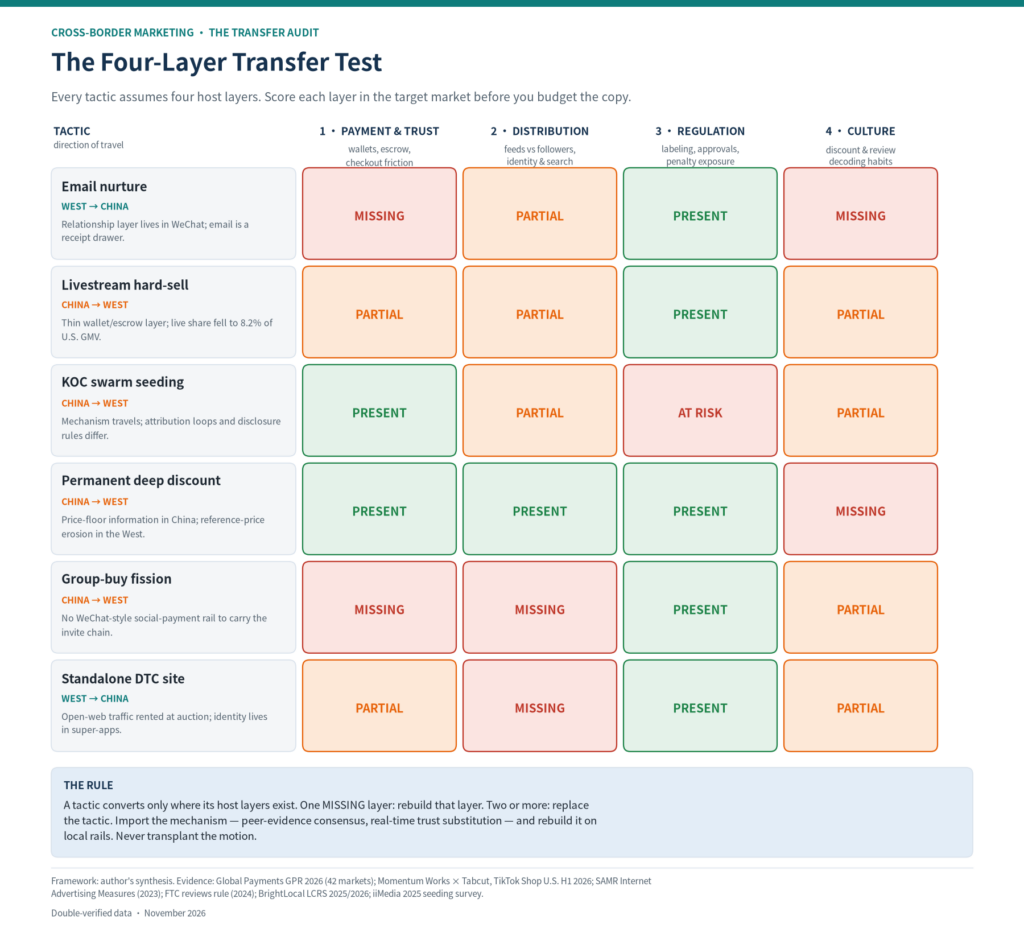
West → China: email nurture withers (the relationship layer lives in WeChat); open-web programmatic underperforms (identity sits inside super-apps); standalone DTC sites rent traffic at auction against platform-native rivals — ASOS is the documented case, and Topshop’s de-facto exit followed in November 2018 when its Tmall store closed and its Shangpin partnership ended. New Look shut all 120 China stores the same autumn; Marks & Spencer closed its mainland stores through 2017 and its Tmall shop in January 2018.
China → West: livestream hard-sell hits thin seller benches and card-form checkout; KOC swarm seeding survives as a mechanism but loses its closed-loop attribution; permanent deep discounting erodes reference prices in brand-led retail; group-buy fission dies because there is no WeChat-style social-payment rail to carry the invite chain.
Neither list is a list of bad marketers. Both are lists of organs without hosts. So stop asking “does this tactic work?” Ask instead: which layers does this tactic assume, and do they exist here?
Layer 1 — Payment and Trust: The Friction You Cannot Copy-Paste
Global Payments’ eleventh Global Payments Report (2026 edition, covering 42 markets and polling some 63,000 consumers) puts numbers on the gap. In 2025, payment apps — wallets, BNPL, account-to-account and bank apps combined — carried 92% of China’s e-commerce transaction value and 89% of in-store value. Globally, digital wallets alone accounted for 56% of e-commerce value, US$13.8 trillion across online and in-store. In the US, wallets carried 40% of e-commerce value — real adoption, but a different animal: card-funded wallets layered on top of a card economy, not super-app wallets that also hold the relationship.
Why does this decide tactics? Because funnel-compressing motions — flash sales, one-tap livestream checkout, fission invites — assume the risk-assessment stage has already been solved by escrow and ubiquitous wallets. China solved it at national scale (Alipay penetration 85%, WeChat Pay 73%, per the same report). Where the shopper still meets a card form and a seller-level trust decision, the compressed funnel leaks at exactly the step the tactic deleted. You cannot A/B-test your way past a missing rail.
Layer 2 — Distribution: Whose Feed Are You Actually In?
China’s content tactics assume interest-graph feeds with recency bias: a swarm of small creators can out-distribute a celebrity because the algorithm rewards fresh engagement, not follower banks. Western tactics historically assumed persistent audiences — the newsletter list, the follower graph, the search ranking. Those assumptions are eroding (feeds are spreading everywhere), but they erode unevenly, and the erosion itself changes which tactics travel.
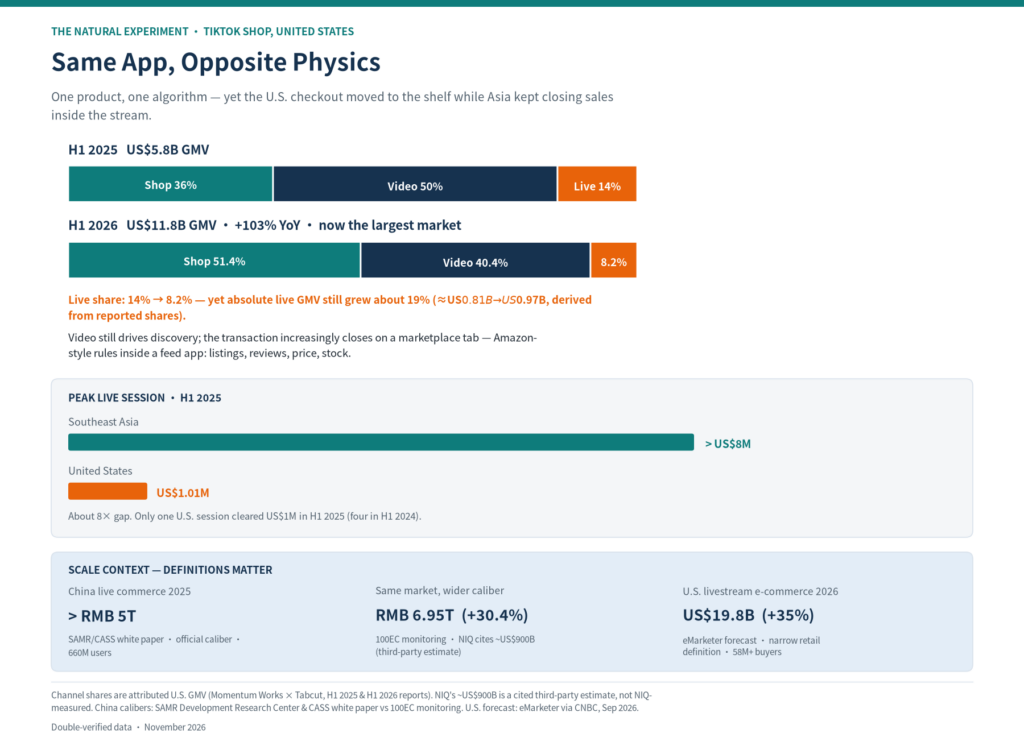
The natural experiment is TikTok Shop: one app, one algorithm, two physics. Momentum Works and Tabcut’s US report for H1 2026 shows the Shop tab’s share of attributed US GMV jumping from 36% to 51.4% in a year, video sliding from 50% to 40.4%, and live narrowing from 14% to 8.2% — even as US GMV doubled to US$11.8 billion and overtook Indonesia as the platform’s largest market. The researchers’ own summary is blunt: many tactics that drive time and conversion in China and Southeast Asia simply failed to work in the US. Discovery stayed video-led; the transaction moved to a marketplace shelf, where listings, reviews, price and stock decide the outcome. Amazon-style rules, inside a feed app.
Layer 3 — Regulation: Ex-Ante Labels vs Ex-Post Fines
The two systems punish ambiguity at different moments. China’s SAMR Internet Advertising Measures (effective May 2023) require that “knowledge sharing, experience posts or consumption reviews” carrying purchase links be conspicuously labelled as advertising; paid rankings must say “advertisement”; livestream participants carry advertiser, publisher or endorser liability depending on their role; and categories like drugs and health foods need pre-approval under the Advertising Law before they can run at all. Compliance is a gate you pass before publication.
The US leans ex-post: the FTC’s fake-reviews rule (effective October 2024) bans fabricated or AI-generated reviews, bought sentiment, undisclosed insider reviews and review suppression, with civil penalties up to $51,744 per violation at launch — adjusted to $53,088 from January 2025. That is a statutory ceiling, not a typical award, but it prices the risk after the fact. A seeding playbook built on undisclosed soft ads dies at different speeds on each side: in China it is stopped at the gate; in the West it runs until enforcement arrives. Same tactic, two regulatory metabolisms. Budget for the gate in one market and the tail risk in the other.
Layer 4 — Culture and Behavior: The Same Signal, Decoded Differently
Culture is real, but it is usually the last layer that matters — the residual that kills otherwise-correct entries. Its sharpest edge is decoding: the same signal means different things.
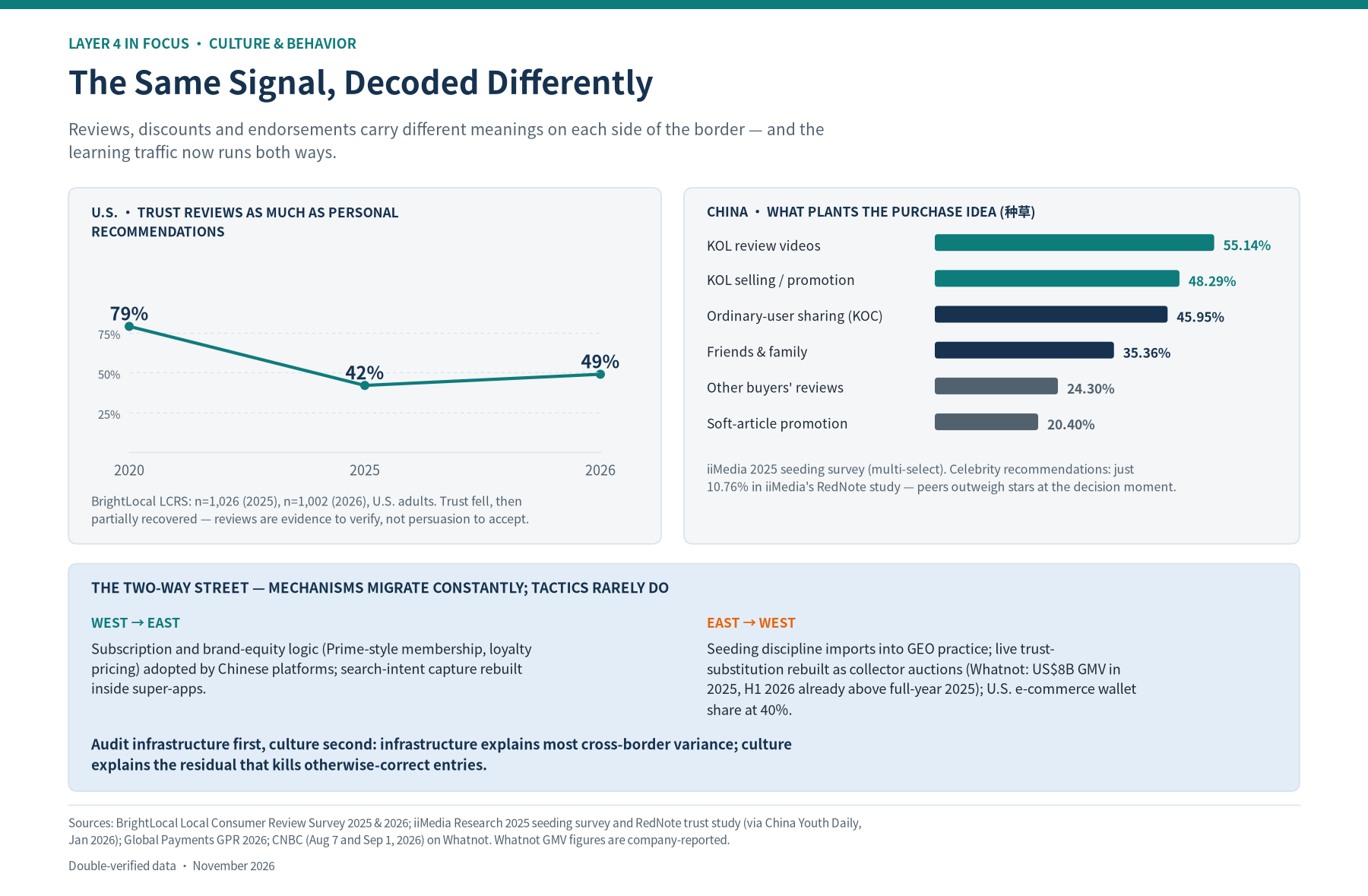
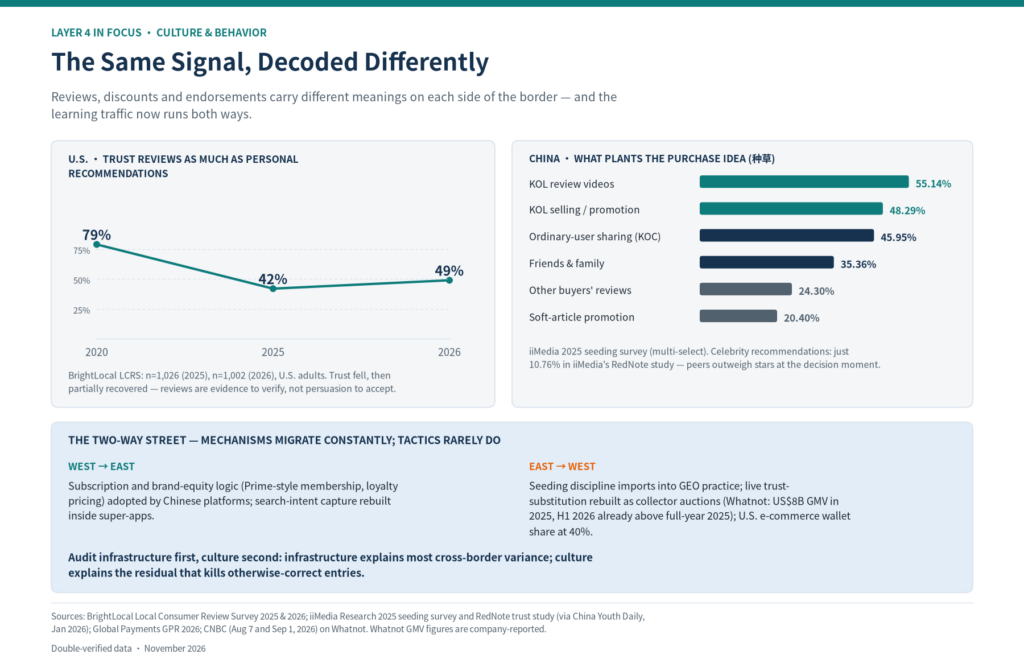
Reviews: BrightLocal’s Local Consumer Review Survey (1,026 US adults in 2025; 1,002 in 2026) tracked trust in reviews-as-personal-recommendations falling from 79% in 2020 to 42% in 2025, then partially recovering to 49% in 2026. American shoppers increasingly read reviews as evidence to verify, not persuasion to accept. China’s review economy runs on a verification reflex too — but wired into platform ranking and a seeding culture where, per iiMedia’s 2025 survey, KOL review videos (55.14%), KOL selling posts (48.29%) and ordinary-user sharing (45.95%) are the top planting channels. Celebrity recommendations? Just 10.76% in iiMedia’s RedNote study. Peers outweigh stars at the decision moment — on both sides of the border, but through different machinery.
Discounts decode differently as well: in China’s price-transparent feeds a flash discount is information (“this is the real price floor”); in brand-led Western retail it is an incentive that trains reference-price erosion. And the review layer is mutating fast: BrightLocal’s 2026 edition found AI tools like ChatGPT used for local recommendations jumped from 6% to 45% in a year, becoming the third-most-used source. The decoding layer now includes machines.
The Scale Trap: Why “$900 Billion vs $20 Billion” Misleads
Before you audit anything, audit the numbers you are auditing with. China’s live-commerce market is genuinely enormous — but the figures circulate in incompatible calibers. The regulator’s own think tank (SAMR’s Development Research Center, with the Chinese Academy of Social Sciences) put 2025 live-commerce GMV above RMB 5 trillion, nearly a third of online retail, with 660 million users. Market monitor 100EC counts RMB 6.95 trillion (+30.4%) on a wider caliber. NIQ’s 2026 global report cites roughly US$900 billion — explicitly a third-party market estimate, not NIQ-measured. All three describe the same beast from different angles; none should be quoted against a US number without saying which caliber you hold.
The US side is worse. eMarketer’s narrow retail definition puts US livestream e-commerce at US$14.64 billion in 2025 and forecasts US$19.8 billion for 2026 (+35%), with 58 million-plus buyers. Coresight/Bambuser’s older, broader “livestream-influenced” framing forecast US$67.8 billion for the same year — a gap of more than three times, driven by definition, not disagreement about reality. And McKinsey’s 2023 study found conversion among people who actually attend live shows is similar everywhere (US 33%, China 32%, Europe 30%, LatAm 36%). The mechanism converts. The habitat decides how many people ever enter the room. That is the whole thesis in one statistic.
What Everyone Misunderstands
Localization equals translation. Language is the thinnest layer. Meesho proved it in reverse: India’s mass market needed cash-on-delivery tolerance and recommendation feeds, not Pinduoduo’s WeChat fission — same customer segment, different required machine.
Best-practice universalism. “What wins in the biggest market must win everywhere.” China’s live commerce and America’s email ROI are both equilibria of their stacks, not portable truths. Litmus’s State of Email 2025 (692 marketers across five English-speaking markets; note Litmus sells email tooling, so treat this as vendor research) found roughly a third of companies reporting ROI above 36:1 — and 22% unable to measure ROI at all. The famous “$36–42 per dollar” is industry shorthand for those bands, not a law of physics. And email’s habitat is thinner than the ROI headline suggests: in China, email never became a primary consumer channel — practitioners consistently report open rates near zero for B2C blasts, while the relationship layer sits in WeChat, whose combined Weixin/WeChat MAU reached 1.432 billion in Tencent’s Q1 2026 report. (Precise “Chinese email check-rate” percentages circulate from paywalled GWI data; we could not verify them publicly, so we make only the directional claim.)
Culture-first explanations. Culture matters, but infrastructure explains most variance. The TikTok Shop experiment — same app, same content formats, ~8× peak-session gap (SEA’s best H1 2025 session topped US$8 million; the US best was US$1.01 million, and only one US session cleared US$1 million that half) — is taste held constant while stack varies.
The one-way street. The traffic is two-way now. Western GEO practice imports Chinese seeding discipline; Chinese platforms import Western subscription and brand-equity logic. Mechanisms migrate constantly; tactics rarely do.
What Actually Travels: Mechanisms, Not Motions
Strip each tactic to its mechanism and the picture clears. Seeding’s mechanism is peer-evidence consensus — it travels anywhere humans trust strangers’ experience, but it must be rebuilt on local rails (affiliate attribution and FTC-compliant disclosure in the West; closed-loop platform data in China). Live commerce’s mechanism is real-time trust substitution — a host who answers questions and demonstrates the product collapses uncertainty. Where the full stack is thin, that mechanism reappears in other formats: Whatnot rebuilt it as collector auctions and reported US$8 billion GMV in 2025, with H1 2026 already above the full prior year (company-reported; CNBC covered its August 2026 round at a US$20 billion valuation). QVC, fresh from Chapter 11, now runs 200-plus live hours a week across seven TikTok channels. The mechanism is alive in the West. The Chinese implementation is not what’s arriving.
Even the payment layer is converging — US e-commerce wallet share at 40% and climbing, per Global Payments. Which means today’s habitat gaps are tomorrow’s arbitrage windows. The audit tells you which gaps are closing, and when to move.
The Counterargument, and Its Limit
“Some tactics are universal.” Fair — search-intent capture, product quality, honest pricing assume no missing layer, so they travel. The test itself reveals which is which. “Stacks converge, so this is temporary.” True, and that is the timing insight, not a refutation. “Culture can’t be reduced to infrastructure.” Agreed — gift aesthetics in Mexico, modesty norms in the Gulf, the decoding habits above. The honest synthesis: infrastructure explains most cross-border variance; culture explains the residual that kills otherwise-correct entries. Check both, in that order.
The Takeaway
Tactics are organs, not organisms. Payment rails, distribution physics, regulatory posture and decoding habits decide whether a motion converts or dies — and the failures run symmetrically in both directions, which is exactly why “execution” and “culture” alone can’t explain them. The transferable unit is the mechanism, rebuilt layer by layer. Run the four-layer audit before any market entry: list the tactic’s assumptions per layer, score each layer’s presence, rebuild or replace what’s missing. The audit is the strategy. Everything else in this series dissects one layer of this map — read them together, and the border stops being where playbooks go to die.