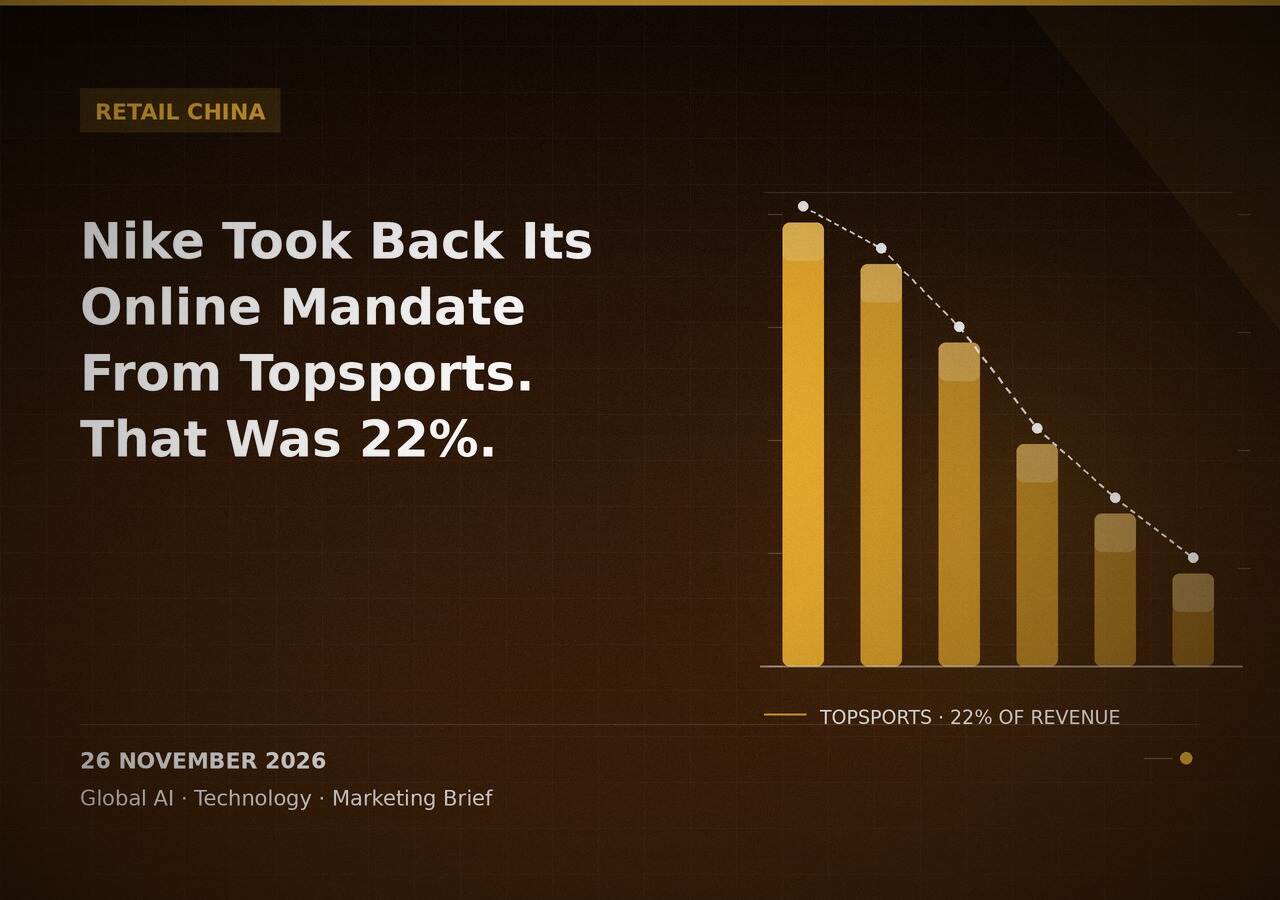
Topsports confirmed in its interim report, published on 23 November, that Nike notified it on 21 July 2026 that Nike product sales through Topsports’ online platforms in mainland China will end entirely on 1 January 2027. Offline distribution cooperation continues.
The number attached to that sentence is the whole story. In the financial year ended 28 February 2026, Nike online platform sales accounted for roughly 22% of Topsports’ total revenue — more than 5.6 billion yuan on 25.74 billion of revenue. Baosheng International, the other major distributor, received the same notice on the same day; that business is about 15% of its revenue.
The half-year numbers already reflect the pressure
For the six months to 31 August 2026, Topsports reported revenue of 10.913 billion yuan, down 11.3%, and profit attributable to shareholders of 662.6 million yuan, down 16.0%. Gross margin fell 0.9 points to 40.1%, which management attributed to deeper discounting. Operating profit fell 16.8% to 827.2 million. Inventory value dropped 15.7% and inventory turnover improved slightly to 146.4 days. Operating cash flow was a net 1.955 billion yuan, and the board declared an interim dividend of 11 fen per share — a payout ratio of 102.9%, which is not the gesture of a company bracing for a shock it has already modelled.
Store count tells its own story: 3,872 directly operated stores at period end, down 17.4% year on year, a net reduction of 488 in six months. Over six years the direct-store network has shrunk by 4,284 stores, or 53%.
Why Nike is doing this, in Nike’s words
At the Q1 FY2027 earnings call, CEO Elliott Hill said China’s online channel had been fragmented and the brand is contracting distribution channels that do not fit its channel strategy. Nike Greater China general manager Shen Kaixi framed it as reducing fragmentation rather than reducing shopping entry points: consolidate online sales into Tmall, JD and Douyin flagship stores plus the brand’s own site and app, cut deep discounting, rebuild a premium position.
The commercial logic is straightforward. Fragmented third-party sellers compete on price against the brand’s own stores, erode premium, and hold the customer data. Taking the channel back converts wholesale revenue into higher-margin direct revenue and puts the customer record in Nike’s own systems.
The cost is also straightforward, and it falls on the partner. Nike’s Greater China revenue was $1.18 billion in Q1 FY2027, down 22% and the ninth consecutive quarterly decline. Fixing a declining business by shrinking its distribution is a defensible move that makes the near-term decline steeper.
The part that never appears in the strategy deck
For a distributor, online authorization is not merely a sales channel. It is the inventory escape valve. Slow-moving stock and odd sizes can be cleared through platform subsidies and livestream discounts at something close to normal price. After January 2027, that valve closes for Topsports — while its physical capacity to absorb inventory is also shrinking, since 3,872 stores is 17.4% fewer than a year ago.
Topsports says it is in ongoing discussions with Nike on inventory recovery and promotional subsidies. That is the real negotiation, and it is about who absorbs the markdown.
The company’s own hedges are visible but early: exclusive operation rights for Ciele, norda, Norrøna and Sierra Designs, a running-concept store format called ektos, and a 95.4 million user base where members generate over 91% of offline and mini-program retail sales and repeat members about 60% of member spend. Those are real assets. None of them yet covers 22% of revenue.