Imagine this: your brand team ships a beautiful national campaign. Same logo, same tagline, same media plan from Vancouver to Halifax. Then a letter arrives from Quebec’s language watchdog, and suddenly your logo’s font size is a legal question.
Welcome to Canada — the country that looks like one bilingual market on a media plan but behaves like two creative systems with a legal border running between them. Since June 1, 2025, Quebec’s Charter of the French Language, supercharged by Bill 96 and its final regulation, has rewritten the geometry of storefronts, the wording on packaging, and the obligations of your HR department. Meanwhile, the rest of Canada runs a lighter, mostly voluntary bilingual playbook — with a new federal layer quietly loading in the background.
One flag. Two operating systems. If you market to Canadians, you need both.
The Number That Explains the Politics
Start with the demographic engine behind all of this. In the 2021 census, French was the first official language spoken for 82.2% of Quebec’s population — down from 83.7% in 2016. On the island of Montreal, it was 58.4%. For the first time, more than a million Quebecers reported English as their first official language spoken.
Quebec’s government reads those numbers as an emergency; Bill 96 is the response. Whatever your politics, the marketer’s takeaway is simple: this isn’t a symbolic gesture that will blow over. It’s a structural intervention with fines attached, and it changed the physical appearance of commercial streets across the province.
Two Systems, One Flag
Here’s the mental model that prevents expensive mistakes:
Quebec is a language-law regime. French isn’t a preference; it’s the default legal state of commerce — signage, products, websites, contracts, invoices, and the language of work. Exceptions exist, but they are narrow, technical, and case-built.
The rest of Canada is a market-practice regime. Federal law requires bilingual labeling on consumer products and imposes official-language duties on federal institutions, but an English-only storefront in Calgary or an English-first campaign in Toronto is generally a branding choice, not an offense. French-language creative outside Quebec is usually a growth tactic aimed at francophone communities — not a compliance obligation.
Most national brands fail by treating Quebec as a translation toggle inside the second system. It isn’t. It’s the first system, and it audits you.
What Actually Changed on June 1, 2025
Bill 96 passed in 2022, but the provisions that hurt — signage, product inscriptions, and the expansion of workplace francization — landed on June 1, 2025, governed by the final regulation published June 26, 2024. Three headline changes:
- Storefronts: non-French trademarks and business names visible from outside must be accompanied by French that is “markedly predominant” — a term the regulation now defines with measurable geometry.
- Products: generic or descriptive words inside a non-French trademark must also appear in French on the product or a permanently attached medium.
- Workplace: francization obligations extended downward from 50 employees to 25.
And one crucial non-change that most 2022–2023 coverage still gets wrong — more on that in the trademark section.
The 2× Rule: Compliance Is Now a Design Spec
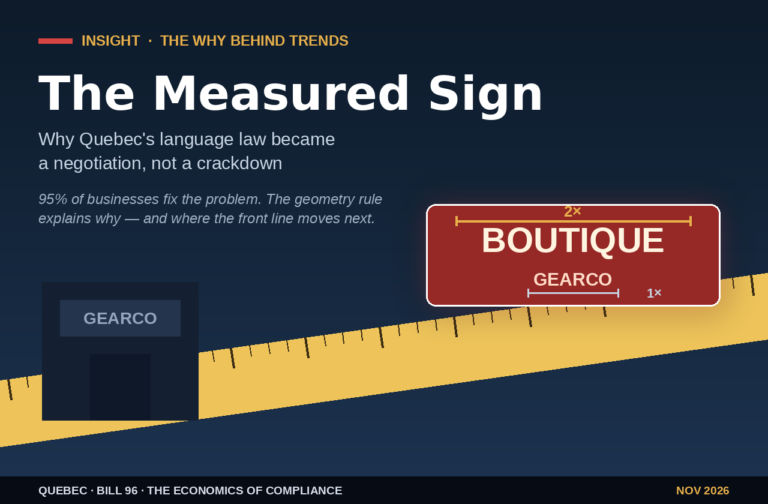
“Markedly predominant” used to be an aesthetic judgment. The final regulation turned it into arithmetic. In the same visual field — everything visible and legible at once without moving — the space allotted to French text must be at least twice the space allotted to text in any other language, with equivalent legibility and permanent visibility.
Read that carefully, because the nuances decide whether your sign passes:
- It’s area, not font size. Your English logo can stay large if the French elements around it together occupy twice its space. A generic term, a description of your products, or a slogan all count.
- Word count, color, and a token translation don’t save you. Inspectors measure space.
- Business hours, phone numbers, addresses, numbers, percentages, and articles (le, la, les…) are excluded from the French tally. Padding your sign with opening hours does nothing.
- On dynamic digital screens, French must be visible at least twice as long as the other language.
- Interior signs visible from outside — including mall storefronts — count as exterior signage. Your food-court kiosk is not a loophole.
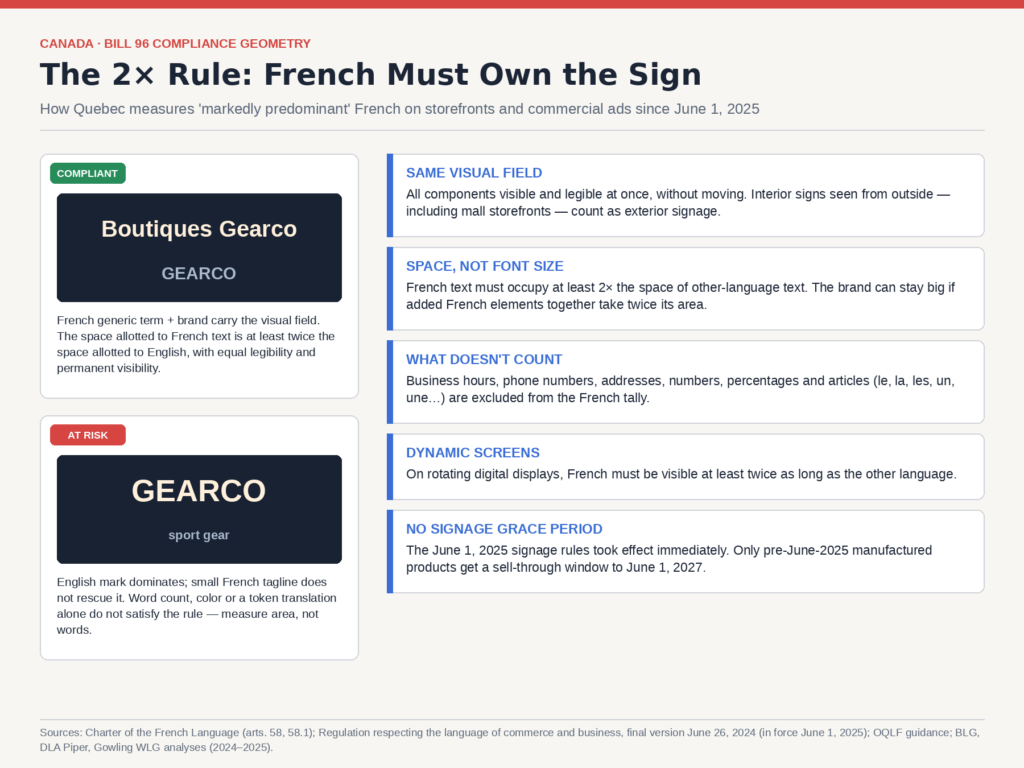
For design teams, this means Quebec signage needs a compliance spec the way a pharma ad needs a legal review: measured mockups, documented visual fields, and sign-off before fabrication. And there was no grace period for signage. The rules bit on day one.
The Trademark Plot Twist Everyone Missed
If you read the Bill 96 headlines in 2022, you learned that the trademark exception would shrink to registered marks only. Panic followed: unregistered brands would lose the right to appear in English on products and signs.
Then the story reversed. The final regulation of June 26, 2024 restored the “recognized trademark” exception — which covers both registered marks and unregistered common-law marks — provided no French version of the mark is registered in Canada. Law firms from BLG to Smart & Biggar flagged the walk-back, and Quebec’s own language office guidance for products confirms it: a recognized trademark can appear on products, packaging, and accompanying documents in another language without translation.
So why does anyone still need a trademark lawyer? Because the exception has teeth marks around it:
- Generic and descriptive terms inside the mark don’t ride along. If your registered mark includes words describing the product’s nature or characteristics — think “Whitening” or “Mint flavor” on a toothpaste — those words must appear in French on the product or a permanently attached medium. The product name as sold and the enterprise name are excluded from this requirement; “Happy Teeth” stays English, “Whitening” gets a French twin.
- A registered French version flips the switch. If a French version of your mark sits on the Canadian register, you must use it on products.
- Signage is a separate, stricter game. Even a perfectly recognized trademark on a storefront needs markedly predominant French beside it. Registration exempts you from translating the mark — not from the 2× rule around it.
The strategic reading: the 2024 reversal removed the guillotine, but the compliance surface is still bigger than it was in 2021. Register your marks anyway — registration remains the cleanest evidence of “recognized” status and the safest posture in a dispute — but don’t believe outdated scare stories that unregistered marks became illegal overnight.
The Swatch Carve-Out: A Watch Brand’s Clever Escape
The most instructive Quebec language case of the decade involves a watch. In October 2025, the Tribunal administratif du Québec set aside an OQLF order that demanded French around the SWATCH sign on a downtown Montreal boutique. Swatch’s argument was delightfully lateral: SWATCH isn’t an English word at all — it’s an artificial combination of letters, which the regulation exempts entirely. No translation, no accompanying French, nothing.
The OQLF countered with the brand’s own marketing history: S for “second,” plus “watch” — a portmanteau with English meaning, published on Swatch’s website. The tribunal shrugged. What matters is public perception, not the advertiser’s etymology. To a watch shopper, SWATCH reads as a coined brand name, like Rolex — not a dictionary word. (Awkwardly for the OQLF, “swatch” actually is an English word meaning sample — but that meaning is irrelevant to someone buying a watch, the tribunal noted.) The fact that Canada’s trademark office registered the mark as distinctive, rather than rejecting it as descriptive, reinforced the conclusion.
Two caveats before you rename your brand something vowel-free:
- The case was decided under the old law. The order predated June 2025, so the tribunal applied the former “sufficient presence of French” regime, not the new 2× requirement. It illuminates how “artificial” is judged; it does not create a safe harbour under the new signage rules.
- Courts have rejected this argument for other marks — TiMES, GLOBOCAM, WELLARC — when the foreign-language origin was demonstrable. Swatch won on its facts: decades of use, a genuinely opaque coinage, and a public that sees a brand, not a word.
The reusable insight: in Quebec, your brand name’s legal identity is decided by what shoppers perceive, not by your brand book.
The Runway Got Fixed: CIPO’s Quiet Turnaround
For two years, the standard advice carried a grim footnote: you can’t register your way to compliance because Canada’s trademark office had a backlog measured in years. At the peak, in February 2024, the wait to first examination exceeded 1,700 days — the longest in the world.
That story is now obsolete, and refreshingly so. In July 2025, the Canadian Intellectual Property Office was confident enough to end its accelerated-examination lane for applications using pre-approved goods and services — everything now shares one queue — because the backlog had come under control. As of November 2026, CIPO’s official forecast for a new application’s wait to examination is about 8.2 months. A clean filing using pre-approved terms can realistically reach registration in about a year.
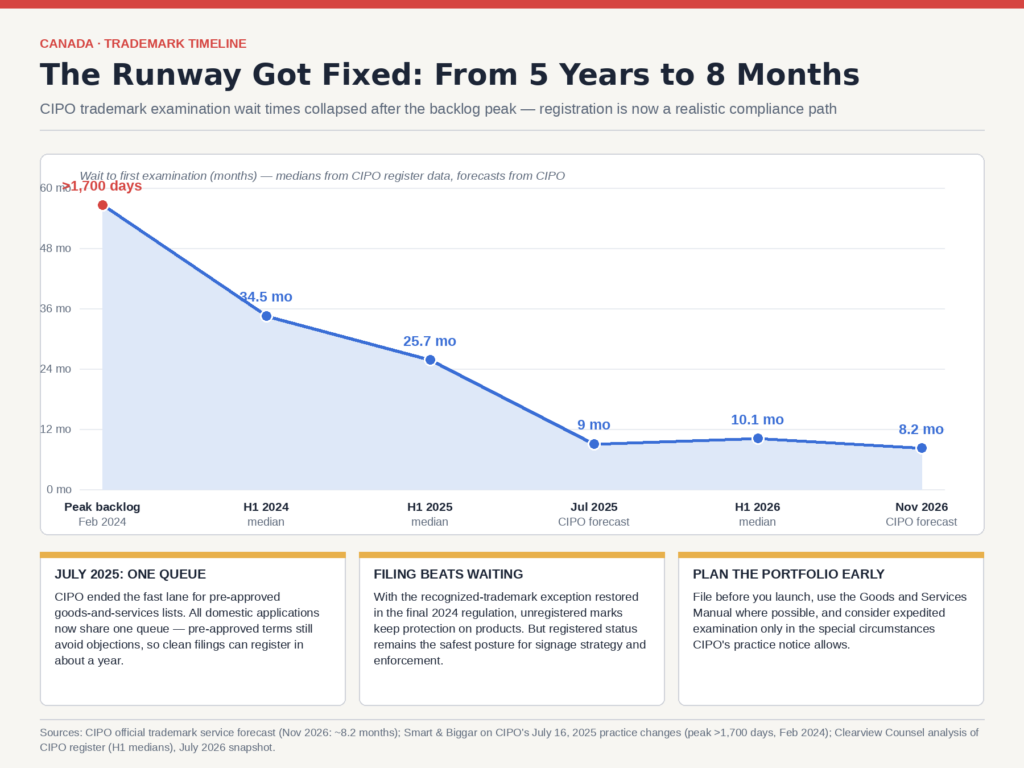
For market-entry planning, this changes the calculus. The old excuse — “we’d register, but the queue is five years long” — is gone. If your Quebec strategy depends on trademark status, file now, use the Goods and Services Manual where you can, and treat registration as a project with a one-year horizon rather than a lottery ticket.
Digital: Your Website Has a Quebec Personality
Quebec’s language law doesn’t stop at the sidewalk. Commercial publications — catalogues, brochures, order forms, websites, social media — must be available in French for the Quebec public, on conditions no less favorable than any other language. A few practical contours from the guidance and case practice:
- Selling or promoting to Quebec consumers is the trigger. A website merely accessible from Quebec isn’t automatically captured; one that targets Quebec shoppers should have a French version. In practice, the OQLF shows some leniency toward companies with no establishment in the province — but “we’re foreign” is a mitigating factor, not an exemption.
- The French version can’t be a ghetto. No extra clicks, no buried toggle, no machine-translated uncanny valley that a human would spot in seconds. Equal accessibility is the standard; equal quality is the smart play.
- Social media counts. If a consumer writes to you in French, reply in French. English comments can get English replies. Your community manager needs a language routing rule, not just a tone-of-voice guide.
- Invoices and receipts must be in French. This sounds clerical until you learn it produced the first published fine of the new era — more below.
The classic exposure pattern: an English-only paid campaign geo-targeted to Montreal, driving to an English-only landing page, fulfilled by English-only paperwork. Each layer is a separate point of contact with the Charter. Fix the chain, not just the ad.
Packaging: The Grace Period Is About Products, Not Cartons
Product inscriptions — labels, containers, wrapping, manuals, warranty cards — must be in French, with no other language more prominent. Federal labeling law already requires English-French bilingual packaging on most consumer goods, so for many CPG brands the baseline is familiar. Bill 96’s addition is the generic-term translation inside trademarks, plus a transitional rule worth reading twice:
Products manufactured before June 1, 2025 that don’t meet the new trademark-translation rule can be sold until June 1, 2027, provided no French version of the mark was registered as of June 26, 2024. A narrow extension covers certain food, drug, and cannabis products manufactured between June and December 2025, coordinated with federal front-of-package labeling changes.
The trap: the clock follows the manufacturing date of the product, not the print date of the packaging. Filling a 2024-printed carton in 2026 creates a 2026 product — fully subject to the new rules today. June 2027 is a sell-through window for old finished goods, not permission to keep using old artwork. If your Quebec distributors are asking for compliant stock early, they’re managing their own risk, because the Charter reaches anyone who distributes or sells in the province.
Enforcement Year One: Loud Complaints, Quiet Fines
How scared should you be? The first year of enforcement data tells a nuanced story. Records obtained by the Montreal Gazette through access-to-information requests show that in the twelve months after the signage rules took effect, the OQLF screened 2,050 complaints, sent 2,213 warning letters, and learned of 969 sign changes — with two files referred to prosecutors, the most serious step taken under the new signage regime at that point. Anonymous complaints are now accepted, the agency’s budget doubled to $49 million, and it runs proactive inspections alongside complaint investigations.
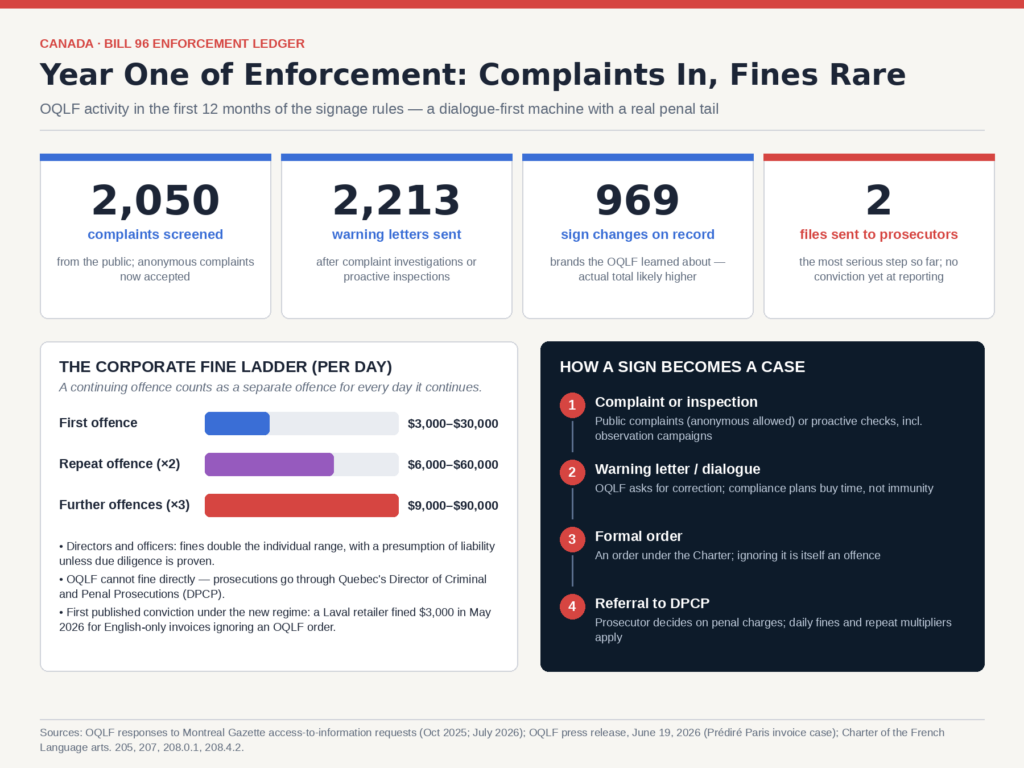
The penal machinery, straight from the Charter, is heavier than the enforcement tempo suggests:
- Corporate fines run $3,000 to $30,000, doubling on a first repeat and tripling after that — up to $90,000.
- A continuing offense counts as a separate offense for every day it continues. That’s how a signage problem becomes a five-figure-per-week problem.
- Directors and officers face doubled individual fines, with a presumption of liability unless they prove due diligence.
- The OQLF doesn’t fine directly; prosecutions go through Quebec’s criminal and penal prosecutor. The agency’s stated approach is dialogue first — businesses showing a credible compliance plan get time, not immunity.
The first published conviction of the new era, announced by the OQLF in June 2026, wasn’t about a sign at all: a Laval retailer was fined $3,000 for English-only invoices that ignored an OQLF order. The lesson generalizes — the machinery starts with a complaint, escalates through an order, and punishes ignoring the order. Respond to the letter. Always.
The cost side is real too. The Retail Council of Canada says one member chain faces $15–20 million to redo its Quebec signage; Quebec’s minister responsible for French has estimated the sector-wide cost at just over $50 million. Both numbers are advocacy-adjacent, but the physical constraints behind them are verified: signs often can’t be shrunk in place, municipalities and landlords must approve changes, and a February 2025 CFIB survey found 53% of Quebec small businesses weren’t ready for the deadline. Compliance is a capital project with permits, not a font swap.
Francization: The Obligation That Reaches Your Org Chart
The least-discussed change may be the stickiest. Since June 1, 2025, businesses employing 25 or more people in Quebec for six continuous months must register with the OQLF and analyze their linguistic situation — a threshold that used to be 50. Hit 100 employees and a francization committee enters the picture. Employees have rights to work in French; hiring can’t require another language unless the job genuinely demands it.
For a foreign brand scaling a Montreal office or a Quebec fulfillment operation, this means language compliance is an HR and ops workstream, not just a marketing one. And the federal layer is loading: Ottawa’s new Use of French in Federally Regulated Private Businesses Act — created by 2023’s official-languages reform — had its draft regulations tabled in April 2026. When brought into force by decree, it will give consumers service-in-French rights and employees work-in-French rights at banks, telecoms, and interprovincial carriers, starting in Quebec and extending to strong-francophone regions two years later. Roughly 500 federally regulated businesses with 25+ employees in Quebec sit in scope. Two governments, two statutes, one direction of travel.
The Rest-of-Canada Playbook
Outside Quebec, breathe — then be deliberate. Federal bilingual labeling still applies to your packaging nationally, and federal institutions have their own official-language duties, but your creative choices are mostly market choices. French-language campaigns aimed at francophone communities in Ontario and New Brunswick are a targeting opportunity, not a legal mandate.
The failure mode to avoid is the reverse of the Quebec mistake: letting Quebec’s requirements silently set the national creative. Because Quebec’s rules are the strictest, some brands default to Quebec-compliant creative everywhere — shrinking logos and inflating French text in markets where neither is required. Sometimes that’s the efficient single-SKU answer. Often it’s a tax you didn’t decide to pay. Make it a decision: one national system with a Quebec variant, or two systems by design. What you can’t afford is one system by accident.
The Operating Checklist
If you run a brand that touches Quebec, work this list in order:
- Signage audit: photograph every exterior-visible sign, measure visual fields against the 2× rule, and remember mall interiors count.
- Trademark portfolio: confirm recognized status, check for registered French versions, file gaps now that the queue is under a year to examination.
- Packaging review: translate generic/descriptive terms inside marks; track manufacture dates against the June 2027 sell-through cliff.
- Digital chain: French site version on equal terms, French replies to French comments, French invoices, and geo-targeted campaigns that land on compliant pages.
- Francization registration: count Quebec headcount against the 25-employee threshold; register and analyze on time.
- Evidence archive: keep dated photos, approvals, translation records, and OQLF correspondence. Due diligence is a legal defense — but only if documented.
- Escalation protocol: any OQLF letter gets a named owner and a response plan. Ignoring an order is the offense that converts paperwork into fines.
The Takeaway
Canada rewards brands that stop pretending it’s one bilingual market. Quebec is a distinct creative system with measured rules, real enforcement, and narrow, winnable exceptions — and its demands now reach from your storefront geometry to your org chart. The rest of Canada is a lighter-touch market where French is strategy, not statute. The brands that win treat the border between those systems as a design constraint, budget for it like infrastructure, and file their trademarks while the runway is short. Everyone else discovers the border the expensive way: one warning letter at a time.