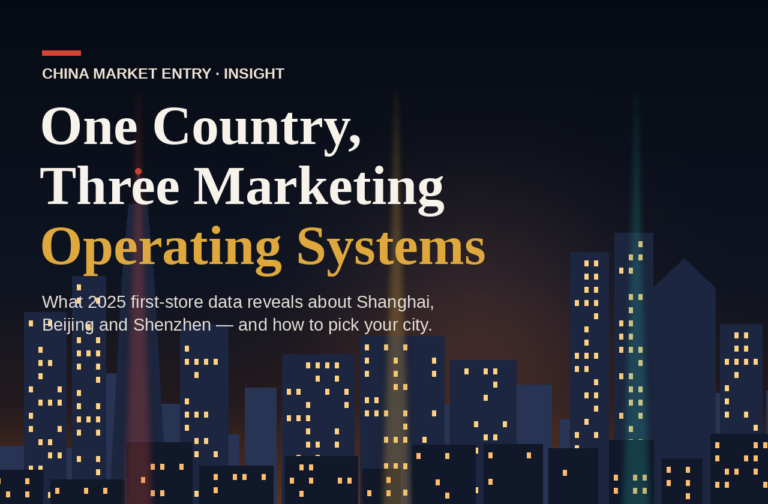
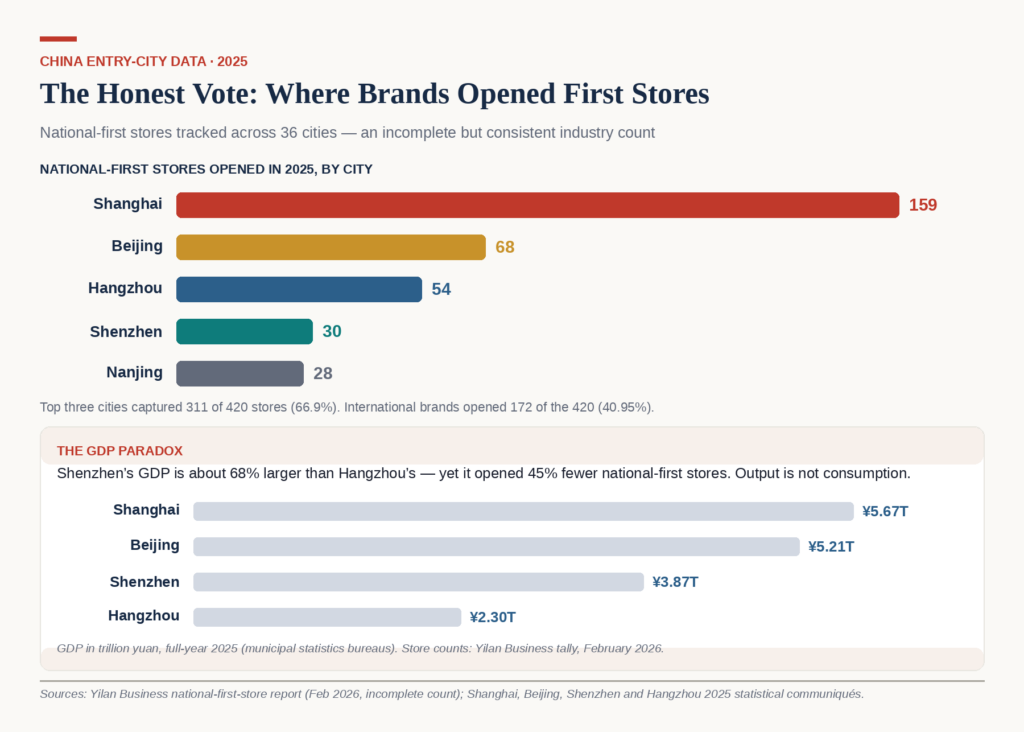
Here is a puzzle that should bother anyone building a China plan on a GDP spreadsheet. In 2025, Shenzhen’s economy produced ¥3.87 trillion in output — roughly 68% more than Hangzhou’s ¥2.30 trillion. Yet when brands voted with their lease deposits, Hangzhou welcomed 54 national-first stores while Shenzhen managed just 30. Shanghai, meanwhile, pulled in 159. Beijing took 68, leapfrogging Hangzhou into second place.
Read those numbers again. The city with nearly double the economic output attracted almost half the debuts. If GDP were the map, this would be a cartography error. It isn’t. It’s the market telling you something GDP hides: Chinese megacities are not points on a wealth ranking. They are three different marketing operating systems, each running different software on what a brand launch is actually for.
First Stores Are the Market’s Honest Vote
Why trust store counts over any survey? Because a first store is expensive, slow and public. A brand opening its first outlet in a country signs a multi-year lease, hires a local team, builds a supply chain and stakes its reputation on a single address. Nobody does that for a focus-group compliment. It is a bet, placed with real money, on a city’s consumer depth over the next decade.
The cleanest recent dataset comes from Yilan Business, a Chinese retail industry researcher whose February 2026 tally tracked at least 420 national-first stores across 36 cities in 2025, up 7.19% from 2024. It is an incomplete count — the firm says so itself — but it applies one consistent ruler: a brand’s first store in the whole country, or a new sub-brand’s debut outlet. International brands opened 172 of the 420, about 41%. And three cities — Shanghai, Beijing, Hangzhou — absorbed 311 of them. Nearly 67% of the nation’s debut energy landed in three postal codes.
Shanghai: The Launch City
Start with the obvious winner and ask what it actually wins. The industry tally gave Shanghai 159 national-first stores in 2025, including 91 international-brand openings with 16 global firsts and 5 Asia firsts. Korea’s MUSINSA chose it for its first international flagship; Germany’s GORE-WEAR put its first global brand flagship there. When a brand needs the world to see its China arrival, it stages that arrival in Shanghai.
The city’s own broader ledger is even bigger. The Shanghai Commerce Commission counts 1,093 first stores of all tiers added in 2025 — roughly three a day — with high-tier openings at 16.8%, and about 3,000 launch events staged across the year. Since 2018 the city has accumulated 8,472 first stores. Note the two rulers here: 159 is the narrow national-first count; 1,093 includes city-level and regional debuts. Mixing them is the classic error in China city comparisons, so keep them separate.
Underneath sits genuine purchasing depth. Shanghai residents’ per-capita disposable income hit ¥91,987 in 2025, more than double the national ¥43,377, according to municipal and national statistics. Retail sales reached ¥1.66 trillion, growing 4.6% against the national 3.7%. One Shanghai policy researcher told Securities Times the city ranks second among global cities for international retailer agglomeration — a claim worth citing as expert assessment rather than gospel, but consistent with what leases show.
Yet here is the twist most entry plans miss: the launch city is not the growth engine. Shanghai’s cosmetics retail grew just 2.7% in the first half of 2026, after 2.9% in the same period of 2025. Its total retail sales actually fell 1.1% in the first nine months of 2026 (up 1.0% excluding cars). The market is deep, saturated and mature. You go to Shanghai to define what your brand means in China — not because incremental volume is easiest there.
Beijing: The Collector City
Beijing’s 68 national-first stores look modest next to Shanghai’s. But watch what sells. While the capital’s headline retail fell 2.9% in 2025, its gold and jewelry retail rocketed — up 39.5% in 2025 and another 21.4% in the first half of 2026, against national jewelry growth of just 1.9%. No city’s residents buy that much more gold than everyone else’s. Something structural is happening.
That something is aggregation. Beijing hosts national-scale, direct-sale jewelry and e-commerce operations — the heritage jeweler Caibai, for instance, reported ¥7.28 billion in online sales in its 2025 annual report, over a quarter of its revenue, run through a Beijing-registered e-commerce subsidiary. China’s retail statistics are booked where the selling entity sits, not where the shopper lives. When a buyer in a northern province orders gold online from a Beijing-headquartered firm, Beijing’s ledger gets the sale. Contrast Shanghai’s champion jeweler Lao Feng Xiang, which runs 5,142 franchised outlets against just 213 direct stores — its national sales scatter across franchisees’ local books.
This is the collector city’s essence, and it long predates e-commerce. The capital aggregates the purchasing power, gift flows and trust-seeking of North China and the Northeast. State policy explicitly feeds this lane: the State Council’s March 2025 measures for international consumption center cities call for heritage brands — the famous “time-honored brands” — to cross over with new consumer labels. For a marketer, Beijing is where authority, provenance and the gift economy convert. A heritage collaboration or an institutional endorsement carries farther here than a trend drop ever will.
Shenzhen: The Young City
Now the puzzle city. Shenzhen’s 30 national-first stores embarrass its GDP line. But look at its people. The 2020 national census found 79.53% of Shenzhen residents aged 15–59, with only 5.36% aged 60 or above. Shanghai, by contrast: 66.8% working-age and 23.4% elderly. Beijing sits at 68.5% and 19.6%; Guangzhou at 74.72% and 11.41%. Shenzhen is not just younger — it is demographically a different country.
Young populations spend differently, and the category data proves it. In the first half of 2026, Shenzhen’s cosmetics retail grew 11.2% while Shanghai’s managed 2.7%. Its telecom-device retail surged 42.4%. This is trend elasticity: new products meeting new households with unformed brand habits. Where Shanghai’s beauty shoppers have twenty years of loyalty behind them, Shenzhen’s are still writing theirs.
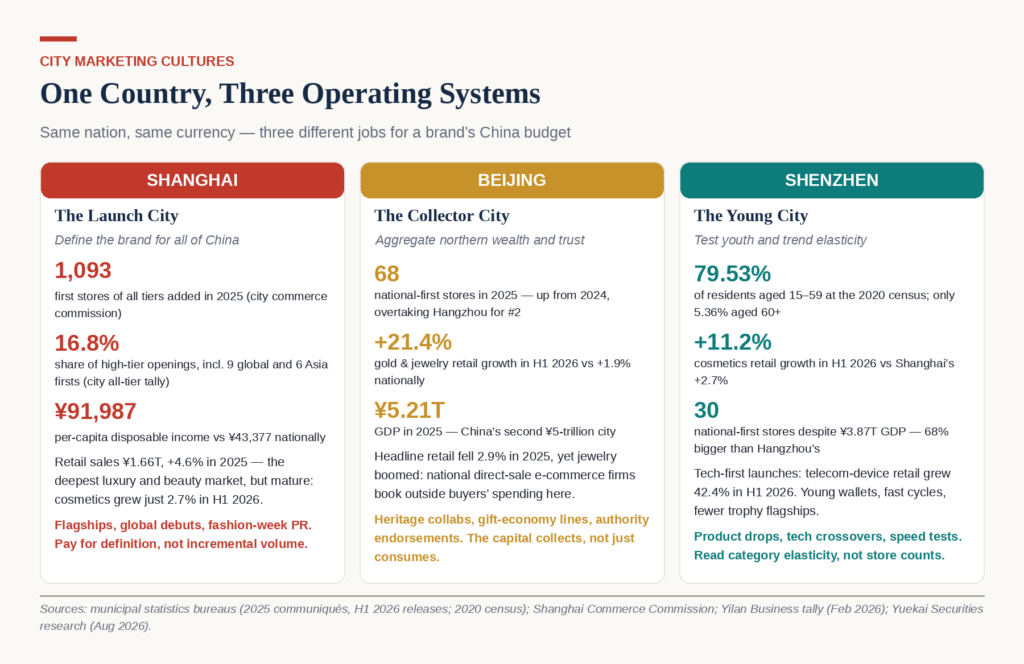
Why, then, so few trophy debuts? Two honest answers. First, verifiable structure: Shenzhen’s launch culture skews to tech-product drops — its first-store scene featured hardware flagships and concept stores rather than luxury temples — and it is notably absent from the State Council’s five-city international consumption center list, which names Shanghai, Beijing, Guangzhou, Tianjin and Chongqing. The policy spotlight simply points elsewhere. Second, a plausible hypothesis rather than established fact, voiced in Chinese industry commentary: much of Shenzhen’s wealth sits in property and equity, and some consumption leaks across the border to Hong Kong. Treat that as a theory to test, not a number to quote. The census data and category growth you can bank on.
Output Is Not Consumption
Step back and the three-city pattern resolves into one idea. GDP measures what a city produces. First stores measure what brands believe a city will consume — repeatedly, over years. Shenzhen produces enormously through factories, ports and tech firms whose profits and payrolls do not translate one-for-one into local shopping. Shanghai’s ¥1.66 trillion retail market actually exceeds its output-to-consumption ratio peers; its metro area is a consumption basin, not just a production node.
So when you rank entry cities by GDP, you are reading the wrong column. The first-store count works as a deflator: it strips out production that never becomes local demand and leaves the market’s honest vote on consumer depth. On that ruler, the order is Shanghai, Beijing, Hangzhou — and Shenzhen is a specialized instrument, not a laggard.
Why the Same Shock Hit Cities Differently
The dining data makes the operating-system metaphor concrete. In 2025, catering revenue fell 3.0% in Beijing and 1.9% in Shanghai, while Guangzhou grew 3.5% and Shenzhen 2.5%. By the first half of 2026 the gap widened: Guangzhou +5.8%, Shenzhen +5.1%, Beijing barely +0.4%, and Shanghai’s above-threshold catering receipts −0.2%. Same country, same consumer squeeze — opposite outcomes. Why?
Researchers at Yuekai Securities, drawing on the Fifth National Economic Census, point to supply structure. In 2023, full-service restaurants accounted for 63.1% of Shanghai’s catering revenue and 60.1% of Beijing’s, versus 56.2% in Guangzhou. Revenue per full-service employee — a rough proxy for operating format, not a ticket-price measure — ran ¥329,000 in Shanghai and ¥276,000 in Beijing against ¥240,000 in Guangzhou and ¥234,000 in Shenzhen. The northern capitals lean toward banquet halls, hotel dining and formal business meals. The southern cities lean toward everyday frequency: work lunches, tea drinks, delivery, hotpot with friends.
Then demand shifted. The China General Chamber of Commerce and Hongcan’s 2025 industry white paper documented the collapse of high-ticket business banquet demand as corporate activity cooled. KPMG’s 2026 China F&B report, using Chenzhen Big Data figures, shows the average dining ticket sliding from ¥36.5 in 2024 to ¥34.7 by the third quarter of 2025 — down 4.9%. Western fine dining fell 5.1% and Chinese fine dining 4.6%, while Chinese and Western fast food slipped only 1.3% and 2.4%. Cities whose food economy was built on occasions took the hit; cities built on habits kept growing.
For marketers the lesson generalizes beyond restaurants. Ask of any city: is demand here occasion-driven or frequency-driven? Occasion markets amplify prestige and ceremony — and contract when budgets tighten. Frequency markets reward habit-forming products and survive downturns. Your activation calendar should match the metabolism.
The Non-Standard Turn
One more shift hides inside the 420-store dataset, and it may matter most for your next activation. True market-entry debuts — what Yilan calls absolute first stores — fell 16.24% to 263. But non-standard first stores, the concept variants brands open inside markets they already serve, jumped 52.43% to 157.
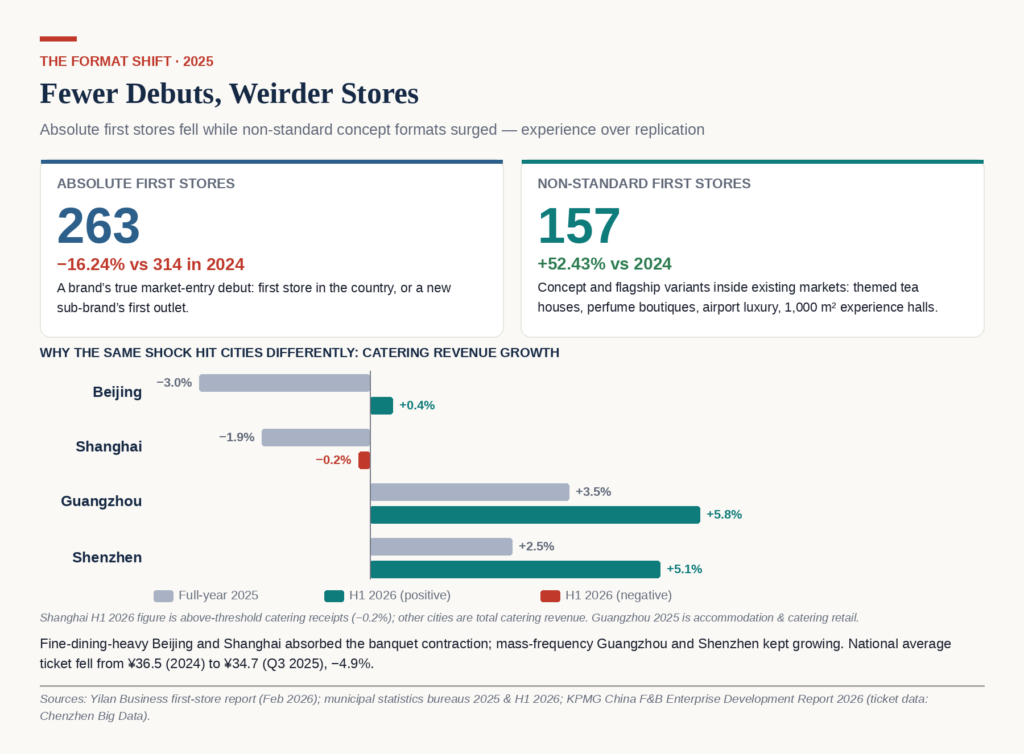
The examples read like a briefing on where attention went. Tea chains, locked in price and product sameness, opened themed tea houses and day-tea-night-bar hybrids. Louis Vuitton opened a perfume and beauty boutique in Nanjing; Hermès put its first domestic airport direct store in Shenzhen’s Terminal 3. Fashion brands built 1,000-square-meter experience halls. When entry debuts get rare and expensive, brands buy attention through reinvention instead. If your China plan still treats “the flagship” as a one-time event, you are budgeting for 2019. The 2025 market pays for serialization: a flagship, then a concept, then a crossover, each a fresh chapter of the same story.
The Policy Machine Behind the Map
None of this is purely organic. The “first-launch economy” is now stated national strategy. The Party’s Third Plenum decision in July 2024 called for actively advancing it; the Central Economic Work Conference that December named it a 2025 priority alongside ice-and-snow and silver-hair economies. In March 2025 the State Council forwarded Commerce Ministry measures backing five international consumption center cities with launch-season events, customs fast lanes for debut imports and heritage-brand crossovers.
Shanghai runs the most developed machinery, now on version 4.0 of its FIRST in Shanghai program: as of March 2026, a one-time ¥1 million reward for Asia-level-and-above first stores, plus subsidies up to ¥1 million for major launch events. The import expo pipeline feeds it — the eighth CIIE in November 2025 staged 461 new product, technology and service launches, including 201 global firsts, and logged $83.49 billion in intended deals. When you time a Shanghai debut to these windows, you are surfing a state-built wave. Just remember the list has five cities, and Shenzhen is not one of them. Policy tailwinds are real, and they are unevenly distributed.
Choosing Your City by Job, Not by Rank
So the decision framework writes itself. Stop asking “which Chinese city is biggest” and start asking “what job do I need done.”
Need to define the brand — earn press, signal commitment, anchor pricing for the whole market? Shanghai. Pay the premium, time the policy windows, and treat the store as media. Need to collect established wealth, ride the gift economy, borrow institutional trust? Beijing. Build heritage collaborations and premium gifting lines, and remember its ledger aggregates a whole region. Need to test whether young consumers actually want the thing — fast, cheap, honest signal? Shenzhen. Drop products, watch category elasticity, and don’t judge the city by flagship counts it was never trying to win.
And sequence, don’t choose. The mature playbook is define in Shanghai, amplify authority in Beijing, iterate with youth in Shenzhen — measuring city-level brand lift separately, because the same campaign is doing three different jobs. The brands that wrote those 420 lease agreements already know this. Now you can read their vote.
The Bottom Line
China’s city tiers were never a GDP ranking. They are three marketing operating systems: a launch city that defines brands on deep but mature demand, a collector city that aggregates northern wealth and trust, and a young city that tests trend elasticity at speed. First-store counts are the market’s honest vote on each system — expensive, public bets that no survey can fake. Read the votes, match the job, and your China budget stops buying the wrong city’s superpower.