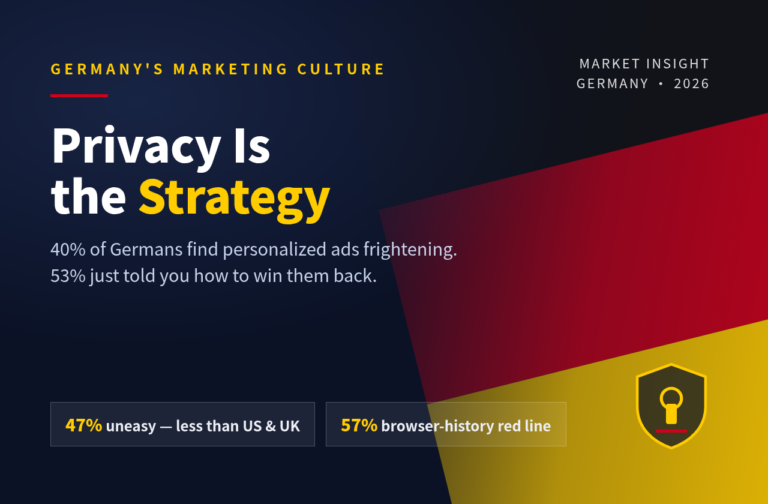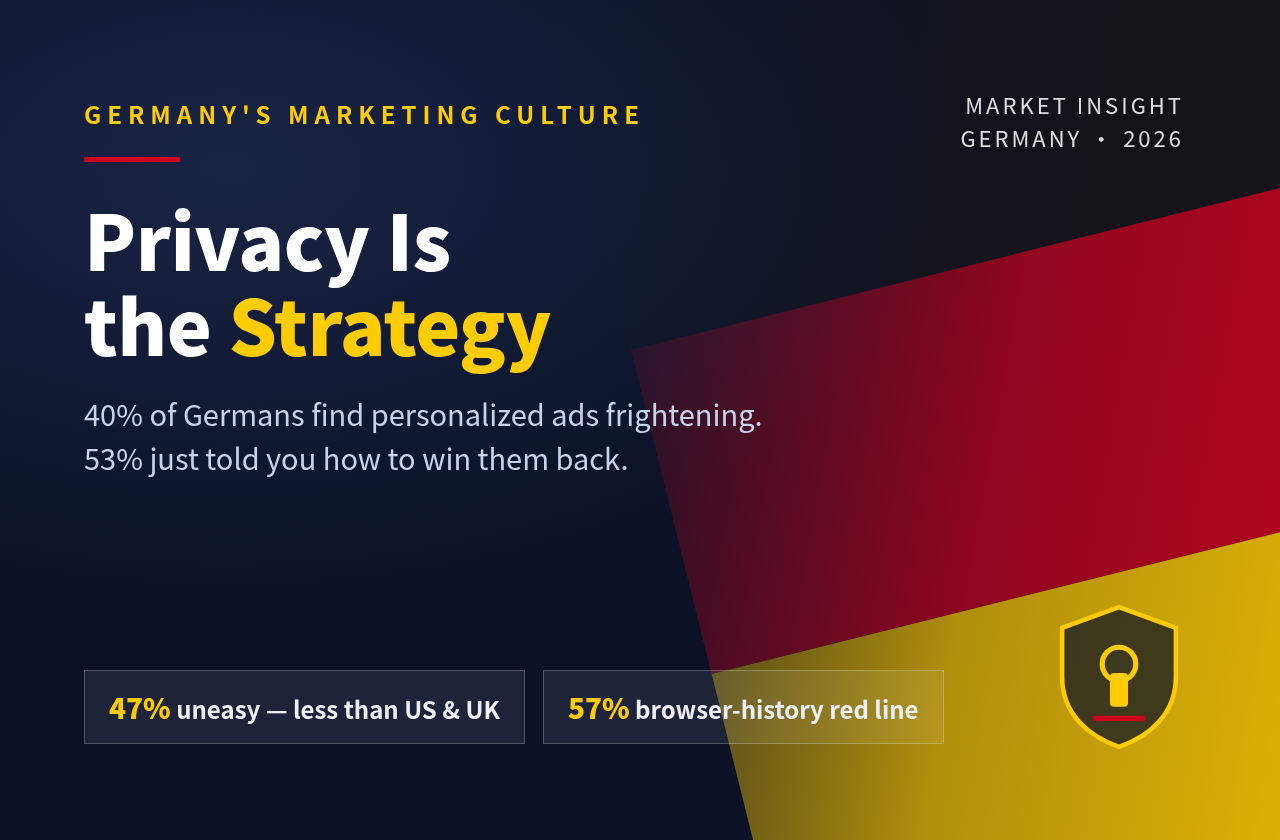
Your best-performing retargeting creative — the one that follows a shopper around the internet for two weeks — has a problem in Germany. Four in ten Germans say personalized ads genuinely frighten them. And here’s the part most international teams miss: 53% of them have already told you exactly what would make them comfortable. The opt-out isn’t the enemy of your funnel. In this market, it’s the entrance.
Germany is Europe’s largest consumer market and the world’s most misread one. Brands arrive with a US-tested playbook, watch their audiences shrink, and blame “the GDPR.” But the data says something stranger and more useful: Germans aren’t even the most privacy-anxious people in the survey. Americans are. What makes Germany different isn’t sentiment — it’s that sentiment here has courts, regulators and conversion habits behind it. Let’s walk through the evidence, then build the playbook.
The Survey That Should Rewrite Your DACH Brief
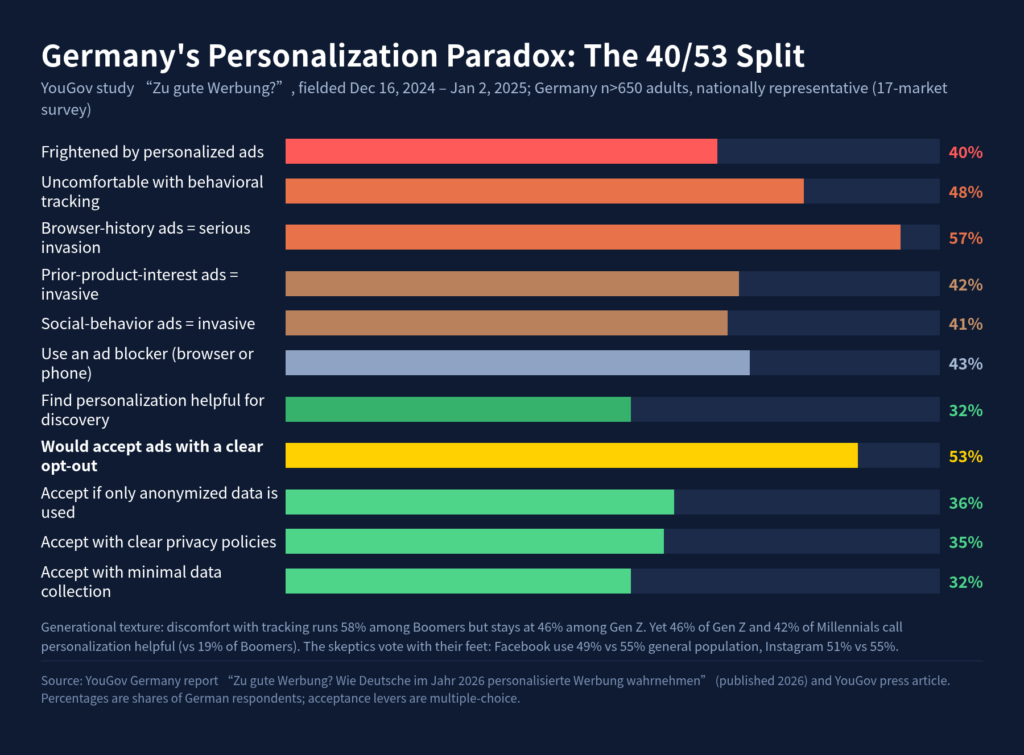
YouGov’s study “Zu gute Werbung?” surveyed a nationally representative sample of more than 650 German adults between December 16, 2024 and January 2, 2025, as part of a 17-market wave, and was published in Germany in 2026. The headline split: 40% of Germans say personalized advertising frightens them, while 32% find it helpful for discovering products. This is not an anti-marketing market. It’s a divided one.
The discomfort has texture. 48% are uneasy about companies using their online behavior for ads — 58% of Baby Boomers, but still 46% of Gen Z. Ask which data crosses the line and the ranking is unambiguous: ads based on browser history feel invasive to 57% (rising to 60% among Gen X and Boomers), ahead of prior-product-interest ads (42%) and social-media-behavior ads (41%).
And people act on it. 43% run an ad blocker; among the frightened who block ads, 40% keep the blocker on permanently, regardless of site. The skeptics also quietly withdraw from the platforms where behavioral ads live: Facebook usage runs 49% among them versus 55% in the general population, Instagram 51% versus 55%. Yet the young see the upside — 46% of Gen Z and 42% of Millennials call personalization helpful, against 19% of Boomers. Your audience isn’t rejecting relevance. It’s rejecting surveillance-flavored relevance.
The Comparison That Breaks the Stereotype
Now the twist that should humble every “Germans are uniquely private” slide deck. In YouGov’s 17-market comparison from the same survey wave, Germany sits in the upper-middle at 47% discomfort — below the United States and Great Britain, which tie for the top at 56%. France reaches 51%, Sweden 50%, Spain 48%. The unweighted market average is 41%; India and the UAE sit at 21%, Hong Kong at 18%.
Read that again: Americans are more uncomfortable with behavioral advertising than Germans, and they find it less helpful for product discovery (27% versus a 39% market average). The stereotype has the ranking backwards. What Germany has that the US lacks is consequence: data-protection authorities that litigate, courts that void manipulated consent, consumer associations that sue platforms, and a shopping culture that rewards proof. Same fear, different enforcement. That’s the actual market difference — and it’s the one your strategy has to answer.
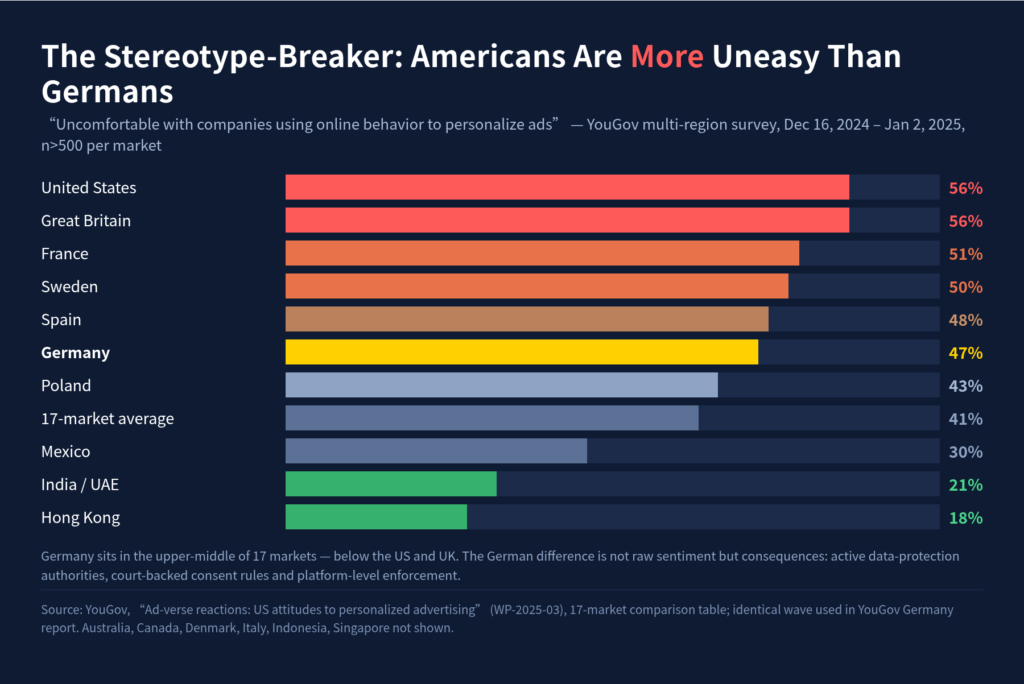
Exhibit A: The Cookie Banner That Lost in Court
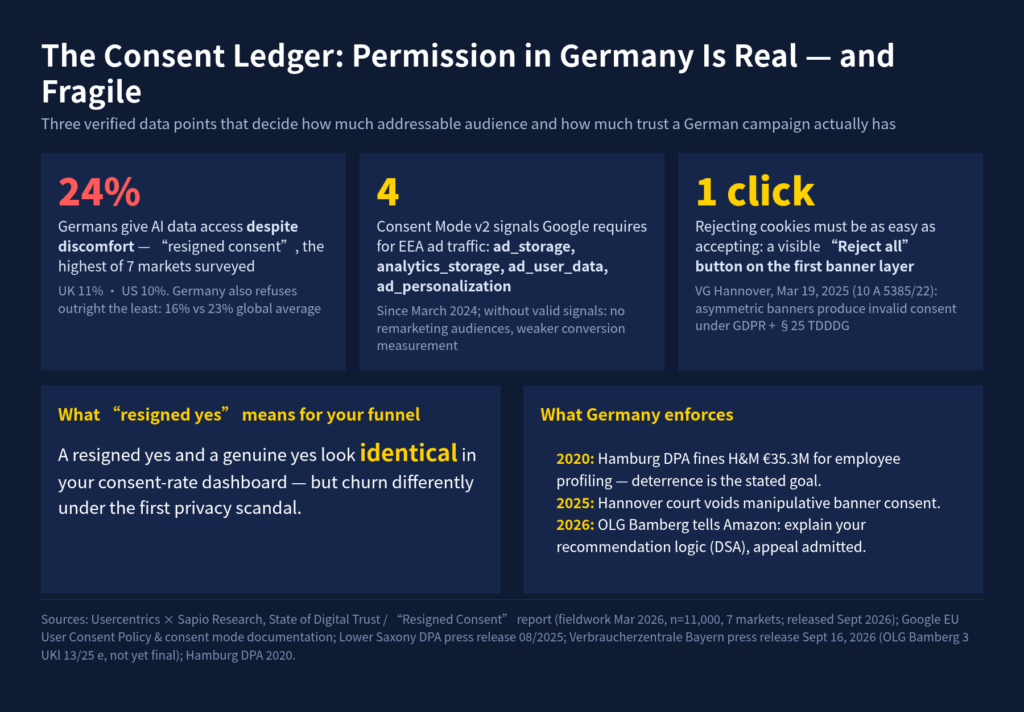
On March 19, 2025, the Hannover Administrative Court (case 10 A 5385/22) upheld an order by Lower Saxony’s data-protection authority against a regional publisher’s consent banner. The verdict reads like a checklist of growth-hacking sins. No equally visible “reject all” button on the first layer? Invalid consent. Rejection buried behind extra menus while acceptance takes one click? Invalid. Repeatedly re-showing the banner until users cave, an “accept and close” label on the X button, no disclosure of partner counts, third-country transfer notices visible only after scrolling? All invalid — under both the GDPR’s consent definition and Germany’s §25 TDDDG, the law governing storage on end devices. The court even confirmed that Google Tag Manager itself required consent in that setup.
The strategic takeaway is uncomfortable for dashboard optimists: a consent rate manufactured by dark patterns isn’t an audience. It’s a liability with a countdown. German enforcement doesn’t just ask whether you have a banner; it asks whether the choice was real.
Exhibit B: Amazon Must Show Its Cards
The second exhibit is fresher. On July 29, 2026, the Higher Regional Court of Bamberg (OLG Bamberg, case 3 UKl 13/25 e) ruled for the Bavarian consumer association against Amazon on three fronts of the EU Digital Services Act. Under Article 27, listing example factors for how search results are ranked isn’t enough — platforms must explain the relative weighting of the criteria that decide what shoppers see first. Under Article 16, a report button labeled “report a problem with this product” misleads users into thinking it’s for complaints, not illegal listings, and forcing a login before reporting is unlawful. Under Article 14, burying moderation and complaint information in terms-of-service labyrinths fails the accessibility test.
Two caveats keep this honest: the consumer association lost its demand for a logged-out de-personalization switch because it couldn’t prove Amazon personalizes for logged-out visitors, and the judgment is not yet final — the court admitted appeal to the Federal Court of Justice, and Amazon has announced legal steps. Still, the direction is unmistakable, building on a 2020 precedent: Hamburg’s regulator fined H&M €35.3 million for profiling employees, explicitly to deter. In Germany, the interface itself is regulated territory. Design accordingly.
The Consent Math Behind Your Shrinking Audiences
Here’s the mechanics layer your media team needs. Since March 2024, Google has required consent signals — Consent Mode v2, adding ad_user_data and ad_personalization to the storage parameters — for advertisers using its measurement, personalization and remarketing features with EEA traffic, under its EU User Consent Policy covering the EEA, UK and Switzerland. Without valid signals, visitors aren’t added to remarketing lists and conversion measurement degrades; correctly implemented consent mode lets Google model part of the gap, but modeling needs data volume and never fully replaces observed conversions. Your backend revenue stays the source of truth.
You’ll see agency claims that German remarketing pools shrink 30–50%. We couldn’t verify any primary measurement behind that range, so treat the direction as certain — consent gates plus 43% ad-blocker usage compound — and the magnitude as a function of your own consent rate. Measure it, don’t quote it. And measure its quality too, because Germany leads the world in a phenomenon the dashboards can’t see.
Resigned Consent: Germany Says Yes and Means No
In the State of Digital Trust 2026 study — 11,000 consumers across seven markets, fielded by Sapio Research in March 2026 for Usercentrics, a Munich company that sells consent-management software (a vendor interest worth naming) — German respondents posted a 24% “resigned consent” rate: people who grant data access despite feeling uncomfortable, because refusing feels like more effort than agreeing. That’s more than double the UK’s 11% and the US’s 10%. Germans were also the least likely to refuse outright: 16%, against a 23% average.
Sit with that combination. Germany is the market most likely to click “accept” and least likely to mean it wholeheartedly. A resigned yes and a genuine yes look identical in your consent-rate KPI — but they behave nothing alike at the first privacy scandal, the first creepy ad, the first unsubscribe wave. If your German consent rate looks healthy, your job isn’t done; it’s just started. Track what consented users do next, not just how many consented.
First-Party Data Is the Asset — and the Newsletter Is the Contract
When behavioral reach gets expensive, first-party relationships become the balance sheet. But Germany runs email on contract law, not best practice. Under §7(2) of the Unfair Competition Act (UWG), advertising email requires prior express consent, and the double opt-in flow — sign-up plus confirmation click — is the de-facto evidentiary standard. The Federal Court of Justice ruled in 2011 (I ZR 164/09) that advertisers must fully document each individual consumer’s consent declaration and be able to produce it at any time; a narrow existing-customer exception exists under §7(3), but it’s no foundation for acquisition.
Practically: your CRM, loyalty program and newsletter are the compliant growth engine — and Customer Match-style uploads inherit the same consent discipline. German subscribers granted permission deliberately; honor frequency and content promises like contract terms, because legally, they are. Permission here is a relationship, not a checkbox.
Contextual Beats Creepy: the Feed Is the Creative
With 57% calling browser-history ads invasive and 43% blocking ads outright, the cheapest reach in Germany is the kind that doesn’t need a profile: search intent, contextual placements, and retail media where the shopper already is. And in e-commerce, the ad that matters most may not look like an ad at all — it’s your product feed.
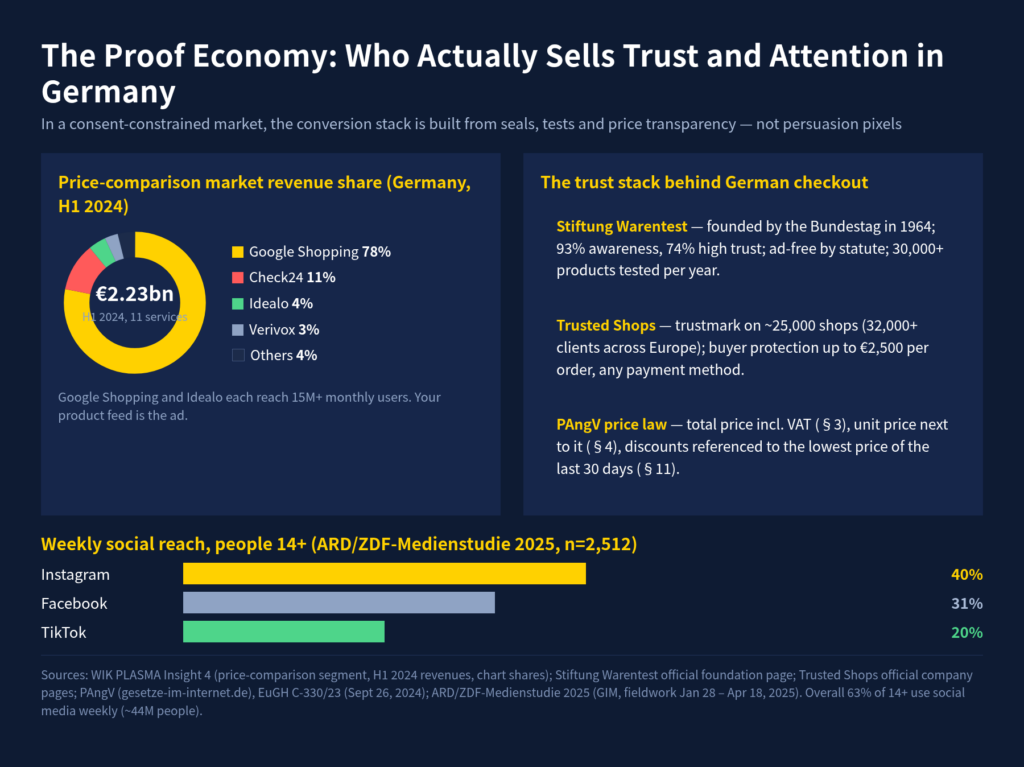
The WIK Research Institute’s PLASMA market database puts numbers on the landscape: across eleven price-comparison services tracked in Germany, aggregated revenue reached about €2.23 billion in the first half of 2024, with Google Shopping alone taking roughly 78%, Check24 about 11%, and idealo about 4%. Google Shopping and idealo each reach more than 15 million monthly users. In a comparison-driven market, your title precision, GTIN hygiene, price accuracy and availability data are your creative. A wrong price in the feed isn’t a rendering bug; it’s a trust violation with screenshots.
The Trust-Seal Conversion Stack
German conversion culture runs on institutional proof, and three names carry most of the weight.
Stiftung Warentest, founded by the German Bundestag in 1964, tests more than 30,000 products a year, buys anonymously at retail, and is barred by statute from taking advertising — independence as a business model. The foundation reports 93% consumer awareness and 74% high trust in its work (its own institutional data). A good rating is marketing gold you can use for free, under strict rules: reference only current tests, state how many products were tested and how many scored equally. Abusing the label invites exactly the litigation Germany is famous for.
Trusted Shops runs the trustmark you’ll see on roughly 25,000 certified shops — part of more than 32,000 client shops across Europe, per the company’s own figures — combining audited criteria, verified reviews and buyer protection covering orders up to €2,500 regardless of payment method. TÜV certification carries similar engineering-grade credibility; even idealo had itself audited as a comparison portal by TÜV Saarland. Placement logic: seals near the checkout and CTA, ratings where the platform allows seller annotations, and never a seal you can’t substantiate. We found no credible public A/B measurement of seal-driven CTR lift — so run your own test rather than quoting an agency’s decimal.
Price Transparency Is Law, Not a UX Choice
The Price Indication Ordinance (PAngV) makes honesty structural. Consumer-facing prices must be total prices including VAT (§3); goods sold by weight, volume, length or area need the unit price — the Grundpreis — clearly and legibly next to the total, including in ads and listing pages (§4). And any advertised discount must reference the lowest total price of the previous 30 days (§11); the European Court of Justice confirmed in September 2024 (C-330/23, Aldi Süd) that percentage claims must be computed against exactly that price.
This is why comparison platforms like idealo and Check24 sit upstream of so many German purchase journeys: shoppers can see price histories, unit prices and shipping costs side by side. Your “was €99, now €59” theater collapses on a platform that shows the item never sold above €69. Price like someone is checking — because in Germany, the platform already did.
Sie or du? Register Is a Targeting Decision
German has two “yous,” and choosing between them is a positioning call. The formal Sie remains the safe default for finance, insurance, health, unfamiliar brands and most B2B contexts; the informal du fits youth, lifestyle and community brands — provided the brand uses du everywhere, consistently. What reads as broken is drift: a Sie landing page, a du retargeting ad, a Sie checkout email. That’s not friendliness; it’s three different companies wearing one logo.
The same discipline applies to AI-generated German copy. Machine drafts routinely mix registers, import anglicisms no native would use in-context, and mangle the compound nouns German precision runs on. Use AI for drafts and variants; let a native reviewer own the final register. Localization here isn’t translation — it’s deciding who you are to this customer.
The Channel Map: Smaller Than the Deck Says
Refresh your reach assumptions with primary data. DataReportal’s Digital 2026 Germany report (October 2025 data) counts 78.5 million internet users (93.5% penetration) and 64.7 million social media identities (77.1%) — the first reported year-on-year decline, about 800,000, though the publisher warns platform data corrections inflate such drops. Facebook’s ad reach stands at 22.8 million — 32.7% of adults, not the “55% of Germans” agency decks claim — down 11.5% year-on-year with the same correction caveat. Instagram reaches 31.3 million; LinkedIn counts 24 million registered members (up 20%, and members aren’t monthly actives); TikTok reaches 23.7 million adults.
Survey data tells the human story: the public broadcasters’ ARD/ZDF-Medienstudie 2025 (GIM Institute, n=2,512) finds 63% of people 14+ using social media weekly — about 44 million — with Instagram at 40% weekly reach, Facebook 31%, TikTok 20%, and growth now coming from the over-50s, not teens. Search, meanwhile, is less monopolized than the folklore “90%+ Google”: StatCounter’s September 2026 figures put Google at 87.8% overall but Bing near 19% on desktop — a Windows-and-Edge office culture that makes dual-engine coverage rational for B2B.
The Playbook: Make the Opt-Out a Feature
Turn the 53% acceptance path into product design. Put a genuine reject-all button on the first banner layer — it’s court-backed law and, paradoxically, a trust signal. Offer granular purposes and, where your stack allows, anonymized or minimal-data modes; YouGov’s acceptance levers (clear opt-out 53%, anonymized data 36%, clear policies 35%, minimal collection 32%) are effectively a consumer-authored spec sheet. Then measure like an operator: consent rate and consent quality (downstream unsubscribes and complaints) as first-class KPIs; incrementality tests between contextual and behavioral campaigns; seal-versus-no-seal experiments at checkout; first-party list depth over lookalike breadth. In B2B, where research cycles are long and desktop-heavy, nurture with specifications, test results and references — countdown timers and “BUY NOW” aesthetics read as unserious to a proof-trained audience (a practitioner observation, not a survey finding).
Bottom Line
Germany doesn’t punish marketing; it punishes marketing that behaves like surveillance and converts like a casino. The data gives you the whole strategy: 40% frightened means contextual over creepy; 53% conditional acceptance means the opt-out is your best trust feature; a court-enforced consent standard means dark patterns are negative-value audiences; and a seal-and-test culture means proof beats persuasion at the moment of purchase. Americans may fear tracking more — but Germans built the machinery that makes fear actionable. Win here, and your privacy playbook is exportable everywhere. Lose here, and no creative will save you.