Deep Dive · for US brand leaders, CMOs and multicultural strategy teams · verified November 2026
Here is an uncomfortable thought experiment. Imagine your toughest customer critic — the one who can tell within three seconds whether your ad was made by people who actually know her life, or by a committee that added a salsa track in post. Now imagine 70 million of her, holding a projected $2.8 trillion in buying power, and already deciding whether your brand deserves a place in the household. That is not a segment inside your market. Increasingly, it is your market’s growth engine. And the old playbook — translate the general-market spot, buy some Spanish-language media, show up in September — is not just underperforming. The audience has learned to detect it on sight.
The Verified Scale — and Why the Trillions Disagree
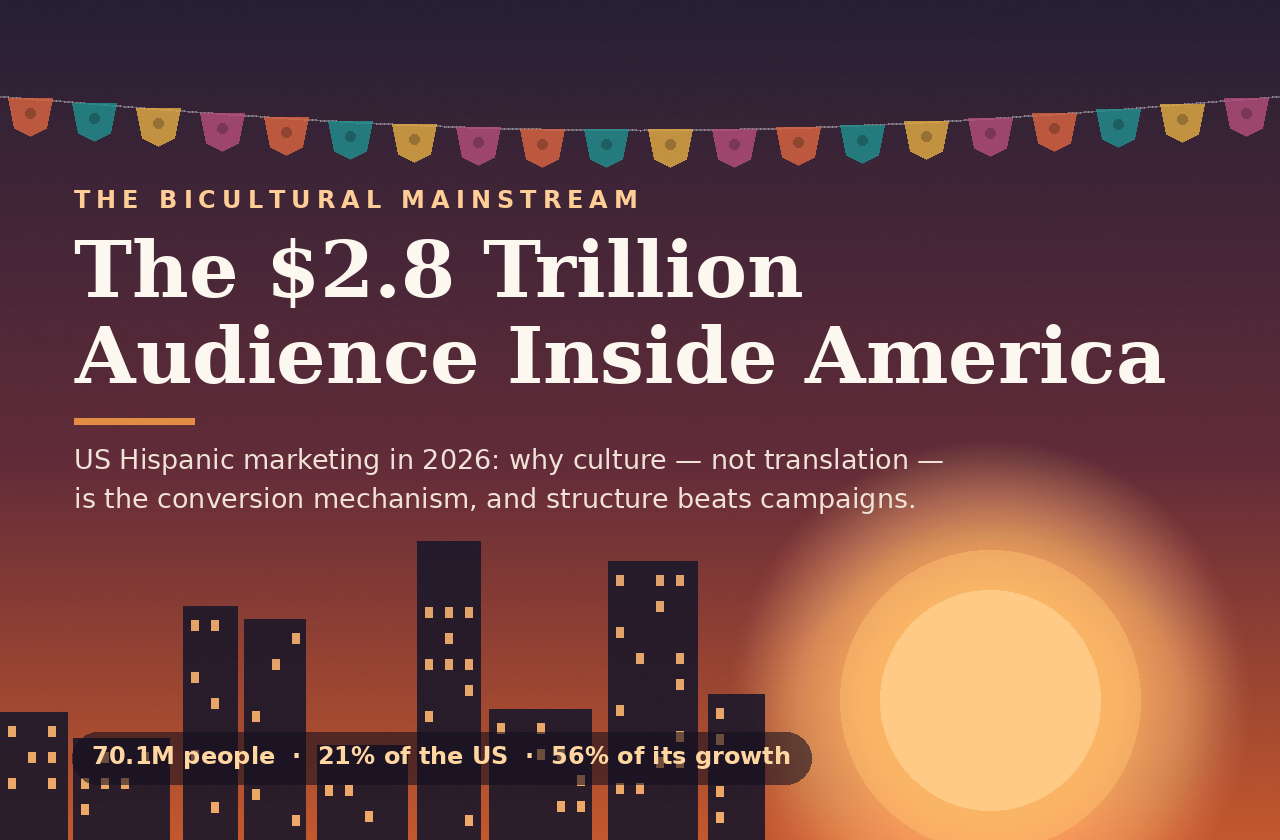
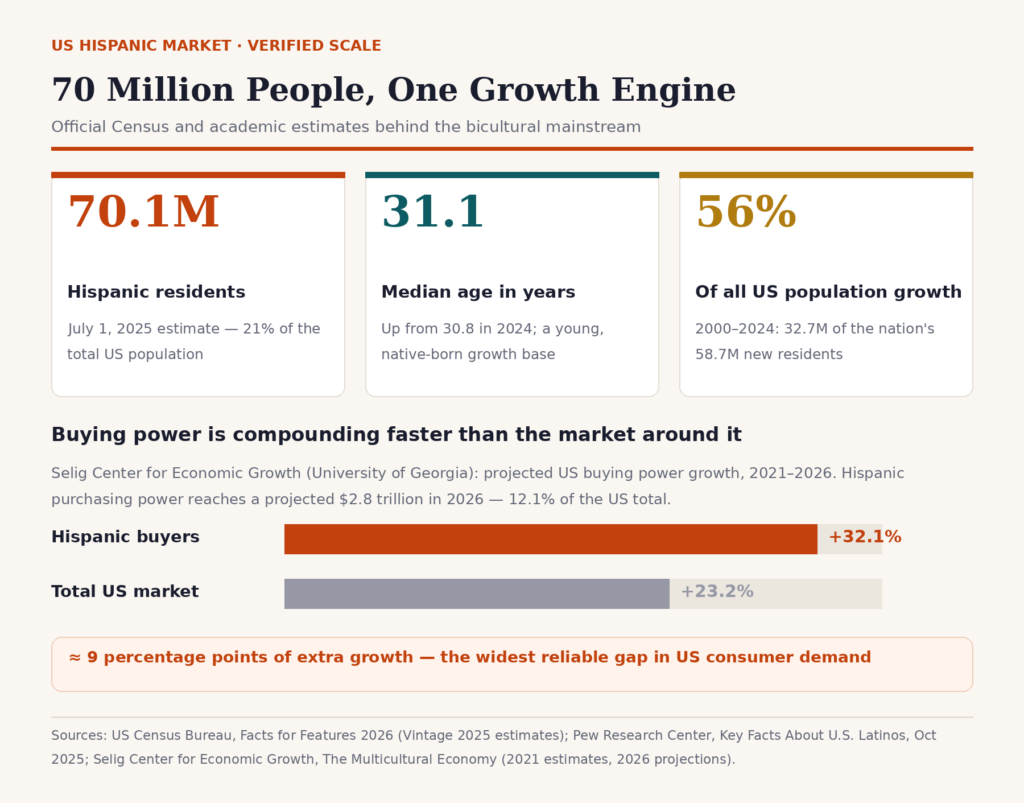
Start with the numbers that survive scrutiny. The US Census Bureau’s 2026 Facts for Features puts the Hispanic population at 70.1 million as of July 1, 2025 — 21% of the country, the largest racial or ethnic minority, with a median age of 31.1. Sixteen states now count a million or more Hispanic residents. Harris County, Texas, alone added 50,093 Hispanic residents in a single year.
Pew Research Center’s October 2025 analysis adds the trajectory: the population nearly doubled from 35.3 million in 2000 to 68 million in 2024, and Hispanics accounted for 56% of all US population growth in that period — 32.7 million of the nation’s 58.7 million new residents. More than any other group. And this is now a native-born story: roughly two-thirds of US Latinos were born in the country.
On money, anchor to the Selig Center for Economic Growth at the University of Georgia, whose Multicultural Economy series has tracked this market for three decades. Its projection: $2.8 trillion in Hispanic buying power in 2026, about 12.1% of the US total, growing 32.1% between 2021 and 2026 versus 23.2% for the whole market — a gap of roughly nine percentage points.
You will also see $4.1 trillion quoted elsewhere. That is not a contradiction; it is a definition. The Latino Donor Collaborative’s GDP research, produced with UCLA and Cal Lutheran economists, measured US Latino GDP at roughly $4 trillion in 2023 — a fifth-largest economy if counted standalone — and its broader purchasing-power metric at $4.1 trillion. Selig measures after-tax income; LDC measures economic output and a wider spending envelope. Different rulers, same direction: this market compounds faster than the one around it. When a deck quotes a trillion-figure without naming the ruler, ask which one.
Structure Beats Campaigns: The Seasonal Line-Item Trap
Every September, the same ritual: a heritage-month campaign, a Latino cast, a translated tagline, a media flight that ends October 15. Then silence for eleven months.
The problem is not effort. It is architecture. A campaign lives in the marketing department; a customer lives in your product, your pricing, your store experience, your service lines. When the ad promises belonging but the app has no Spanish option, the packaging ignores household size, and the call center cannot handle a bilingual conversation, the audience draws the obvious conclusion: the ad was a costume. Culture work that stops at the creative department is theater, and this audience reviews theater harshly. The brands winning here treat Hispanic growth as a business-structure question — product, distribution, CX, hiring — with marketing as the amplifier, not the whole show.
The Bicultural Mainstream: Codeswitching Is the Default
The single most outdated assumption in the old playbook is the language binary: Spanish-dominant versus English-dominant, two audiences, two media plans. The reality in 2026 is a bicultural mainstream that codeswitches the way you switch browser tabs.
iHeartMedia’s February 2026 study with Collage Group — a survey of 2,000 US adults including 1,200 Hispanic adults, conducted in English and Spanish — found that bicultural Latinos, who identify as equally American and Hispanic, now represent nearly 40% of all US Latinos. Two-thirds hold that dual identity explicitly, and 78% say they feel more connected to their heritage than a year ago. Note the vendor interest: iHeartMedia sells audio advertising, so treat its channel findings accordingly — but the identity data aligns with independent research.
The behavioral payoff is striking. Bicultural Latinos are 60% more likely than the average consumer to buy from brands that reflect them, and 61% say they would pay more for those brands. Read that again: cultural reflection is not a sentiment metric. It is a pricing lever. Meanwhile 73% are open to trying new brands — this is an audience actively shopping for someone who gets them.
The Authenticity Detector: 87% Spot the Fake
If the bicultural premium is the carrot, the authenticity detector is the stick. LatiNation Media, a Latino-owned media company, commissioned research firm ThinkNow to survey 400 bilingual and English-dominant Hispanic adults aged 18–34 across the US in May–June 2025. The sample was 90% US-born. That is exactly the cohort the old Spanish-language-first playbook was never built for.
The findings, published as Culture Decoded: 87% notice when advertising lacks cultural authenticity, and 32% detect it instantly. Yet 59% say they reward brands that acknowledge their heritage with loyalty and engagement, and 67% expect brands to reflect their cultural identity truthfully. A caveat worth keeping: this is a vendor-commissioned study with a modest sample measuring self-reported attitudes, not an experiment. Directionally, though, it matches what practitioners see in comment sections every day.
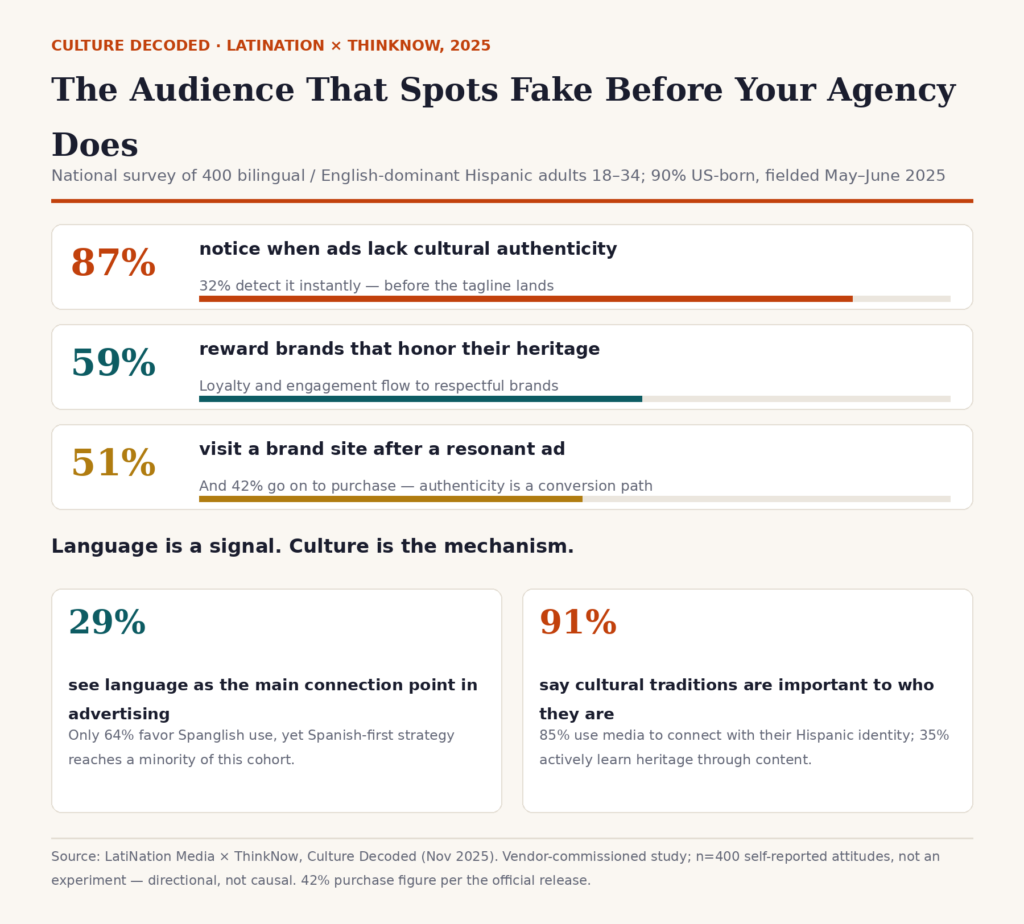
The mechanism underneath: only 29% of respondents treat language as the primary connection point in advertising, while 91% say cultural traditions matter to who they are. Culture is the conversion mechanism. Language is one signal among many — necessary sometimes, sufficient never.
English-First, Heritage-Rooted
So should your creative be in English or Spanish? The honest answer is that the question itself is dated. This cohort lives in English and feels in two cultures.
In the LatiNation sample, half were English-dominant and half balanced Spanish and English — yet 64% embrace Spanglish, and 85% use media actively to connect with their Hispanic identity, with 35% deliberately using content to learn about their heritage. Media is not just entertainment here; it is identity infrastructure for second- and third-generation kids whose grandparents’ stories were not in the school curriculum.
The Hispanic Marketing Council, hosting Collage Group researchers in a February 2026 webinar, reported that 63% of Hispanic Gen Z prefer ads that incorporate Spanish even in English-language environments. Sit with the apparent contradiction: English-dominant lives, Spanish-appreciating feeds. The resolution is that Spanish functions as a trust signal — a wink that says we know your kitchen, your abuela’s phrases, your humor — inside an otherwise English-first story. A well-placed “mijo” lands; a fully translated script aimed at an English-dominant 24-year-old can feel like being addressed as someone’s grandfather. And credibility flows through people, not formats: the same HMC session found creators and influencers often carry more trust than traditional media.
The Conversion Chain Nobody Budgets For
Authenticity is usually filed under brand equity — soft, slow, unmeasurable. The Culture Decoded data argues otherwise. Among respondents who engaged with a culturally resonant ad, 51% visited the brand’s website, and 42% went on to make a purchase after engaging with culturally authentic content. That is a performance funnel, not a halo.
The practical implication: brief and measure cultural work like performance work. Pre-test creative with bicultural panels before launch — the 32% who detect fakery instantly will not give your media budget a second chance. Track site visits and conversion from creator partnerships with the same rigor you apply to paid search. When the finance team asks what cultural fluency returned, you should have a number, not a mood.
Family Is the Decision Unit
One more structural difference the general-market funnel misses: who actually decides. ThinkNow’s demographic research puts average Hispanic household size at 3.8 people versus 3.2 nationally, and multigenerational households are common. The buyer is frequently a household, not an individual — the daughter who researches in English, the father who evaluates in Spanish, the grandmother whose approval settles it.
Categories where this matters most: housing and financial services, education, food and beverage, autos, insurance, telecom family plans. Messaging built for a solo decision-maker undersells to a committee. Creative that shows the intergenerational table — and products priced and packaged for larger households — converts the actual buying unit.
Geography Beyond the Big Three
The map is moving. Census American Community Survey five-year estimates put California at 15.8 million Hispanic residents, Texas at 12.0 million and Florida at 6.1 million — still the big three, but no longer the whole story. Texas crossed a historic line in 2022: Hispanic Texans became the state’s largest population group at 40.2%, edging past non-Hispanic white Texans at 39.8%, the first such shift since at least 1850, as confirmed by the state demographer.
The faster growth is increasingly in the Southeast and other new-destination states — Georgia, North Carolina and Tennessee among the sixteen states now above a million Hispanic residents. The strategy error is running a national Hispanic plan built entirely on Mexican-American cultural cues from Los Angeles when your growth ZIP codes are Salvadoran in Northern Virginia or Dominican in Providence. Origin mix is local. National brands should build a national framework with locally specific casting, food references and dialect — think regionally, execute locally.
A Streaming-First Audience Your Media Plan Hasn’t Met
Where is the attention? Nielsen’s 2025 Diverse Intelligence Series found that 55.8% of Hispanic TV time goes to streaming, versus 46% for the total US, with YouTube alone taking 19.1% — more than all broadcast networks combined. EMARKETER forecasts put Hispanic digital video penetration at 84.1%, the highest of any US racial or ethnic group. The Culture Decoded cohort mixes free and paid streaming (61% use both), and discovery runs through social feeds and creators before it ever reaches a TV screen.
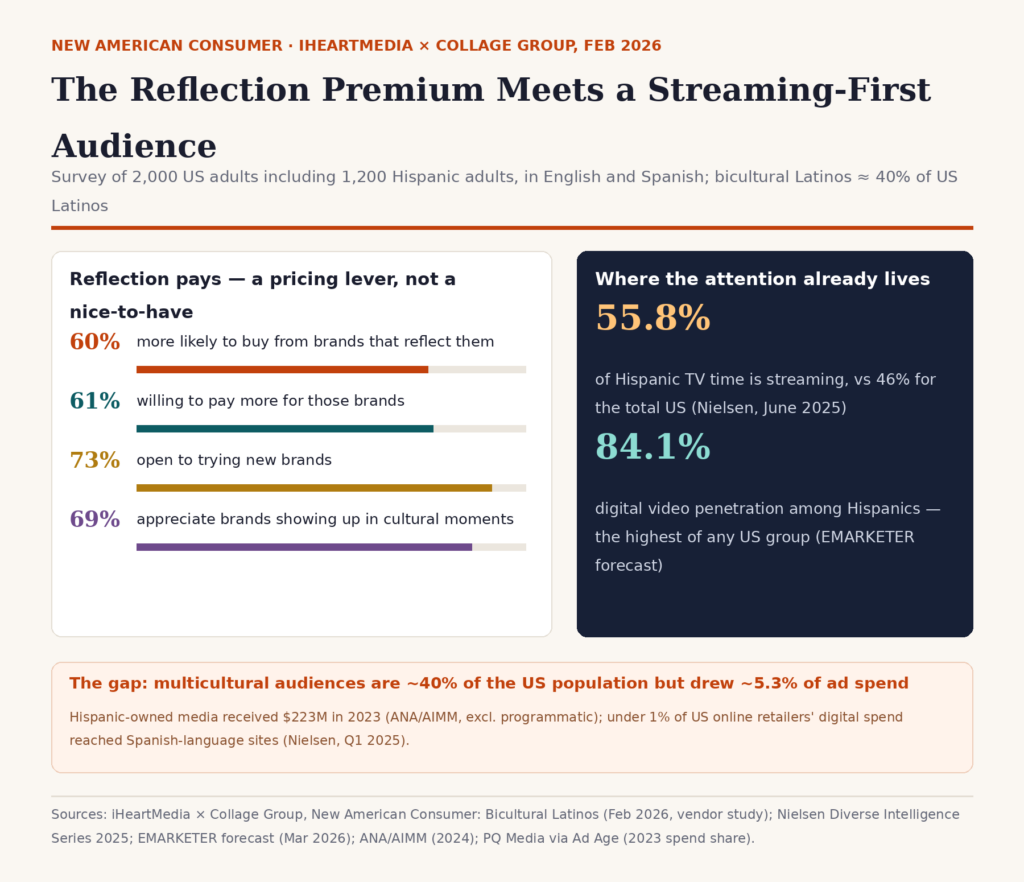
Now the mismatch that should embarrass the industry: Nielsen found that less than 1% of US online retailers’ digital ad spend reached Spanish-language sites in early 2025, and roughly 96% of what did flow went to YouTube — a platform holding about a fifth of Spanish-speaking audiences’ TV time. Zoom out and the ANA’s Alliance for Inclusive and Multicultural Marketing tells the same story: multicultural audiences are around 40% of the population but attracted roughly 5.3% of ad spend in 2023, and Hispanic-owned media companies received just $223 million that year, excluding programmatic. The audience migrated to streaming years ago. The budgets are still commuting to an address it no longer lives at.
The Trust Climate: Silence Is Not Neutral
There is a 2026-specific layer you cannot strategize around: the immigration-enforcement climate has turned brand behavior into a purchase criterion. ThinkNow ran three survey waves — August 2025, December 2025 and March 2026, each with 500 Hispanic and 526 non-Hispanic respondents — presented with the Hispanic Marketing Council. The findings: 70% of Hispanics expect brands to do something when enforcement affects their communities; only 23% accept neutrality. And this is not hypothetical sentiment — 57% say they have already changed where they shop or which brands they support, versus 38% of non-Hispanics, with Spanish-dominant and bilingual consumers shifting at nearly twice the rate of English-dominant ones.
The same research maps both edges of the blade: 53% would be more likely to support a brand that publicly backs immigrant communities, and 49% would abandon one with pro-enforcement messaging. Running inclusive ads while staying publicly silent earned no credit. For brands with mixed-status customers and employees, community presence — welcoming stores, Spanish-language service, support for local Latino small businesses — is now retention strategy, not PR.
Fix the Research Before You Fix the Creative
Here is the quiet upstream failure: you cannot build for a buyer your research never met. The spend gap documented by the ANA has a mirror in insight departments, where general-market panels routinely under-represent Hispanic respondents relative to their share of category buyers — so the “consumer truth” your strategy rests on was structurally sampled away.
Three repairs, in order. First, quota and weight your panels to actual category-buyer demographics, and pay for bilingual instrument design rather than translating an English questionnaire — question wording carries cultural assumptions. Second, respect naming: ThinkNow’s culture research found that when media and companies describe the community as a whole, 43% prefer “Hispanic” and 26% “Latino,” while origin-country labels dominate inside the community; “Latinx” remains a marginal preference under 10%. Ask your actual customers, in context. Third, build a pipeline from insight to product — if the research says households buy as a unit and your packaging team never sees the research, you have a filing system, not an insight function.
The Playbook: Seven Structural Moves
Pulling the evidence together, the operating model writes itself:
- Year-round presence, not seasonal flights. The 69% who appreciate brands showing up in cultural moments also notice the eleven-month absence. Budget always-on, spike for moments.
- English-first, heritage-rooted creative. Mainstream genres carrying authentic cultural detail — the HMC award jury’s phrase for the winning work was that it lives inside the culture rather than observing it from outside.
- Creators as trust infrastructure. Long-term partnerships with creators the community already believes, not casting that merely looks the part.
- Pre-test with bicultural panels. With 87% detecting inauthenticity, cultural QA belongs before launch, next to legal review.
- CX that matches the promise. Bilingual service paths, Spanish options where they serve real households, store teams that reflect the trade area.
- Rebalance media to where attention lives. Streaming, YouTube, creators and audio — bicultural Latinos are heavy audio users, and iHeart’s data shows a 22% lift in radio-ad-driven purchase. Fund Hispanic-owned media beyond token line items.
- Measure by segment. Report Hispanic penetration, conversion and retention separately. What gets a line in the dashboard gets a line in the budget.
None of these is a campaign. All of them are structure. That is the point.
The Bottom Line
The Hispanic market stopped being an “emerging segment” sometime in the last decade; the org charts just have not been updated. Seventy million people, a fifth of the country, the majority of its population growth, buying power compounding nine points faster than the market — and an authenticity radar that punishes exactly the shortcuts most budgets still fund. The winners of the next five years will not be the brands with the best heritage-month spot. They will be the ones whose product, pricing, service and research were rebuilt for the bicultural mainstream — and whose advertising simply tells the truth about it.