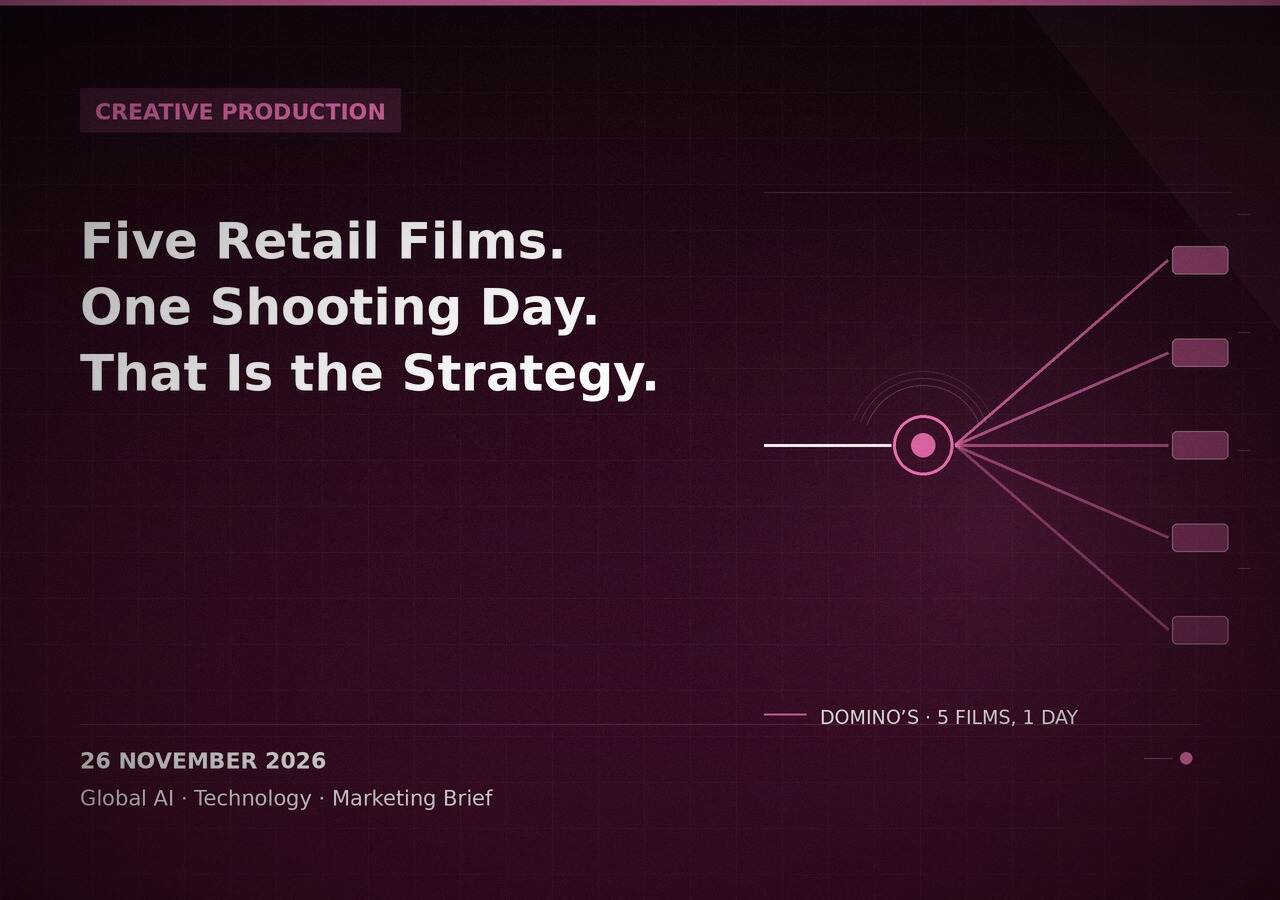
Domino’s has released the first of five retail films under its “Drop Everything* It’s Domino’s” platform, and the production detail is the interesting part: all five were shot in camera on a single day.
The first film, Buried Dad, hangs on a summer deal so good that the lead character defies the laws of physics to reach it — pushing through neck-deep sand, in the version circulating, to get to a Domino’s.
The films are built to flex across promotion and new product development. The same idea can carry a large-format brand ad and a faster, cheaper retail spot without losing what the agency calls craveability. They run across TV, digital and social through the southern summer, with out-of-home support.
Why one shooting day is a media decision, not a production one
The arithmetic of retail advertising is that production cost sets a floor on how many messages you can run. A campaign that costs seven figures to shoot can afford one proposition per season. A campaign that costs five figures per film can afford five propositions, refresh creative when a promotion changes, and test hooks without writing off the shoot.
Bureau of Everything’s Cam Blackley frames it as entertainment discipline: “Entertainment is really important to us no matter where in the funnel the ideas live. We’re building Domino’s retail to be unexpectedly scroll stopping, to make you smile and make you crave a slice.”
Strategy founder Emily Taylor supplies the operating logic: “QSR is inherently a fast moving category, where deals need to deliver on what a customer wants against an ever changing competitor landscape. The flexibility in these retail constructs allow us to adapt at speed without ever losing the craveability and quality cues.”
Read those two quotes together and the structure is clear. Blackley is defending creative ambition at the bottom of the funnel — retail work, not brand work — and Taylor is defending the delivery mechanism that keeps it affordable.
The context both quotes avoid
Domino’s is a brand with a discounting problem, and this platform is an attempt to change that. Trade coverage describes the company as under pressure and the new positioning as an effort “to kick its discounting habit.”
That reframes the five-film structure. The cheap-looking-but-expensive-to-ignore discount ad is the thing they are trying to move away from; the answer is not fewer deals but better-made deals, delivered fast enough that the brand can run promotions without looking like a coupon operation. Five films in one day is what makes that affordable.
The films also landed a week after Domino’s appointed Lara Thom as global CMO — timing that suggests a new marketing lead inheriting a platform built to be iterated rather than a single campaign to be defended.
What this does not tell you
There is no publicly disclosed cost per film, no media weight, no view-through or sales data. The claim that one shooting day produces five films is verifiable from the credits and the agency’s own account; the claim that this makes advertising more effective is not yet evidenced.
There is also a regional trap worth naming. This is an Australia and New Zealand campaign — southern summer, ANZ brand roles in the credits — not a global platform rollout. Reading it as Domino’s worldwide strategy would overstate it. What travels is the production model, not the campaign.