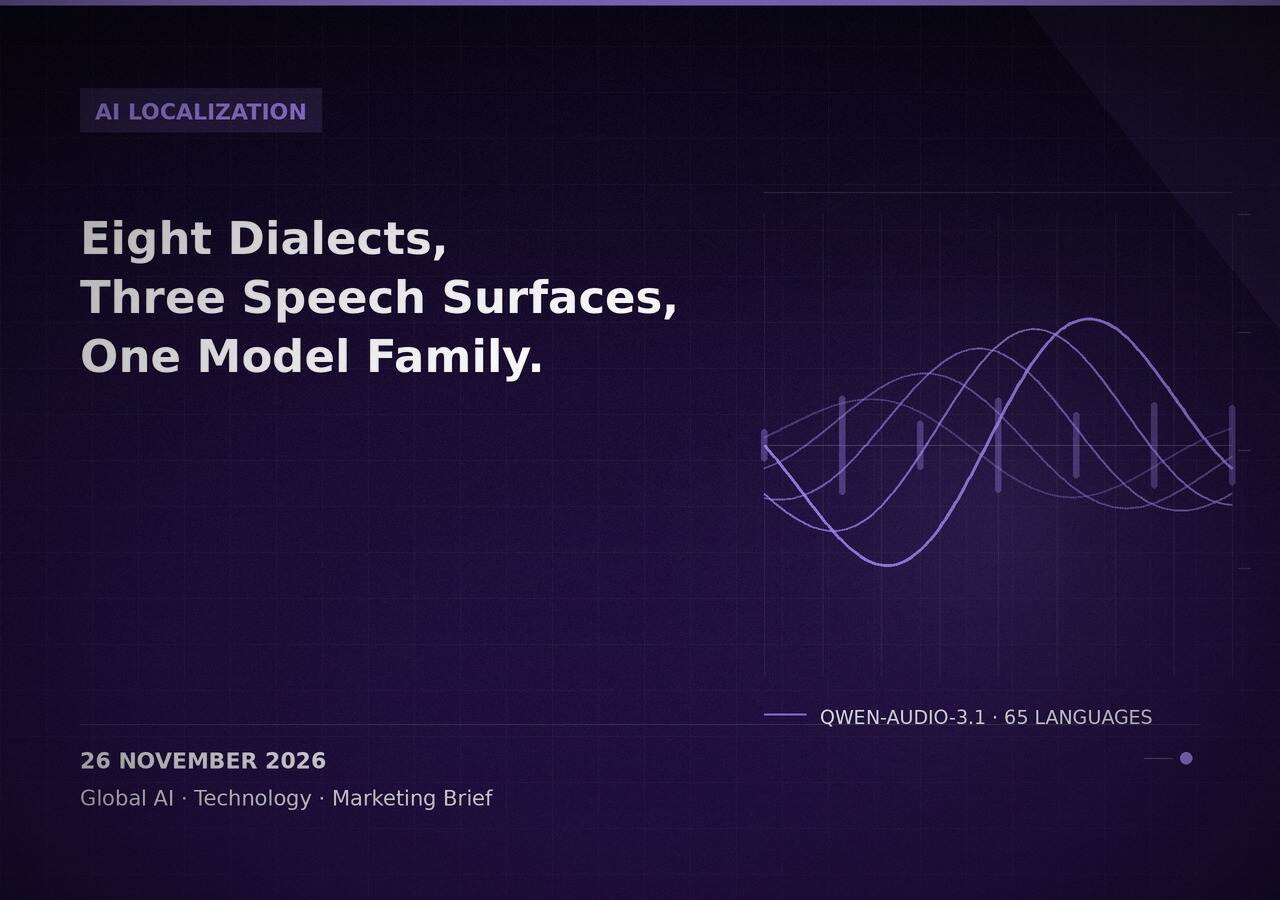
Alibaba’s Qwen team announced on 26 November that the Qwen-Audio-3.1 speech family has gained expanded multilingual coverage, weighted toward Chinese dialects. The three hosted SKUs now report: ASR at 59 languages and 8 Chinese dialects, TTS at 65 languages and 6 dialects, and Realtime at 53 languages and 6 dialects. All three are callable.
Read the three numbers as a ranking rather than a list. Language coverage runs ASR > TTS > Realtime, and dialect coverage runs 8 > 6 = 6. That ordering is not arbitrary — it tracks task difficulty. Transcription only has to decode what was said. Synthesis has to produce a voice that can carry the dialect, which requires speakers and prosody the decoder does not need. Realtime has to recognise, generate and manage turn-taking inside one pass, so every added language spends latency budget three ways.
The number that moved the other way
Here is the detail worth flagging, because it does not appear in the announcement graphic. Qwen’s September release documentation, when the family launched at the Yunqi Conference on 23 September, described 16 Chinese dialects. The November update describes 8. Nothing published explains the difference, and the models did not get worse at Cantonese in nine weeks.
The most plausible reading is a change in how the count is defined — eight dialect families (Mandarin, Cantonese, Wu, Minnan, Hakka, Gan, Xiang, Jin) plus regional accent groups would produce a larger figure. But that is inference, not disclosure. Anyone quoting “8 dialects” as a capability gain should note that the same series was previously described as covering twice as many.
What else the release does not contain
There is no new benchmark table, no technical report, and no pricing change attached to this update. The announcement was a single post with one image listing the three language counts and not a single dialect figure.
That makes this a coverage release rather than a quality release. The distinction matters for procurement: broader language support changes which markets you can enter; it says nothing about word error rate in a noisy call centre, latency under load, or how the model handles code-switching mid-sentence.
The September launch is the more interesting artifact for anyone evaluating substance. It shipped five product lines, including an ASR variant with four deployment configurations plus a Next model for audio understanding, and a TTS tier that generates speech, sound effects and ambience together. The November update touched the three callable SKUs and left the Next models alone.
Where dialect support actually pays
The commercial case is less about novelty than about friction. Mandarin-first ASR degrades in exactly the situations where voice interfaces are most useful: an elderly customer explaining a problem in Wu, a factory worker logging a fault in Cantonese, a livestream host switching register for a regional audience. Chinese dialect recognition is the difference between a demo and a deployed product in those segments.
For content and marketing operations, the practical consequences sit in three places: subtitle generation for regional creators, voice-over for localised advertising, and customer service triage where the caller’s dialect currently determines whether they reach a human.