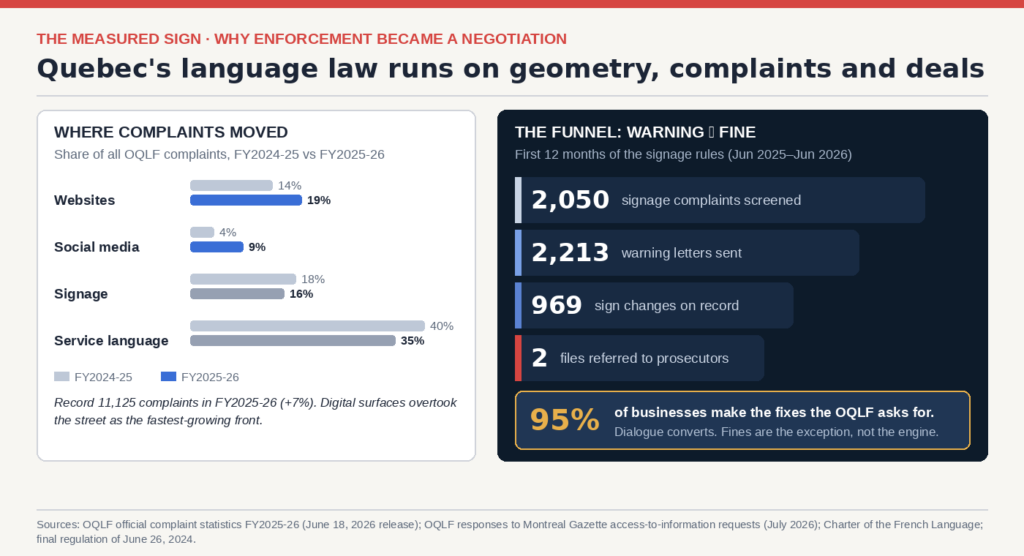
Here is a paradox worth sitting with. Quebec passed the toughest language rules in a generation, doubled its language watchdog’s budget to $49 million, and accepted anonymous complaints against businesses. Then, in the first year of the new signage regime, the office screened 2,050 complaints, sent 2,213 warning letters — and referred exactly two cases to prosecutors. No signage conviction. Meanwhile, the office reports that 95% of businesses make the corrections it asks for.
That isn’t a crackdown failing. It’s a different machine working exactly as designed — and understanding the mechanism tells you where your compliance budget should actually go.
Geometry Made Compliance Negotiable
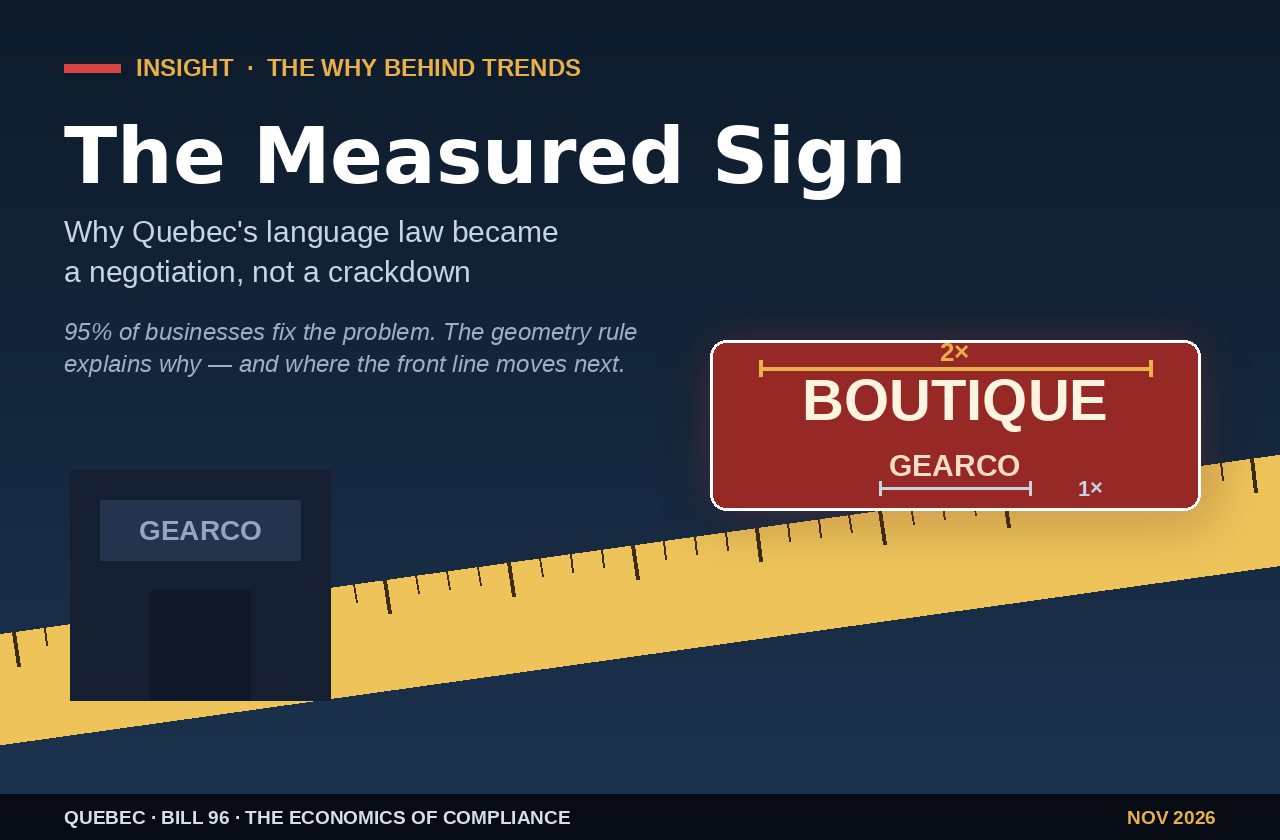
The decisive design choice wasn’t the fines. It was replacing a subjective standard (“sufficient presence of French”) with a measurable one: French must occupy at least twice the visual space of other-language text. A ruler creates something a courtroom battle never does — a shared, cheap test both sides can run. An inspector can photograph a sign and measure it. A retailer can mock up a fix and verify it before fabrication. When compliance becomes arithmetic, the natural resolution becomes a conversation about centimeters, not a fight about rights. The 2× rule quietly converted enforcement into engineering.
The Reversal That Kept the Peace
Notice what the government gave back. Bill 96’s original text would have stripped unregistered trademarks of their French exemption — a guillotine for thousands of small brands. The final regulation of June 2024 restored it. Why? Because the old rule collided with a broken runway: at its peak, Canada’s trademark queue ran past 1,700 days. You cannot demand registration-backed compliance while the registration office is five years behind. The state traded legal breadth for enforceability — narrower demands that businesses can actually meet, backed by a watchdog that mostly asks rather than prosecutes. With CIPO’s examination wait now forecast at about eight months, the runway excuse is gone, but the negotiation architecture remains.
The Front Line Is Moving to Your Feed
The most revealing number isn’t in the signage data at all. In the OQLF’s official 2025–26 statistics — a record 11,125 complaints — signage accounts for just 16%, and falling. Commercial documentation jumped from 24% to 33% of all complaints; website complaints rose from 14% to 19%, and social-media complaints more than doubled, from 4% to 9%. A sign gets fixed once. A feed publishes daily. The street was a finite compliance project; the feed is an infinite one — and complainants have figured out that a screenshot is the cheapest evidence in the province.
The insight for global brands: Quebec’s language regime runs on measurable rules, cheap complaints, and negotiated fixes. Budget accordingly. Your signage risk is a one-time capital project with a ruler. Your social and web risk is an operating line item that never ends — and it’s where the complaints are going next.