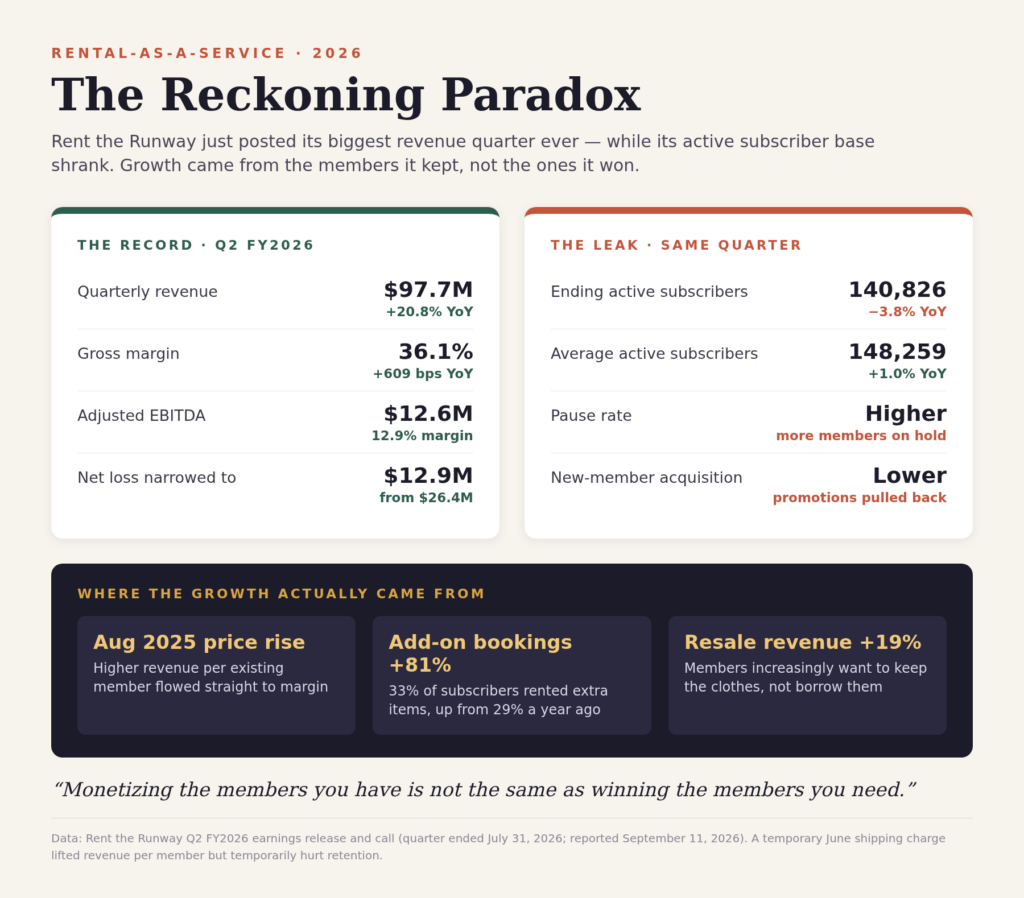
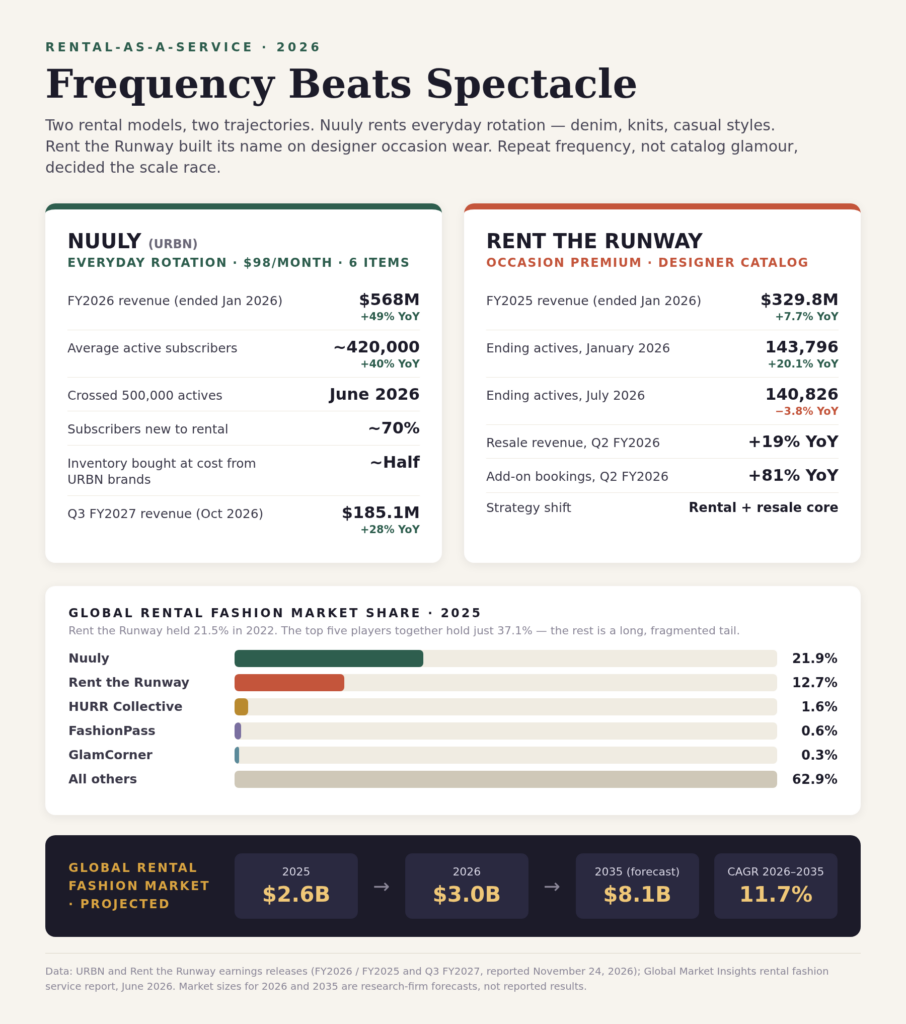
On September 11, Rent the Runway announced the biggest quarter in its seventeen-year history: $97.7 million in revenue, up 20.8% in a single year. In the same press release, almost as an afterthought, sat a number that tells the truer story. Ending active subscribers: 140,826. Down 3.8%.
Read those two lines together and you have the entire state of rental-as-a-service in 2026. The business of lending clothes is not dying. It is growing up — and growing up means discovering that access is a tool, not an ideology. Some corners of the closet economy are compounding beautifully. Others are quietly leaking members while their income statements look healthier than ever. If you run a DTC brand, a subscription business, or anything with a circular-economy slide in its deck, the difference between those corners is the most useful marketing lesson of the year.
Let’s open the books.
A Reckoning, Not a Collapse
First, give Rent the Runway its due. Fiscal 2025 revenue reached $329.8 million, up 7.7%, and the company reported net income of $22.6 million — its first annual profit, though roughly $96.3 million of that came from a one-time gain on restructuring debt, so let’s not throw confetti just yet. The August 2025 recapitalization was the real lifeline: total debt cut from over $340 million to about $120 million, maturities pushed to 2029, and $20 million of fresh capital from private-equity partners.
Then came the bet. After years of shrinking its cash burn — free cash flow was roughly negative $7 million in fiscal 2024 — management deliberately reversed course and spent $74.9 million on rental inventory, pushing fiscal 2025 free cash flow to about negative $46 million. It worked, briefly: ending active subscribers jumped 20.1% to 143,796 by January.
But watch what happened next. In fiscal 2026, the company pulled back promotions, leaned on an August 2025 price increase, and watched gross margin climb 609 basis points to 36.1%. Adjusted EBITDA hit $12.6 million, a 12.9% margin. Beautiful economics — purchased, in part, with subscriber shrinkage. Management attributed the decline to a higher pause rate, weaker promotion-driven acquisition, and a temporary June shipping charge that lifted revenue per member while bruising retention.
Here’s the uncomfortable sentence worth framing: monetizing the members you have is not the same as winning the members you need.
Frequency Beats Spectacle
Now look at the other side of the ledger. Nuuly, the rental arm of Urban Outfitters’ parent URBN, closed its fiscal year in January with $568 million in net sales — up 49%, beating its own $500 million target — on roughly 420,000 average active subscribers and about $35 million in segment profit. It crossed 500,000 active subscribers in early June. In its latest quarter, reported November 24, revenue grew another 28% to $185.1 million. A Wells Fargo analyst note put it bluntly: Nuuly now has more than twice Rent the Runway’s active subscribers.
Why did denim beat gowns? The answer is frequency. Rent the Runway built its legend on designer occasion wear — the dress you need for one Saturday in June. Nuuly built its engine on everyday rotation: jeans, knits, casual styles a 28-year-old actually wears on a Tuesday. Occasion demand spikes and vanishes. Rotation demand comes back every month, like a tide.
Two structural advantages pour fuel on that tide. Nuuly buys about half its inventory at cost from sister brands Anthropologie, Free People, and Urban Outfitters — a margin subsidy no independent renter can replicate. And around 70% of its subscribers had never rented clothing before. Nuuly isn’t stealing Rent the Runway’s customers; it’s manufacturing new ones. At $98 a month for six items, with easy pausing and the option to buy what you love, it priced rental as a wardrobe habit rather than a luxury event.
The Share Shift You Shouldn’t Ignore
The market-share tables confirm the story. Global Market Insights, a commercial research firm, estimates Nuuly held 21.9% of the global rental fashion market in 2025 against Rent the Runway’s 12.7% — down from 21.5% in 2022. The top five players together hold just 37.1%, which means nearly two-thirds of this market is still a fragmented tail of regional and peer-to-peer players.
The same report sizes the market at $2.6 billion in 2025, projects $3 billion for 2026, and forecasts $8.1 billion by 2035 — an 11.7% compound annual growth rate. Treat those forward numbers as research estimates, not gospel. The directional point survives any margin of error: the category is expanding, and the growth is flowing toward whoever rents the clothes people wear most often.
The Honest Math of Access
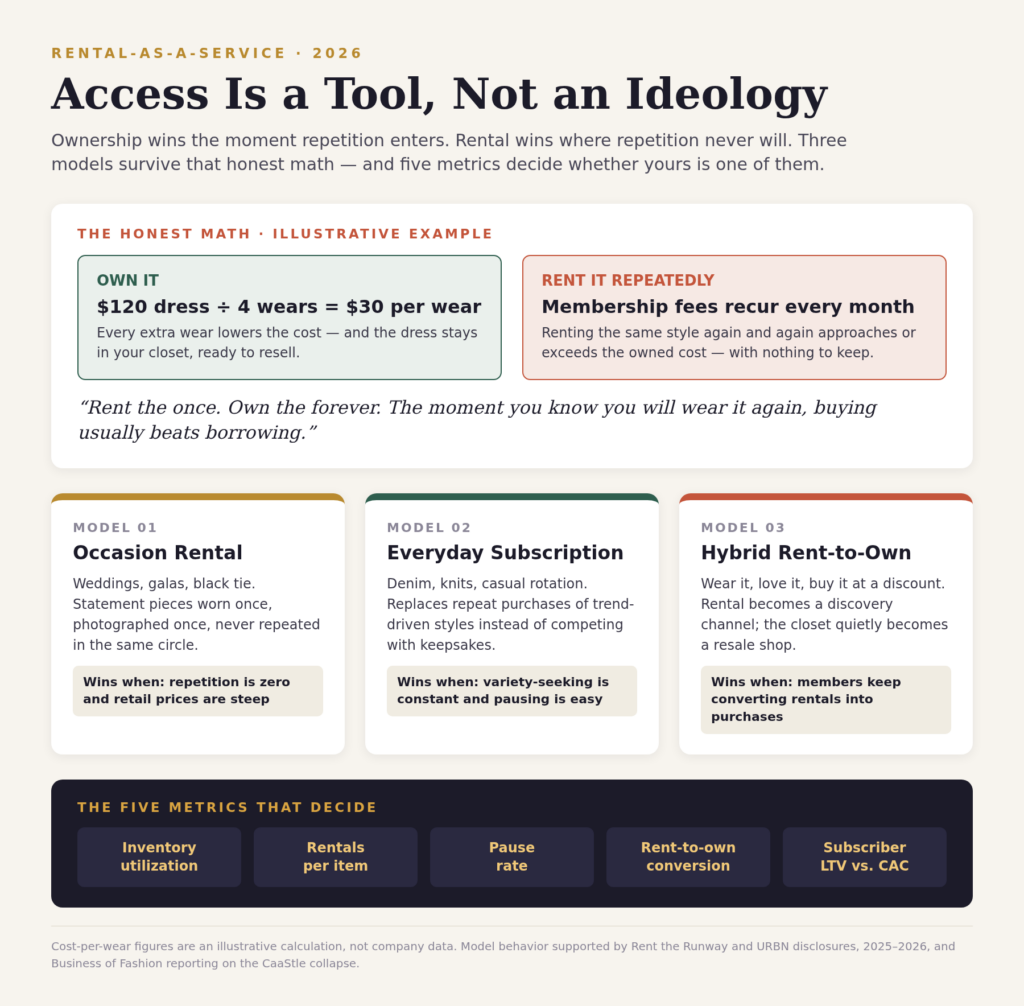
Strip away the branding and rental lives or dies on arithmetic a shopper can do on her phone. Take a $120 dress. Buy it, wear it four times, and you’re at $30 per wear — and every additional wear makes it cheaper, while the dress itself retains resale value. Rent that same style repeatedly through a membership and the fees recur every month, approaching or exceeding the owned cost, with nothing left in your closet at the end.
That’s the trap the first wave of rental marketing never wanted to discuss. Ownership wins the moment repetition enters. Rental wins where repetition never will — the wedding guest dress you can’t be photographed in twice, the gala gown, the ski jacket for one trip a year.
So here’s the rule I’d tape to every circular-economy strategy deck: rent the once, own the forever. Access is a tool you deploy against a specific consumption pattern. It is not a moral upgrade over ownership, and customers — who are perfectly capable of doing division — know it.
The Real Competitor Was Resale All Along
Here’s the twist the industry spent a decade missing. Rental’s most dangerous rival was never another rental platform. It was the secondhand market — and the customers’ own desire to keep things.
Look at what Rent the Runway’s members actually did in that record quarter. Resale revenue grew 19%. Add-on bookings jumped 81%, with a third of subscribers paying to rent extra items beyond their plan. Management now describes resale as a core growth engine and has paused its marketplace, on-site advertising, and new B2B dry-cleaning pilots to concentrate on rental and resale. Nuuly, meanwhile, has always let subscribers buy rented items at a discount.
Read the behavior, not the positioning: people try things through rental, fall in love, and want to own them. A dress bought secondhand often costs less than a year of membership aimed at borrowing similar dresses. The platforms that survive are the ones honest enough to monetize that impulse — rental as the fitting room, resale as the checkout. The closet in the cloud is quietly becoming a resale shop with a lending library attached.
What CaaStle Taught Everyone
If you want the cautionary tale, it’s already written. CaaStle, the white-label operator behind most brands’ rental experiments, filed for Chapter 7 liquidation in June 2025 after raising more than $500 million. An external audit commissioned by its own board found 2023 revenue of $15.7 million against a $90 million net loss. Its founder was sentenced to five years in prison in August 2026 for defrauding investors.
The fraud was sensational; the business failure underneath it was ordinary. Ralph Lauren’s The Lauren Look, Banana Republic’s Style Passport, American Eagle’s AE Style Drop, Eloquii Unlimited, Maje Forward — the single-brand rental sites are defunct, most of them before the scandal broke. A single brand’s closet can’t deliver the variety that makes a monthly fee feel worth paying, and the cleaning, shipping, and restocking costs never bent to the projections.
The lesson generalizes beyond fashion: rental economics are utilization economics. If your inventory doesn’t turn fast enough, no amount of brand equity or sustainability storytelling will save the margin.
Three Models That Survive the Math
Sift the survivors and three durable patterns emerge.
Occasion rental serves the zero-repetition moments: weddings, galas, black tie. High retail prices, one-time use, social pressure against repeating outfits. Reserve-style à-la-carte rental fits here, and it remains a genuine business.
Everyday subscription replaces repeat purchases of trend-driven clothing. It wins when variety-seeking is constant, price points are accessible, and pausing is frictionless — because a customer who can leave easily is a customer who comes back. This is Nuuly’s territory, and it’s where the scale is.
Hybrid rent-to-own treats rental as discovery: wear it, love it, buy it at a discount. The rental fee becomes a customer-acquisition cost for an ownership transaction, and the member who converts is often the most profitable one you have.
Notice what none of these models promise: replacing ownership wholesale. They win by picking the exact slice of consumption where borrowing genuinely beats buying — and letting the customer own everything else.
Utilization Is the Moat
Underneath all three models sits the same unglamorous capability: reverse logistics run at high utilization. Every garment must come back, get inspected, cleaned, repaired, photographed, and re-shipped — thousands of times a week — at a cost per cycle low enough to leave a margin.
Watch where the winners spend. Nuuly bought its Missouri fulfillment center outright and is building East Coast capacity designed to support roughly 1.2 million subscribers — capacity, to be clear, not a subscriber count. Rent the Runway, conversely, trimmed its fiscal 2026 inventory investment guidance to $53–55 million from $74.9 million spent, then nudged it up from an earlier $45–50 million plan to keep fall occasions stocked. Both are tuning the same dial: inventory against demand, item by item.
The technology layer serves that dial. Rent the Runway’s AI outfit generation went live for all customers by late June with app engagement around 35%, ahead of expectations; pilot users added items to their bags 12% more often. Virtual try-on entered pilot in August. AI-refreshed product imagery lifted views on updated styles by 129%, and a new search algorithm improved subscription conversion by about 10%. None of this is spectacle. It’s demand forecasting and utilization optimization wearing a consumer-friendly interface.
New Leadership, a Narrower Bet
The strategy reset came with a leadership reset. Co-founder Jennifer Hyman stepped down in May 2026, and Paige Thomas — previously CEO of Saks OFF 5TH and a Nordstrom Rack veteran — became chief executive on September 14. Alongside the record quarter came a $15 million backstopped rights offering and a $10 million term loan, plus guidance that active subscribers would stay roughly flat through the back half of the year.
That’s an execution story, not a growth story: an off-price retail operator running a margin-first playbook on a repaired balance sheet. Whether flat subscribers can coexist with double-digit revenue growth for long is the open question. Pricing power has a ceiling; household closets do not expand to meet earnings guidance.
Sustainability: Bring Proof, Not Slogans
Rental’s green halo deserves scrutiny in both directions. The credible anchor is WRAP’s research, widely cited by the Ellen MacArthur Foundation: keeping clothes in active use nine months longer cuts their carbon, water, and waste footprints by roughly 20–30%. Extending utilization is genuinely good physics, and rental is one mechanism for it.
But the category’s favorite talking points — fashion causes 10% of global emissions, 92 million tonnes of waste a year — are contested zombie statistics; newer industry estimates put apparel’s emissions share closer to 2%. If your rental pitch leans on numbers researchers have debunked, you’re not selling sustainability, you’re selling a liability. And a rented garment shipped, dry-cleaned, and shipped again has its own footprint; the math only works when utilization is high and logistics are tight.
The marketing implication is simple: publish per-rental utilization and lifecycle data, not vague planet-saving claims. In a greenwashing crackdown, proof is the differentiator.
Should Your Brand Rent? A Five-Question Filter
Before you add a rental tab to your site, answer honestly:
- Is your price point high enough that borrowing saves the customer real money in a single use?
- Does your product survive multiple cycles — durable, multi-season, cleanable?
- Does your audience crave variety, or do they buy keepsakes? Keepsake buyers belong to resale, not rental.
- Can you run reverse logistics, or afford a partner who can? CaaStle’s corpse marks this exit.
- Will you let customers buy what they rent? If not, you’re fighting your own best customers.
Then measure what matters: inventory utilization, rentals per item, pause rate, rent-to-own conversion, and subscriber lifetime value against acquisition cost. If those numbers don’t clear your retail margin, rental is a marketing expense — price it as one, or skip it.
The Bottom Line
2026 didn’t kill rental. It sorted it. The winners picked a consumption pattern — occasions with zero repetition, or everyday rotation with endless variety — and built utilization machines underneath. The strugglers discovered that record revenue can mask a shrinking audience, and that the customer’s urge to keep things is stronger than the industry’s urge to lend them. Access over ownership was never a revolution. It’s a tool. Use it where the math works, sell ownership everywhere else, and let resale collect the customers who fall in love.