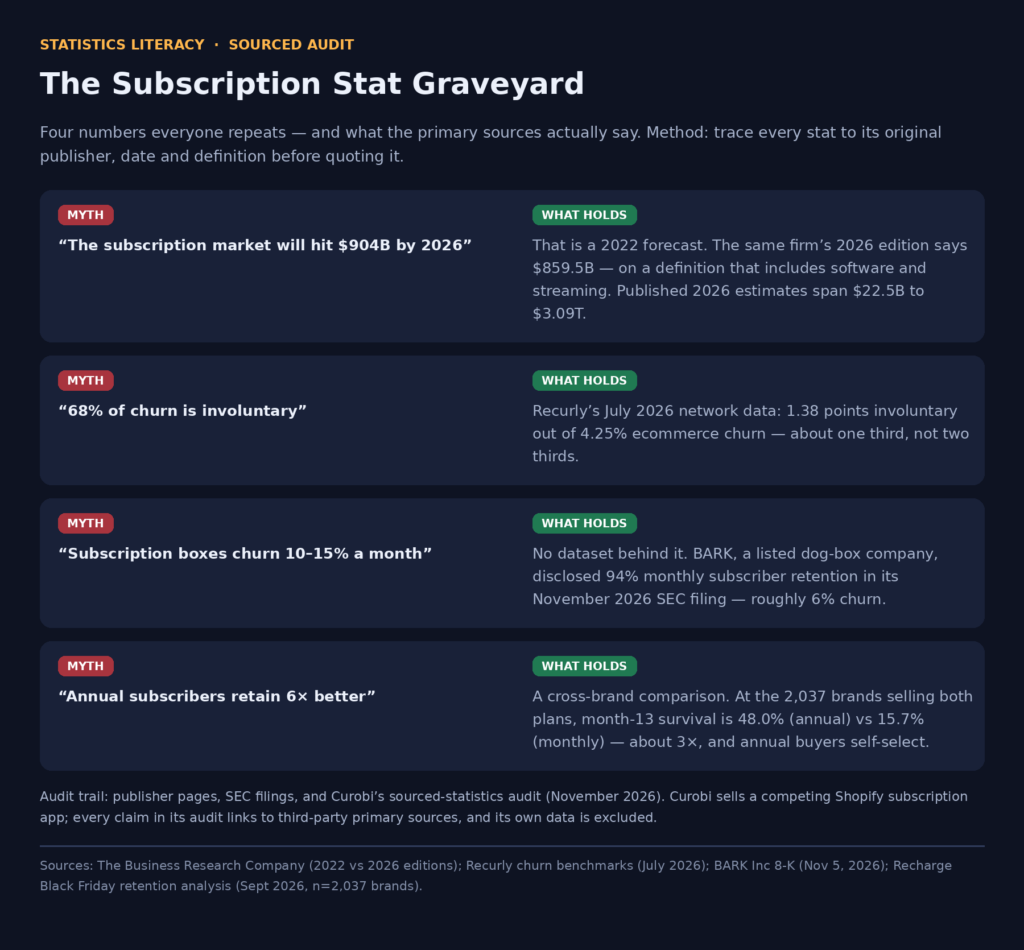
Somewhere in your last strategy deck, there is a statistic that deserves a headstone. Maybe it is the “$904 billion subscription market by 2026.” That number traces to a 2022 press release; the same research firm’s 2026 edition now says $859.5 billion, on a definition that quietly includes software and streaming. Maybe it is “68% of churn is involuntary,” usually attributed to Recurly. Recurly’s actual July 2026 network data shows 1.38 points of involuntary churn out of 4.25% for ecommerce — about a third, not two thirds.
Here is the uncomfortable part: the myths are now auditable, and the real data tells a sharper story than any of them. A subscription is not a business model you switch on. It is a survival curve with a cliff at the second renewal — and the two highest-return fixes are not pricing tricks. They are recovering the failed card and offering the pause. Let’s walk through what actually holds.
How to Read a Subscription Statistic Before You Repeat It
Start with market size, because it is the worst offender. Published 2026 estimates of the “subscription ecommerce market” run from $22.5 billion to $3.09 trillion — a 137-fold spread catalogued in Curobi’s sourced-statistics audit (November 2026; Curobi sells a competing Shopify subscription app, but every entry links to third-party primary sources and excludes its own data). The trillion-dollar figure counts video streaming. The mid-range figures count SaaS and online courses. None of the firms publishes a reproducible method, and none isolates what most operators mean: physical goods sold on a schedule by independent stores.
So quote a range with definitions attached, or use measured numbers instead. Chewy’s Autoship customer sales reached roughly $2.8 billion — 84.6% of net sales — in the quarter ended August 2026, per its earnings disclosure. BARK, a listed dog-box company, reported 94% monthly subscriber retention in its November 2026 SEC filing. Zuora’s Subscription Economy Index found its 600-plus recurring-revenue companies grew 3.4 times faster than the S&P 500 over the twelve years through 2023 — a vendor index over its own billing platform, but at least system-generated rather than surveyed.
One more hygiene rule: check the period. Recurly’s benchmark page labels its medians “annual,” yet its own compounding example implies monthly math. Quote the voluntary–involuntary split, not the headline level, until you have confirmed the denominator.
The Renewal Curve: A Cliff, Not a Slope
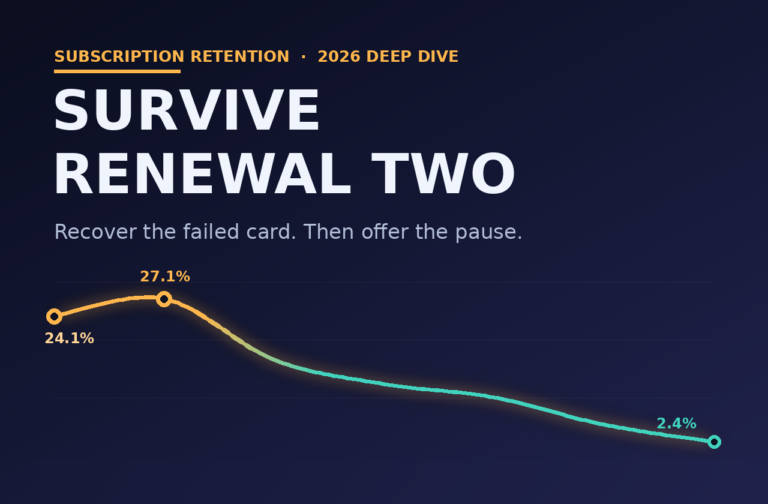
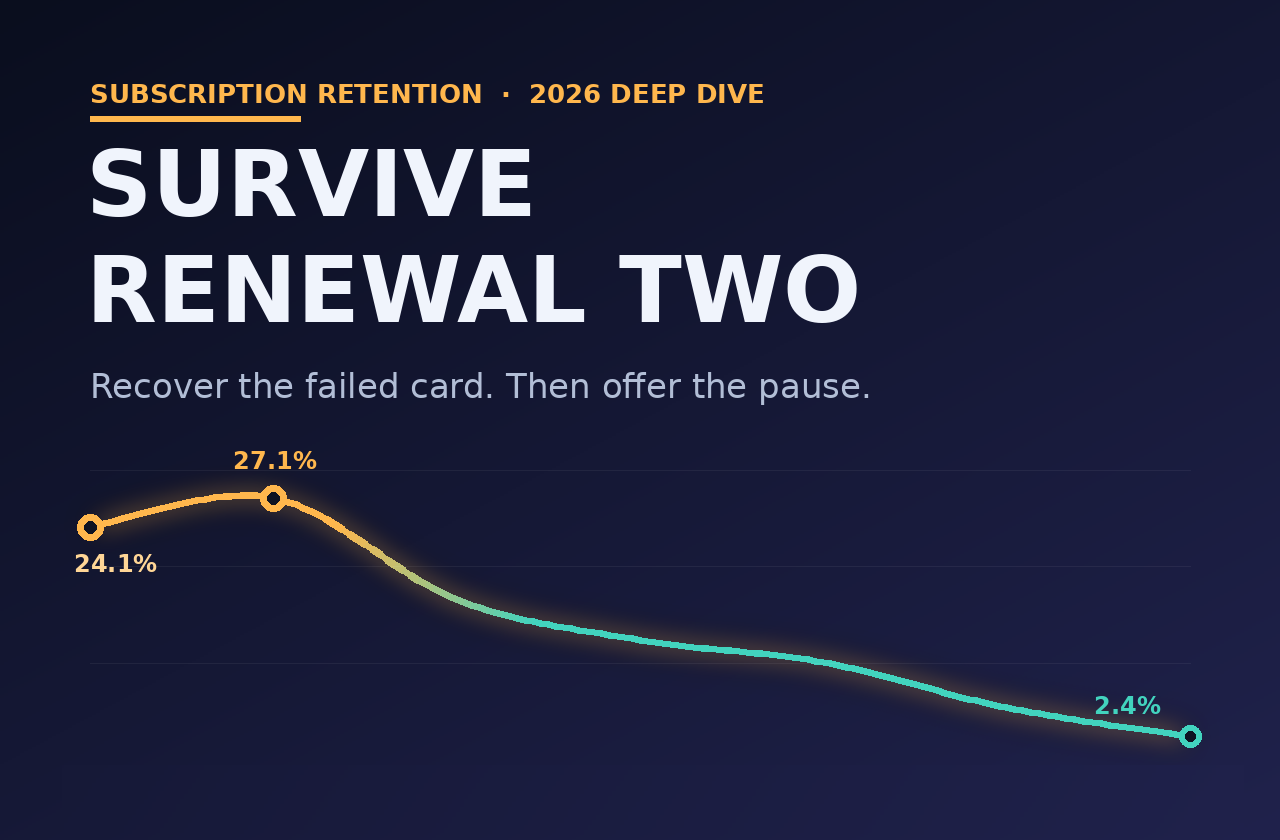
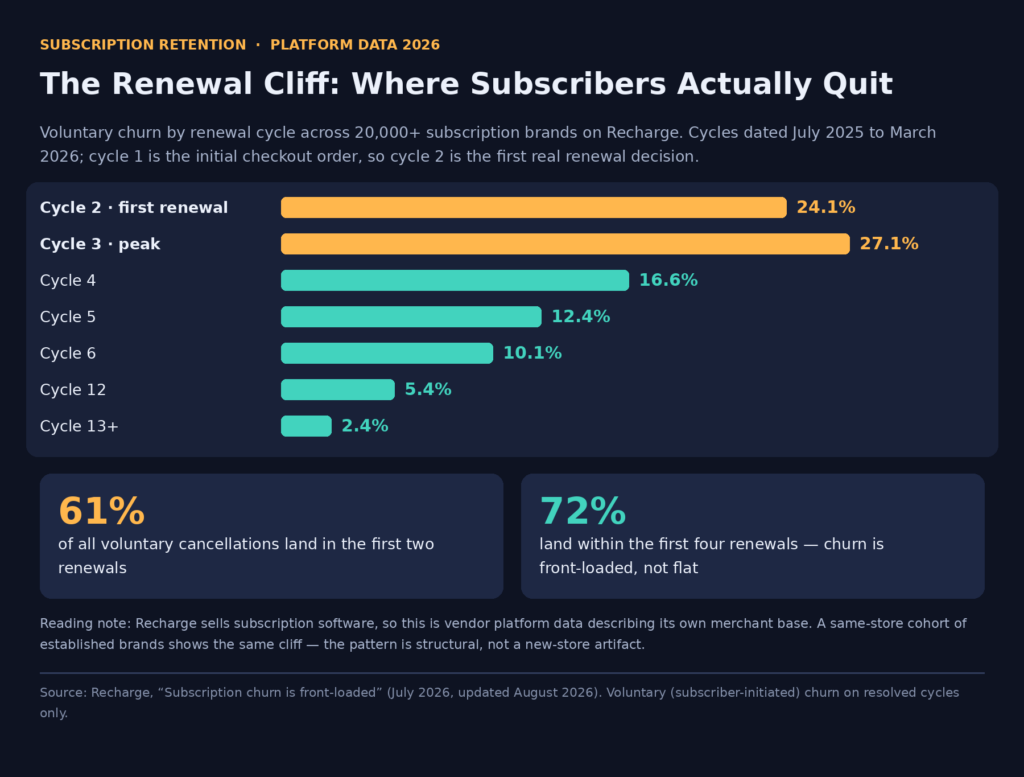
Recharge, the largest Shopify subscription platform, analyzed resolved renewal cycles from July 2025 through March 2026 across more than 20,000 brands. The shape is blunt. Cycle 1 is the initial checkout, so the first real renewal decision is cycle 2 — and it already sheds 24.1% of the subscribers who reach it. Cycle 3 peaks at 27.1%. Then 16.6% at cycle 4, about 10% by cycle 6, 5.4% by cycle 12, and 2.4% after that.
Concentration follows: roughly 61% of all voluntary cancellations land in the first two renewals, and 72% within the first four. This is vendor platform data describing Recharge’s own merchant base — but the obvious objection (maybe churn-prone new stores drag the curve down) was tested. A same-store cohort of established brands shows the same cliff. The front-loading is structural behavior, not a mix effect.
Why does this matter more than any monthly benchmark? Because a blended monthly churn rate averages the cliff away. It tells you how much you are losing, not when — and when is where the leverage lives. A point of churn saved at the first renewal touches far more subscribers than the same point saved at cycle 10.
Consumables Churn First — Not Apparel
The category split inverts the usual assumption. Food and beverage leads first-renewal churn at 28.2%, followed by pets (27.8%), health and wellness (26.5%), and beauty (26.3%). Fashion and apparel sits lowest at 16.1%, though Recharge flags that base as thin and directional. Home goods looks calm early (23.4%) but carries the highest mature churn at 12.3% — a slow-burn value problem rather than an expectation clash.
Think about what a second box actually is for a consumable: the moment a shopper decides whether they want this thing again, on a schedule, at this price. The verdict arrives fast. If you sell coffee or supplements, your expectation-mismatch problem is bigger than the apparel-framed version of this story suggests.
Three Churn Archetypes, Three Different Fixes
SubSummit’s State of the Subscription Box Industry 2026 report (an industry-association synthesis of vendor research, not a single dataset) separates churn into three archetypes, and misdiagnosis is expensive.
Early churn is usually an onboarding mismatch: the product experience does not match the expectation your acquisition copy created. That is a communication problem with a 30-day intervention window — not a pricing problem. Mid-stage churn is value erosion: novelty fades, usage drops. Recurly’s consumer research finds 51% of churned subscribers cite “not using it enough,” which no discount can fix. Late-stage churn is pricing and competitive pressure — where pause offers, loyalty, and win-backs belong.
A flat save offer sprayed across all three wastes the moment. Match the intervention to the reason, and match the reason to the lifecycle stage.
Engineer the First Box Like a Product Launch
If 61% of cancellations cluster in two renewals, your first delivery is the product launch that matters. Set expectations honestly in acquisition creative — a subscriber acquired on a fantasy cancels on contact with reality. Treat the unboxing as designed experience, not packaging afterthought.
And be careful what you buy with discounts. Recharge’s analysis of roughly 29.8 million subscriptions first paid between July and December 2025 found that 65.0% of subscribers with no first-order discount reached their first renewal, against 53.4% of those whose first order was 90% off or more. A within-store comparison across 350 brands confirmed the gap, so it is not just brand mix. Deep discounts recruit people who wanted the deal, not the relationship. Recharge calls it an association, not causation — fair — but the direction should temper any “90% off first box” growth plan.
The Silent Third: Involuntary Churn Nobody Voted For
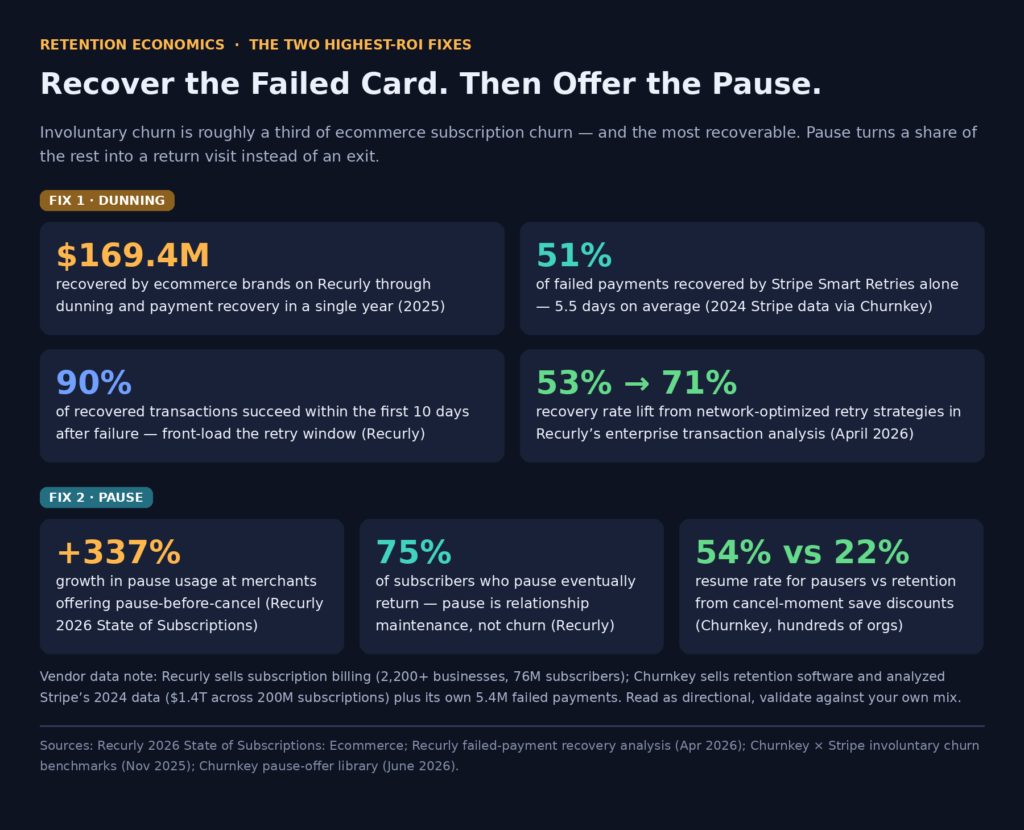
Roughly a third of ecommerce subscription churn is involuntary: a card expires, a bank flags a renewal, funds run short, and a subscriber who still wants the product simply stops receiving it. The gradient by price point is steep. In Recurly’s July 2026 data, subscriptions priced $10–25 carry about 30% involuntary share of churn; at $100–250 it falls to about 16%. Cheap impulse signups fail quietly at scale.
The failure mix is knowable: across Churnkey’s 5.4 million failed payments, insufficient funds alone accounts for about 40.5% of declines — a timing problem, which is exactly what smart retries solve. On Stripe’s 2024 data (analyzed by Churnkey, which sells recovery software), Stripe’s Smart Retries alone recovered 51% of failed payments in 5.5 days on average; layering Churnkey’s retries lifted that to 55% in 4.8 days. Recurly reports 90% of recovered transactions succeed within the first ten days, and its enterprise analysis shows optimized retry strategies lifting recovery from roughly 53% to 71%.
The money is real: ecommerce brands on Recurly recovered $169.4 million through dunning and payment recovery in a single year, per its 2026 ecommerce report. (Its benchmarks page quotes different recovery totals for different windows — one more reason to attach the period to the number.)
One academic warning label: research by Einav, Klopack and Mahoney in the American Economic Review (May 2025), using payment-card network data, estimates consumer inattention raises seller revenue by 14% to over 200% — and months when a card is replaced show sharply higher cancellation. A dunning email is not just a payment prompt; it is a moment when a subscriber reconsiders the whole relationship. Write it as a value reminder, not a collections notice.
Pause Is Not Churn
The second high-return fix costs no margin at all. Recurly’s 2026 State of Subscriptions — 2,200-plus businesses, 76 million subscribers, mostly digital and software, so read it as directional for physical goods — found pause usage rose 337% year over year at merchants offering pause-before-cancel, and three out of four pausers eventually return. Its July 2026 benchmarks page adds that 38% of consumers prefer pausing over canceling outright.
Churnkey’s platform data sharpens the comparison: paused subscribers resume at 54% on average, reaching 89% at top-performing organizations, while save-discounts offered at the cancel moment retain only 22%. The discount-buyer takes the coupon and leaves a cycle later; the pauser keeps their account, their price, and a return date.
There is even a seasonal rhythm for physical boxes: Recurly’s ecommerce report shows pause activity peaking in October and a predictable reactivation rebound in March. Schedule your unpause flows against that calendar instead of improvising. Keep pauses honest — cap the length, show the resume date — so the bridge does not become a permanent discount in disguise.
The Frictionless Paradox — and the Compliance Clock
Here is the counterintuitive finding from SubSummit’s report: removing cancellation barriers increases consumers’ willingness to subscribe in the first place. The fear of being trapped is itself an acquisition blocker. An easy exit is conversion optimization wearing a compliance costume.
Get the legal status right, though, because most articles have not updated it. The FTC’s 2024 click-to-cancel rule was vacated by the Eighth Circuit on July 8, 2025, on procedural grounds; the narrow 1973 rule was reinstated, and the FTC opened a fresh rulemaking in March 2026. No replacement federal rule is in force as of late 2026 — but enforcement never stopped. The FTC continues bringing cases under ROSCA (its Amazon Prime and Uber actions are the templates), and California’s auto-renewal law is actively enforced. In the UK, the DMCC Act subscription regime is expected to commence in spring 2027: pre-contract disclosures, renewal reminders, two 14-day cooling-off windows, straightforward online exit, CMA enforcement. The government’s impact assessment puts unwanted subscription spending at about £1.6 billion a year across roughly 9.7 million contracts. Build the easy exit now; you will need it by law, and it sells anyway.
Pricing Under Fatigue: The $5 Tipping Point
Fatigue is real but selective. In the survey research synthesized by SubSummit, 41% of consumers identify as subscription-fatigued, 40% cut back a subscription in the last three months, and 75% are frustrated by repeated price increases. A $5 monthly increase is enough to push 60% of streaming subscribers toward considering cancellation. Fatigue is a filter that kills weak value delivery — not a ceiling on the model.
The demand signal to watch: 67% of consumers are open to usage-based or hybrid pricing, and 70% of operators now offer annual plans. Annual buyers generate 50–60% higher revenue per user in Recurly’s data, with more fragile renewals. And retire the “annual subscribers retain 6× better” headline: at the 2,037 Recharge brands selling both plan types, month-13 survival was 48.0% for annual Black Friday signups versus 15.7% for monthly — about 3×, like for like, and annual buyers self-select for commitment. Bundling, meanwhile, is the strategy industry forecasters expect to outpace pure acquisition in 2026 — a forecast, not a measurement.
Win-Back: The Channel Nobody Budgets
In ecommerce specifically, only 1 in 7 new sign-ups is a returning customer, Recurly’s ecommerce report finds — against nearly 1 in 4 across its mostly-digital full network. Physical-goods brands are leaving the cheapest acquisition channel unbudgeted.
The behavioral opening is older data with a durable lesson: C+R Research’s 2022 survey (1,000 US consumers, April–May 2022) found people estimated their subscription spend at $86 a month, then itemized $219 — and 42% had forgotten they were still paying for something they no longer used. Dated numbers, timeless psychology. An audit-flavored campaign (“we found your forgotten subscriptions”) meets customers in that gap. Low-commitment on-ramps help too: Recurly reports micro-subscriptions — short paid passes — convert 13% of buyers into recurring plans, while traditional trial conversion has slid to 34%.
Reviews as Expectation Management
Treat reviews as churn infrastructure, not decoration. Label tenure prominently — “subscriber, month 6” carries a commitment signal no star rating can. Surface long-term reviews inside the cancellation flow, where a wavering subscriber most needs evidence that it gets better after a mediocre box. And resist showcasing only your best box ever: reviews that over-promise train exactly the onboarding-mismatch churn that kills cycle 2. Honest expectation-setting is retention work done months in advance.
When AI Manages the Subscription
Recurly’s 2026 consumer research finds 43% of consumers comfortable with AI managing parts of their subscriptions. Read that as a roadmap: assistants that audit spending, flag unused services, and execute cancellations on command. Your future churn may arrive as an API call from someone’s agent. The defense is not friction — it is auditable, machine-readable value: clear usage summaries, honest pricing, and plans that live on native commerce rails agents can parse. Value justification is becoming the retention moat.
The Measurement Stack That Replaces the Monthly Blend
Five instruments, in order. One: churn by renewal-cycle cohort, not a blended monthly rate — find where your own curve peaks. Two: the voluntary–involuntary split, because they demand different budgets. Three: pause-return rate, tracked per cohort with the resume date attached. Four: dunning recovery in dollars, with its own KPI, not open rates. Five: win-back share of new signups, so reactivation gets a line in the acquisition plan.
Two literacy traps to close the loop. Recurly’s growth figure — subscription growth slowing from 15.4% to 12.6% in 2025 — describes its own platform, mostly software and media; there is no measured “box industry growth rate,” whatever the roundups claim. And whenever two pages from the same vendor quote different totals, the window or the population changed. Ask which before you quote either.
The Bottom Line
Stop quoting 2022 forecasts. Instrument your renewal curve and aim your retention budget at the first two renewals, where 61% of cancellations live. Recover the failed cards before you chase win-backs — that silent third never voted against you. Offer the pause and schedule the return. Make cancellation easy enough that subscribing feels safe. Fatigue is not killing subscriptions; it is auditing them. Pass the audit.