Open your kitchen drawer. Count the products wearing a brand you could actually recall in a quiz: the batteries, the foil, the storage bags. Somewhere in that drawer sits a quiet economic revolution — products engineered, packaged and marketed by companies whose names you have never bothered to learn, yet whose shelves you keep restocking. And here is the twist most sellers miss: two completely different business models hide behind that anonymity, and confusing them is one of the most expensive strategy errors in modern commerce.
One model rents a product. The other owns one. In 2026, only one of them compounds.
1. The Distinction That Decides Everything
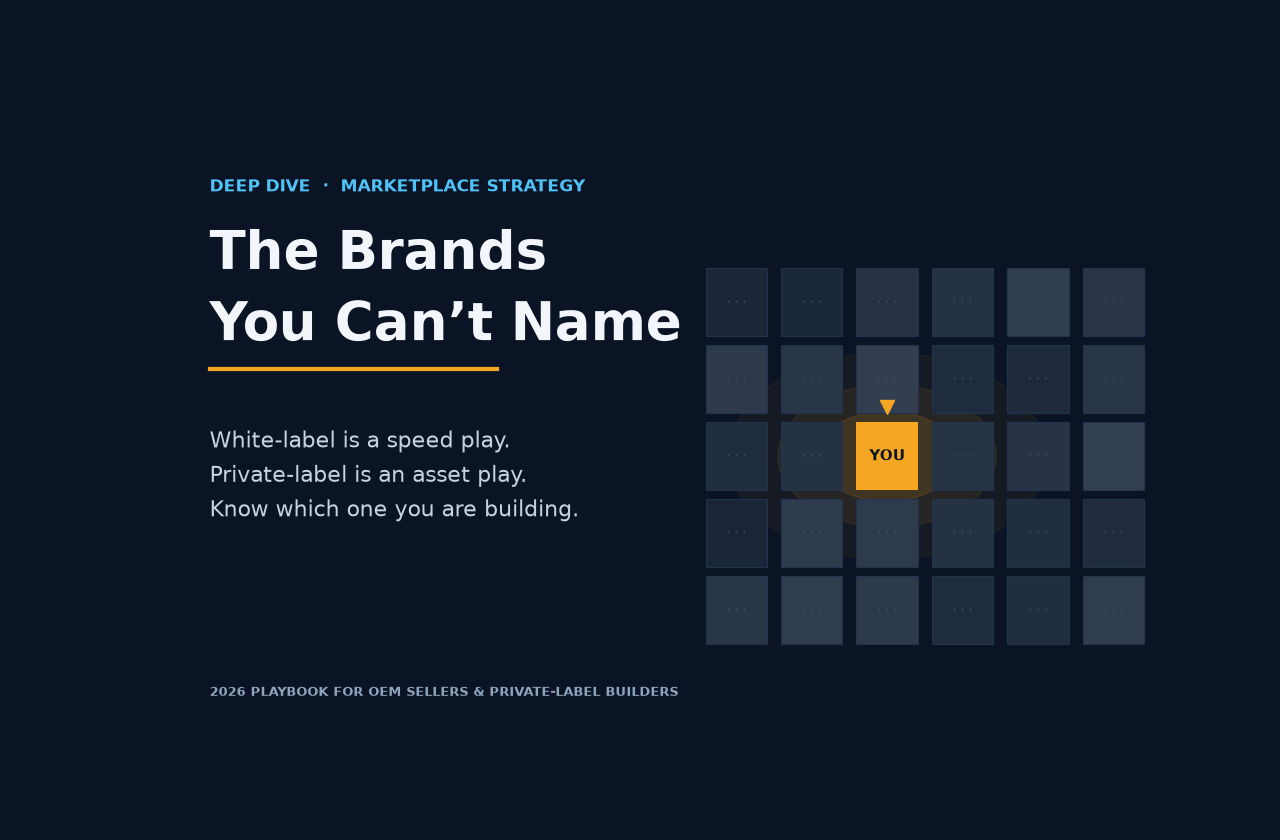
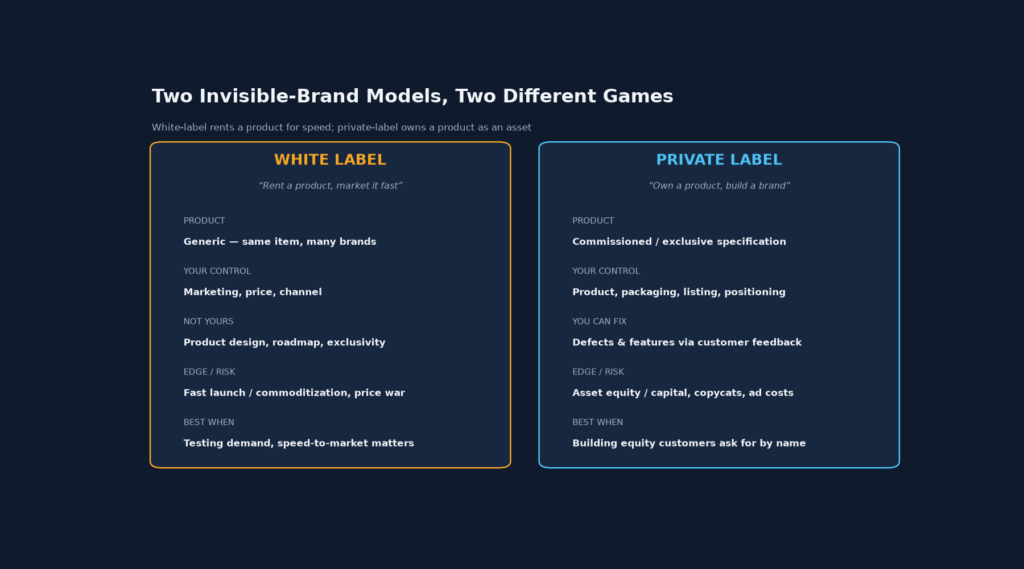
Let’s get the definitions straight, because the whole strategy hangs on them. White label means a manufacturer produces a generic item and multiple brands buy it, slap their logo on it, and sell it as their own. You control the marketing; you do not control the product. Private label means you commission or exclusively control the product itself — the specification, the packaging, the positioning, the listing. Retailer giants like Costco’s Kirkland Signature run this model at industrial scale; so does a solo seller who works with an OEM factory to fix the flaw every competitor’s reviews complain about.
Same invisibility. Opposite economics. White label is a speed play: rent a product, market it fast, harvest while the window is open. Private label is an asset play: own a product, improve it, and let every sale, review and repeat customer deposit equity into something you could one day sell.
2. White-Label Mechanics: Fast In, Fast Commoditized
Why do sellers choose white label at all? Because speed is real money. No tooling, no sampling rounds, no compliance homework on a product you designed — you pick a proven generic item, brand it, and ship. For testing demand or riding a trend cycle, that agility matters.
But notice what you have rented: the identical product is available to every competitor with the same supplier contact. Your differentiation lives entirely in marketing, and marketing advantages decay. Worse, on marketplaces where multiple sellers share one listing, the Buy Box algorithm turns identical offers into a price auction. You didn’t build a brand; you joined a queue where the cheapest seller wins the sale. That is commoditization by design, not by accident.
3. Private-Label Mechanics: The Feedback Loop You Actually Own
Private label flips the control panel. Because the product is yours by specification, a one-star review isn’t just damage — it’s a design brief. Complaints about clumping, flimsy zippers, confusing instructions? Next production run fixes them. Competitors renting the same generic item can only cut price; you can improve the offer.
That asymmetry is the engine of the entire model. Every iteration deepens the gap between your product and the commodity baseline, and every improved unit sold generates reviews that describe a better product than the one your rivals are still shipping.
4. The Numbers Say the Wave Is Structural
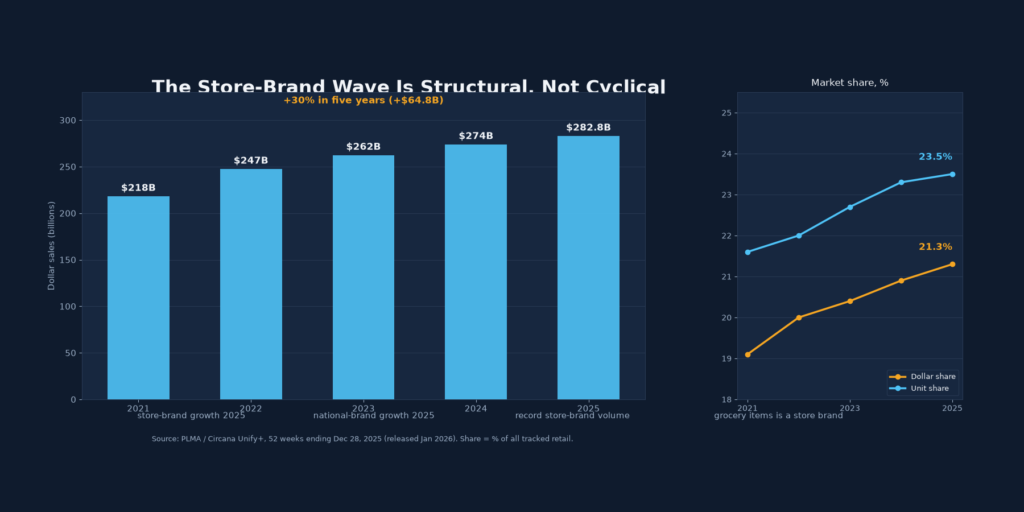
If you doubt whether “invisible brands” can win, look at the scoreboard. According to the Private Label Manufacturers Association’s Circana Unify+ data released in January 2026, U.S. store-brand sales hit a record $282.8 billion in 2025, growing 3.3% while national brands managed just 1.2%. Store brands now hold 21.3% of dollar share and a record 23.5% of unit share — roughly one in four grocery items scanned in America wears a retailer’s own name. Over five years, the category added $64.8 billion, a 30% climb.
That is not a recession blip. That is a decade-long rewiring of how shoppers assign trust.
5. What Kirkland Teaches Every Small Seller
Costco’s Kirkland Signature is the model’s proof of concept. CEO Ron Vachris said on the December 2024 earnings call that Kirkland products represent about a third of Costco’s sales — up from the “high 20s” percentage he cited that September, against fiscal 2024 net sales of $249.6 billion. Executives say Kirkland items average roughly 20% better value than national brands while creating a margin tailwind.
Read that combination carefully: trust, price and placement, working together. Costco didn’t win by being cheapest; it won by making its own name a quality guarantee. The lesson scales down. A niche seller who becomes “the brand that finally fixed the leaking lid” is running the same play Kirkland runs — just in a smaller pool.
6. The Cautionary Tale: Amazon’s Own Retreat
But here’s the counterweight nobody selling the private-label dream mentions. Amazon — with the best shopper data on Earth — reportedly eliminated 27 of its 30 private-label clothing brands in 2023, keeping only Amazon Essentials, Amazon Collection and Amazon Aware, while its private brands overall accounted for about 1% of retail sales. The Wall Street Journal and Reuters linked the cuts to cost discipline and antitrust pressure; Amazon’s own statement said customers gravitate to its biggest brands.
The takeaway isn’t “private label fails.” It’s that data and distribution alone don’t create demand for a name. Dozens of forgettable house labels died; the few customers actually asked for survived. Differentiation and genuine brand pull are the load-bearing walls. Everything else is scaffolding.
7. Brand Registry: The Gate Between Tenant and Owner
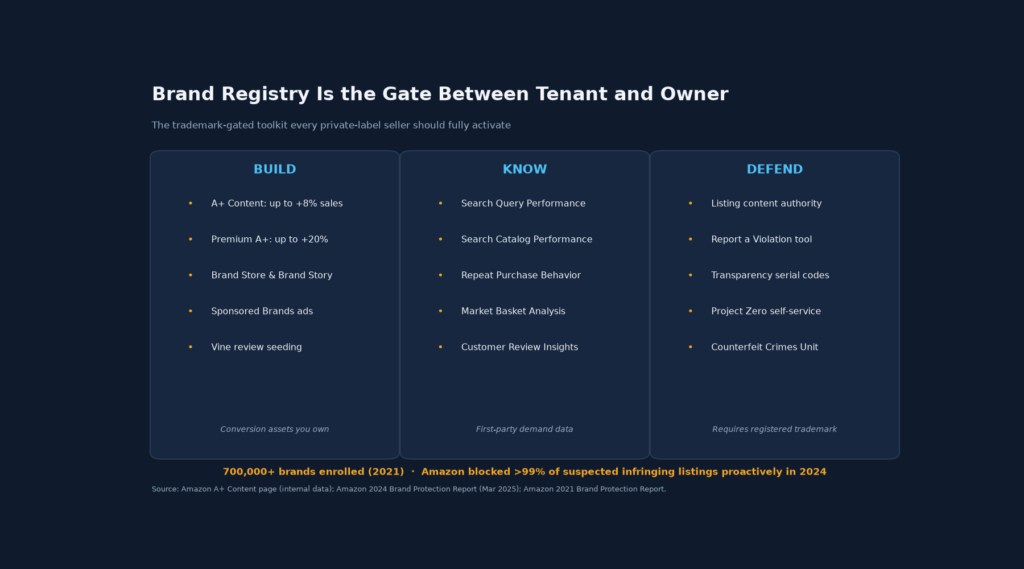
On Amazon specifically, ownership gets institutionalized through Brand Registry, the trademark-gated program that had over 700,000 active brands enrolled by 2021 and keeps growing. Enrollment unlocks three stacks of capability, and most sellers activate only the first:
- Build: A+ Content, which Amazon’s own data says can lift sales by up to 8% in its basic form and up to 20% with well-implemented Premium A+; a Brand Store; Sponsored Brands ads; Vine review seeding.
- Know: Brand Analytics dashboards — Search Query Performance, Repeat Purchase Behavior, Market Basket Analysis — first-party demand data resellers never see.
- Defend: listing content authority, Report a Violation, Transparency serialization and Project Zero.
One nuance worth real money: Amazon now accepts pending trademark applications for enrollment, not just registered marks — but the enforcement tools (Report a Violation, Transparency, Project Zero) still require full registration. Enroll early for the marketing stack; file cleanly so the defense stack arrives fast.
8. The Strange Side Effect: Trademarks for Machines
A 2026 analysis in Communications of the ACM documented something fascinating: Brand Registry has quietly reshaped the U.S. trademark system itself. Small-business trademark filings roughly doubled since the program began, and applications for “nonsense marks” — random strings like XUFFBV — grew from almost none to over 20,000 a year, about 4.5% of filings. Why? Because the algorithm rewards enrollment, not memorability.
Understand what that means for you. A registry-compliant gibberish name buys tool access; it does not buy a brand. The moat was never the certificate. It’s whether a customer would type your name into the search box unprompted.
9. Control Is Not Profit: The Cost Squeeze Is Real
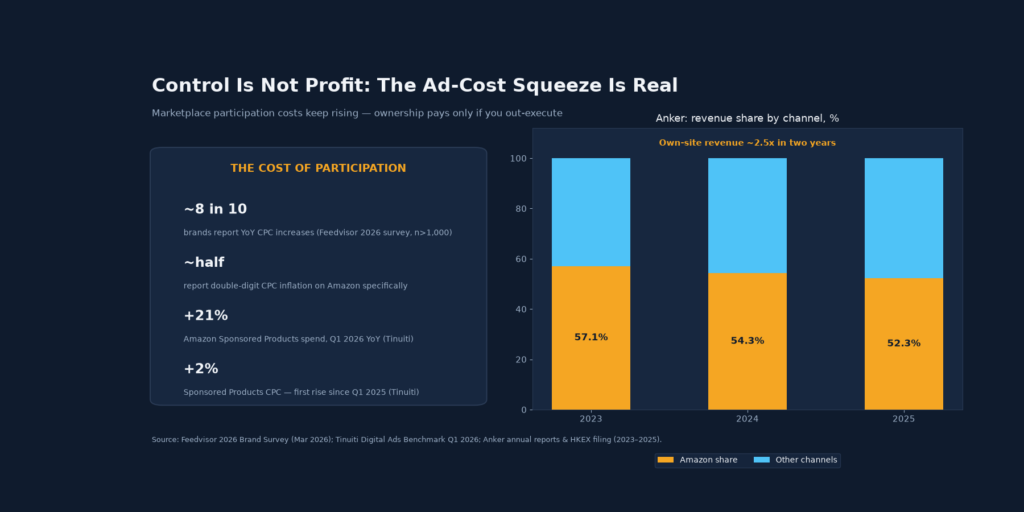
Ownership is necessary, not sufficient. Feedvisor’s 2026 survey of more than 1,000 e-commerce brands found nearly eight in ten reporting year-over-year CPC increases, with roughly half experiencing double-digit CPC inflation on Amazon specifically; more than half responded by raising prices. Tinuiti’s Q1 2026 benchmark — drawn from over $4 billion in managed ad spend — shows Sponsored Products spend up 21% year over year with CPCs rising 2%, their first increase since early 2025. Jungle Scout’s 2025 seller survey puts the pain in rank order: shipping costs (38%), cost of goods (34%), advertising (32%).
So yes: copycats will come, ads will cost more, and a quality defect can become a recall — Anker, the gold-standard private-label graduate, recalled about 1.16 million PowerCore 10000 units in the U.S. in June 2025 after 19 reports of fires and explosions, per the CPSC. The difference between models isn’t the absence of risk. It’s your menu of responses: a white-label seller can only match price; a private-label owner can fix the product, strengthen the listing and defend the margin.
10. Differentiation Beyond Price: Five Levers
Where does the premium actually come from? Five levers, in rough order of durability: material (the upgrade competitors won’t fund), feature (the fix mined from rivals’ one-star reviews), packaging (the unboxing that photographs well), bundle (the combination that solves the whole job), and positioning (the specific person you serve better than anyone). Notice that none of them is “lower price.” Price is what you compete on when you’ve run out of reasons to exist.
Then encode those levers into the listing itself: a title built around search intent, bullets that pre-answer objections, images that provide visual proof, a comparison chart that wins the argument silently. That’s what the A+ uplift numbers actually pay for — not decoration.
11. The OEM-to-Brand Upgrade: Anker’s Ledger
For manufacturers, the private-label path is a margin migration: from anonymous supplier earning manufacturing margin to named brand earning brand margin. Anker is the canonical case — founded in 2011 selling replacement laptop batteries, it posted RMB 24.71 billion (roughly $3.4 billion) in 2024 revenue, up 41.1%, with net profit up 30.9%.
But study the second derivative, not the headline. Amazon’s share of Anker’s revenue fell from 57.1% in 2023 to 54.3% in 2024 to 52.3% in 2025, while its own brand websites more than doubled in revenue over two years. Even the best graduate of the marketplace school spends a decade building exits from the campus. Off-platform equity — your site, your email list, your retail relationships — is what keeps a brand from being hostage to one platform’s policy mood.
12. Launch Economics: Count the Whole Stack
Before you fall in love with the asset story, price the ticket. A private-label launch funds sampling, tooling or minimum orders, compliance testing, freight and duties, photography and listing build, launch advertising, and enough working capital to survive the reorder gap. Wholesale and white label skip most of that — which is exactly why their ceiling is lower. Run unit economics after every fee: referral, fulfillment, storage, ads, returns. If the spreadsheet only works at a 2% ad cost assumption in a category where CPCs climb yearly, you don’t have a business; you have a countdown.
13. Measure What Compounds
Track the metrics that reveal asset formation, not just revenue: brand-name search volume (do strangers type your name?), review velocity and rating trend (is the product improving?), repeat purchase rate (does the offer earn loyalty?), off-platform traffic share (are you building exits?), and contribution margin after all fees and ads. These five dials tell you whether you’re building Kirkland-in-miniature or just renting shelf space with extra steps.
The Verdict
White label is a legitimate tactic — rent a product, test a market, move fast. Just never confuse the tactic with the strategy. Private label, done with genuine differentiation, full Brand Registry activation, honest unit economics and off-platform equity, converts invisible products into visible assets. In a marketplace that rewards machine-speed, the only durable moat is a brand customers ask for by name, not a SKU they find by price.