Put three verified figures side by side and the story stops adding up.
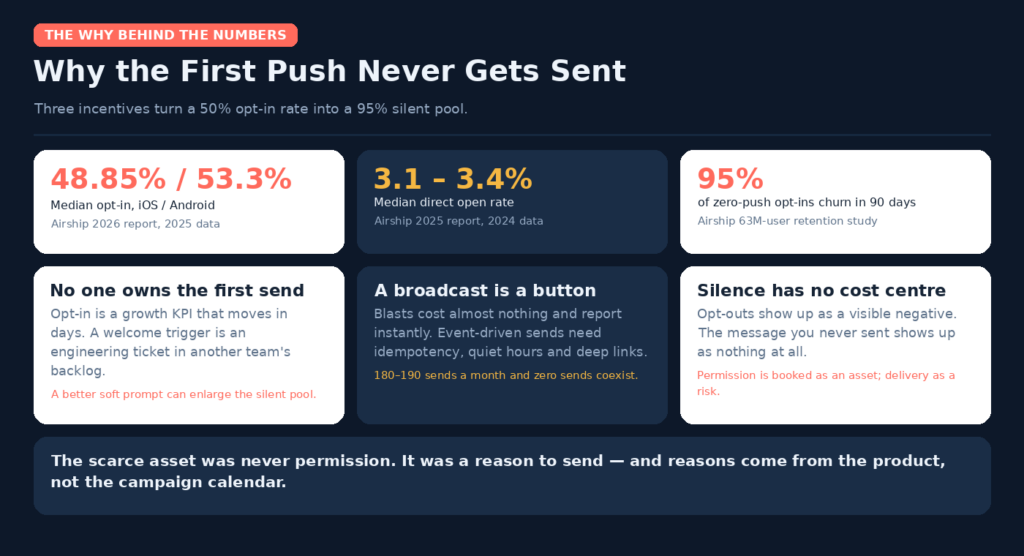
Half of a typical app’s users grant push permission — 48.85% on iOS and 53.3% on Android in Airship’s 2026 benchmarks, built on 681 billion notifications sent to more than 3 billion users in 2025. Teams spend quarters on soft prompts to move it a few points; explaining value before the system dialog can lift opt-in by up to 40%.
Then Airship’s 2017 study of 63 million new users found something stranger. More than a quarter of the 47 million who were opted in received zero pushes in their first 90 days — and retained worse than people who declined: opt-outs kept 50% better on Android retail, 36% better on iOS. Airship says marketers lose 95% of new users within 90 days when they fail to message those who raised their hand.
So why is the first message the one thing no one is accountable for sending?
What the data reveals
Airship’s phrase: opt-in users do not have greater affinity — they have greater expectations. A tap on Allow is a tab left open. Leave it empty and the disappointment beats never having asked. Zero-send users were the largest Android cohort in four verticals; Airship called it APPathy. Permission is not an asset. It is an obligation with a 90-day expiry.
Three mechanisms behind the silence
No one owns the first send. Opt-in rate lives with growth; it responds to copy within days. The first triggered push lives with engineering — event streams, idempotency, quiet hours, deep links, token fallbacks. Nobody is promoted for shipping it. A better prompt enlarges the waiting pool; only the trigger serves it.
A broadcast is cheaper than a reason. A blast to everyone is one button and an instant chart. A contextual message — a price drop on a saved item — is engineering work. Hence both extremes coexist: media apps near 360 pushes per user per month at the 90th percentile, and a quarter of opted-in users at exactly zero. Sending less cannot fix one; sending more cannot fix the other. Both are scheduled from a calendar instead of caused by a user.
Silence has no cost centre. An opt-out arrives as a negative number someone must explain. The message never sent arrives as nothing — no alert, no red row, no postmortem — while permission is booked as a win next to installs. The incentives are rational and backwards: permission is an asset, delivery a risk, omission free. Apple adds another reason to defer: notification summaries and Reduce Interruptions Focus filter the lock screen, and iOS marketing pushes need separate consent under Guideline 4.5.4.
What it means
The scarce resource is not attention, permission, or the lock screen. It is a legitimate reason to interrupt someone — and reasons come from the product, not the calendar. A shipped order, a saved item back in stock, a trial ending tomorrow: user-caused events with a natural expiry, and the only sends that survive an AI summary because they are facts.
So give one named owner a single rule: no opted-in user reaches day 7 with an empty send history. Keep a randomized holdout to prove the welcome push adds retention — Airship’s zero-to-weekly 5x multiplier in Android retail is correlational, and the cohort predates Android 13.
The industry spent a decade teaching marketers how to ask. It never taught anyone whose job it is to answer.