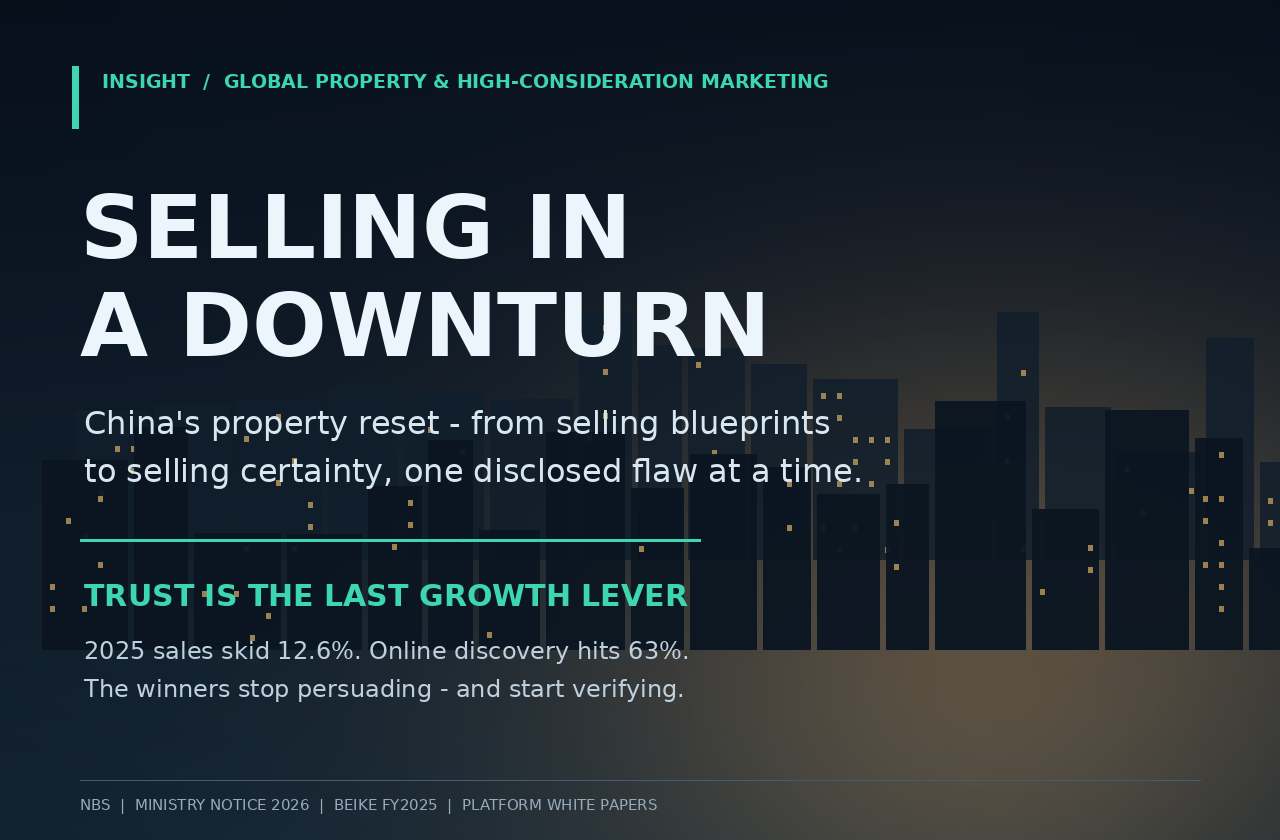
Picture this. You are standing in a show apartment on the edge of Wuhan, and the salesperson does something no salesperson is supposed to do. She tells you the nearby highway is noisy. She walks you to the window, asks you to listen with it shut, then open, then shut again. She hands you the decision and steps away.
That scene, disclosed by Beike’s management on a November 2026 earnings call, is a small thing. It is also a rather large clue. China’s property market has spent three decades selling an image of the future — a rendering, a floor plan, a promise that the keys will arrive eventually. Now that the future has become suspect, the people selling homes are discovering that the most persuasive thing they can do is tell the truth about the present.
Something deeper is changing here. The scarcer asset in this market is no longer demand. It is belief. And the marketers who are winning are the ones who quietly stopped trying to persuade buyers and started helping them verify.
The downturn arithmetic
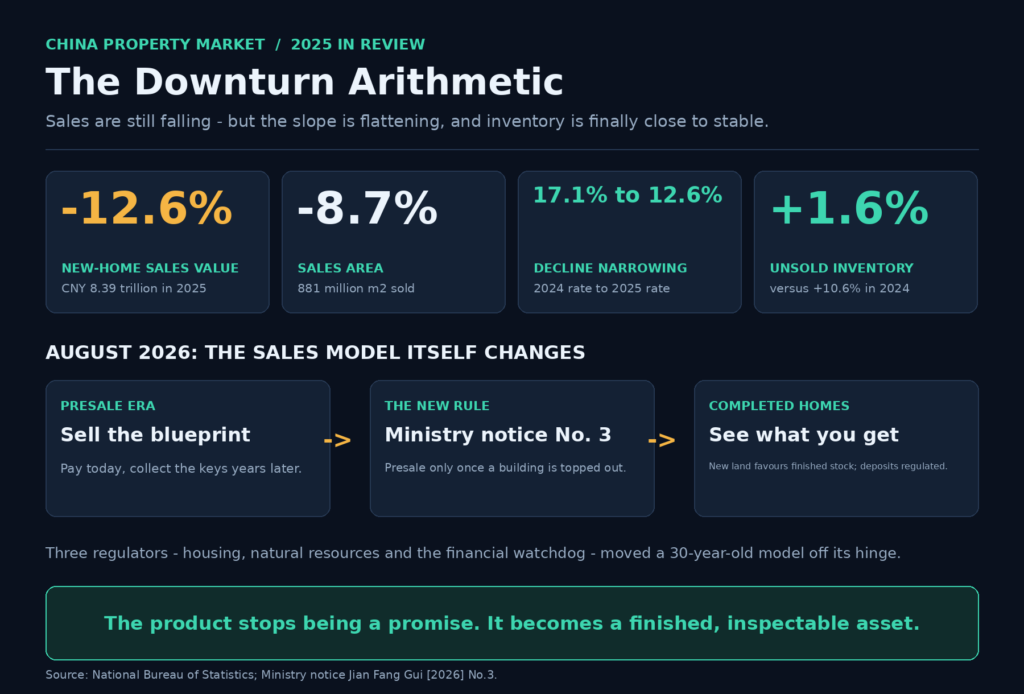
Let us get the numbers straight, because the headline number is misleading on its own. According to China’s National Bureau of Statistics, new-home sales value came in at 8.39 trillion yuan in 2025, down 12.6 percent. Sales area fell 8.7 percent to 881 million square metres. Development investment dropped 17.2 percent.
So yes, the market is still shrinking. But look one layer down. That 12.6 percent decline is narrower than the 17.1 percent fall recorded in 2024. Unsold floor space grew just 1.6 percent last year, against 10.6 percent a year earlier. The inventory tide, which had been rising at a double-digit clip, has almost stopped rising.
Is this a recovery? No. Call it what the official commentary calls it: a market “stopping the fall and stabilising.” The distinction matters for marketers, because a falling market changes the job. When prices only go up, marketing is a megaphone. When buyers believe prices might fall, the megaphone becomes noise. You have to give them a reason to act that has nothing to do with urgency.
Two more signals are worth noting. Banks had approved 6.7 trillion yuan of “white-list” project loans by May 2025, covering more than 16 million homes — a figure that passed 7 trillion later in the year. And in the first quarter, registrations of existing-home transfers were up 34.7 percent, with “mortgage-in-place transfers” — the ability to sell a property without first clearing its loan — surging on a monthly-average basis. The transaction machinery is being kept alive even as new construction withers.
The 30-year model comes off its hinge
In August 2026, three regulators — the Ministry of Housing and Urban-Rural Development, the Ministry of Natural Resources, and the financial regulator — issued a notice that did something quite radical for a conservative system. They moved the sales model off its hinge.
The rule, formalised as Jian Fang Gui [2026] No. 3, says that any project still using presale must have its single building structurally topped out before sales begin. More strikingly, projects on newly granted land are to prioritise the sale of completed homes — what Chinese coverage calls “what you see is what you get.” A regulated deposit system replaces the old free-for-all, and each project is assigned a single “lead bank.”
Why does this matter to a marketer more than an economist? Because for thirty years, the product being sold was not a home. It was a promise dressed up as a home. Marketing’s job was to make an unfinished object feel finished — through show flats,CGI gardens and a brochure full of sunlight. That entire craft depends on the buyer accepting a leap of faith.
Take the leap away and the craft becomes pointless. If the flats are built, the garden exists and the light can be measured at 4 p.m., the only remaining question is whether the home is actually good. Marketing has to move from imagination to evidence. Its centre of gravity shifts from the rendering to the resolution of doubt.
There is a cost to this, and it is worth being honest about. Industry estimates put the display cost of a completed-home project meaningfully higher than a presale one, and the cash-recovery cycle several months longer. Developers who grew up on fast turnover will feel that in the bones. But that is precisely why trust has become economic, not merely ethical. When you must carry the finished asset on your books, you cannot afford a buyer who walks away.
The funnel moved before the buyers did
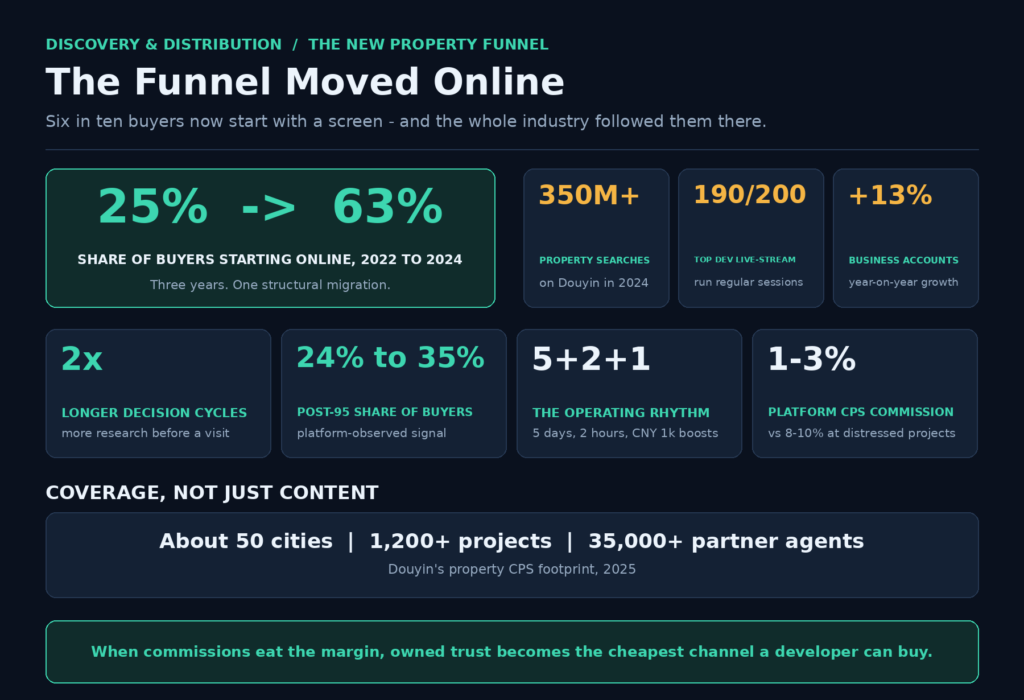
Here is a number that reframes everything. The share of homebuyers who begin their search online rose from 25 percent to 63 percent in the three years to 2024, according to a white paper published by Douyin’s life-services unit and Ocean Engine. More than six in ten buyers now treat a screen as the starting point of a purchase that may cost half a million pounds.
Think about what that means for a high-consideration category. The old funnel was a funnel in the literal sense: awareness, interest, a site visit, a decision. The new one is more of a knot. Buyers search, watch, save, share with a family group chat, search again, and only then show up — by which point they often know the floor plan better than the agent does.
Users made more than 350 million active property searches on Douyin in 2024; annual property searches reached 4.5 billion, up 43 percent. Viewership of property livestreams jumped 196 percent. And decision cycles roughly doubled. That last figure is the one that should keep a sales director awake. A buyer who takes twice as long to decide is a buyer who needs twice as much reassurance — and a buyer who is far less susceptible to a closing tactic.
This is the structural reason the industry went online. It did not go online because online advertising was cheap. It went online because that is where doubt gets resolved now.
Livestream is the new showroom
More than 190 of China’s top 200 developers now run regular livestream selling sessions, according to the 2025 Real Estate Livestream Practice White Paper produced by Mingyuan Cloud, Douyin SDK and Ocean Engine. Property business accounts grew 13 percent year on year. A working rhythm has even crystallised: the “5+2+1” model — stream more than five days a week, for at least two hours a session, with more than 1,000 yuan of paid boost per push.
Why would anyone try to sell a five-million-yuan apartment on a phone? Because the stream is not really a sales channel. It is a trust channel. A two-hour session lets a buyer observe an agent answering awkward questions from strangers, see the same floor plan explained a dozen ways, and judge whether the person on screen is someone to be trusted with a down payment. That is a great deal of verification, delivered cheaply and in public.
The content that converts is rarely the glossy stuff. According to the same white paper, professional property evaluation is the most popular format — buyers rewarding detail, comparison and candour. In a market where the marketing used to be all polish, the new currency is competence made visible.
The channel war, and who pays for it
But eking out trust on a livestream is slow work, and developers have historically preferred to buy demand outright. Enter the channel war. Commission on hard-to-shift projects in some cities has reached 8 to 10 percent — an extreme, not an industry average, but extreme enough to delete a project’s margin.
Against that, platform-driven CPS (cost-per-sale) arrangements have looked refreshingly cheap, with commissions commonly in the 1 to 3 percent range. Douyin’s property CPS footprint now covers roughly 50 cities, more than 1,200 projects and over 35,000 partner agents. Organisational charts have followed the money: the old “self channel” teams are being restructured into digital-channel and content-production units.
Here is the trap, though. A cheap channel is still a rented one. The platform owns the relationship, the algorithm owns the reach, and the moment the commission rises or the rules shift, the developer is exposed. There is a reason a 36Kr report in 2025 raised the possibility that Douyin might rethink CPS altogether. A channel that can be repriced overnight is not an asset. It is a subscription.
The strategic answer is not to abandon channels but to stop confusing them with strategy. Pay for reach by all means. But build the thing the channel cannot take away.
The quiet advantage of the private domain
This is where WeChat Channels — video accounts inside the ecosystem people already use for family, work and payments — become interesting. For an agent with a decade of client contacts, the mechanics matter enormously. A piece of content on Douyin must be rediscovered; a piece of content in a WeChat Channels feed can be forwarded, with one tap, to a decade of prior clients, a family group or a neighbourhood circle.
That is the difference between broadcasting and handing something to someone. In a downturn, past clients are the cheapest and most credulous audience you have — credulous not because they are foolish, but because they already have evidence of how you behave when a deal goes wrong. Activation beats acquisition when acquisition costs keep climbing.
The broader point is that a private domain is not a mailing list. It is a reservoir of prior trust that can be reactivated at near-zero media cost. Developers who treat it as a broadcast channel waste it. Developers who treat it as a service channel — answering, advising, introducing the right unit rather than the most expensive one — compound it.
Disclose the flaw, then let the buyer decide
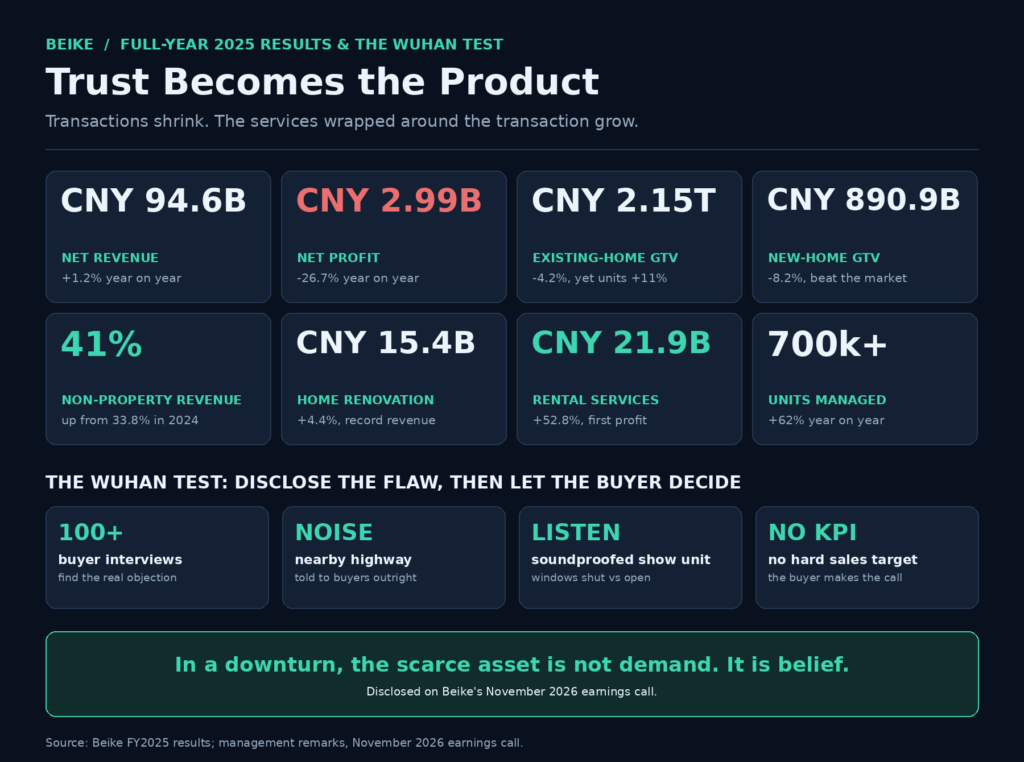
Which brings us back to Wuhan. The details matter, so here they are. In a tail-end project of roughly 300 units, Beike’s team conducted more than 100 buyer interviews and found that the objection was not price or layout. It was noise from a nearby highway. Instead of dodging the issue, the team worked with Shengdu, Beike’s renovation arm, to install soundproofing in the show unit — and invited each buyer to hear the difference with the windows sealed and unsealed, floor by floor.
Management’s account of the pilot is striking. “Instead of dodging it, we explained it to them,” Beike’s chief financial officer Xu Tao said on the call, describing the acoustic differences across floors. “We gave them the freedom to make the final decision.” In that pilot, no hard sales metric was imposed. That is a remarkable thing for a sales organisation to say out loud.
Was this altruism? Hardly. Reports on the pilot noted that roughly a third of buyers who reserved a unit also chose a renovation package — a neat illustration of what happens when a seller helps rather than pushes. The disclosure opened a door to a second, higher-margin conversation. Honesty was not a cost centre. It was a funnel.
This is the core of the insight. In a falling market, the seller who hides the flaw wins the objection and loses the relationship. The seller who surfaces the flaw loses a little immediate conversion and gains the only thing that compounds: belief that this person will tell you the truth later, when it matters more.
The platform that stopped selling only houses
Watch what Beike did with its own P&L, because it is the same logic at corporate scale. For full-year 2025, net revenue reached 94.6 billion yuan, up 1.2 percent, while net profit fell 26.7 percent to 2.99 billion yuan. Existing-home GTV slipped 4.2 percent to 2.15 trillion yuan — yet the number of second-hand transactions rose 11 percent, a record. Read those two figures together and you get “price for volume”: more homes changing hands, each for less.
New-home GTV fell 8.2 percent to 890.9 billion yuan, which sounds bad until you notice it beat the market: national residential sales value fell about 13 percent and the top-100 developers’ sales fell nearly 20 percent. In a downturn, the leader does not escape the rain. It simply owns more umbrellas.
The real story is the mix. Non-property revenue hit 41 percent of the total, up from 33.8 percent a year earlier. Home renovation brought in 15.4 billion yuan, up 4.4 percent and a record. Rental services brought in 21.9 billion, up 52.8 percent, with more than 700,000 units under management, up 62 percent — and, for the first time, a full-year operating profit.
Step back and the strategy is legible. Beike’s “one body, three wings” structure — transactions at the core, plus renovation, rental and a C2M homebuilding arm — is an attempt to stop being a business that ends at the transaction. A brokerage that only earns at closing has an incentive to close, whether or not the home suits you. A service platform that earns across the life of a home has an incentive to get the match right. The business model and the trust model finally point in the same direction.
That alignment is the quiet lesson here. Trust-based marketing is not a softer version of sales. It is what sales looks like when the incentive horizon gets longer.
AI in the sales office: assistant, not replacement
None of this happens without tooling, and the tooling is arriving fast. A 2026 survey of property agents by 58.com and Anjuke found AI adoption at 49.7 percent nationally. AI “presenters” can keep a livestream running around the clock; AI bidding tools claim to lift click-to-lead conversion; AI sales assistants answer private messages while a human sleeps.
The interesting question is not whether these tools work — the case studies say they do — but what they should be allowed to do. An AI that generates a thousandfloor-plan videos has not solved the buyer’s problem. The buyer’s problem is: which of these flats will make my mornings bearable? Automation can supply information at heroic scale. It cannot supply judgment about a family’s life, and it cannot honestly say “this one is wrong for you” unless someone designs it to.
The strategic line is worth drawing clearly. Use AI to produce more evidence, not more persuasion. Let it shorten the path to an answer, not manufacture a fake urgency. In a trust economy, a tool that makes you sound more human while being less human is a liability with good production values.
The buyer who changed faster than the pitch
Who is making these demands? According to the platform white papers, buyers born in the 1990s now make up close to half of the market, and the post-1995 cohort alone rose from 24 percent to 35 percent of buyers in a single year. (Treat that as a platform signal, not a national census: a separate study from Beike’s Hangzhou research arm points the other way, suggesting the under-30 share has actually fallen over a longer horizon. Both can be true, because they count different populations.)
What matters for the pitch is less the percentage than the posture. This cohort arrived online, treats a purchase as a research project, and is remarkably unimpressed by status cues. The white paper argues that demand has shifted from “having a home” to “living well” — from investment to use. People are not buying an appreciating asset so much as a better Tuesday morning.
That is a profound change in what a home is for, and therefore in what marketing is for. You cannot sell the dream of appreciation to someone who has watched appreciation evaporate. You can sell the certainty of a quieter bedroom, a shorter commute, a building that will actually be finished — claims that can be checked.
Three markets, one weather system
China is not alone in this, and the comparisons sharpen the point. In the United States, the “lock-in effect” has kept existing-home sales near generational lows: roughly 4 million transactions in 2024, the weakest since 1995, because homeowners with sub-4-percent mortgages will not sell and buy at today’s rates. In Japan, some nine million homes — around 14 percent of the stock — sit vacant, and local governments are pushing “akiya banks” to match empty houses with new owners, sometimes for free. In Dubai, off-plan units account for roughly 60 to 70 percent of residential transactions, a structure that repeatedly runs into delivery delays and the trust problems that follow.
Three very different markets, one shared disease: when buyers cannot trust the promise, the promise stops clearing. The responses differ in language but not in logic. Make the asset inspectable. Lower the cost of being wrong. Let the buyer verify.
The fascinating part is that this is not a downturn tactic that gets discarded when prices recover. Once buyers have learned to verify, they do not unlearn it. The markets that rebuild trust first will keep the advantage long after the cycle turns.
The playbook, in one breath
If you are a marketer in a high-consideration category facing your own version of this weather, the translation is fairly direct.
Build verification content, not aspiration content — the walkthrough, the measurement, the answer to the awkward question. Treat disclosed flaws as an asset rather than a liability; a flaw you name becomes a term you control. Activate the private domain before buying another impression, because a prior client is a relationship you already paid for. Extend the value curve past the transaction, as Beike did with renovation and rental, so that your interest and the buyer’s interest overlap for years instead of for one afternoon. And use AI to accelerate evidence, never to counterfeit intimacy.
None of this is comfortable. It asks organisations built for speed to move at the speed of trust, which is slower and more expensive up front. But the arithmetic is on its side. When a channel costs 8 percent of the deal and an honest conversation costs a two-hour livestream, the honest conversation is not the soft option. It is the cheap one.
The bottom line
China’s property market is not done falling. But something more interesting than the price cycle is under way. A 30-year model based on selling a future has been replaced, almost overnight, by a model that must sell a present — a finished, inspectable, flawed, real present.
That shift has moved the buyer online, turned livestreams into evidence rooms, exposed the hidden tax of rented channels, and pushed the largest platform in the market to earn its keep across the whole life of a home. Through all of it, one variable keeps surfacing: whether the seller can be believed.
So the broker who asks you to listen to the highway is not a curiosity. She is the prototype. In a downturn, trust is not a brand value. It is the last growth lever left — and the only one that gets cheaper the more you use it.