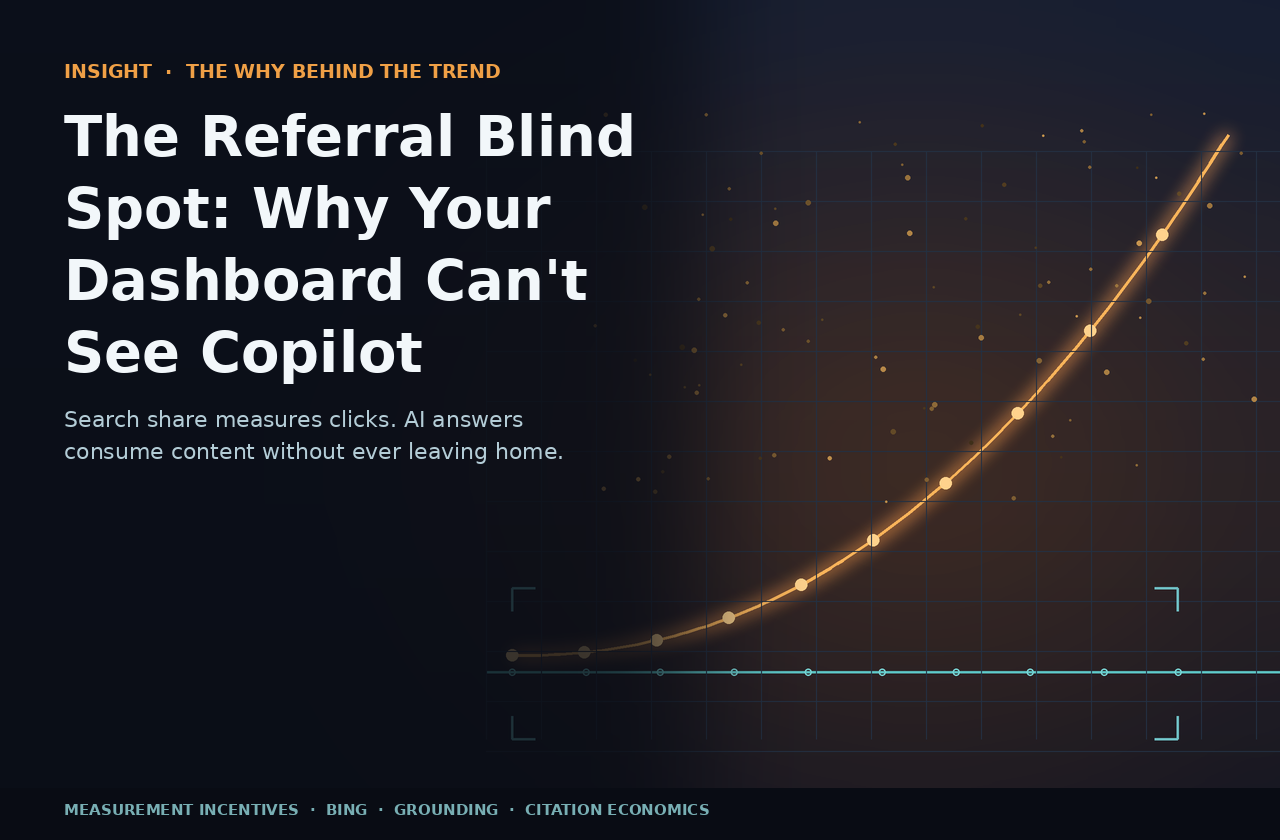
Here is a small mystery. In April 2026, Microsoft announced Bing had crossed one billion monthly active users. Your analytics, meanwhile, show Bing sending you roughly the same trickle it sent in 2023. Both things are true. The resolution is not that Microsoft is lying or your tracking is broken. It is that your dashboard measures a behavior — the click — that AI answers were specifically designed to eliminate. Once you see the mechanism, a lot of “Bing doesn’t matter” budget decisions start to look like measuring theater attendance by counting people who left early.
Blind Spot One: The Denominator Is Mostly Phones
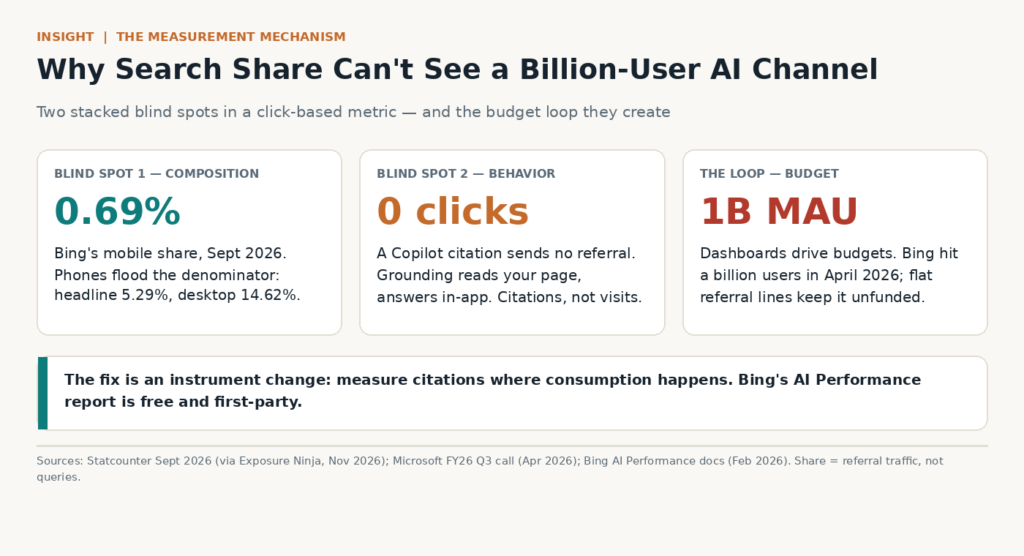
Statcounter’s September 2026 numbers put Bing at 5.29% of worldwide search. Look one layer down and the average dissolves: 14.62% on desktop, 0.69% on mobile. Search share is a traffic-weighted average, and mobile traffic dwarfs desktop — so phones, where Bing is nearly absent, drag the headline down and bury the desktop audience where B2B research actually happens. The metric isn’t wrong. It is answering a question (“what fraction of all search referrals?”) that has almost nothing to do with yours (“where do my buyers research?”). Averages are excellent at hiding exactly the segment you sell to.
Blind Spot Two: Citations Don’t Click
The deeper blindness is behavioral. When Copilot grounds an answer in your page, the consumption happens inside the assistant. Your facts get read, weighed, and spoken — and no referral is ever generated. Microsoft’s own AI Performance report exists precisely because citations and visits are different events: a single site logged 19,717 citations in 91 days in one agency’s export, activity that would be almost entirely invisible in a clicks-based dashboard. Your content can be working hard in a channel your instrumentation cannot register. Zero measured traffic is not zero influence; it is zero clicks, which was never the same thing.
The Loop: Why the Blindness Persists
So why hasn’t anyone fixed the instrument? Because the incentives run the other way. Marketing budgets are defended with dashboard screenshots, and dashboards are built on referrals. A channel that produces citations but no visits gives its advocate nothing to screenshot — while the cost of adding it (an hour of Bing Webmaster setup) is small enough to keep postponing indefinitely. This is the classic measurement trap: the metric that is easy to report quietly becomes the metric that is worth optimizing, and the channel that cannot appear in the report quietly becomes the channel that does not exist. Not through malice — through friction. Nobody gets fired for ignoring a 5% line item. They might get fired for spending a week on something the CFO’s dashboard can’t see.
What Follows
The escape is not believing harder in AI traffic; it is changing instruments. Bing’s AI Performance report is free, first-party, and already waiting in Webmaster Tools — total citations, cited pages, grounding-query themes. Verify the site, enable IndexNow, export the baseline, and suddenly the invisible channel has a number you can put in a slide. The billion users were always there. What was missing was a ruler that could measure them.