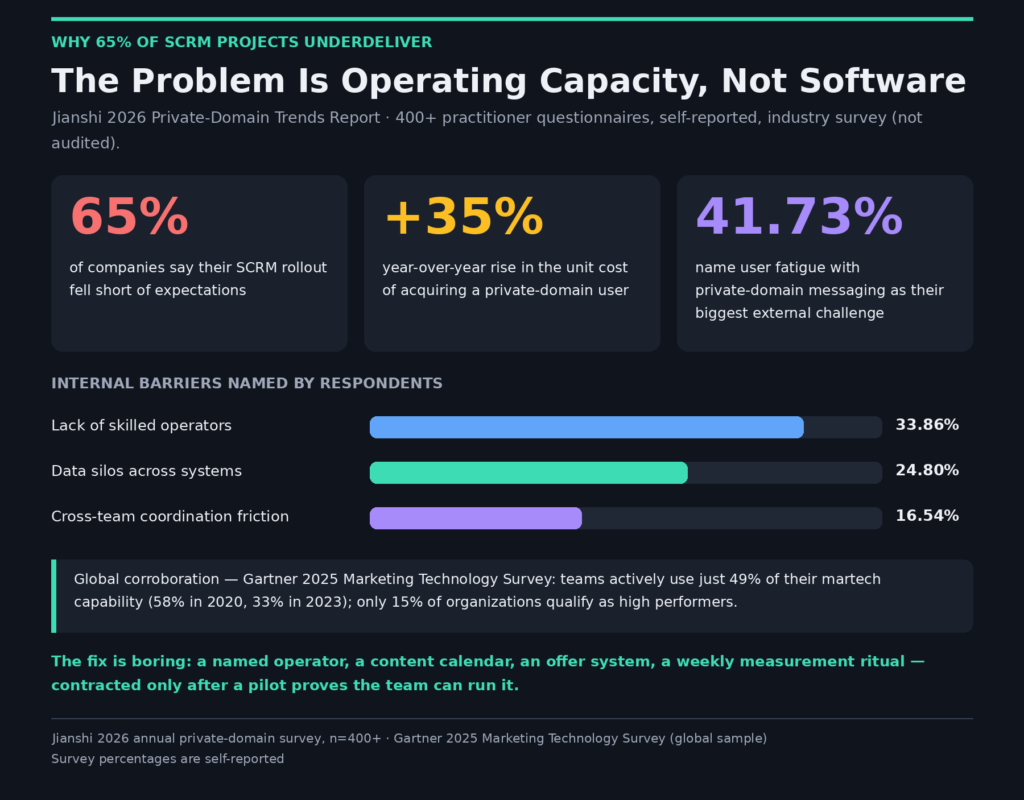
Every Chinese CRM buyer eventually meets the same number. In its 2026 annual private-domain survey — more than 400 practitioner questionnaires, self-reported and not audited — the research firm Jianshi found that roughly 65% of companies said their SCRM rollout fell short of expectations. Not 65% of cheap tools. Not 65% of small teams. Sixty-five percent of the people who bought the software, signed the contract, and sat through the demo.
Meanwhile the platform underneath all of it keeps getting better for free. WeCom — Tencent’s enterprise arm of WeChat — now counts more than 14 million registered enterprises and organizations, and businesses use it to serve over 750 million WeChat users every day. Its built-in customer features absorb more of what SCRM vendors used to sell every year.
So the 2026 buying question is not “which SCRM is best.” It is “which tier do I actually need, and can my team operate it?” This guide maps the landscape in three tiers plus a data layer, gives you a capability matrix, a decision flow, and the operating prerequisites that separate you from the 65%. If you want the strategic background first, our earlier deep dive on China’s SCRM stack covers why the category exists at all.
1. Start with the failure rate, not the feature list
The Jianshi survey is an industry poll, so treat its decimals as directional. But its shape is corroborated by a much bigger sample on the other side of the world: Gartner’s 2025 Marketing Technology Survey found that teams actively use only 49% of their martech capability — down from 58% in 2020 — and just 15% of organizations qualify as high performers on goals and ROI.
Two independent surveys, two continents, one conclusion: the bottleneck is operating capacity, not software. Jianshi’s respondents named their internal barriers plainly — lack of skilled operators (33.86%), data silos (24.80%), and cross-team coordination friction (16.54%). Notice what is absent from that list: missing features.
The same survey found the cost of acquiring a private-domain user rose about 35% year over year, and 41.73% of companies named user fatigue with private-domain messaging as their biggest external challenge. Buying a louder tool for an audience that is already tired is how budgets die.
2. The market you are shopping in
Consultancy estimates put China’s private-domain operations solutions market at roughly RMB 13.7–14.3 billion in 2025 (Zhiyan Consulting says 14.3; CIC’s comparable scope says 13.7), heading toward RMB 16.9 billion in 2026. That is real money — and still small next to the commerce it serves: private-domain commerce overall reached RMB 6.4 trillion in 2025, about forty cents of every yuan spent online in China.
Read those two numbers together and the industry’s economics snap into focus. The software layer is a thin slice of a huge retained-revenue pool. Vendors compete hard for a modest license budget, which explains the feature wars, the aggressive bundling, and the ranking articles that never disclose a methodology. No audited market-share table for SCRM vendors exists publicly. Anyone quoting one is guessing, and usually selling.
3. The native floor: what WeCom already does free
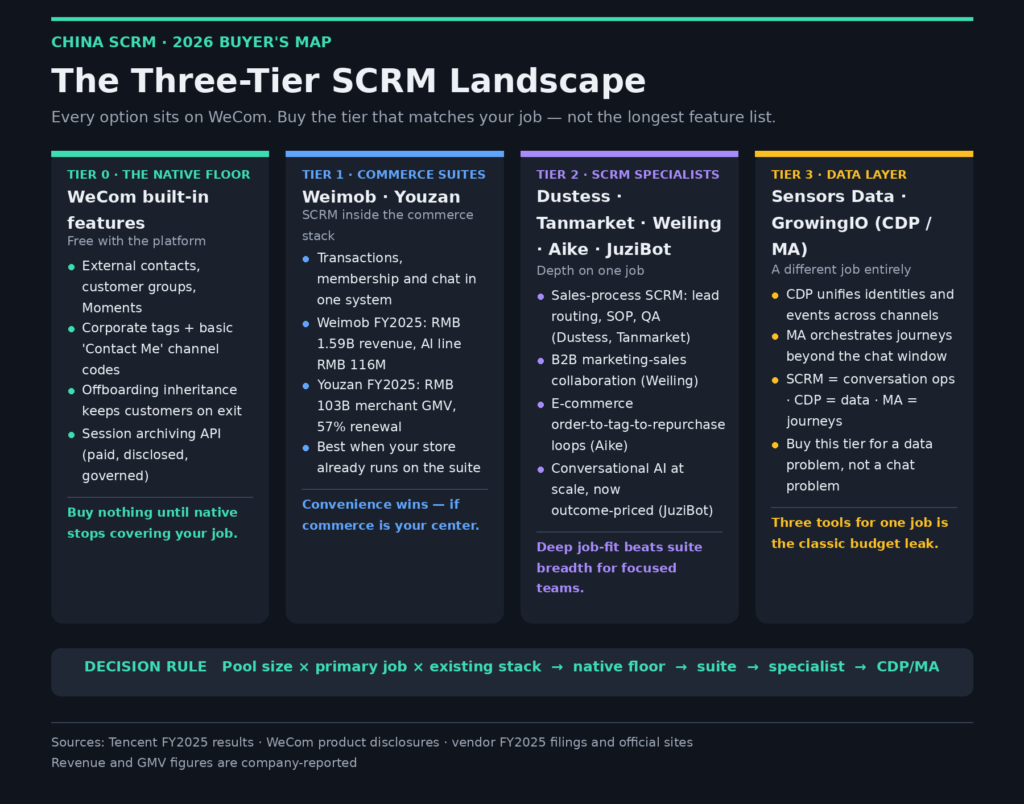
Before any vendor call, open WeCom’s own admin console. The platform natively provides external contacts (your customers’ existing WeChat accounts, no new app), customer groups, customer Moments, corporate tags, “Contact Me” channel codes, and offboarding inheritance — when a salesperson leaves, their customers reassign to colleagues instead of walking out the door. Conversation archiving exists as a governed platform API: paid, disclosed to staff and customers, contractually controlled.
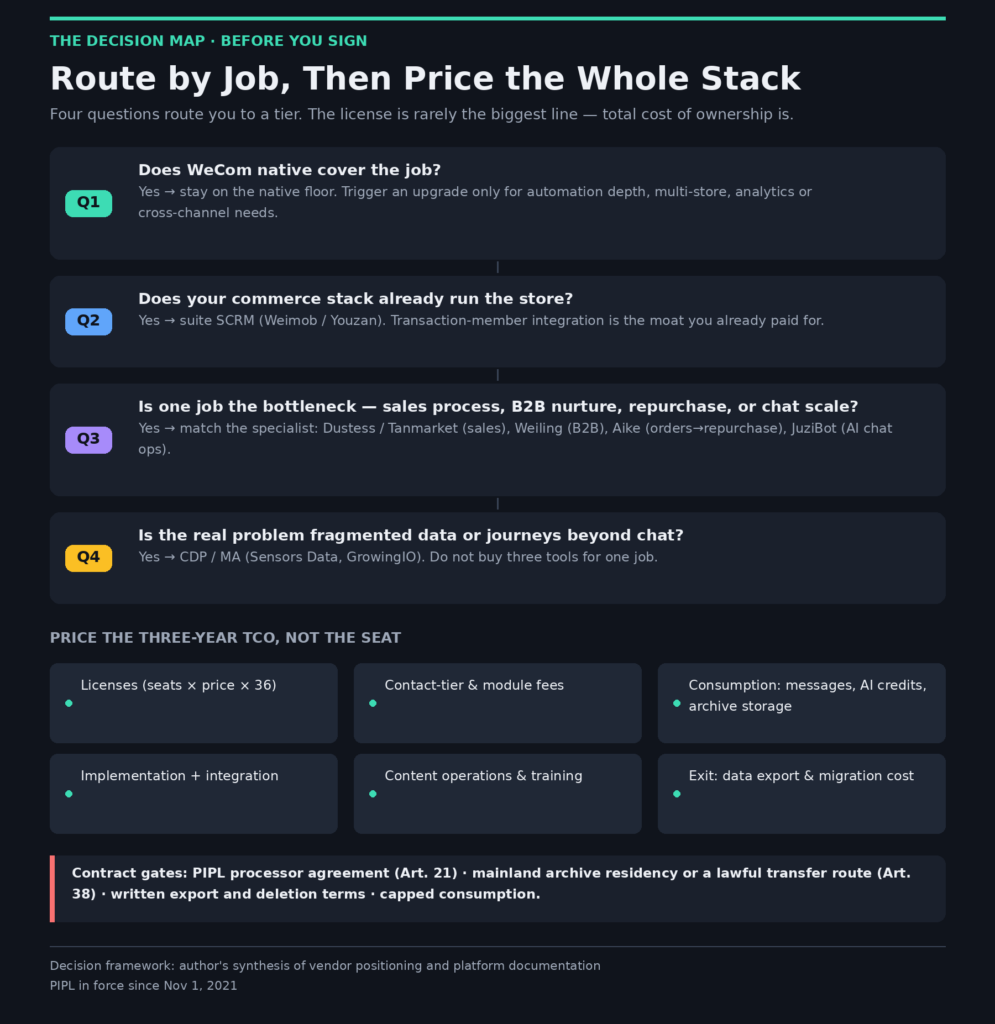
That is a functioning baseline SCRM. For a five-person team with one store and a few thousand customers, it may be the whole answer. The honest rule: if native covers your job, don’t buy. Upgrade triggers are specific — automation depth beyond manual sends, multi-store coordination, order-level analytics, or cross-channel data. Vague ambition (“we need to do private domain properly”) is not a trigger; it is how the 65% happens.
One fresh wrinkle belongs in every 2026 evaluation. WeCom tightened its customer-data APIs effective December 18, 2025: third-party apps now lose access to customer lists when a company stops actively using them, trial apps see limited history, and agency-developed apps no longer return avatars, gender, or remarked phone numbers. The platform is actively pruning dormant integrations — which means a shelfware SCRM license can now decay into a broken one. Ask every vendor how their certification and data access survive these rules.
4. Tier 1 — Commerce suites: SCRM where the transaction lives
If your store already runs on Weimob or Youzan, their SCRM modules deserve the first demo, because the hardest integration — transactions to customer identity — is already done.
Weimob’s FY2025 results show revenue of RMB 1.59 billion, up 18.9%, with its first adjusted annual profit since 2021 (RMB 42.4 million). The interesting line is AI: RMB 116 million of AI-related revenue, 7.3% of the total, growing 137.5% half-over-half, built on its WAI product family whose monthly active merchants grew 66.7%. The suite is quietly becoming an AI operations layer on top of commerce.
Youzan’s FY2025 tells the store-side story: revenue of RMB 1.49 billion, operating profit up 81% to about RMB 180 million, and roughly RMB 103 billion of merchant GMV — of which RMB 53.7 billion, more than 52%, came from physical-store SaaS. Renewal rates reached 57% overall and 68% among mid-to-large merchants. Its company-reported AI numbers (treat them as vendor claims, not audited results): smart-marketing campaigns drove RMB 120 million of transactions, and AI customer service cut service costs by around 80% while generating RMB 16.56 million of attributed sales. Youzan moved to the HKEX main board in April 2026.
The suite logic is convenience with a moat: membership, orders, and conversation share one customer record. The trade-off is gravity — suites optimize for their own commerce rails, and leaving later costs more than leaving a specialist.
5. Tier 2 — Specialists: one job, done deeply
Specialists win when a single job is your bottleneck. Positioning below reflects each vendor’s public documentation as of November 2026; scale figures are vendor claims, and feature scope varies by edition — verify in a pilot.
Dustess sells sales-process SCRM: leads auto-import from ad platforms, route by rules, recycle when neglected; stage-gated follow-up tasks push reps through the funnel; AI drafts follow-up notes from conversations and runs quality checks at full coverage instead of spot checks. It claims 10,000+ clients across 30+ industries. Best fit: high-ticket B2C and lead-heavy sales floors — clinics, education, home renovation.
Tanmarket covers similar ground with an audit flavor: session review, sensitive-word and sensitive-action alerts, twenty sales-activity metrics, group SOPs with execution calendars. It claims 2,000+ industry-leading clients. Best fit: mid-to-large sales organizations that need supervision and compliance visibility as much as automation.
Weiling built a collaborative CRM for B2B: marketing and sales share one customer view from ad click to WeCom conversation, with content-read tracking that surfaces intent. Founded in late 2020 and backed by Tencent and Sequoia China Seed among others, it deliberately positions against “supervision-first” CRM — empower the rep, and the data follows. Best fit: B2B teams and high-consideration sales with long nurture cycles.
Aike connects e-commerce orders to WeCom customers: a buyer adds your rep from a parcel card, the system matches their Taobao/Tmall/JD/Douyin order history, tags update automatically, and repurchase SOPs fire by category and cycle. Founded 2015, claiming 10,000+ clients. Best fit: multi-platform consumer brands whose private domain lives or dies on repeat purchase.
JuziBot is the shape of things to come. It began as conversational automation infrastructure for WeChat and WeCom at scale; its 2026 positioning is enterprise agentic AI employees delivered against business outcomes — it claims 1,000+ enterprise deployments and offers pay-per-lead pricing for sales roles. Best fit: teams with huge chat volume that want to buy results rather than seats. Note the model risk: outcome-priced AI is new, and contracts deserve the same scrutiny as any performance deal.
6. Tier 3 — When the real purchase is a CDP or MA
Some “SCRM” shortlists are misdiagnosed data problems. If your pain is that the same customer exists as five identities across app, store, mini-program, and chat, you need a customer data platform — Sensors Data and GrowingIO both sell enterprise CDP lines that unify identities and events. If your pain is journeys that span channels beyond chat, that is marketing automation, which GrowingIO also ships.
Keep the boundary map honest: SCRM operates conversations, a CDP unifies data, MA orchestrates journeys. They compose; they don’t substitute. Buying all three to solve one job is the classic budget leak — and the fastest route to three dashboards that disagree. Our CDP-versus-SCRM comparison walks through the overlap in detail.
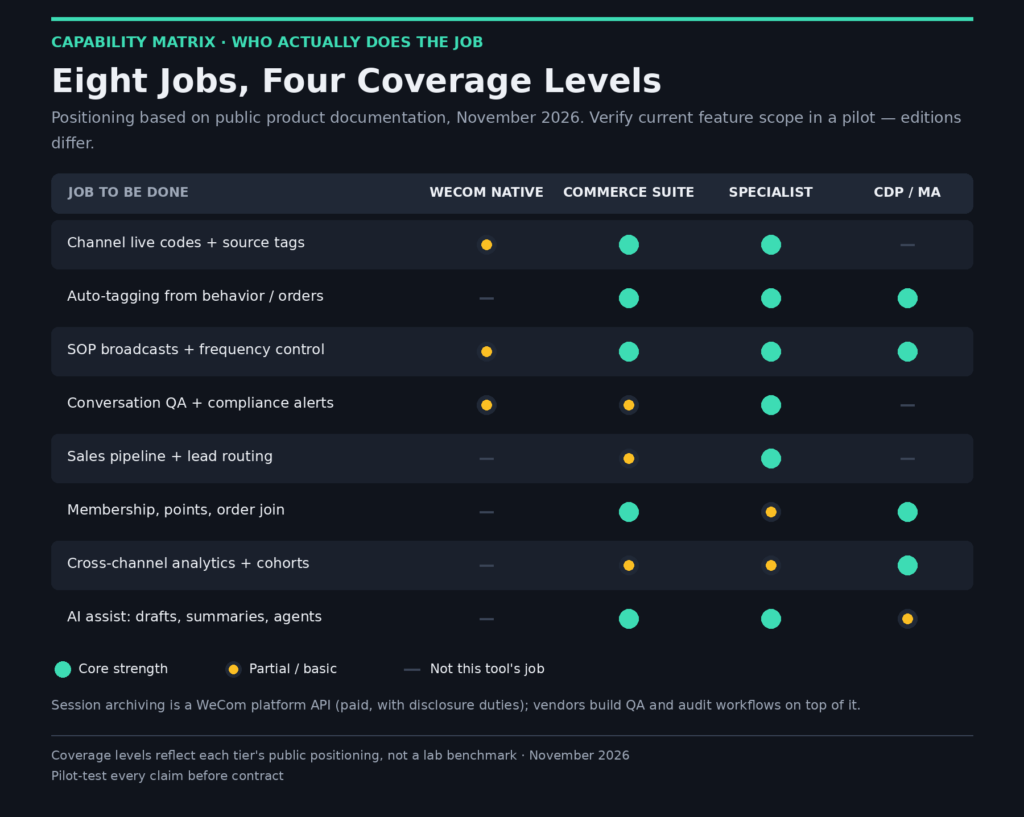
7. The capability matrix
Feature lists converged years ago; what differs is which job each tier does natively well. The matrix below is a positioning map, not a lab benchmark — editions differ, so pilot-test every claim that matters to you.
| Job | WeCom native | Suite | Specialist | CDP/MA |
|---|---|---|---|---|
| Channel live codes + source tags | Basic | Core | Core | — |
| Auto-tagging from behavior/orders | — | Core | Core | Core |
| SOP broadcasts + frequency control | Basic | Core | Core | Core |
| Conversation QA + compliance alerts | Archive API | Partial | Core | — |
| Sales pipeline + lead routing | — | Partial | Core | — |
| Membership, points, order join | — | Core | Partial | Core |
| Cross-channel analytics + cohorts | — | Partial | Partial | Core |
| AI assist: drafts, summaries, agents | — | Core | Core | Partial |
8. The 65% prevention plan: operating capacity first
Here is the uncomfortable truth the survey data keeps pointing at: the tool is maybe a fifth of the outcome. Before you sign anything, four prerequisites should already exist on paper.
- A named operator. One person owns the private domain’s P&L contribution, with allocated hours. “Marketing will run it” means nobody will.
- A content calendar. Four weeks of approved assets, offers, and service scripts — because the failure mode is not silence, it is improvised spam.
- An offer system. Defined reasons for a customer to stay: early access, member pricing, service priority. Fatigue at 41.73% says the audience is done with broadcast coupons.
- A measurement ritual. A weekly review of cohort repeat rate, contact deletions, and reply rates. Contact decay is the honest metric: in chat, an annoyed customer deletes you, and the dashboard shows it.
Then apply the pilot-before-contract rule: run one store, one cohort, one job for 60–90 days on a trial or monthly plan. If the team cannot operate it at pilot scale, an annual contract will not fix that — it will only make it expensive. Jianshi’s data shows agencies losing share to in-house operation for exactly this reason: the capability has to live inside your team.
9. Cost and contract reality
SCRM pricing in China is quote-based; published price lists age into fiction within a year. Negotiate the model, not just the number: per-seat (watch read-only users billed at full rate), per-contact-tier (cap it, and define “active” so deleted and blocked contacts don’t count), per-module (archiving priced as an upsell is a values tell), and consumption (messages, AI tokens, archive storage — the invisible leak).
Price the three-year total cost of ownership, not the license: seats × price × 36, plus tier and module fees, plus consumption at your real volume, plus implementation and integration, plus the content operations and training your team needs, plus exit. That last term decides whether you own your customer relationships or rent them: get written export terms for contacts, consent records, and archives, at a fixed price, before signing.
Compliance is contract scope, not paperwork garnish. Under PIPL, in force since November 2021, your vendor is an entrusted processor: Article 21 requires a processing agreement covering purpose, method, and safeguards. Article 38 governs any cross-border transfer of that data — security assessment, certification, or the standard contract are the main routes, plus a residual statutory clause. Ask where the conversation archive physically lives, and put the answer in the contract. And remember archiving is a consent product: enable it without disclosure flows and you have converted a compliance asset into a documented liability.
10. Honest boundaries
Three things this guide will not pretend. First, no audited vendor market shares exist publicly; the ranking you just read is a positioning map built from filings and official documentation, and vendor scale claims are labeled as claims. Second, the 65% figure comes from an industry survey of 400+ self-selected practitioners — directionally powerful, statistically soft. Third, this landscape is moving fast: WeCom’s December 2025 API tightening, Weimob’s pivot to AI-agent workflows, and JuziBot’s outcome-priced AI employees all landed within twelve months. Re-verify feature scope at procurement, not from articles — including this one.
The short version
China’s SCRM market in 2026 is a three-tier stack on a free native floor, sold into a RMB 14-billion software budget serving RMB 6.4 trillion of retained commerce. Most failures are operating failures, not product failures. Route by job — native, suite, specialist, or data layer — staff the operation before you buy the tool, pilot before contract, and price the exit before the entrance. Do that, and the 65% is somebody else’s statistic.