You have watched the rooms. You know about the nested loops, the tiered hosts, the console operator making second-by-second calls while the host keeps smiling. What you do not have — what most teams outside China never see — is the document. In a serious Douyin selling room, the session is not improvised by a charismatic host. It is executed from a run-of-show: a product sequence sheet, a loop script, a role-cue table, a traffic plan, emergency plays and a debrief format. This playbook hands you that document, layer by layer, with the verified mechanics and the legal tripwires marked in red.
Scale check before we start: China’s livestream e-commerce market reached roughly RMB 5.8 trillion in 2024 — an iResearch estimate cited in a May 2025 report by the state-affiliated China International Electronic Commerce Center — close to 40% of online retail. The China Netcasting Services Association’s 2025 report counted 833 million livestream viewers and 38.8 million professional hosts; the occupation itself was formally recognized by the Ministry of Human Resources in July 2024. This is an industry with textbooks now. Literally: Make Friends, the operator behind China’s best-known 24-hour selling room, published a two-volume operations textbook in November 2025. We will borrow its spine.
Pre-show: build the product sequence sheet
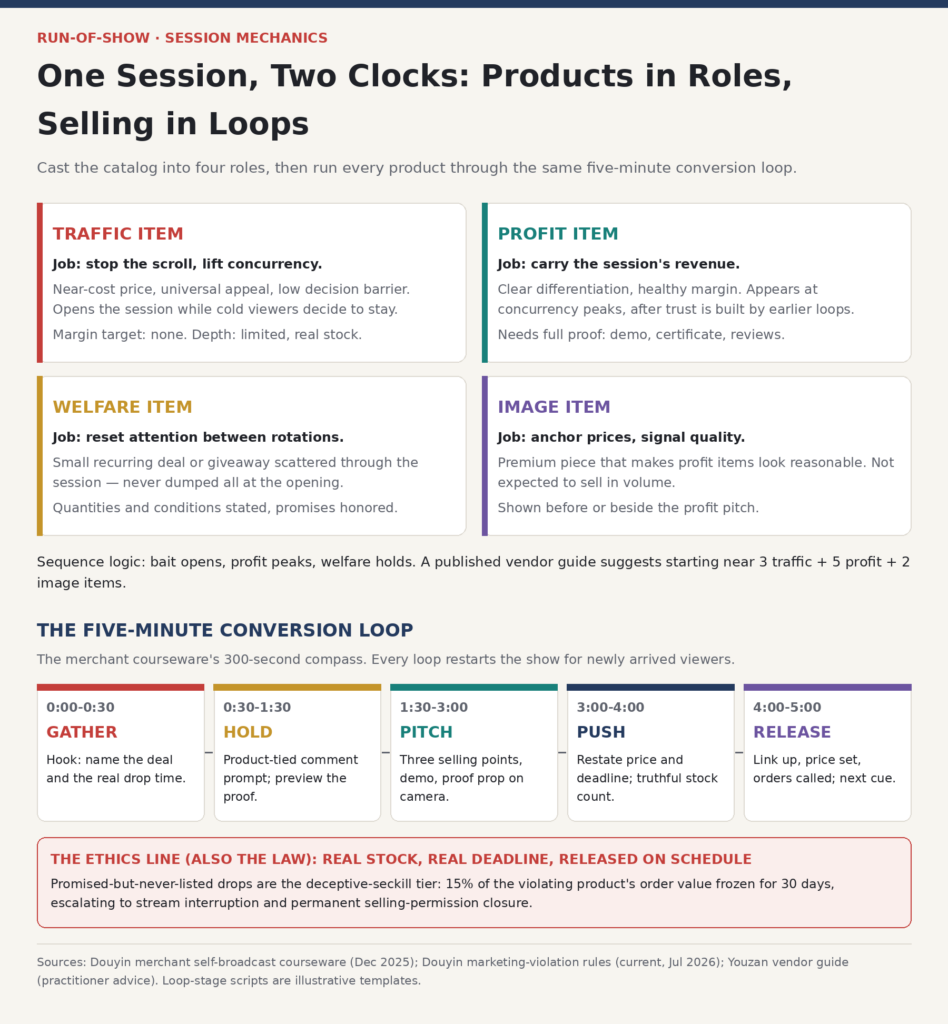
Chinese operators call it the sequence sheet — the ordered list of what sells when. Products are cast into four roles, like a heist crew. The traffic item is cheap, universally wanted, near-cost: its job is stopping the scroll, not earning margin. The profit items carry the session’s revenue and need trust built before they appear. The welfare item is a recurring small giveaway or deal that resets attention. The image item is your premium piece — it anchors prices and makes the profit items look reasonable; nobody expects it to sell in volume.
The sequencing logic is consistent across operator guides: bait opens, profit peaks, welfare holds. Open with the traffic item while cold viewers decide whether to stay; move to profit items when concurrency crests; scatter welfare through the session rather than dumping it all at the start. One published vendor guide (Youzan, a commerce SaaS provider — practitioner advice, not platform law) suggests a starter mix of three traffic items, five profit items and two image items so the pacing stays explainable.
Give every product a card: three selling points maximum, one proof prop, the price mechanic, stock depth, the drop cue, and a fallback if it stalls. Three points, not ten — the loop below only gives you minutes.
The loop script: the five-minute compass
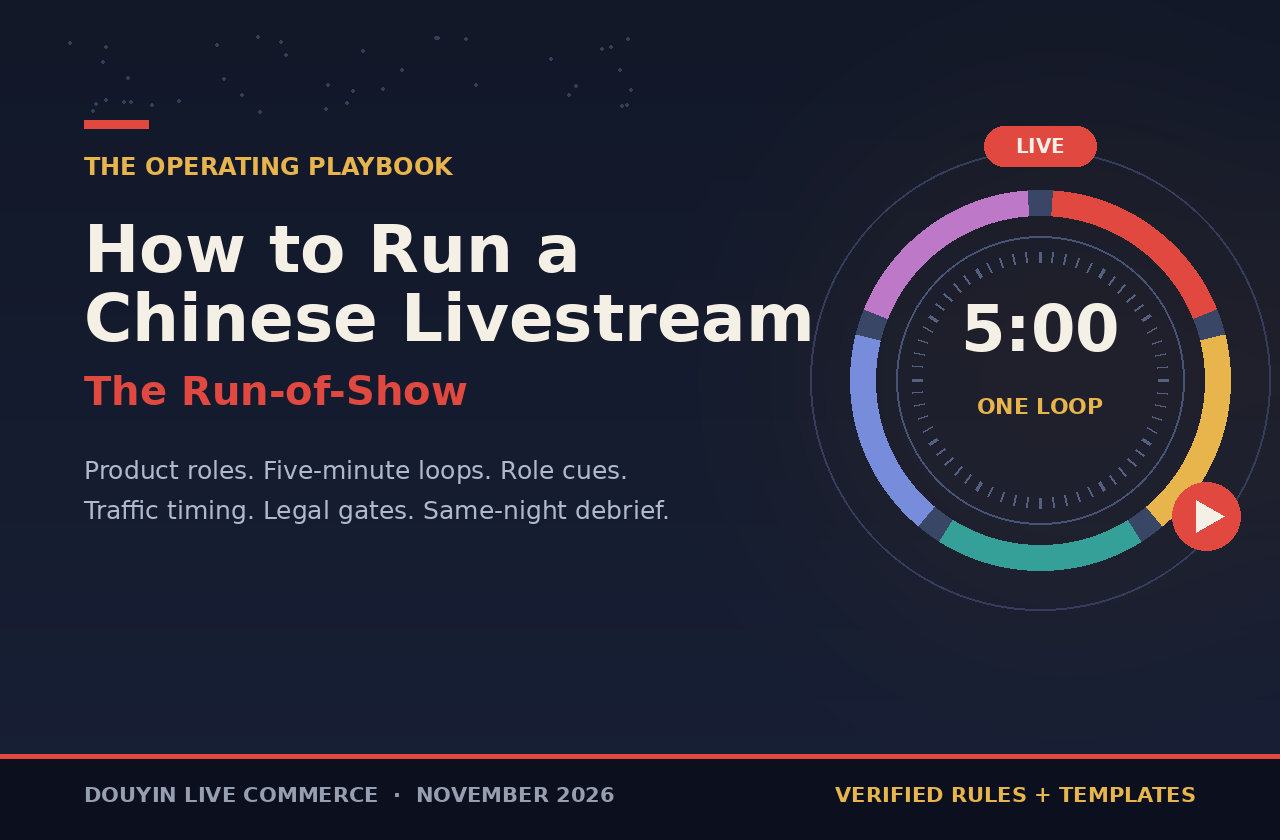
The official Douyin self-broadcast efficiency courseware circulated in December 2025 — a 48-page training deck for merchants — organizes organic-traffic selling around what it calls a 300-second conversion compass: a five-minute conversion loop. The practitioner convention breaks each loop into five stages: gather, hold, pitch, push, release. Gather the arriving viewers with the hook. Hold them with the stakes — what drops, when, at what price. Pitch the product with its proof. Push the decision with a real deadline. Release the stock and let the orders land. Then the next loop starts, because viewers who arrived at minute four deserve the same show as viewers from minute zero.
Here is a timecoded template for one loop (illustrative wording — write your own claims, and read the compliance section before you do):
- 0:00–0:30 — Hook: name the deal and the drop time. “In four minutes, this drops at half the shelf price — 200 units, real stock.”
- 0:30–1:30 — Hold: prompt a comment tied to the product (“type your size”), preview the proof prop.
- 1:30–3:00 — Pitch: three selling points, demonstration, certificate or ingredient list on camera.
- 3:00–4:00 — Push: restate price mechanic and deadline; console confirms stock countdown — truthfully.
- 4:00–5:00 — Release: link up, price changed, orders called out; co-host handles objections; transition cue to the next product.
Stack loops into product rotations, and reset welfare periodically so each new traffic wave lands on something sticky. Exact medium-loop lengths vary by operator; treat any fixed “30-minute” or “3-hour” clock you see in blog posts as folklore, not spec.
The order-holding ethics line
Holding orders — building anticipation before releasing stock — is legal only when the scarcity is real. Douyin’s current marketing-violation rules define deceptive seckill as promoting low-price flash deals or free giveaways that are never honored or cannot be honored: promising a drop at a stated time and never listing it, advertising “unlimited free” that math cannot support, or fake countdown pressure while stock never moves. Platform penalties escalate from freezing 15% of the violating product’s order value in the commission account for 30 days (deceptive-seckill tier) up to interrupting the stream and permanently closing selling permissions. Non-standard seckill display — a lesser tier — still triggers a 5% freeze. Real stock, real deadline, released on schedule: that is the whole ethics line, and it is also the law’s line. Legal Daily’s 2023 investigation into livestream “hype assistants” quoted experts warning that fabricated stock countdowns may infringe consumers’ right to know and right to choose.
Role cues: who does what, when
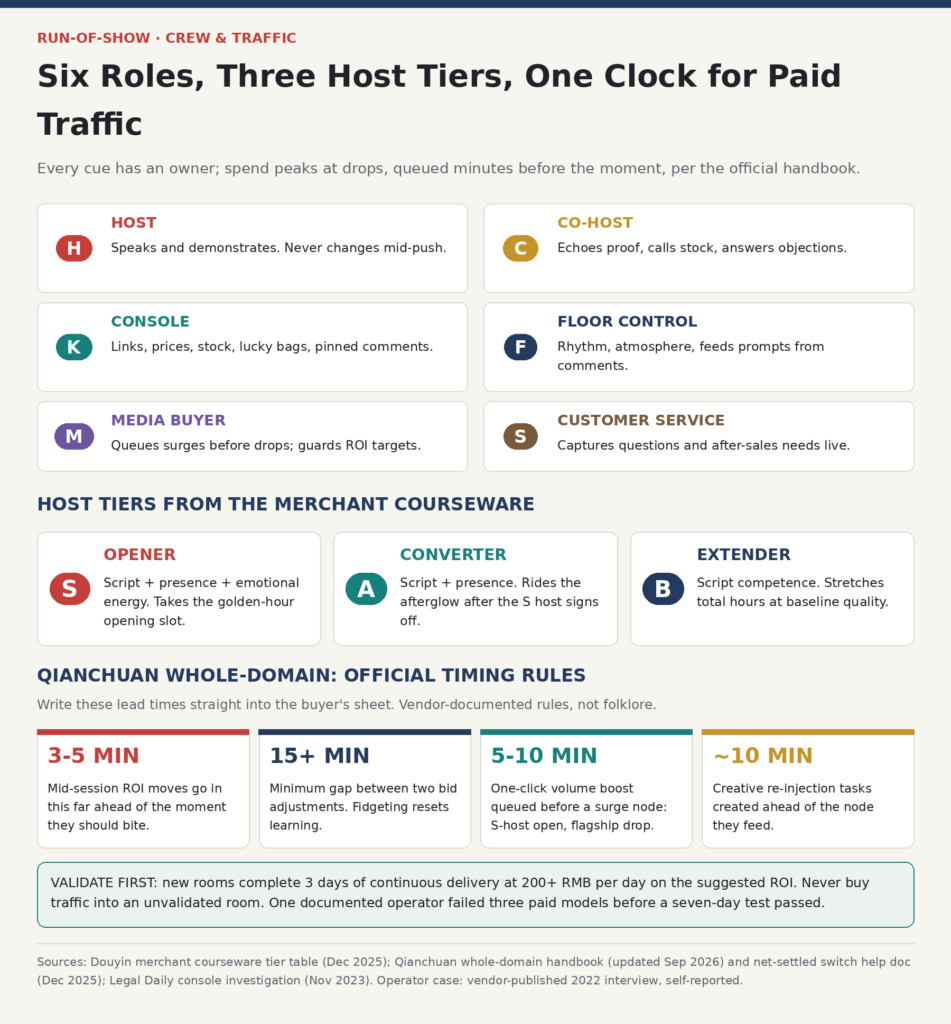
A selling room is a crew, not a solo act. The host speaks and demonstrates. The co-host supports, echoes proof, and answers objections. The console operator runs links, prices, stock, lucky bags and pinned comments. The floor controller watches rhythm and atmosphere — and, per the Legal Daily investigation, the console and hype roles are often the same person, delivering scripted call-and-response with the host inside one-minute exchanges. The media buyer runs paid traffic. Customer service captures questions and after-sales needs in real time.
Write a cue table per loop phase: at release, console pins the link, co-host calls stock, floor controller cues music; at pitch, floor controller feeds objection prompts from the comment stream. Ambiguity is the enemy — when two people think the other will change the price, nobody does.
Host tiers and the shift-change checklist
The merchant courseware grades hosts into three tiers by capability: S-tier openers with script skill, presence and emotional energy take the golden-hour opening; A-tier converters ride the afterglow after the S host signs off; B-tier extenders keep competent baseline coverage to stretch total hours. Schedule to the tier, not to seniority. Make Friends pushed its founder’s share of room GMV below a third within months of launching its always-on room in 2021 — the system, not the star, is the asset. At every handoff: brief the incoming host on current loop position, live stock, running welfare timer and any incident in progress; never change host mid-push.
Traffic coordination: the buyer’s sheet
Paid traffic on Douyin runs through Qianchuan, and its whole-domain mode now optimizes the room’s total net-settled ROI across paid and organic inventory. Since December 29, 2025, whole-domain net-settled bidding is the only mode for new livestream campaigns — though existing in-flight standard plans were not force-stopped. Two structural rules shape your sheet: one Douyin account maps to one whole-domain ad account, and switching whole-domain on auto-pauses the account’s other livestream campaigns.
The official handbook gives timing rules you can write directly into the run-of-show: mid-session ROI adjustments go in 3–5 minutes before the moment you want them to bite, with at least 15 minutes between two bid changes; one-click volume boosts are set 5–10 minutes before a surge node; creative re-injection tasks about 10 minutes ahead. Translate: when the S host opens or a flagship product drops, the buyer has already queued the surge — spend peaks at drops, not after them. New rooms should first complete the handbook’s validation window: three days of continuous delivery at no less than RMB 200 per day, adopting the system’s suggested ROI.
And the rule the case studies teach painfully: do not buy traffic into an unvalidated room. One documented operator (a 2022 vendor-published interview — historical and self-reported) burned through three paid-traffic models before a short-video-fed model passed a seven-day test; only then did two accounts scale to 211 sessions and 814 hours a month at RMB 30M+ GMV. Validation first, budget second.
Engagement and conversion plays
The courseware’s scene guidance includes trust props: ingredient lists, lab-test certificates, genuine user reviews shown on camera. Build your objection library from real comment logs — price, authenticity, sizing, shipping — and script the co-host’s answers. Follow-and-join incentives are fine; conditioned engagement is not. Douyin’s induced-interaction rules ban making discounts or purchase eligibility contingent on meaningless comments, likes or watch-time quotas. Lottery mechanics must state quantities and conditions and actually deliver; China’s Anti-Unfair Competition Law caps prize-draw top awards at RMB 50,000. Prompt product-relevant comments (“which color?”) instead of engagement farming (“type 666 for a coupon”) — the first feeds your pitch, the second feeds a violation notice.
Emergency plays: the decision tree
Pre-assign an owner and a fallback for each failure. Stock-out mid-push: console kills the countdown claim instantly, host pivots to the waitlist or the next product — never “keep pretending.” Price error: correct on air within the moment, honor what was promised where feasible, log it; the regulation now requires an on-air correction mechanism anyway. Traffic crash: buyer checks plan status and room violations before touching bids; floor controller slows the loop and runs welfare. Negative-comment flood: customer service triages genuine complaints publicly, console manages rule-breaking content — real-time interaction management is a legal duty, not a vibe. Host fatigue: swap at a loop boundary using the tier bench; a tired S host converts worse than a fresh A host.
Compliance gates: what the law now requires
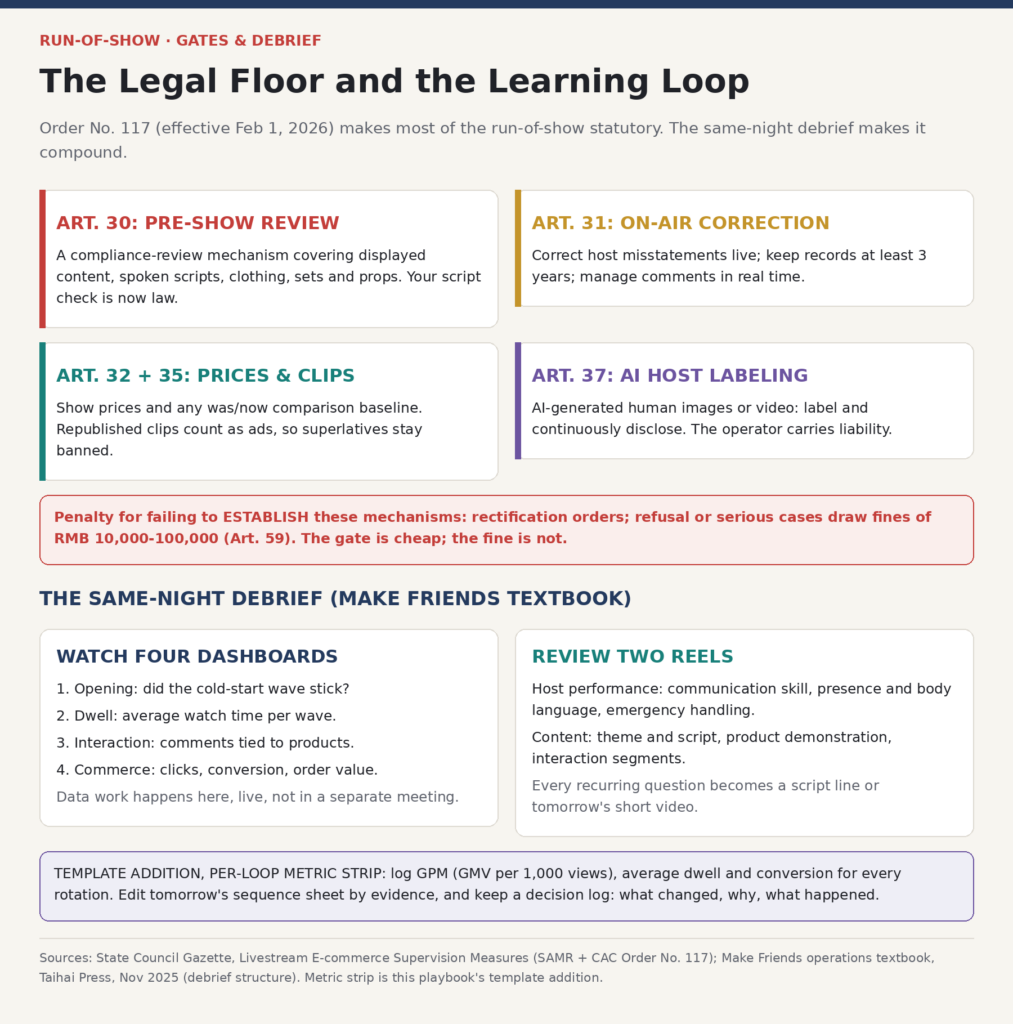
Since February 1, 2026, the Livestream E-commerce Supervision Measures (SAMR and CAC Order No. 117) turn most of this playbook from best practice into obligation. Article 30 requires a pre-broadcast compliance review mechanism covering displayed content, spoken scripts, clothing, sets and props — your script review is now statutory. Article 31 requires an on-air correction mechanism for host misstatements, with records kept at least three years, plus real-time management of comments. Article 32 requires clear prices and, for any “was/now” promotion, the comparison baseline. Article 35 treats clipped livestream content republished as promotion as commercial advertising — so superlatives like “best” or “number one” that the Advertising Law bans apply to your highlight reels too. Article 37 requires AI-generated human hosts to be labeled and continuously disclosed, with the operator liable. Failing to establish the review, correction or labeling mechanisms draws rectification orders and fines of RMB 10,000–100,000 where refusal or severity applies. Budget one compliance owner per session; the gate is cheap, the fine is not.
The debrief: watch four dashboards, review two reels
The Make Friends textbook splits live monitoring into four dashboards — opening, dwell, interaction and commerce — and the post-show debrief into two reviews: host performance (language and communication skill, presence and body language, emergency handling) and content (theme and script, product demonstration, interaction segments). Run it the same evening, while memories are honest. Add one template card of our own: a per-loop metric strip logging GPM (GMV per thousand views), average dwell and conversion for each rotation, so tomorrow’s sequence sheet is edited by evidence. Every recurring comment question becomes either a script line or a short video for tomorrow’s feed. Keep a decision log — what you changed, why, and what happened — because the log is what turns a lucky session into a repeatable one.
Failure modes to audit before you scale
No sequence sheet, so pricing is improvised at the worst moment. Loop drift, where the room quietly becomes a chat show. Role ambiguity at handoffs. Buying traffic before the room converts it. Skipping the debrief because tonight went well — especially because tonight went well. And compliance improvisation: the induced-engagement script that worked in 2023 is a penalty tier in 2026.
Summary
The Chinese selling room’s edge is not talent density; it is documentation density. Cast your products into roles and sequence them bait–profit–welfare. Run the five-minute loop with real scarcity and proof on camera. Assign every cue an owner, tier your hosts, sync spend to drops with the official timing rules, and pre-write your emergencies. Treat Order No. 117’s mechanisms as the floor, not the ceiling. Debrief the same night against four dashboards and two reels, and let the decision log compound. Charisma improvises one good night. A run-of-show delivers a thousand.