For most of the past five years, picking between Youzan and Weimob felt like choosing between two ships taking on water. Both bled cash. Both cut staff. Both watched their share prices fall off a cliff. Then 2025 happened: both companies finally posted a profit — and they did it in almost opposite ways.
That is what makes this comparison interesting now. Youzan (06051.HK, moved from the GEM board to the Hong Kong main board in April 2026) bet on merchant depth: fewer, bigger, stickier customers, with physical-store SaaS as the growth engine. Weimob (02013.HK) bet on a dual engine: prune the client base, lean hard into Tencent-ecosystem advertising, and become the first Chinese commerce SaaS vendor to disclose a real AI revenue line.
So the question is not “which vendor is better?” It is “which business model matches yours?” This guide walks through the audited FY2025 numbers, the H1 2026 interim results that stress-tested both stories, the AI economics nobody puts in the sales deck, and a six-scenario decision matrix you can take into a procurement meeting.
The Short Answer
- Single-brand DTC store or WeCom-driven private domain: Youzan, for the deeper out-of-the-box commerce and CRM stack.
- Chain stores and offline retail: Youzan again — store SaaS is now 56% of its GMV and growing 13% a year.
- You want software and ad buying under one contract: Weimob, with eyes open about the conflict of interest.
- Budget-sensitive small merchant: honestly, neither yet. Try Weixin Shop’s native tooling first.
- Cross-border ambitions: Weimob has the more explicit going-global strategy, but it is early.
Everything below explains why — and where these answers could break.
Two Companies, Two Business Models
Youzan: Depth Over Headcount
Youzan sells commerce infrastructure: mini-program storefronts, store and chain-management systems, membership CRM, sales-associate (guide) tooling, plus payment and value-added services. In FY2025 its subscription solutions brought in RMB 770 million and merchant solutions RMB 715 million — a roughly balanced split. The strategic story is in the mix shift: store SaaS generated RMB 53.7 billion of GMV, 52% of the RMB 103 billion total, and its paying merchant count actually shrank to 52,809 while average annual merchant sales rose 6% to RMB 1.95 million. Fewer customers, more revenue per customer. Renewal rates tell the same story: 57% overall, 68% among mid-to-large merchants.
Weimob: The Dual Engine
Weimob runs two businesses wearing one trench coat. Subscription solutions (RMB 897 million in FY2025) include its Smart Retail line for brand retailers — 7,699 merchants, of which 1,205 are brands spending roughly RMB 183,000 each on average. Merchant solutions (RMB 695 million, up 65.1%) is essentially a Tencent-ecosystem advertising agency: it handled RMB 16.69 billion in gross ad billings in FY2025. Note what that means: most of Weimob’s commerce gravity is media buying, not software seats. In September 2025 it raised about US$200 million (HK$1.556 billion) from Infini Capital at HK$2.26 per share, making the Abu Dhabi–Hong Kong investor its largest single shareholder at roughly 16%, then immediately invested in Silicon Valley agent-commerce startup Genstore.ai and stood up a going-global business unit.
The FY2025 Financial Health Read
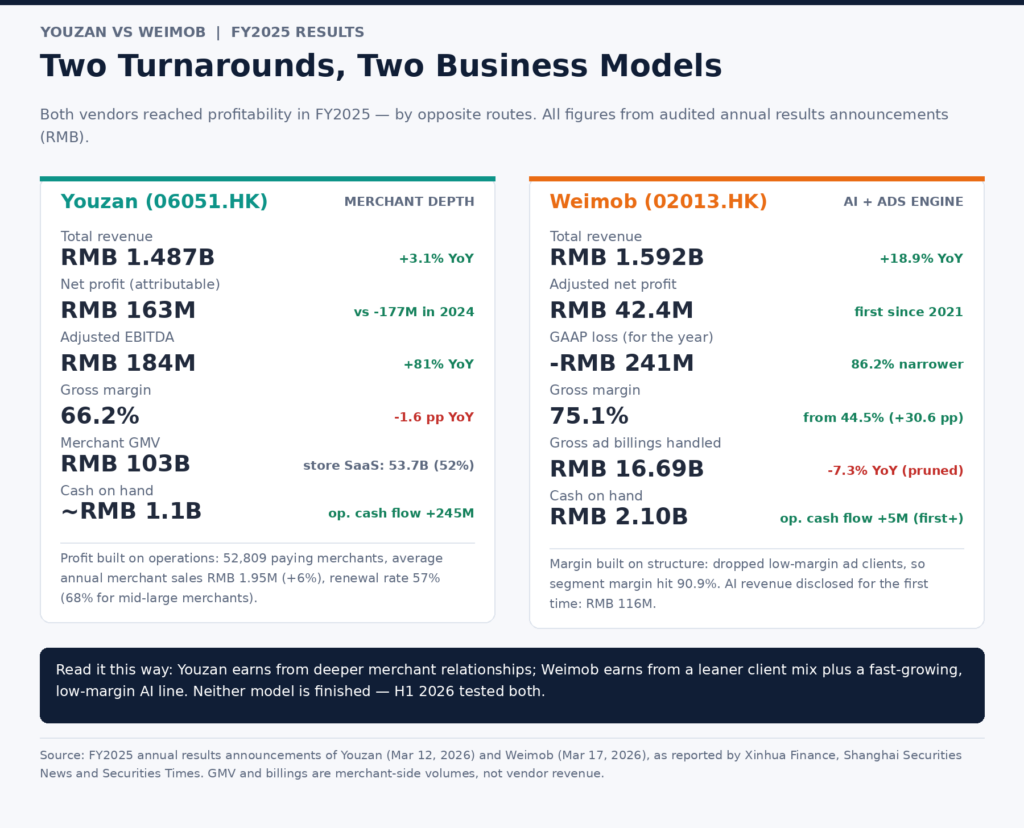
Here is the nuance the headlines flatten. Youzan earned RMB 163 million attributable profit on RMB 1.487 billion revenue, with adjusted EBITDA of RMB 184 million (up 81%), RMB 245 million of operating cash inflow, and roughly RMB 1.1 billion of cash in the bank. That is a real, self-funded turnaround.
Weimob’s RMB 1.592 billion revenue grew faster (+18.9%), and its gross margin leapt from 44.5% to 75.1%. But read the fine print: adjusted net profit was RMB 42.4 million — the first annual adjusted profit since 2021 — while the GAAP result was still a loss of RMB 241 million for the year, albeit 86.2% narrower. The margin miracle is mostly arithmetic: by dropping low-margin, high-advance-payment ad clients, the merchant-solutions segment margin jumped to 90.9% even as gross billings fell 7.3% and average ad spend per merchant declined 8.5% to RMB 247,174. Operating cash flow turned positive for the first time — by RMB 5 million. A rounding error, directionally precious.
What Profit Quality Means for You
Why should a buyer care about any of this? Because vendor finances are your roadmap insurance. A vendor with genuine operating cash (Youzan) can keep shipping features without a funding round. A vendor whose profit depends on one-off adjustments and a fresh US$200 million war chest (Weimob) can invest aggressively — but may reprice, restructure, or sunset products faster. Neither is disqualifying. Both belong in your risk register. And the market remains skeptical of both stories: Youzan’s market value sits roughly 90% below its 2021 peak, and Weimob’s stock fell more than 20% in two sessions after its 2026 interim report.
H1 2026: The Momentum Test
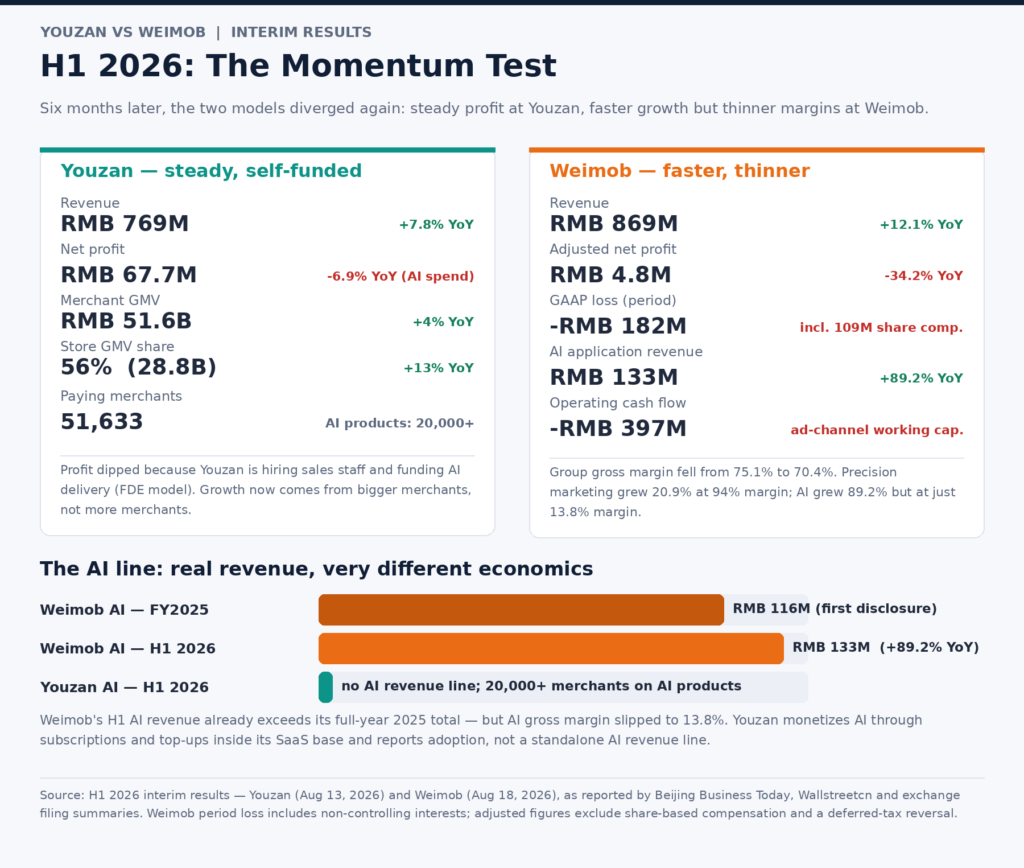
Six months of 2026 data sharpen the picture. Youzan’s revenue rose 7.8% to RMB 769 million — its fastest growth in years — while net profit slipped 6.9% to RMB 67.7 million because it is hiring sales staff and funding AI deployment. Store GMV grew 13% to RMB 28.8 billion, now 56% of the total. Average merchant sales hit RMB 1 million for the half, up 8%. The paying base kept shrinking (51,633), which is either disciplined pruning or a growth ceiling, depending on which renewal cohort you believe.
Weimob grew 12.1% to RMB 869 million, but the quality wobbled: group gross margin fell from 75.1% to 70.4%, the period loss widened to RMB 182 million (including RMB 109 million of share-based compensation and a RMB 41 million deferred-tax reversal), adjusted net profit fell 34.2% to RMB 4.8 million, and operating cash flow swung to a RMB 397 million outflow, which the company attributes to working capital for new ad channels. Precision marketing remains the profit machine: RMB 408 million revenue at a 94% gross margin. The cash pile — RMB 1.995 billion — buys time.
The AI Bet: Revenue vs Adoption
Weimob did something genuinely useful for buyers: it put a number on AI. First disclosure in FY2025: RMB 116 million of AI-related revenue. Then H1 2026: RMB 133 million, up 89.2% year over year — already more than the entire previous year. Its WAI product family (upgraded into a natural-language retail agent in 2026), the WIME creative tool for small merchants, enterprise WAI Pro, and a new star-series of AI-native products including a GEO tool for generative-search visibility make up the fastest-growing line it has.
But here is the catch nobody markets: that AI revenue carries a gross margin of just 13.8%, down from 16.4%. Weimob is, in effect, buying AI market share at near-cost. Rapid adoption, unproven economics.
Youzan took the opposite reporting stance — no standalone AI revenue line — but claims over 20,000 merchants using its AI products: a store-operations agent that plans campaigns, creates content and lists products autonomously; an AI customer-sales digital employee spanning WeChat, mini-programs, Douyin and RedNote; a GEO service that restructures brand content so AI assistants recommend it; and a forward-deployed-engineer model for custom delivery. Monetization runs through subscriptions and usage top-ups inside the existing SaaS base. You cannot compare the two AI lines apples-to-apples, and you should distrust anyone who tries.
Will AI Agents Eat Commerce SaaS?
The industry’s fashionable fear is that AI agents will make SaaS dashboards obsolete. Youzan’s founder has publicly argued the reverse: AI makes transaction-and-marketing SaaS more valuable, because agents need systems of record to act on. The H1 numbers offer a truce position — both vendors are shipping agents, both are growing, and both are discovering that AI delivery costs real money. For buyers, the practical takeaway: ask what the agent can execute (refund, restock, launch a campaign), not what it can chat about, and get usage pricing in writing before your bill discovers it for you.
Capability Comparison by Job
| Job to be done | Youzan | Weimob |
|---|---|---|
| Mini-program / DTC storefront | Core strength, deepest default stack | Solid, sales-led packaging |
| Chain stores & offline retail | Core strength (store SaaS 56% of GMV) | Strong for large brand retailers |
| Membership CRM & private domain | Core strength, guide tooling mature | Strong, ads-to-CRM loop |
| Tencent-ecosystem ad management | Not a business line | Core strength (RMB 16.69B billings) |
| AI content / AI service agents | 20,000+ merchants adopting; usage-priced | Disclosed revenue line; low margin |
| Cross-border / going global | Limited emphasis | Explicit strategy, early stage |
Feature depth here is vendor-reported from filings and product documentation — treat every cell as a demo hypothesis, not a lab result.
The Scenario Decision Matrix
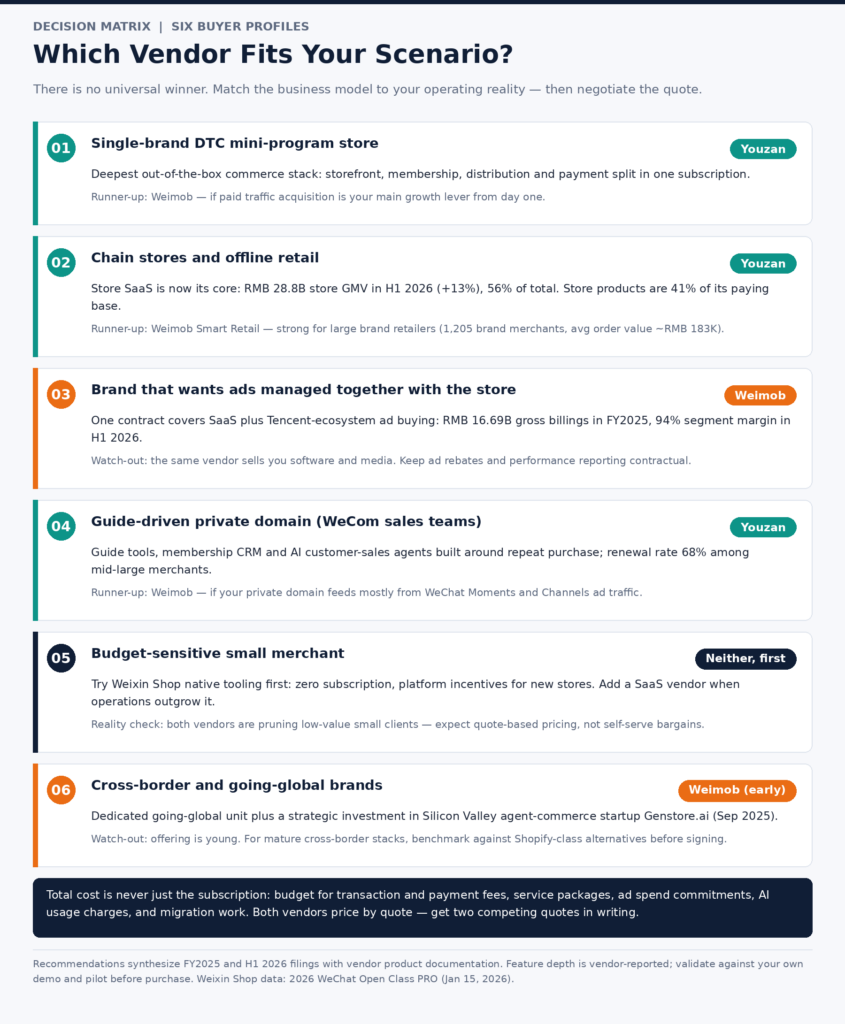
The matrix above is the deliverable; the logic underneath it is simple. Match the vendor’s revenue engine to your operating reality. If your growth comes from repeat purchases and store operations, buy the vendor whose own growth comes from exactly that (Youzan). If your growth comes from paid traffic and you want one throat to choke for software plus media, buy the agency-SaaS hybrid (Weimob) — but contractually separate ad rebates, performance reporting and data access from the software agreement, because a vendor that grades its own ad homework has an obvious incentive problem.
Pricing Reality and True TCO
Both vendors price by quote, and both have been openly pruning low-value clients — so budget-sensitive buyers should expect sales calls, not self-serve bargains. Your real cost stack: subscription + transaction/payment fees + service packages + ad spend commitments + AI usage charges + migration labor. Get two competing quotes in writing, including exit terms. The subscription line is typically the smallest number in that list.
Ecosystem Lock-In and the Weixin Shop Squeeze
Both vendors live inside Tencent’s walled garden; a WeChat policy change is a shared weather event you cannot hedge away. The newer twist is that the landlord now runs its own store. Weixin Shop’s GMV more than doubled in 2025, and at the January 2026 WeChat Open Class, Tencent disclosed that service providers contribute nearly 50% of new-store GMV across a 5,900-strong provider ecosystem. Read that twice: the platform is simultaneously the biggest threat to third-party SaaS and its biggest distribution channel. Both Youzan and Weimob have responded by building Weixin Shop integration layers — Weimob launched a five-solution Weixin Shop package including CRM membership operations in January 2025. Before signing anything multi-year, ask each vendor: which of your features survive if Tencent ships a native equivalent next quarter?
Migration and Switching Costs
Switching commerce SaaS is not exporting a CSV. Member balances, points liabilities, stored value, order history, guide-customer bindings and mini-program identity all have to land somewhere — and stored-value liabilities carry legal obligations, not just technical ones. Practical rules: negotiate data-export rights (format, frequency, cost) into the initial contract; run new stores or new channels on a challenger vendor before moving the core; and treat dual-vendor setups as a legitimate architecture, not a failure. The cheapest migration is the one you scoped before signing.
Honest Boundaries
The financials here are audited FY2025 announcements plus unaudited H1 2026 interims, cross-checked against Xinhua Finance, Shanghai Securities News, Securities Times, Beijing Business Today and exchange filing summaries. GMV and ad billings are merchant-side volumes, not vendor revenue. Feature and AI-adoption claims are vendor-reported. Pricing is opaque by design. And there is no universal winner — anyone selling you one is selling you something else.
The Verdict
Youzan is the safer operational bet for stores, chains and repeat-purchase businesses: real profit, real cash, a product roadmap aimed squarely at merchant depth. Weimob is the higher-variance bet for traffic-driven brands: faster growth, a genuine AI first-mover position, deep Tencent ad plumbing — purchased with thinner margins, negative interim cash flow and a strategy still mid-flight. Buy the model that matches how you actually grow, contract for the exit before the entrance, and re-run this comparison every renewal cycle. In this market, two years is a geological era.