Every few months someone rediscovers that Telegram CPMs are absurdly cheap, writes a thread about the arbitrage, and predicts the window will close. It has been “about to close” since 2021. That prediction keeps failing for a reason worth understanding: the discount is not a market inefficiency waiting to be corrected. It is the load-bearing wall of Telegram’s business model.
Start with the numbers that make the anomaly concrete. Telegram’s public channels generate roughly a trillion views per month. Yet when the Financial Times reviewed the company’s investor documents in May 2025, advertising brought in only about $250 million of $1.4 billion in 2024 revenue — the smallest of three pillars, behind Premium subscriptions ($292 million) and the roughly half attributed to partnerships and the mini-app ecosystem. When Durov launched revenue sharing in February 2024, he said only about 10% of channel views carried ads at all. A trillion units of supply chasing a quarter-billion of demand: of course the price is low. The interesting question is why demand stays thin on a billion-user platform.
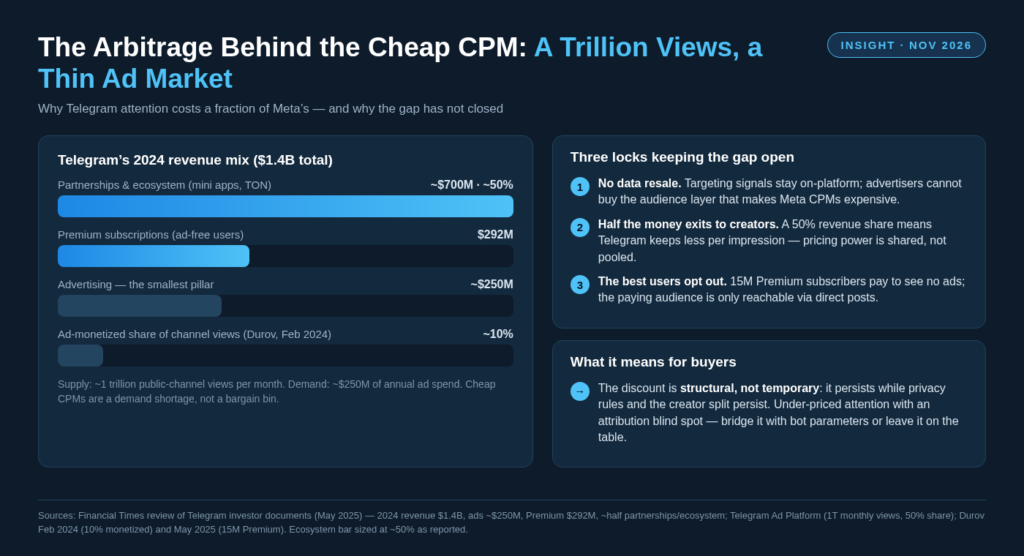
Three locks keep it thin. First, Telegram refuses to sell the audience layer. Meta’s expensive CPMs are not really payment for attention; they are payment for certainty about who is paying attention. Telegram’s privacy policy keeps every targeting signal on-platform — even the light inference added in August 2026 is never passed to advertisers. Strip out the data resale, and you strip out most of what performance budgets pay premiums for. The buyers who fund expensive auctions simply have less to buy here.
Second, half the money leaves the building. The 50% revenue share means Telegram pools less revenue per impression than a platform that keeps everything — and the terms make clear the share is voluntary and revocable, so Telegram cannot quietly squeeze creators later without breaking its own growth engine. Pricing power is shared by design.
Third, the most valuable users pay to disappear. Fifteen million Premium subscribers — likely the heaviest, highest-income segment — see no platform ads at all. Telegram effectively sells its best audience a privacy exemption, then monetizes everyone else. That is a deliberate trade: subscription revenue from the top, cheap contextual reach across the base.
So the arbitrage is real but conditional. You are buying underpriced attention with the certainty removed — no pixel, no retargeting, no view-through. The brands that win here are the ones whose economics tolerate that: niche audiences concentrated enough that context does the targeting, and measurement teams willing to bridge attribution with bot parameters. Everyone else experiences the cheap CPM as a trap, not a bargain. The window is not closing. It was never a window — it is the architecture.