Everyone in influencer marketing can see that KOC content is cheap. Almost nobody asks the follow-up question: cheap relative to what? The answer is not “relative to KOLs.” It is “relative to the queue of people waiting to do the work.” Once you see that, four scattered facts snap into a single mechanism.
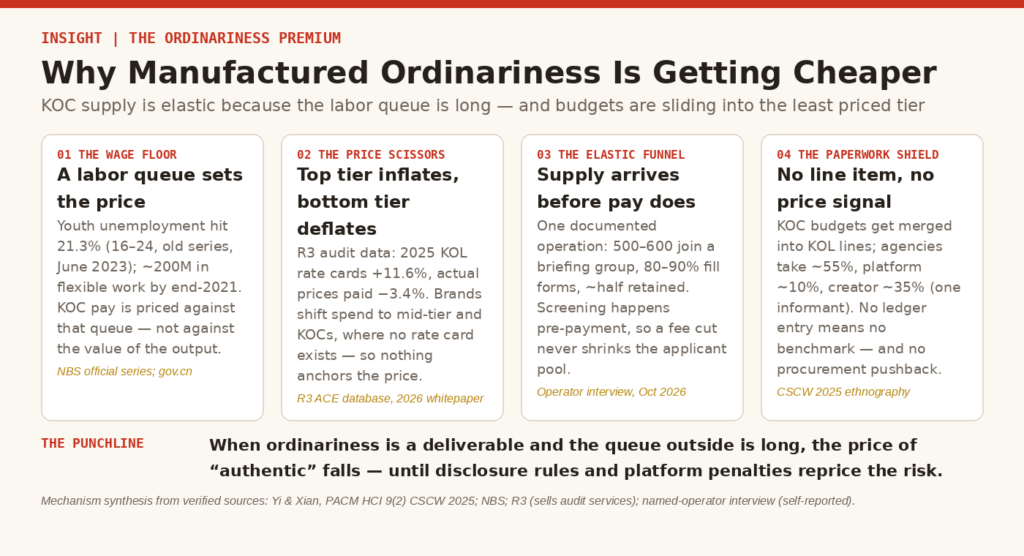
Start with the floor. When youth unemployment for the 16–24 cohort hit a record 21.3% in June 2023 (China’s official series, before the methodology revision), and roughly 200 million people were already in flexible employment, an enormous pool of educated, digitally fluent labor became available at near-zero reservation wages. A side hustle that might pay is not competing against a salary. It is competing against nothing. That is the wage floor the entire KOC tier stands on.
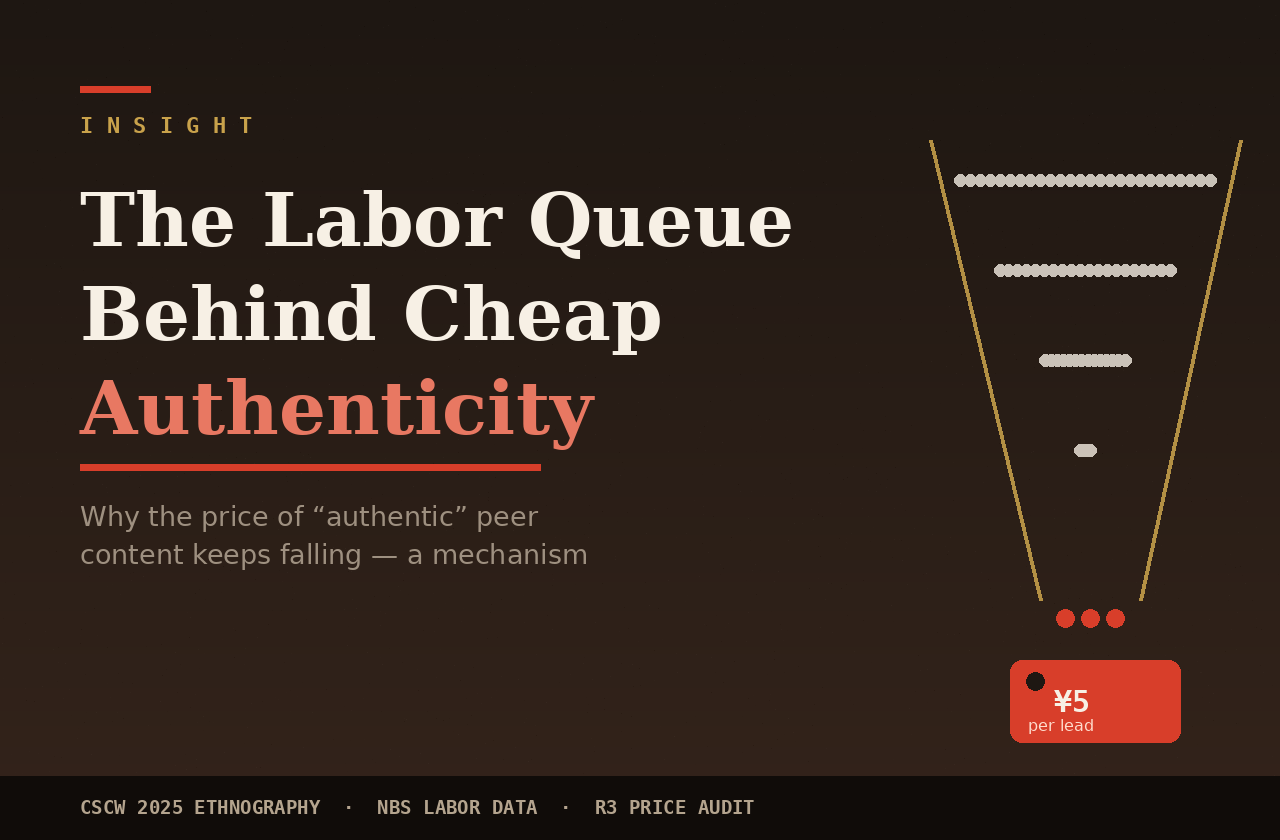
Now watch what happens to supply. In one documented operation, 500–600 people join a briefing group, 80–90% fill screening forms, and about half survive selection — all before a single yuan changes hands. Because the screening happens pre-payment, cutting the fee doesn’t shrink the applicant pool. Supply is almost perfectly elastic at the bottom. Economics 101 does the rest: elastic supply plus a queue outside the door equals a price that only moves down.
The demand side accelerates it. R3’s audit data shows 2025 KOL rate cards rising 11.6% while actual prices paid fell 3.4% — brands squeezing the formal tier and sliding budget toward mid-tier creators and KOCs. But the informal tier has no rate card at all. There is no published price to anchor a negotiation, so each brand pays whatever the queue will accept.
And the mechanism protects itself. The CSCW 2025 ethnography documents KOC budgets merged into KOL line items — no ledger entry, no benchmark, no procurement officer ever asking why a thousand posts cost what they cost. One creator’s account of the split (55% to agencies, 10% to the platform, 35% to her) survives only because a researcher asked. Invisible prices cannot be bid up.
Here is the discovery worth sitting with: the market is not failing to price authenticity. It is successfully pricing ordinariness — a deliverable with a long labor queue behind it — and the discount is structural, not temporary. It reverses only when something reprices the risk: disclosure enforcement under China’s 2023 ad rules, platform penalties, or a scandal that makes cheap, undisclosed peer content expensive again. Until then, every brand budget shifting “down-market” is flowing into the one tier engineered never to push back.